POTS and Brain Fog
Choose what brings you here
Where are you starting?
Brain fog cause guide
Evidence and recovery context
The main sign
What happens after you stand up?
Does your thinking get harder within minutes, and does lying down help?
How POTS is diagnosed
Heart rate is only part of the diagnosis
A clinician must also consider symptoms, blood pressure, medicines, hydration, anemia, thyroid problems, and other explanations.
What people often miss
The first few minutes may feel fine
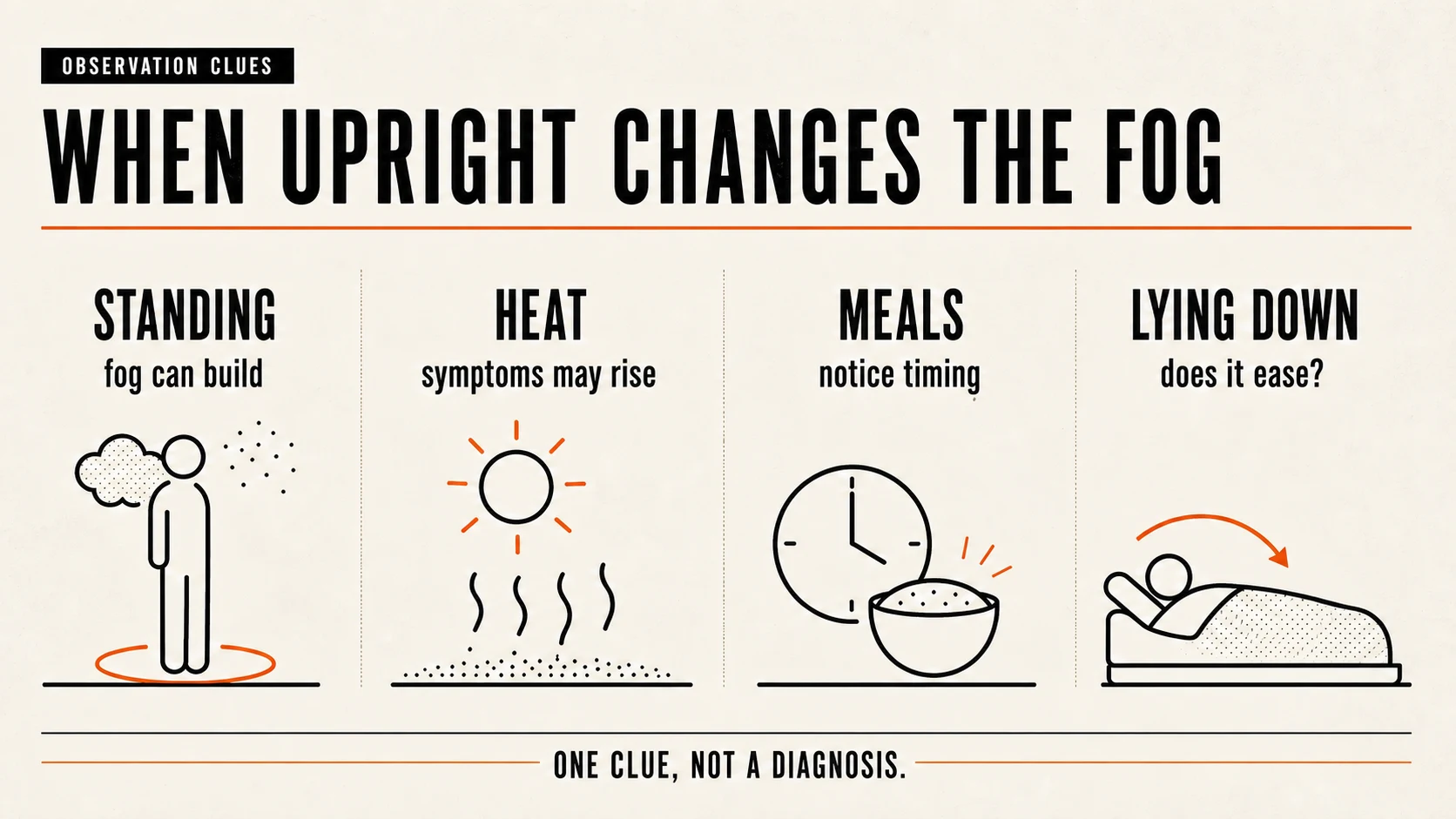
Thinking problems, racing heart, dizziness, or weakness may build the longer you stay upright, then ease when you sit or lie down.
When POTS may be involved
Could POTS be the cause?
Postural orthostatic tachycardia syndrome (POTS) may explain your brain fog if standing up makes your heart race while your thinking gets harder. Lying down often helps. Heart rate matters, but a diagnosis also depends on your symptoms, blood pressure, medicines, and other possible explanations.
What to notice
Compare your heart rate and symptoms after lying down and after standing. Use the guided check on this page if you can safely stand without help.
What normal blood tests can't tell you
Routine blood work can rule out some other explanations, but POTS testing looks at what happens to your heart rate, blood pressure, and symptoms after you stand.
Investigating: I think POTS is causing my fog
What changes when you stand up
A heart-rate rise alone does not diagnose POTS. A clinician also checks how long symptoms have lasted and whether blood pressure falls. They weigh medicines, hydration, anemia, thyroid problems, and other causes of a racing heart or brain fog.
Why lowering your heart rate may not clear brain fog
Lowering your heart rate may not improve your thinking.
Heart rate and thinking are different outcomes. Poor sleep, migraine or sedating medicines can still affect thinking after upright symptoms improve. POTS can also affect attention and short-term memory while seated: a small study found thinking problems even with normal blood-flow speed to the brain. [Wells 2020]
What to know first
What to know before you start
- Heat, showers, queues, or a long time upright can make both the body symptoms and the thinking problems worse.
- POTS-related brain fog can continue while you sit or lie down. A lack of relief from changing position does not, by itself, show that another condition is responsible.
- Extra sodium and fluid are common parts of treatment, but the amount depends on kidney, heart, blood-pressure, medicine, and pregnancy considerations.
- Some exercise programs begin with rowing, swimming, or a recumbent bike because upright exercise can be too much at first.
- Many people with POTS report brain fog. Anxiety can exist alongside it, but anxiety alone does not explain a repeatable worsening after standing.
- Formal diagnosis uses standardized standing or tilt-table testing. The heart-rate threshold differs for adults and adolescents. Your clinician checks the result against your symptoms, blood pressure, and other possible causes.
This standing check records heart rate and optional blood pressure at set times over 10 minutes. Write down any symptoms separately. The result can show whether to ask a clinician about a formal standing assessment. You can save it to My Fog or copy it.
Follow the standing check
Ten-minute standing check (NASA Lean Test)
Feel faint? End the test.
- If you have a history of fainting, have someone with you.
- Have someone present or within earshot.
- End the test now if you feel faint, your vision darkens, or you feel like you'll pass out.
- If you feel unsafe at any point, sit or lie down right away.
This takes about 15 minutes total. You'll need: something to measure your heart rate (finger on wrist, pulse ox, or smartwatch), a wall to lean against, and ideally someone present.
Raj et al., CMAJ, 2022. PMID 35288409. Plash et al., Clin Sci, 2013. PMID 22931296. This home check records heart rate and blood pressure. It does not diagnose or rule out POTS.
In Your Words
How POTS brain fog feels
"Some people say their thinking drains away after they stand. Their vision may dim, their heart pounds, and they need to sit or lie down before they can think clearly again."
"A larger meal can worsen upright symptoms for some people because the body sends more blood to digestion."
"Thinking may still be hard while seated, but standing can make it noticeably harder."
"Normal routine blood tests do not rule POTS out. The useful information is what happens to heart rate, blood pressure, and symptoms after standing."
Standing up or staying upright clearly makes my thinking worse.
You may think more clearly after lying down.
Heat, showers, standing in line, or long upright days hit my brain hard.
Thinking often worsens alongside palpitations, dizziness, shaky legs, or dimming vision.
Symptoms
When thinking gets worse with POTS
Check when your thinking changes. POTS is more likely when it gets harder after standing, heat, a shower, a larger meal, or a long time upright. Some difficulty may remain while you sit.
Timing and triggers
| When | What changes |
|---|---|
| Morning Worse | Symptoms may be worse after a night without fluids, especially when you first get upright. |
| Post Meal | After larger meals, some people have more dizziness, fatigue, or brain fog while upright. |
| Constant | Trouble thinking can last while seated, but POTS is more likely involved when standing still makes it worse. |
Check whether thinking gets harder after standing, in heat, or during a shower, then eases after you lie down.
That change makes POTS more plausible because it ties the thinking problem to being upright. POTS can also contribute when brain fog persists while you sit or lie down.
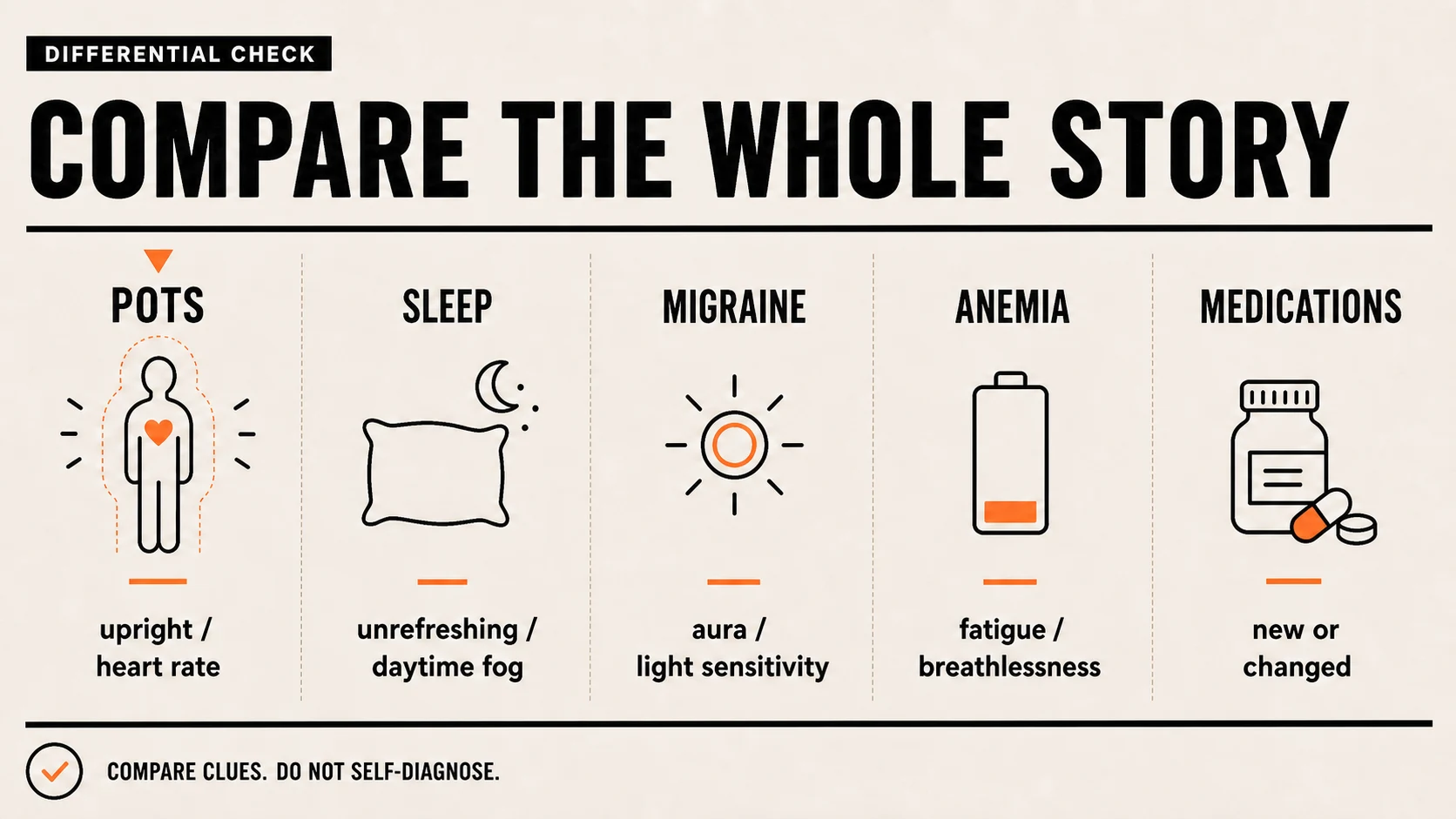
POTS may explain why thinking gets worse upright, while anemia, dehydration, hypermobility, medicine effects, migraine, or post-viral illness may add separate problems.
POTS or another explanation?
POTS compared with anxiety, delayed crashes, and hypermobility
POTS or anxiety?
Both can cause a racing heart, shakiness, dizziness, and trouble thinking. POTS becomes more likely when standing starts the symptoms and lying down helps, even when you do not feel anxious.
The question to ask: Do the symptoms begin after standing and ease when you lie down?
- Standing or a long time upright starts it
- Heart rate rises after the change in position
POTS, a delayed crash, or Long COVID?
They can occur together. POTS symptoms may ease soon after lying down. Myalgic encephalomyelitis/chronic fatigue syndrome (ME/CFS) can involve post-exertional malaise: a delayed worsening after physical or mental effort that may last into the next day or longer.
The question to ask: Does lying down help quickly, or does effort cause a delayed crash?
- POTS is closely tied to being upright
- ME/CFS is closely tied to the delayed effect of exertion
POTS and Ehlers-Danlos syndrome
POTS and hypermobile Ehlers-Danlos syndrome (EDS) can occur in the same person. Joint instability, pain, and physical strain may add to thinking problems without ruling out POTS.
The question to ask: Are joint pain and instability adding a second problem to the upright symptoms?
- POTS can explain the change after standing
- EDS may add pain, fatigue, and physical strain
Other conditions to consider
Other causes of upright brain fog and a racing heart
Standing can worsen more than one condition. Each row explains the difference that is worth noticing.
Anemia or iron deficiency
Both can cause fatigue, breathlessness, dizziness, and a racing heart.
Ask: Is the fatigue present in every position, with pallor or breathlessness, or does it rise mainly after standing?
Dehydration or electrolyte loss
A short period of illness, heat, vomiting, diarrhea, or low fluid intake can produce a similar upright worsening.
Ask: Did this begin with a clear fluid loss, or has the same response after standing continued when you are otherwise well?
Medicine effects
Some medicines can change heart rate, blood pressure, alertness, or balance.
Ask: Did the symptoms begin or change after you started, stopped, or changed the timing of a medicine?
Sleep apnea
Both can leave you exhausted, forgetful, and unable to concentrate.
Ask: Is thinking already hard when you wake up, or does it get harder mainly after being upright?
Upright hypoperfusion without POTS
Upright brain fog can happen even when your heart-rate rise is below the POTS threshold.
Ask: Does standing still bring on symptoms when the heart-rate rise stays below the POTS cutoff?
Thyroid problems
Thyroid problems can cause fatigue, temperature changes, and slower thinking throughout the day.
Ask: Are the problems steady in every position, or does standing produce the clearest worsening?
Blood sugar changes
Thinking problems and a racing heart after meals can sometimes resemble POTS symptoms.
Ask: Does thinking get harder after eating in every position, or after standing, heat, showers, and long upright time?
When meals matter too
A larger meal can make upright symptoms harder for some people with POTS.
Check whether the thinking problems follow eating, standing, or both. That can separate a meal-related POTS worsening from a glucose problem or another explanation.
- Does thinking worsen after eating only when you stay upright, or in every position?
- Does it follow a larger meal, a long gap without food, or no consistent meal timing?
- Do dizziness, a racing heart, or near-fainting happen at the same time?
A change after meals doesn't prove POTS or a glucose disorder. It only shows you should check each one separately.
Diagnosis
How POTS is diagnosed
Doctors diagnose POTS from a sustained heart-rate rise and ongoing symptoms while upright. They also check blood pressure and rule out other causes of the fast heart rate.
All of these must be present
- Your heart rate rises by at least 30 beats per minute within 10 minutes of standing and stays elevated. For ages 12 to 19, the required rise is at least 40 beats per minute.
- You frequently have symptoms while upright, such as lightheadedness, palpitations, weakness, blurred vision or fatigue. They improve when you lie down.
- The symptoms have lasted for at least three months.
- Your blood pressure does not show a sustained drop of at least 20 mmHg in the top number or 10 mmHg in the bottom number after standing.
- No other condition or medicine explains the fast heart rate. Doctors check for causes such as anemia, dehydration, fever, infection, thyroid disease, prolonged bed rest and medicines that raise heart rate.
Other findings to mention
- Feet that turn purple, red or mottled while standing
- Whether fluids or sodium from your existing treatment plan change symptoms
- Symptoms that began after an infection
- Joint hypermobility or an Ehlers-Danlos syndrome diagnosis
What the assessment may include
- Heart rate, blood pressure, and symptoms measured after lying down and standing
- Tilt-table testing when office measurements do not confirm or rule out POTS
- Blood tests for other explanations such as anemia, iron deficiency, thyroid disease, or electrolyte problems
- Selected autonomic, small-fiber, norepinephrine, or antibody tests when the history gives a specific reason
Before you start sodium or fluid loading
These steps can give your clinician useful data. Get their OK before taking a lot of extra sodium if you're pregnant, take medicines that make sodium risky, or have kidney disease, heart failure or uncontrolled high blood pressure.
While you wait for formal evaluation
Use the standing check above
The guided tool records heart rate and optional blood pressure at set times while you lie down and stand. Write down any symptoms separately. The readings give you a record to discuss at an appointment, but they do not diagnose POTS.
Ask whether extra sodium is safe for you
POTS treatment often includes more sodium and fluid. The amount needs to account for kidney disease, heart failure, high blood pressure, pregnancy, and medicines.
Ask about the right type of compression
Waist-high or abdominal compression may reduce pooling more than calf-only garments. Fit and pressure still need individual guidance.
Bring a few clear examples
You don't need an hour-by-hour account. A few examples of what happened after standing, how long it took, and whether lying down helped can make your symptoms easier to explain.
Reduce triggers you already know
Heat and long periods of standing commonly make symptoms harder. Sitting for a shower or taking breaks may reduce the strain while you wait for an assessment.
If thinking is hard right now
If you become dizzy or close to fainting, sit or lie down right away.
Around you
Stand up in stages, keep cool, and move or sit when symptoms build.
Treatment options
What treatment can include
Daily changes
Clinician-guided fluid and sodium plan
Often part of first-line care when it is safe. The amount depends on kidney, heart, blood-pressure, pregnancy, and medicine considerations.
Waist-high or abdominal compression
Compression higher up the body may reduce pooling more than calf-only garments. Fit and pressure still need individual guidance.
Exercise that begins seated or lying down
Some rehabilitation programs begin with rowing, swimming, or a recumbent bike before adding upright exercise. A delayed post-exertional crash changes whether this is appropriate.
Physical counter-maneuvers
Leg crossing, muscle tensing, squatting, or lying down may reduce symptoms during an upright episode. They do not replace an assessment of fainting or new severe symptoms.
Medicines
Medicines chosen for the problem being treated
A specialist may consider medicines that affect heart rate, blood-vessel tone, or blood volume. Blood pressure, resting pulse, pregnancy, fatigue, and other conditions change which option is appropriate.
Products that add fluid and electrolytes
Electrolyte products
Products vary widely in sodium and other ingredients. Use one only as part of a fluid and sodium plan that is safe for you, and let that plan set the amount.
Food and fluids
Where diet may matter
Steady meals, no fasting: for people whose health depends on steady blood sugar or regular meals. Anti-crash eating.
Eat every 3-4 hours. Include protein, fat and a complex carb at every meal, and eat the protein first to steady glucose. If intermittent fasting triggers symptoms, consider regular meals instead. Have caffeine with food. If morning thinking is slow, try a light snack before bed.
For POTS: smaller, more frequent meals, since large meals can pool blood in the gut. Heart Rhythm Society guidance describes increased sodium and roughly 2-2.5 L fluids for many POTS patients. Your clinician sets the number after checking for kidney disease, heart failure, and uncontrolled high blood pressure. Drop alcohol during stabilization if it worsens symptoms.
Steady meals, no fasting
For people whose health depends on steady blood sugar or regular meals.
Choose small, simple meals
Simple meals take less preparation when fatigue or nausea makes cooking difficult.
Daily support
Other ways people manage symptoms
Where therapy may help: Therapy is not the main treatment for POTS. It may help with the fear, grief, or disruption that can follow repeated symptoms. Occupational therapy can also help with work, school, and energy limits.
Compression garments
Reclined exercise (starting position)
What some people say helped:
- Some people report a clinician-guided fluid and sodium plan eases dizziness or thinking problems. One person's amount is not automatically safe for another person.
- People often say waist-high or abdominal compression helps more than knee-high socks.
- Some people improve with exercise that begins lying down or seated. Others have a delayed crash and need ME/CFS or Long COVID considered before following a fixed program.
- Some people report short-lived improvement after IV saline. That experience does not show who needs it or make routine IV treatment risk-free.
What often made things harder:
- Being told the symptoms were anxiety without checking what happened after standing.
- Beginning with upright exercise when standing already caused severe symptoms.
- Lowering the heart rate without treating the other reason the person still felt faint, exhausted, or muddled.
What surprised people:
- Brain fog can improve even when the heart rate isn't completely normal. Pulse alone does not show whether thinking, dizziness, fatigue, and upright tolerance have improved.
- Hypermobility, mast-cell symptoms, migraine, and post-viral illness can occur alongside POTS and may need separate attention.
- Small changes to position, temperature, or compression can matter more than they sound when standing is the trigger.
What people reported:
Brain fog - what has helped you?
A dysautonomia thread about whether anything helps the brain fog, beyond dizziness. The replies are useful because they separate what helps the kind tied to upright blood flow from what actually changes all-day slow thinking.
What were your first signs of POTS or dysautonomia?
The thread describes early excessive sleepiness, tremors and trouble at work, then a constant high heart rate, head pressure and night sweats. After COVID and stress, the poster's heart rate jumped from around 80 to 165 on standing.
Anything help your brain fog?
Poster says reading and TV become hard to follow during bad periods and asks directly what helps. Replies mention rest, pacing, beta blockers, electrolytes, water, midodrine, low-dose naltrexone, gut healing, and stimulants or migraine meds helping certain overlap profiles.
Why thinking changes
Why POTS can affect thinking
Researchers have not found one single reason for POTS brain fog. Studies have examined changes in blood flow while upright, autonomic signalling, blood volume, and related conditions. Anxiety may be present too, but it does not explain every change that begins after standing.
A normal broad cognitive screen does not necessarily end the cognitive assessment. In a small 2026 study, average MoCA scores were preserved while a more specific executive task was slower in the POTS group. That does not diagnose POTS; it shows why a broad score can miss a narrower difficulty.
What studies have found
What research has clarified
This section separates what studies or clinical guidance can support from what a home observation can and cannot prove.
This home standing check records heart rate, optional blood pressure and time after standing. Write down symptoms separately. Reaching a heart-rate threshold still does not diagnose POTS at home; symptoms, blood pressure, duration, and other explanations also matter.
Heart Rhythm Society POTS Consensus 2015
Purple, red, or mottled feet after standing can occur with dependent blood pooling. A photo may help show what happened, but skin color alone is not a POTS test.
Dysautonomia International patient education (dysautonomiainternational.org); dependent acrocyanosis is a recognized clinical sign of venous pooling in POTS
In one highly symptomatic Long COVID cohort, 143 of 467 participants met POTS criteria. That figure describes a selected clinical group, not everyone who has had COVID.
Björnson M et al., Circ Arrhythm Electrophysiol. 2025 | DOI: 10.1161/CIRCEP.124.013629
When someone stands, blood vessels normally tighten and help return blood to the heart. In some forms of POTS, that response is reduced and the heart rate rises to compensate.
Stewart JM et al., Am J Physiol Heart Circ Physiol 2009;297(4):H1319-H1327
Commercial receptor-antibody tests did not distinguish 116 people with POTS from 81 controls in a 2022 study. Gunning and colleagues had previously found receptor autoantibodies in many participants in a 55-person POTS study. The later result limits the diagnostic use of those commercial tests; it does not rule out all immune mechanisms.
Gunning et al., JAHA 2019; Hall et al., Circulation 2022 (DOI: 10.1161/CIRCULATIONAHA.122.059971) | DOI: 10.1161/JAHA.119.013602
Patient surveys describe years of delay before diagnosis. Many respondents say the first explanation they got was psychological.
Dysautonomia International Survey Studies
A NASA Lean Test assesses heart rate, blood pressure and symptoms during 10 minutes of standing. This guided version records heart rate and optional blood pressure; you can save those readings to My Fog. Write down symptoms separately.
Bateman Horne Center; Ross et al., Clin Auton Res 2013
Repeated standing measurements can show whether the same change happens again. They do not replace an assessment or prove that POTS is the explanation.
Dysautonomia International; heart rate variability testing
Cold hands and slow color return are not specific to POTS. They may be worth mentioning, but at home they can't diagnose a circulation or autonomic disorder.
Clinical assessment; capillary refill time
A tilt-table test records heart rate, blood pressure, and symptoms while the table tilts you from lying down to an upright angle. Some clinics use a standardized active standing test instead.
Heart Rhythm Society POTS Consensus 2015
A specialist may consider standing norepinephrine when they suspect hyperadrenergic POTS. The specialist reads the result with blood pressure, symptoms, medicines, and the wider assessment.
Raj et al., Autonomic Neuroscience 2020
Specialists may consider targeted autoimmune testing in selected cases. Doctors weigh a positive antibody result alongside everything else. On its own, it doesn't prove an autoimmune subtype or make someone eligible for immune treatment.
Aboseif et al., Cleveland Clinic Journal of Medicine 2023
If a clinician has cleared extra sodium for you, a change after an electrolyte drink may suggest blood volume matters. It does not diagnose POTS, and sodium loading is not safe for everyone.
Dysautonomia International; 2021 POTS Expert Consensus
Standing up in stages and tightening the calf or thigh muscles can reduce immediate upright symptoms for some people.
Johns Hopkins Medicine POTS Management
Long-term pediatric follow-up suggests that symptoms can change over time, although many patients still need ongoing care. Compression, clinician-guided volume support, suitable exercise, and medicines may each have a role.
Boris et al., JAHA 2024
31% met POTS criteria in a selected Long COVID group
Brain fog is extremely common in POTS. Salt, fluids, compression, and better volume support help many people. But diagnosis is still often delayed for years, and many are first told their symptoms are psychological.
Björnson M et al., Circ Arrhythm Electrophysiol. 2025
Some people improve a lot once treatment targets the upright symptoms. Others need longer-term care, especially when migraine, post-viral illness, hypermobility, sleep problems, or another condition remains.
How long it can take: Some measures may change symptoms within days or weeks. When exercise rehabilitation suits you, it usually takes months to judge. No single timetable fits everyone.
What can change the timeline
- How old you were when symptoms began
- What started the POTS and whether another illness is still active
- Whether the fluid, sodium, compression, or exercise plan is safe and sustainable for you
- Whether related problems such as hypermobility, mast-cell symptoms, iron deficiency, or post-viral illness are also being treated
Describe What Happens
How to explain the upright symptoms
My brain fog is reliably worse when I am upright and better when I lie down. I want orthostatic vitals or tilt-style testing and I want to know whether this fits POTS better than anxiety or another explanation.
Tests that may come up:
- 10-minute active stand or NASA Lean Test
- Tilt Table Test
- ECG and ambulatory heart monitor
- CBC, ferritin, TSH, and CMP
- Autonomic Testing
- Your brain fog stays exactly the same whether you sit, stand, or lie down.
- There is no heart-rate change, dizziness, or difficulty staying upright alongside it.
- Another cause, such as sleep apnea, anemia, medicine effects, or anxiety, explains the symptoms more clearly.
Red flags to mention
- Fainting that causes a head injury or another unsafe fall
- Severely high blood pressure during an episode
- New or steadily worsening loss of automatic body functions (not the usual upright symptoms)
- Could my upright symptoms and thinking changes be part of the same orthostatic problem, and what would you test next?
- Does the way this began make targeted autoimmune testing relevant in my case?
- Which parts of a fluid, sodium, or compression plan are safe for me?
- If intravenous (IV) saline changed my symptoms once, what does that tell us, and what does it not prove?
- Three morning heart-rate and blood-pressure records after five to ten minutes lying down and during ten minutes standing. Test with someone nearby. End it if you feel faint.
- Symptoms beside each reading, including brain fog, dizziness, palpitations, chest discomfort, breathlessness, weakness, nausea, shaking, vision change, and near-fainting.
- The make and model of your cuff or heart-rate device, and whether you took readings before caffeine, nicotine, food, exercise, compression, extra fluid, salt, or morning medicines.
- A list of every medicine and supplement, including stimulants, antidepressants, diuretics, blood-pressure medicines, decongestants, beta blockers, midodrine, fludrocortisone, and ivabradine.
- A seven-day record of sleep, fluids, meals, heat, showering, periods, illness, activity, and how long symptoms improve after lying down.
- Earlier ECG, heart monitor, echocardiogram, blood counts, ferritin, thyroid, kidney, electrolyte, glucose, and autonomic reports.
- Any history of fainting, concussion from a fall, migraine, hypermobility, long COVID, autoimmune disease, diabetes, eating problems, heavy periods, pregnancy, or prolonged bed rest.
- Three daily activities limited by standing, such as showering, cooking, shopping, school, work, exercise, or waiting in line.
"Could this be anxiety?"
The symptoms repeatedly begin after I stand and improve after I lie down, including when I do not feel anxious. Could we record heart rate, blood pressure, and symptoms after standing before deciding?
"Your blood pressure is normal"
My concern is the heart-rate rise and symptoms after standing. Could we check both heart rate and blood pressure over several minutes?
(24) (11) (11) (25) (12) (26) (27) (28) (29)
POTS assessment and access
Guidance used in this region
Heart Rhythm Society Expert Consensus Statement on POTS (2015)
- •Diagnostic criteria: heart rate rises at least 30 bpm (40 if age 12-19) within 10 minutes of standing or head-up tilt, without orthostatic hypotension (a blood-pressure drop)
- •Symptoms must be chronic (≥6 months) and not explained by other conditions
- •Active standing test or tilt table test are diagnostic
- •First-line treatment: fluid/salt loading, compression garments, exercise reconditioning
How assessment usually works: United States
Where people usually begin and what may happen next
POTS symptoms are often mistaken for anxiety. A record of what happens to heart rate, blood pressure, and symptoms after standing can make the first appointment more specific.
What POTS test results can show
The numbers clinicians interpret alongside symptoms and blood pressure
No single number explains the whole day. These results help when they match what happens after standing and a clinician has considered other causes.
Lab ranges vary by facility.
If your insurance denies coverage
Tools to appeal denials (US-specific)
Note:This condition/test typically requires prior authorization. Get approval before scheduling.
A template you can adapt for an appeal
Tip:Fill in the blanks with your specific scores and symptoms. Customize as needed.
Rules that can affect repeat prescriptions
POTS is often undertreated. If first-line medications fail, document this for insurance appeals for second-line treatments like ivabradine.
Check your insurer's current policies. If the insurer doesn't reverse the denial, a patient advocate can take over the appeal. Many hospitals and disease-specific nonprofits have one on staff.
Safety and daily life
Driving
POTS can cause lightheadedness, near-fainting, or fainting that may affect driving safety. If you experience near-fainting or fainting, you may be advised not to drive until symptoms are controlled. In the UK, you may need to inform the Driver and Vehicle Licensing Agency (DVLA) if symptoms affect safe driving. Treatment often allows safe driving once symptoms stabilize.
Work and occupational safety
Standing for prolonged periods can trigger symptoms. Workplace accommodations may include: seated work options, frequent breaks, access to water and salty snacks, compression garments under uniform. POTS may qualify for reasonable adjustments under disability laws.
Pregnancy
POTS symptoms can improve or worsen during pregnancy and after birth. Several POTS medicines have safety limits in pregnancy, so discuss the plan with your obstetrician and POTS clinician before you conceive if possible.
Why coverage may be delayed
- Tilt table test 'not medically necessary'
- Specialist referral denied without adequate documentation
- Compression garments not covered as 'durable medical equipment'
- Certain medications (ivabradine) require documented failure of other treatments
Get urgent medical care for sudden confusion, new weakness or numbness, a new change in vision or speech, a seizure, fever with confusion, or a rapid decline. It isn't safe to assume these are routine POTS.
Not Sure This Is Your Cause?
Brain fog has many possible explanations. The Causes & Contributors library covers symptoms, tests, treatments, and the limits of each explanation.
When ongoing POTS symptoms need another medical review
Some changes are worth taking beyond home observations, either because the diagnosis is still unclear or because the current plan is not enough.
Fog and a racing heart both worsen after standing
When the same upright change keeps returning and lying down helps, a clinician can repeat the measurements and decide whether you need formal orthostatic testing.
Fainting or repeated near-fainting
Fainting needs medical assessment because POTS is not the only possible explanation and falls can cause injury.
The symptoms began after an infection
POTS can begin after a viral illness, including COVID. The timing helps a clinician understand what changed and what else may be present.
The plan you were given is not helping
If a clinician-guided fluid, sodium, or compression plan hasn't helped, ask for another look at the diagnosis, medicines, treatment plan, and overlapping conditions.
Joint problems, allergic symptoms, poor sleep or low iron
Hypermobility, mast-cell symptoms, broken sleep, and low iron can add separate problems that POTS treatment alone may not fix.
POTS at different ages
POTS at different ages and with other conditions
Post-viral onset (including post-COVID)
In a study of 467 highly symptomatic people with Long COVID who had not been hospitalized, 143 met POTS criteria at assessment. All had at least 50% sick leave, and the median time since infection was 12 months. This describes that selected group, not everyone with Long COVID or the risk of developing POTS.
EDS/hypermobility overlap
POTS and hypermobile Ehlers-Danlos syndrome can occur together. More flexible blood vessels are one proposed explanation for the overlap. Compression and fluids or sodium may help manage POTS. An hEDS diagnosis alone does not tell you whether they will help more than beta-blockers.
Older adults
Doctors may miss POTS in older adults. Many common drugs (blood-pressure pills, diuretics, antidepressants) worsen standing symptoms. Get yours reviewed carefully.
Pregnancy and adolescence
POTS during adolescence and pregnancy
Adolescents
POTS most commonly presents in adolescence, especially during growth spurts. Frequently misdiagnosed as anxiety or school avoidance. Many teens improve with puberty completion, but some transition to chronic adult POTS.
For ages 12 to 19, the diagnostic cutoff is a heart rate rise of at least 40 bpm within 10 minutes of standing.
Pregnancy
POTS is roughly four to five times more common in women than men. Women also wait significantly longer for diagnosis and report more severe symptoms overall. Symptoms often fluctuate with menstrual cycle. Pregnancy can temporarily improve or worsen POTS.
A 2023 community survey found POTS symptoms most often worsened in the first trimester and again late in pregnancy or early postpartum, but the course was still variable. (30)
How POTS research changed
POTS and Brain Fog: A Research Timeline
1871
DaCosta describes 'soldier's heart' in Civil War veterans
Jacob Mendes DaCosta records soldiers with exercise intolerance, pounding hearts, and trouble thinking on standing. It's the earliest clinical description of what doctors later recognized as POTS.
1993
Schondorf and Low name POTS and define diagnostic criteria
At the Mayo Clinic, Schondorf and Low review 16 patients whose heart races on a tilt-table test. They propose the first diagnostic criteria for Postural Orthostatic Tachycardia Syndrome.
Schondorf R & Low PA, Neurology 1993;43(1):132-137
2009
Stewart links POTS to reduced cerebral blood flow
Stewart et al. show that standing lowers brain blood flow in POTS patients and weakens the brain's control of that flow. It's the first explanation of how standing triggers brain fog.
Stewart JM et al., Am J Physiol Heart Circ Physiol 2009;297(4):H1319-H1327
2013
Ross defines brain fog in POTS for the first time
Ross et al. survey 138 POTS patients and characterize brain fog as difficulty focusing, forgetfulness, and cloudy thinking reported by over 95% of patients.
Ross AJ et al., Clin Auton Res 2013;23(6):305-311
2015
Heart Rhythm Society publishes first expert consensus on POTS
Sheldon et al. publish the Heart Rhythm Society expert consensus establishing standardized diagnostic criteria (heart rate increase of 30+ bpm within 10 minutes of standing) and treatment recommendations.
Sheldon RS et al., Heart Rhythm 2015;12(6):e41-63
2019
Antibody findings raise an autoimmune hypothesis
Gunning and colleagues study 55 people with POTS and find antibodies against autonomic receptors in many participants. The findings suggest a possible immune role in POTS.
Gunning WT III et al., J Am Heart Assoc. 2019;8(18):e013602
2021
NIH Expert Consensus Meeting establishes research priorities
The National Institutes of Health (NIH) convenes POTS experts for the first federal consensus meeting, summarizing current understanding and identifying priorities for future research including the post-COVID surge in cases.
Vernino S et al., Auton Neurosci 2021;235:102828
2025
Brain SPECT imaging reveals cerebral perfusion deficits
A 2025 SPECT brain-scan study of POTS patients with thinking problems finds abnormal brain blood flow. It's worst in the front of the brain and movement and touch areas, especially in people who also have joint hypermobility.
Seeley MC et al., Sci Rep 2025;15:3487
2026
RECOVER-AUTONOMIC reports early ivabradine results in Long COVID POTS
Early public results from the RECOVER-AUTONOMIC trial showed ivabradine lowered heart rate in adults with Long COVID POTS but didn't significantly improve overall POTS symptoms. Researchers haven't yet published the full peer-reviewed results.
Common Questions
Common questions about POTS brain fog
Can POTS cause brain fog?
Yes, POTS can make concentration, short-term memory, word finding, and mental stamina worse. It becomes a stronger explanation when those problems build after standing and ease after lying down.
What does POTS brain fog feel like?
People often describe slower thinking, losing the thread of a conversation, difficulty finding words, visual dimming, or a sudden need to sit down. The important part is whether these problems become worse while upright.
Could dehydration cause the same symptoms?
Dehydration can make heart racing, dizziness and brain fog worse. One dehydrated day is not enough to identify POTS. POTS becomes more plausible when the same upright worsening keeps coming back and other explanations have been considered.
Wells CC et al. JAHA. 2020; Björnson M et al. Circ Arrhythm Electrophysiol. 2025
How is POTS brain fog different from anxiety?
Both can cause a racing heart, shakiness, and trouble thinking. POTS is more likely when standing, heat, showers, or long periods upright reliably make symptoms worse and lying down helps. That's true even when you don't feel anxious.
What can a home standing check tell me?
The home check records heart rate, optional blood pressure and time after standing. Write down symptoms separately. It may suggest asking your doctor about a formal standing test, but it can't diagnose POTS by itself.
Wells CC et al. JAHA. 2020; Björnson M et al. Circ Arrhythm Electrophysiol. 2025
Why can brain fog last after the heart rate improves?
Heart rate is only one part of POTS. Thinking problems can remain when low blood volume, poor sleep, migraine, pain, medicine effects, post-viral illness, or post-exertional crashes still contribute. Check these possibilities instead of assuming the POTS diagnosis was wrong.
Sheldon et al., Heart Rhythm Society 2015 Expert Consensus Statement on POTS
How do doctors test for POTS?
Assessment usually begins with heart rate, blood pressure, and symptoms measured after lying down and standing. A tilt-table test or standardized active standing test may be used. Other tests are chosen to rule out conditions such as anemia or thyroid disease, or to investigate a particular POTS presentation.
How quickly can treatment change POTS brain fog?
Lying down or cooling off may change upright symptoms quickly. Compression and a clinician-guided fluid or sodium plan may take longer to judge. Suitable exercise rehab usually takes months to judge. If you get a delayed crash after exertion, ease off.
Sources and related guides
What to read next
Visit prep
Open the POTS doctor handout
Open the public handout now to prepare focused questions for your visit.
This opens in your browser. We don't ask for email or add you to lists.
Managing: I have POTS and still have brain fog
Diagnosed, but thinking problems still need their own plan
A POTS diagnosis can explain your upright symptoms, but not every hour of fatigue or brain fog. Here's what to revisit when your heart rate improves but your thinking doesn't.
Start with what makes your day difficult. Choose one problem, then open an option for practical steps and the evidence.
Feeling faint now? Sit or lie down safely. Sudden speech difficulty, one-sided weakness, chest pain or failure to recover needs emergency help, not this treatment chooser. When to get urgent help.
Before extra salt, fluids or exercise: heart or kidney disease, high blood pressure, pregnancy and fluid restrictions change the plan. Delayed crashes after effort need PEM-aware care. POTS treatment guidance · ME/CFS guidance.
Standing and near-fainting
Make the next upright task safer and more manageable.
Sit or lie down before a near-faint becomes a fallGet off your feet when vision, balance or awareness starts to go.Who this applies to: POTS with lightheadedness or near-fainting
Start here: Reach a safe seat or lie down. Pause driving, stairs and tasks that need clear judgment. Get help if you cannot move safely.
Look for: An episode settles without a fall, and you can resume safely rather than repeatedly struggling upright.
Important: New chest pain, severe breathlessness, one-sided weakness, speech difficulty, injury or failure to recover needs urgent or emergency assessment.
Timing: Immediate support during an episode, not long-term disease treatment.
Cost and effort: No equipment needed; access to a safe place matters.
Make hot showers and queues less demandingReduce a trigger you already recognize rather than adding a new treatment.Who this applies to: POTS worsened by heat or prolonged standing
Start here: Use comfortably cooler water, ventilate the room, sit for drying and dressing, and plan a seated pause before the next upright task.
Look for: The same shower or outing causes less lightheadedness and shorter recovery.
Important: Cooling means avoiding overheating, not ice baths or deliberate cold stress. Feeling faint? Cut it short.
Timing: Compare normal days with and without the adjustment.
Cost and effort: Low cost; weather and workplace conditions may limit control.
Try compression that includes the abdomenCoverage and fit may matter more than buying another pair of calf socks.Who this applies to: POTS with upright pooling symptoms
Start here: Discuss a fitted abdominal or waist-high garment. Try it for the upright tasks that matter to you and check comfort, skin and ability to put it on.
Look for: Less dizziness or pounding heart and more usable standing time.
Important: Seek fitting advice with arterial disease, significant skin problems, heart failure or pregnancy. Pain, numbness or color change needs review.
Timing: Studies found acute effects during tilt and over hours in the community; sustained tolerability matters.
Cost and effort: Heat, cost and difficulty dressing can outweigh benefit.
Read the existing compression section
Browse all 40 options and their evidence
Search for a treatment or practical problem. The library is alphabetical and doesn't rank treatments. Some entries explain why a marketed or experimental option isn't ready for routine use.
No matching option. Try a broader word or clear the filters.
Adapt rehabilitation to joint pain and instabilityThe exercise that suits your circulation also needs to suit your joints.Who this applies to: POTS with hypermobility, pain or instability
Start here: Tell the rehabilitation clinician which joints hurt or give way. Choose supported movements and joint-stability goals rather than copying an online routine.
Look for: Safer movement and less pain without more upright symptoms or delayed crashes.
Important: Hypermobility does not automatically establish hEDS. Skip forceful stretches or manipulations that make unstable joints worse.
Timing: Usually an ongoing, adjustable plan.
Cost and effort: May need physical therapy or equipment.
Read about overlapping problems
Study findings and sources
Evidence: Association and individualized care
Who was studied: POTS patients with suspected or diagnosed hypermobility conditions.
POTS reviews describe hypermobility overlap. Addressing pain and instability is a separate rehabilitation consideration.
Thinking and brain blood flow: This research hasn't shown a specific improvement in brain fog or thinking test scores, or that the treatment changes blood flow to the brain.
What this cannot tell us: No study here proves a shared POTS-hEDS mechanism or shows that joint treatment cures POTS.
Ask for a rethink when the plan has stalledThe next step may be a better question, not another drug.Who this applies to: Persistent, atypical or poorly controlled orthostatic symptoms
Start here: Bring your symptoms, treatment response and available standing measurements. Ask what finding would change the next decision and which tests are necessary.
Look for: A clearer target and a realistic follow-up plan.
Important: Could you faint? Do standing tests with someone. A smartwatch or one high pulse does not diagnose POTS; new severe symptoms need separate assessment.
Timing: Depends on access and the clinical question.
Cost and effort: Specialist tests can be expensive. Not everyone needs every test.
Study findings and sources
Evidence: Clinical diagnostic guidance and 2026 consensus abstract
Who this advice concerns: People with POTS or other forms of orthostatic intolerance.
History, symptoms, standing heart rate and pressure, and exclusion of mimics underpin assessment. Selected tests may clarify rhythm, endocrine or other contributing problems. This is guidance on assessment, not a treatment trial.
What this cannot tell us: Subtype terms overlap.
Ask for the accommodation that solves a specific taskA chair, flexible breaks or remote attendance can remove an avoidable demand.Who this applies to: POTS affecting school, work or travel
Start here: Name the problem and requested change: seating during a meeting, a shorter queue, written instructions, flexible breaks or help carrying bags.
Look for: You can participate with fewer symptoms or less recovery afterward.
Important: These are ideas to ask for, not a legal right in every country. Use existing disability or occupational-health support where available.
Timing: Benefit can be apparent once the change is in place.
Cost and effort: Depends on cooperation and access rather than a medical product.
Study findings and sources
Evidence: Functional guidance and evidence gap
Who this advice concerns: People reporting that POTS limits daily life.
The self-management review found few studies on communication and social support. Accommodations offer practical help, but the review did not establish how much they improve POTS symptoms or thinking.
Ask whether drinking before an upright task helpsA very small study measured working memory, not just pulse.Who this applies to: Selected POTS patients without a fluid restriction
Start here: Ask whether the timing of water within your agreed daily plan could help before an unavoidable upright task. Drink at an easy pace, with no extra challenge.
Look for: The task feels easier and thinking is clearer, rather than only a different heart-rate reading.
Important: Rapid extra water is unsuitable with some heart, kidney or sodium problems. This is not a repeated water-loading protocol.
Timing: An acute laboratory effect; lasting daily benefit remains uncertain.
Cost and effort: Low cost; drinking tolerance matters.
Study findings and sources
Evidence: Small before-and-after physiological study
Who was studied: Eight neuropathic POTS patients and eight controls.
Participants were tested supine and upright before and after 500 mL water. Upright working-memory performance and subjective symptoms improved in the POTS group.
Thinking / brain fog: Directly tested: upright working memory improved. Alertness and divided attention did not improve in the same way; this is not proof of global cognitive recovery.
Brain blood flow: This research hasn't shown that the treatment changes blood flow to the brain.
What this cannot tell us: Tiny selected sample, repeated testing and no blinded sham-water comparison. The study amount is not an instruction.
- (37)Primary study.
Change the meal that repeatedly makes standing harderTry smaller portions before removing whole food groups.Who this applies to: POTS with reproducible post-meal worsening
Start here: Split a large meal into smaller meals while keeping enough food overall. Compare how you feel afterward, and plan to sit rather than queue after eating.
Look for: Less post-meal lightheadedness and enough energy without losing weight unintentionally.
Important: Keep this from turning into fasting, a strict low-carbohydrate diet or a blood-sugar self-diagnosis. Diabetes, weight loss or food restriction needs tailored help.
Timing: Assess several ordinary meals; long-term diet effects are uncertain.
Cost and effort: Usually inexpensive, but preparation may take more planning.
Study findings and sources
Evidence: Small mechanistic glucose study plus guidance
Who was studied: Healthy controls and POTS patients chosen for post-meal symptoms.
An oral glucose challenge increased upright tachycardia and reduced stroke volume in the POTS group. This supports investigating meal-related symptoms.
Thinking and brain blood flow: This research hasn't shown a specific improvement in brain fog or thinking test scores, or that the treatment changes blood flow to the brain.
What this cannot tell us: A glucose challenge is not a trial proving one whole diet works. Smaller meals are a practical translation, not a tested cure.
Change the plan when activity causes a delayed crashPhysical and mental effort both count when recovery takes days.Who this applies to: POTS with ME/CFS or suspected post-exertional malaise
Start here: Reduce or split the activity that reliably brings on a delayed crash. Build the rest in first, and see how the next day goes before adding anything back.
Look for: Fewer delayed crashes, with less disruption to daily life while you recover.
Important: Pacing is not a cure and not a fixed exercise ladder. Still, get new symptoms checked instead of provoking a crash to self-test.
Timing: Check several days and the delayed recovery period, not only how you feel during activity.
Cost and effort: May require help with work, care duties and routine tasks.
Study findings and sources
Evidence: ME/CFS guideline applied to overlap illness
Who was studied: ME/CFS patients. NICE's advice isn't for everyone with POTS.
NICE supports individualized energy management and advises against programs using fixed incremental exercise increases for ME/CFS.
Thinking and brain blood flow: This research hasn't shown a specific improvement in brain fog or thinking test scores, or that the treatment changes blood flow to the brain.
What this cannot tell us: This is an overlap-specific safety distinction, not evidence that all POTS patients must avoid exercise.
Check for sleep disorders and review sedating medicinesInsomnia, sleep apnea and sedating medicines deserve their own questions.Who this applies to: POTS with unrefreshing or disrupted sleep
Start here: Describe snoring or breathing pauses, trouble falling asleep, repeated waking and next-day drowsiness. Match treatment to the sleep problem found.
Look for: Better sleep and daytime function without a worse medication hangover.
Important: Skip new sedatives. A wearable sleep score can't diagnose a sleep problem. Marked sleepiness can make driving unsafe.
Timing: Depends on the sleep disorder and treatment.
Cost and effort: Assessment and treatment access vary.
Study findings and sources
Evidence: Patient survey plus established sleep-disorder care
Who was studied: 138 people with POTS aged 14–29 answered the brain-fog survey. The separate sleep-apnea advice applies to people with confirmed sleep apnea.
In the POTS survey, poor sleep often went together with brain fog. Treating a diagnosed sleep disorder is a separate care target.
Thinking / brain fog: Check daytime thinking directly. Sleep treatment won't always restore it in POTS.
Brain blood flow: This research hasn't shown that the treatment changes blood flow to the brain.
What this cannot tell us: The survey cannot show that sleep loss causes every case of POTS brain fog or that sleep treatment cures POTS.
Check whether caffeine or alcohol makes your own symptoms worseGo by how you react. Coffee affects people differently.Who this applies to: POTS with suspected drink-related symptoms
Start here: Change one drink habit at a time. Note palpitations, sleep and upright symptoms; reduce caffeine gradually if withdrawal headaches are likely.
Look for: A clearer link between the drink and symptoms, with fewer unwanted effects.
Important: Caffeine is not a substitute for fluids or sleep. People dependent on alcohol need medical help to reduce safely rather than stopping abruptly.
Timing: Several days to compare routine use, allowing for withdrawal effects.
Cost and effort: No special product needed.
Study findings and sources
Evidence: Guidance and patient experience
Who was studied: People with POTS. Everyone responds differently.
NHS guidance advises attention to caffeine and alcohol as potential aggravators. A dependable POTS brain-fog benefit from caffeine was not established in this evidence set.
Thinking and brain blood flow: This research hasn't shown a specific improvement in brain fog or thinking test scores, or that the treatment changes blood flow to the brain.
What this cannot tell us: Personal improvement after changing a drink does not identify the underlying POTS mechanism.
Check whether treatment is adding to the brain fog or racing heartA useful medicine for one problem can make another harder.Who this applies to: POTS with medication-related symptoms
Start here: Bring a list of prescriptions, over-the-counter products and supplements with the times you take them. Compare new symptoms with dose or timing changes.
Look for: A safer balance between the medicine’s original benefit and dizziness, fatigue, pulse and clarity.
Important: Keep taking beta-blockers, clonidine, antidepressants or other regular medicines until the prescriber changes them.
Timing: Depends on the medicine, withdrawal plan and original illness.
Cost and effort: Usually a clinical review rather than a new purchase.
Study findings and sources
Evidence: Clinical guidance and a randomized adverse-effect study
Who was studied: 27 POTS patients in a short-term atomoxetine crossover trial.
Atomoxetine increased standing heart rate to 121 versus 105 beats/min with placebo and worsened symptoms. Other medicines can affect pressure, hydration or alertness.
Thinking and brain blood flow: This research hasn't shown a specific improvement in brain fog or thinking test scores, or that the treatment changes blood flow to the brain.
What this cannot tell us: One acute study does not mean all ADHD or psychiatric treatment is unsuitable. Review the specific medicine and competing needs.
Consider oral rehydration before assuming an IV is betterA properly prepared solution is different from an energy drink or any product called electrolytes.Who this applies to: People with POTS who need to get more fluid in by mouth
Start here: Discuss whether an oral rehydration solution fits your plan. Compare ingredients and mix the product at the strength the directions give.
Look for: Better tolerance of ordinary upright activity and easier drinking without excessive expense.
Important: Sodium, potassium, sugar and fluid restrictions matter. Severe dehydration or inability to keep fluids down needs assessment, not endless drinks.
Timing: The small physiological study tested effects about an hour after treatment.
Cost and effort: Commercial products can add up. We don't endorse any brand.
Study findings and sources
Evidence: Small acute comparative study
Who was studied: 10 young POTS patients and 15 controls under lower-body negative pressure.
Both oral rehydration and IV saline helped POTS patients tolerate being upright. Oral rehydration also improved brain blood-flow speed on one test measure.
Thinking / brain fog: Cognitive performance was not a demonstrated outcome.
Cerebral blood flow: Researchers used ultrasound to measure how fast blood moved in a brain artery during the lab test. That isn't total blood flow to the brain.
What this cannot tell us: This was not a long-term adult clinical trial or proof every electrolyte product is equivalent.
- (43)Primary study.
Coordinate POTS care with post-COVID and PEM needsEvidence from classic POTS does not automatically settle post-COVID treatment.Who this applies to: POTS developing with Long COVID
Start here: Use one coordinated plan for upright symptoms, sleep, cognitive difficulties and delayed crashes. Make sure exercise advice accounts for PEM when present.
Look for: Better daily function across the symptoms that matter to you, with fewer conflicting instructions.
Important: A heart-rate medicine alone can't promise recovery. If exercise leaves you worse later, pause scheduled increases.
Timing: Review over weeks to months; no reliable universal recovery schedule.
Cost and effort: Appointments with several services can take time and be difficult to arrange.
Study findings and sources
Evidence: Trial-team report with population-specific limits
Who was studied: 181 adults with Long COVID POTS (RECOVER-AUTONOMIC).
The March 2026 announcement said ivabradine lowered heart rate but didn't beat placebo on overall symptoms. Researchers haven't fully analyzed the trial's coordinated-care results yet.
Thinking and brain blood flow: This research hasn't shown a specific improvement in brain fog or thinking test scores, or that the treatment changes blood flow to the brain.
What this cannot tell us: The retrieved source is a conference results announcement, not the full outcomes paper. We can't assume classic POTS and post-COVID POTS trial groups are the same.
Desmopressin is a short-term option for a few peopleIt makes the kidneys hold on to water, which lowered standing heart rate for a few hours in one trial.Who this applies to: Selected POTS patients; off-label use
Start here: A specialist prescribes and supervises this. If your specialist prescribes it, follow the fluid instructions exactly and use it only for the situation you agreed on. That means no extra water on top.
Look for: A clear improvement on the occasions you use it, big enough to be worth the blood tests.
Important: Holding on to extra water can push your blood sodium too low, which is dangerous, and drinking more on top makes that more likely. That risk is the reason one good short study does not make this a routine daily medicine.
Timing: The published trial followed a single dose over four hours.
Cost and effort: Prescription, blood tests and careful planning.
Study findings and sources
Evidence: Randomized acute crossover trial
Who was studied: 30 POTS patients, but only some had symptom data.
Standing heart rate was 101.9 beats per minute after desmopressin against 109.2 on placebo, and symptom burden improved. The researchers said the approach's safety needs studying before doctors can recommend it as a routine treatment.
Thinking and brain blood flow: This research hasn't shown a specific improvement in brain fog or thinking test scores, or that the treatment changes blood flow to the brain.
What this cannot tell us: Nothing here tells you about taking it regularly. The trial ran for four hours and measured neither long-term safety nor lasting improvement in daily life.
- (45)Randomized crossover trial.
Discuss fludrocortisone when the aim is holding on to more fluidIf you take it, you'll need monitoring too.Who this applies to: Selected POTS patients; off-label use in the US
Start here: Ask your doctor why they'd raise blood volume, what result counts, and how they'll check blood pressure, potassium and swelling.
Look for: Better upright function without edema, high pressure or potassium problems.
Important: Fluid retention, low potassium and hypertension can occur. Heart failure or kidney disease can change safety.
Timing: Individual review over days to weeks; durable POTS benefit is uncertain.
Cost and effort: Prescription plus lab and pressure monitoring.
Study findings and sources
Evidence: Consensus use with limited POTS trial evidence
Who was studied: POTS patients selected for volume support.
Guidelines cover fludrocortisone but say controlled trials are few.
Thinking and brain blood flow: This research hasn't shown a specific improvement in brain fog or thinking test scores, or that the treatment changes blood flow to the brain.
What this cannot tell us: A reliable POTS-wide response rate or a direct cognitive benefit.
Discuss ivabradine for excessive sinus heart rateSome people prefer it, but lower pulse does not guarantee less fatigue or brain fog.Who this applies to: Selected POTS patients; off-label use in the US
Start here: Ask about suitability, interactions, baseline rhythm and pregnancy considerations. Choose an outcome beyond heart rate to review.
Look for: Less palpitations and better usable upright time without troublesome visual symptoms or bradycardia.
Important: It can slow heart rate too much and cause luminous visual effects. Pregnancy and drug interactions require specific checks.
Timing: Small trials used about a month per phase; post-COVID results assessed a longer treatment period.
Cost and effort: Access and cost may be limiting.
Read the existing medication questions
Study findings and sources
Evidence: Small randomized trials and a separate post-COVID trial announcement
Who was studied: 22 hyperadrenergic POTS patients in 2021; 28 women in a 2026 crossover trial; 181 post-COVID adults in RECOVER.
Ivabradine lowered heart rate in the small trials. RECOVER reported lower heart rate without a significant overall symptom advantage over placebo in Long COVID POTS.
Thinking / brain fog: The 2026 crossover study measured thinking objectively, but didn't show that ivabradine itself improved it. Its mental-clouding comparison was not significant (p=0.15).
Brain blood flow: This research hasn't shown that the treatment changes blood flow to the brain.
What this cannot tell us: Different populations and outcomes; the RECOVER source is a conference announcement, not a full peer-reviewed outcomes paper.
Discuss midodrine when your blood vessels are not tightening enoughIt narrows blood vessels, so it suits a different problem from a medicine that slows the heart.Who this applies to: Selected POTS; off-label for POTS in the US
Start here: Ask whether your blood pressure and circulation make this a sensible fit. Get instructions on timing, on your resting blood pressure, and on which side effects to report.
Look for: Better upright tolerance without excessive pressure when resting.
Important: Watch for high lying-down blood pressure, scalp tingling and trouble passing urine. It's approved for orthostatic hypotension only.
Timing: A small crossover study used two-week phases.
Cost and effort: Prescription and blood-pressure monitoring.
Read the existing medication questions
Study findings and sources
Evidence: Randomized placebo-controlled crossover study
Who was studied: 20 patients aged 12 to 20. The study classed 12 as neuropathic, eight hyperadrenergic.
Midodrine improved blood vessel measures and standing heart rate in the neuropathic group. The hyperadrenergic group didn't show similar effects.
Thinking and brain blood flow: This research hasn't shown a specific improvement in brain fog or thinking test scores, or that the treatment changes blood flow to the brain.
What this cannot tell us: Small, young sample and study-specific phenotype definitions. Symptoms alone cannot assign you to the responding subgroup.
Discuss propranolol when a fast heart rate is the main problemAim to feel and function better. The lowest possible pulse isn't the goal.Who this applies to: Selected POTS patients; off-label use in the US
Start here: Ask whether a beta-blocker fits your resting pulse, blood pressure, breathing history and goals. Agree what to monitor and when to review it.
Look for: Less pounding heart and improved upright function without worse fatigue or faintness.
Important: Bradycardia, low pressure, tiredness and bronchospasm can occur. Asthma and other conditions can rule it out. If you stop taking it, come off it gradually.
Timing: Older trials assessed hours; a 2026 crossover trial used four-week phases.
Cost and effort: Prescription and monitoring; cost varies.
Read the existing medication questions
Study findings and sources
Evidence: Randomized crossover studies
Who was studied: An earlier short-term POTS study, and a 2026 trial that analyzed 28 women after three drug phases.
In 2026, peak tilt heart rate was 100 versus 118 beats/min with placebo. Short-term effects do not establish a cure or a superior drug for everyone.
Thinking / brain fog: 2026 secondary findings: post-tilt mental-clouding score was lower (3.6 versus 4.9; p=0.005), and upright reaction time improved. Other cognitive domains did not clearly differ.
Brain blood flow: This research hasn't shown that the treatment changes blood flow to the brain.
What this cannot tell us: Small, all-female completer sample; multiple secondary outcomes. A lower dose performed better symptomatically than a higher dose in earlier work.
Discuss pyridostigmine when tachycardia remains troublesomeGut tolerance can determine whether a useful pulse response is worth it.Who this applies to: Selected POTS patients; off-label use in the US
Start here: Discuss the intended symptom target and your bowel history. Review upright function and side effects together.
Look for: Less upright tachycardia and better symptoms without disruptive diarrhea or cramping.
Important: Abdominal cramps, diarrhea and other cholinergic effects can limit use. Other conditions and medicines require a prescribing check.
Timing: The small trial assessed two to four hours, not long-term recovery.
Cost and effort: Prescription and review.
Study findings and sources
Evidence: Randomized acute crossover trial
Who was studied: 17 POTS patients.
At two hours, heart rate was about 100 versus 111 beats/min with placebo, with improved symptom burden and no significant pressure change.
Thinking and brain blood flow: This research hasn't shown a specific improvement in brain fog or thinking test scores, or that the treatment changes blood flow to the brain.
What this cannot tell us: Short observation and a very small group. Long-term benefit and cognitive effects remain uncertain.
Droxidopa has much weaker evidence in POTS than in neurogenic hypotensionA medicine used for another orthostatic disorder is not automatically a POTS solution.Who this applies to: Refractory POTS; off-label use for POTS in the US
Start here: Ask what the medicine targets and why it suits you better than options with stronger evidence.
Look for: A worthwhile improvement in daily function, not simply a prescription change.
Important: High pressure while lying down, headache and other side effects need monitoring. US approval covers neurogenic orthostatic hypotension only.
Timing: POTS evidence comes from retrospective follow-up, not a defined controlled course.
Cost and effort: Cost, insurance and monitoring can be substantial.
Study findings and sources
Evidence: Retrospective uncontrolled POTS study
Who was studied: Researchers analyzed 37 patients after excluding some with side effects, hypertension or access problems.
Only 27% reported better quality of life. Some reported symptoms eased, yet 40.5% stopped treatment over side effects or no benefit.
Thinking and brain blood flow: This research hasn't shown a specific improvement in brain fog or thinking test scores, or that the treatment changes blood flow to the brain.
What this cannot tell us: Selection, exclusions and absence of a control group make benefit uncertain. You can't assume the benefit seen in neurogenic orthostatic hypotension trials will be the same in POTS.
Get help coping with POTS and any anxiety or depressionHelp with stress, grief or anxiety should accompany medical care, not replace it.Who this applies to: POTS with distress, isolation or a separate mental-health condition
Start here: Pick support for a real problem: coping with unpredictable symptoms, explaining your limits, or treating anxiety or depression you also have.
Look for: Less distress and more ability to do what matters to you.
Important: Therapy doesn't prove POTS is psychological. It's no reason to deny you proper autonomic care.
Timing: Varies; agree a concrete goal and review point.
Cost and effort: Groups may be free; therapy access and cost vary.
Study findings and sources
Evidence: Supportive care; limited POTS intervention evidence
Who was studied: People with POTS. Mental-health care has its own treatment goals.
The 2025 self-management review did not identify included intervention studies targeting psychological wellbeing or social support. Lack of trials does not make support worthless.
Thinking and brain blood flow: This research hasn't shown a specific improvement in brain fog or thinking test scores, or that the treatment changes blood flow to the brain.
What this cannot tell us: Whether CBT or stress reduction corrects autonomic dysfunction or cures POTS.
Give your working memory less to holdOne calendar, written steps and fewer interruptions can make a task less demanding.Who this applies to: POTS with attention or memory difficulties
Start here: Choose one recurring mistake. Set a reminder for what comes next, and do the task seated with fewer interruptions where possible.
Look for: Fewer missed steps and less effort completing the same task.
Important: These supports are not brain training or a treatment proven to restore cerebral flow. Sudden or progressive neurological changes need assessment.
Timing: You can judge usefulness on the next few attempts.
Cost and effort: Low effort if you pick one system rather than several apps.
Study findings and sources
Evidence: Cognitive studies; strategies are practical extrapolation
Who was studied: Small POTS-versus-control studies, including seated tests.
Wells found poorer cognitive performance in a seated POTS group despite similar measured cerebral-flow responses; another study found changes during sustained cognitive stress.
Thinking / brain fog: Studies measured cognitive impairment directly. The benefit of these practical aids was not tested in those studies.
Cerebral blood flow: TCD velocity findings differed by protocol; neither study validates a home blood-flow score.
What this cannot tell us: These were observation studies, not trials of reminders or calendars. They justify taking thinking problems seriously, not promising a strategy will reverse them.
Investigate repeated allergic-type episodes on their own meritsGet hives, flushing or wheeze checked properly. A symptom list can't tell you the cause.Who this applies to: POTS with recurrent allergic-type symptoms
Start here: Tell the clinician what actually happens, when it happens, and what you think set it off. Ask whether allergy or mast-cell assessment is worth doing and what the testing would show.
Look for: Fewer clearly identified episodes with treatment directed at a confirmed problem.
Important: Throat swelling, severe breathing trouble or collapse needs emergency care. You need more than a POTS label to start a restrictive diet or antihistamine stack.
Timing: Depends on the condition found.
Cost and effort: Testing and specialist access can be costly.
Read about overlapping problems
Study findings and sources
Evidence: Clinical overlap discussion; uncertain prevalence
Who was studied: Selected POTS patients with allergic-type symptoms.
POTS reviews discuss mast-cell symptoms as a possible coexisting issue; the association does not diagnose MCAS.
Thinking and brain blood flow: This research hasn't shown a specific improvement in brain fog or thinking test scores, or that the treatment changes blood flow to the brain.
What this cannot tell us: POTS, hEDS and MCAS are not one established diagnosis or a justification for treating all three without assessment.
- (32)Clinical review.
IVIG is not an established routine POTS treatmentA controlled trial did not show superiority to albumin in selected autoimmune POTS.Who this applies to: Selected suspected autoimmune POTS; not routine care
Start here: Ask what would justify immune treatment: a separate autoimmune diagnosis or research reason? A positive commercial antibody test alone wouldn't.
Look for: For a trial, patient-centered outcomes and adverse effects under protocol monitoring.
Important: Infusion reactions, clot and kidney risks, expense and access burden matter. A positive antibody test doesn't prove IVIG will help.
Timing: The iSTAND trial assessed a 12-week course.
Cost and effort: High cost and repeated supervised infusions.
Study findings and sources
Evidence: Randomized controlled iSTAND trial
Who was studied: 30 randomized (16 IVIG, 14 albumin); 27 finished.
Change in COMPASS-31 symptom scores was not significantly different between IVIG and albumin (p=0.629). Both groups could improve.
Thinking and brain blood flow: This research hasn't shown a specific improvement in brain fog or thinking test scores, or that the treatment changes blood flow to the brain.
What this cannot tell us: Albumin was an active volume-expanding comparator, not inert placebo. The small study does not support routine IVIG for POTS.
- (56)Primary study.
Judge heart rate, thinking and daily life separatelyA better number is useful information. It is not the whole result.Who this applies to: Anyone reviewing a POTS treatment
Start here: Before a treatment changes, agree with your clinician which one everyday task should get easier. At the review, answer that question directly rather than reporting a pulse reading.
Look for: You can say what got better and what got worse without leaning on a single number.
Important: Stand as usual, not over and over to bring symptoms on. A home reading isn't enough to change a prescription.
Timing: Use a review period appropriate to the treatment.
Cost and effort: A conversation at the review. No wearable needed.
Study findings and sources
Evidence: Practical interpretation of trials and cognitive studies
Who was studied: POTS studies that measured circulation and patient-centered outcomes.
Trials show that heart-rate changes and symptom or cognitive outcomes can diverge. This supports measuring the outcome the person actually wants to improve.
Thinking / brain fog: Ask directly whether memory, speed or finishing tasks changed. Your pulse can't tell you that.
Brain blood flow: This research hasn't shown that the treatment changes blood flow to the brain.
What this cannot tell us: One person's experience cannot separate a real effect from placebo, from good and bad days, or from everything else that changed at the same time.
Keep the reason for an antidepressant separate from POTS treatmentTreating depression or anxiety is different from prescribing it to fix tachycardia.Who this applies to: POTS with an antidepressant or norepinephrine-active medicine
Start here: Review the original indication and your response with the prescriber. Bring changes in pulse, dizziness, sleep and mood to the discussion.
Look for: Benefit for the intended condition without unacceptable orthostatic effects.
Important: If it's ever stopped, the dose has to come down slowly. Different medicines have different effects; one acute study does not invalidate ongoing mental-health treatment.
Timing: Acute circulation effects and antidepressant benefit over weeks are different questions.
Cost and effort: Prescription and review.
Study findings and sources
Evidence: Two randomized acute crossover studies
Who was studied: 39 POTS patients took sertraline. In a separate study, 27 took atomoxetine.
Sertraline modestly increased seated pressure but did not improve standing heart rate or symptoms over four hours. Atomoxetine worsened tachycardia and symptoms.
Thinking and brain blood flow: This research hasn't shown a specific improvement in brain fog or thinking test scores, or that the treatment changes blood flow to the brain.
What this cannot tell us: These are specific drug and timeframe findings, not proof every SSRI, SNRI or ADHD medicine has the same effects.
Make hot showers and queues less demandingReduce a trigger you already recognize rather than adding a new treatment.Who this applies to: POTS worsened by heat or prolonged standing
Start here: Use comfortably cooler water, ventilate the room, sit for drying and dressing, and plan a seated pause before the next upright task.
Look for: The same shower or outing causes less lightheadedness and shorter recovery.
Important: Cooling means avoiding overheating, not ice baths or deliberate cold stress. Feeling faint? Cut it short.
Timing: Compare normal days with and without the adjustment.
Cost and effort: Low cost; weather and workplace conditions may limit control.
Study findings and sources
Evidence: Patient guidance
Who was studied: Heat-sensitive POTS patients.
NHS guidance identifies heat and prolonged standing as common aggravators and recommends practical adjustments.
Thinking and brain blood flow: This research hasn't shown a specific improvement in brain fog or thinking test scores, or that the treatment changes blood flow to the brain.
What this cannot tell us: No universal room temperature, cold-plunge protocol or quantified brain-fog benefit follows from this guidance.
- (36)Patient guidance.
Make your agreed fluid plan easy to followRemove practical barriers before assuming you need stronger treatment.Who this applies to: POTS where extra fluids are medically appropriate
Start here: Keep drinks accessible while seated and spread your agreed intake across the day. Ask how heat, illness or vomiting should change the plan.
Look for: Less dizziness and more usable upright time, without swelling or needing to force drinks.
Important: Heart or kidney disease, low blood sodium, high blood pressure, pregnancy and fluid restrictions may change what is safe. Stick to your water plan when symptoms break through.
Timing: Review symptoms and tolerance over days to weeks.
Cost and effort: Low cost, but you may need frequent bathroom breaks.
Read the existing fluids and sodium section
Study findings and sources
Evidence: Consensus-supported volume management
Who was studied: POTS patients selected for oral volume support.
Experts recommend drinking fluids early in treatment if that's right for you.
Thinking and brain blood flow: This research hasn't shown a specific improvement in brain fog or thinking test scores, or that the treatment changes blood flow to the brain.
What this cannot tell us: Which fluid plan suits you. More is not automatically better, and drinking water does not confirm hypovolemia.
Modafinil has not been proven to clear POTS brain fogThe controlled study tested short-term circulation and tolerability, not improved thinking.Who this applies to: Selected patients with a separate fatigue or wakefulness treatment question
Start here: Ask what indication is being treated and what evidence supports it. Review sleep, other medicines and likely harms before considering a stimulant-like option.
Look for: Better daily function without worse sleep, blood-pressure problems or other symptoms.
Important: Blood pressure, insomnia, interactions and prescribing restrictions matter. POTS does not make it a routine cognitive treatment.
Timing: The POTS study lasted four hours.
Cost and effort: Prescription access and monitoring; cost varies.
Study findings and sources
Evidence: Randomized acute crossover tolerability trial
Who was studied: 54 POTS patients.
Modafinil didn't significantly worsen standing heart rate but raised systolic (top-number) blood pressure. Overall POTS symptoms were no better than placebo.
Thinking / brain fog: This trial didn't show better thinking. Researchers suggested testing that later.
Brain blood flow: This research hasn't shown that the treatment changes blood flow to the brain.
What this cannot tell us: Tolerability in an acute experiment is not evidence of cognitive efficacy or chronic safety.
- (58)Randomized crossover trial.
Separate occasional IV rescue from a plan for regular infusionsFeeling better once after saline does not prove you need a port.Who this applies to: Severe POTS decompensation or inability to rehydrate orally
Start here: When an acute episode prevents adequate drinking, seek clinical assessment. For recurrent requests, review oral support, the cause of fluid loss and the whole treatment plan.
Look for: Recovery from a specific episode and a sustainable plan that avoids unnecessary vascular access.
Important: Repeated cannulation and central lines carry infection and clot risks. Routine long-term saline is discouraged in consensus guidance.
Timing: Benefits reported are usually short-lived; long-term comparative evidence is weak.
Cost and effort: Repeated visits, expense and access complications can be substantial.
Study findings and sources
Evidence: Consensus guidance, acute comparative study and patient survey
Who was studied: Selected decompensated POTS patients; self-selected survey respondents.
Patients report relief, but surveys cannot establish efficacy. A small study makes oral rehydration worth asking your doctor about. IV isn't automatically better.
Thinking / brain fog: Survey respondents reported less brain fog.
Brain blood flow: This research hasn't shown that the treatment changes blood flow to the brain.
What this cannot tell us: Neither a personal response nor an uncontrolled report establishes that chronic infusions improve long-term outcomes.
Sit or lie down before a near-faint becomes a fallGet off your feet when vision, balance or awareness starts to go.Who this applies to: POTS with lightheadedness or near-fainting
Start here: Reach a safe seat or lie down. Pause driving, stairs and tasks that need clear judgment. Get help if you cannot move safely.
Look for: An episode settles without a fall, and you can resume safely rather than repeatedly struggling upright.
Important: New chest pain, severe breathlessness, one-sided weakness, speech difficulty, injury or failure to recover needs urgent or emergency assessment.
Timing: Immediate support during an episode, not long-term disease treatment.
Cost and effort: No equipment needed; access to a safe place matters.
Study findings and sources
Evidence: First-aid and patient guidance
Who was studied: People feeling faint, including people with POTS.
NHS guidance advises lying down or sitting safely when faintness begins. We don't have a randomized POTS result for this basic safety step.
Thinking / brain fog: Thinking may feel easier as an episode settles; this is not a quantified cognitive-treatment result.
Brain blood flow: This research hasn't shown that the treatment changes blood flow to the brain.
What this cannot tell us: Symptom relief after lying down does not confirm a POTS diagnosis or measure brain blood flow.
Start exercise lying down or sittingReclined exercise is one way to begin. You don't have to push through crashes.Who this applies to: POTS, where post-exertional crashes are already being managed
Start here: Agree an adaptable plan that starts below your current capacity, often seated or recumbent. Include recovery and daily function when deciding whether to progress.
Look for: Better tolerance of ordinary tasks, not just a longer workout.
Important: Delayed worsening lasting into the next day or longer needs PEM-aware assessment. Fixed increases despite symptoms are not appropriate for ME/CFS.
Timing: Usually weeks to months before you can tell.
Cost and effort: Time, supervision and equipment may be substantial; completion can be difficult.
Read the existing exercise guide
Study findings and sources
Evidence: Small intervention study and systematic review
Who was studied: 19 people with POTS finished Fu's study. A later review looked at varied POTS exercise studies.
First came a four-week drug phase, then three months of exercise. After training, standing heart rate and quality of life improved. The 2025 review found major bias and inconsistency.
Thinking and brain blood flow: This research hasn't shown a specific improvement in brain fog or thinking test scores, or that the treatment changes blood flow to the brain.
What this cannot tell us: The sequential design was not a clean randomized exercise-versus-drug comparison. Results do not establish suitability for PEM, severe illness or every patient.
Sympathetic-lowering medicines suit a small groupGuanfacine, clonidine and methyldopa calm the nerve signals that speed up the heart and raise blood pressure. They aren't general brain fog treatments.Who this applies to: Selected hyperadrenergic POTS; off-label use
Start here: Ask what shows these nerve signals are too high in your case, and how your clinician checks drowsiness, blood pressure and benefit.
Look for: Fewer disabling adrenergic episodes without worse drowsiness or faintness.
Important: These medicines can worsen fatigue or low pressure. Let your doctor adjust clonidine. Stopping it suddenly can cause a sharp rise in blood pressure.
Timing: An individualized trial with review; no established universal duration.
Cost and effort: Specialist assessment and monitoring.
Study findings and sources
Evidence: Phenotyping study and uncontrolled treatment cohort
Who was studied: 28 people sorted by subtype, plus 38 given guanfacine.
The study associated a hyperadrenergic biomarker with greater self-reported response to guanfacine. It was not a randomized treatment comparison.
Thinking / brain fog: The observational response does not establish improved objective cognitive performance.
Brain blood flow: This research hasn't shown that the treatment changes blood flow to the brain.
What this cannot tell us: Biomarker-guided findings need confirmation. They don't prove everyone with palpitations or high norepinephrine should take guanfacine.
Take supplements for a confirmed deficiency or another medical reasonMagnesium, CoQ10 and other stacks do not have established POTS brain-fog benefits.Who this applies to: POTS patients considering supplements
Start here: Check whether there is a defined deficiency or separate indication. Review ingredients, interactions and the evidence for the exact product.
Look for: A corrected deficiency or specific improvement that justifies cost and side effects.
Important: Take high-dose supplements only for a proven deficiency or another clear reason. Supplements can alter blood pressure, bowel function or other medicines, and quality varies.
Timing: Depends on the deficiency; no validated POTS stack or timetable.
Cost and effort: It can get expensive. After a review, keep only what clearly helps.
Study findings and sources
Evidence: Evidence map and diagnosis-specific supplementation
Who was studied: Studies in other illnesses or healthy volunteers. They don't prove it helps POTS.
This search did not establish reproducible POTS cognitive benefits for a general magnesium, B-vitamin, vitamin D, CoQ10, creatine or herbal stack.
Thinking / brain fog: No dependable POTS brain-fog benefit established for these stacks.
Brain blood flow: This research hasn't shown that the treatment changes blood flow to the brain.
What this cannot tell us: An absence of convincing evidence is not proof no individual ever benefits. Deficiency treatment remains a separate question.
Treat iron deficiency or anemia when tests show itCorrect a separate problem instead of adding iron to a general POTS stack.Who this applies to: POTS with suspected anemia, deficiency or blood loss
Start here: Ask whether blood count and iron testing fit your history, especially bleeding, restrictive intake or breathlessness. Treat confirmed deficiency and investigate its cause.
Look for: Improving laboratory results and physical capacity, with symptoms reviewed separately.
Important: Iron can cause gut effects and be harmful when unnecessary. Continued bleeding needs investigation; deficiency alone does not prove low brain blood flow.
Timing: Often weeks to months, depending on cause and treatment.
Cost and effort: Costs and route of treatment vary.
Study findings and sources
Evidence: Iron-deficiency guideline; not a POTS treatment trial
Who was studied: Adults with iron-deficiency anemia.
Guidelines back replacing iron and checking for blood loss or poor absorption when needed. Anemia may mimic or worsen orthostatic tachycardia.
Thinking / brain fog: Replacing iron may treat a cause of brain fog that's separate from POTS.
Brain blood flow: This research hasn't shown that the treatment changes blood flow to the brain.
What this cannot tell us: There is no justified POTS-wide benefit percentage or reason for everyone with POTS to take iron.
Treat migraine as a separate contributorHeadache days and sensory sensitivity can remain even when upright symptoms improve.Who this applies to: POTS with migraine symptoms
Start here: Describe headache frequency, light or sound sensitivity, aura and medicine use. Ask for a migraine plan that accounts for your blood pressure and fatigue.
Look for: Fewer disabling headache days and easier concentration on those days.
Important: A sudden severe headache or new focal neurological symptoms is not a routine migraine assumption.
Timing: Acute and preventive treatments have different review periods.
Cost and effort: Costs depend on treatment and access.
Study findings and sources
Evidence: Clinical management of a coexisting condition
Who this advice concerns: People with POTS who also have migraine symptoms.
The POTS clinical review recognizes migraine as an associated condition. It provides a reason to assess persistent symptoms beyond heart rate.
Thinking / brain fog: Any benefit to thinking is indirect. Fewer headaches don't prove it, so check it.
Brain blood flow: This research hasn't shown that the treatment changes blood flow to the brain.
What this cannot tell us: Association is not evidence that migraine caused the POTS or that treating it restores circulation.
- (32)Clinical review.
Treat persistent gut symptoms without progressively banning foodsNausea, constipation and diarrhea can make any fluid or meal plan difficult.Who this applies to: POTS with troublesome gastrointestinal symptoms
Start here: Describe whether the obstacle is nausea, early fullness, bowel symptoms or weight loss. Ask for targeted assessment and a diet you can maintain.
Look for: Enough food and fluid, more comfortable meals and less disruption.
Important: Ongoing vomiting, bleeding, dehydration or unplanned weight loss needs a doctor. Dysautonomia doesn't cause every symptom, so ask about other causes.
Timing: Depends on the cause; no fixed POTS gut recovery time.
Cost and effort: Access varies; excessive restriction can increase both effort and expense.
Study findings and sources
Evidence: Clinical assessment of associated symptoms
Who this advice concerns: People with POTS and persistent gastrointestinal symptoms.
The review describes digestive symptoms in POTS that can make it hard to eat and drink enough to follow your treatment plan. Those symptoms may need treatment of their own.
Thinking and brain blood flow: This research hasn't shown a specific improvement in brain fog or thinking test scores, or that the treatment changes blood flow to the brain.
What this cannot tell us: That any single low-histamine, gluten-free or low-FODMAP diet suits all POTS patients.
Try compression that includes the abdomenCoverage and fit may matter more than buying another pair of calf socks.Who this applies to: POTS with upright pooling symptoms
Start here: Discuss a fitted abdominal or waist-high garment. Try it for the upright tasks that matter to you and check comfort, skin and ability to put it on.
Look for: Less dizziness or pounding heart and more usable standing time.
Important: Seek fitting advice with arterial disease, significant skin problems, heart failure or pregnancy. Pain, numbness or color change needs review.
Timing: Studies found acute effects during tilt and over hours in the community; sustained tolerability matters.
Cost and effort: Heat, cost and difficulty dressing can outweigh benefit.
Read the existing compression section
Study findings and sources
Evidence: Randomized crossover trial plus community study
Who was studied: 30 adults in a tilt trial; a later community study included 26 participants.
Tilt heart rate averaged 109 without compression, 103 with leg compression, 97 with abdominal and 92 with full compression; symptoms also improved. Community use suggested benefits over several hours.
Thinking and brain blood flow: This research hasn't shown a specific improvement in brain fog or thinking test scores, or that the treatment changes blood flow to the brain.
What this cannot tell us: Not blinded and not a guarantee that any garment helps. No study here establishes a cognitive cure.
Turn one standing job into a seated jobChange the shower, kitchen or queue that regularly leaves you wiped out.Who this applies to: POTS with task-related upright symptoms
Start here: Choose one task: prepare food at a table, use an appropriate shower seat, or ask to sit while waiting. Keep a safe exit and breaks available.
Look for: You finish that task with fewer symptoms and still have energy for the next thing.
Important: Use stable, suitable seating, especially on wet floors. Stay seated instead of standing longer to prove it worked.
Timing: Often judge over several ordinary attempts.
Cost and effort: May need a seat, equipment or cooperation at work.
Study findings and sources
Evidence: Guidance and practical adaptation
Who was studied: People whose symptoms worsen upright.
Reducing prolonged standing is part of POTS self-management guidance. Direct trials of a shower seat or seated meal preparation were not identified.
Thinking / brain fog: Less upright demand may make a task easier; improved memory from the adaptation itself has not been tested.
Brain blood flow: This research hasn't shown that the treatment changes blood flow to the brain.
What this cannot tell us: A useful accommodation is not proof that it changes the underlying autonomic disorder.
Use muscle tensing only while you can do it safelyA brief maneuver may help you reach a seat when warning symptoms allow.Who this applies to: POTS or fainting-prone people with enough warning
Start here: Learn a leg-crossing or muscle-tensing maneuver appropriate to your mobility. Use it briefly, then sit or lie down if symptoms persist.
Look for: Less lightheadedness while reaching a safe place.
Important: Squat or balance on crossed legs only while you're steady. Near-fainting is a reason to get down safely, not to keep standing.
Timing: A short-lived response during warning symptoms.
Cost and effort: No purchase; training and safe balance matter.
Study findings and sources
Evidence: POTS guidance plus indirect randomized evidence
Who was studied: The major recurrence trial of 223 people with vasovagal syncope, not POTS.
The counterpressure trial reduced recurrent vasovagal fainting over follow-up. POTS guidance also includes maneuvers for warning symptoms.
Thinking and brain blood flow: This research hasn't shown a specific improvement in brain fog or thinking test scores, or that the treatment changes blood flow to the brain.
What this cannot tell us: The vasovagal result isn't a POTS success rate, and the trial didn't test thinking.
Use salt as part of an agreed plan, not by guessworkSalt can change circulation, but the research does not promise clearer thinking.Who this applies to: POTS where sodium expansion has been cleared
Start here: Clarify your plan in consistent units: sodium and salt are not the same quantity. Include food and electrolyte products in the agreed total.
Look for: Fewer upright symptoms and better function, with acceptable blood pressure and no troublesome swelling.
Important: Use the amount agreed for you, whatever a trial used. Heart failure, kidney disease, high blood pressure, pregnancy and medicines can change the plan.
Timing: A small trial measured the body's response after six days. Long-term benefit needs review.
Cost and effort: Usually inexpensive; food preferences and swelling can limit use.
Read the existing fluids and sodium section
Study findings and sources
Evidence: Randomized crossover diet study
Who was studied: 14 POTS patients and 13 healthy controls.
In POTS, six days on high sodium raised plasma volume compared with low sodium. Standing heart rate and norepinephrine fell. Overall symptom scores didn't clearly improve.
Thinking and brain blood flow: This research hasn't shown a specific improvement in brain fog or thinking test scores, or that the treatment changes blood flow to the brain.
What this cannot tell us: The study used research diet extremes, not a universal prescription. Physiological improvement does not establish long-term function or cognition.
Vagus stimulation is promising research, not a proven consumer-device fixOne small sham-controlled trial is a reason to study it, not buy any device online.Who this applies to: POTS participants in a specific stimulation protocol
Start here: Consider an appropriately supervised trial. Ask whether a marketed device, stimulation site and schedule actually match the study.
Look for: Clearly better upright symptoms and function, not only a device score.
Important: Skip DIY electrical stimulation. Research hasn't shown a wearable works for POTS. Device and personal medical precautions differ.
Timing: The trial studied two months.
Cost and effort: Device expense and daily treatment time.
Study findings and sources
Evidence: Randomized sham-controlled trial
Who was studied: 26 people with POTS assigned to real or fake ear stimulation.
At two months, the postural heart-rate rise was lower with active stimulation (17.6 versus 31.7 beats/min).
Thinking / brain fog: A reliable cognitive benefit was not established.
Brain blood flow: This research hasn't shown that the treatment changes blood flow to the brain.
What this cannot tell us: Small sample, protocol-specific and short follow-up. Bigger repeat trials should measure patient-centered outcomes.
- (67)Primary study.
How to read the evidence
Evidence labels describe research for the named population and outcome, not your chance of responding. Guideline-supported care is not necessarily backed by a large trial. Practical support can be useful without a treatment effect size. Experimental and indirect evidence does not justify routine use.
These are editorial descriptions, not formal GRADE scores. Cost, burden and medical fit are separate from evidence strength. The shortlist is not a compulsory treatment ladder.
Heart rate, arm blood pressure, cerebral-flow velocity, total flow and thinking are different outcomes. Each evidence entry lists the outcomes measured. An improved reading does not guarantee clearer thinking.
Add an option and your question to My Fog. Opening My Fog does not save anything automatically.
Diagnosed but still have brain fog
A POTS diagnosis explains the upright heart-rate rise. If your pulse improves but thinking does not, check whether poor sleep, migraine, medication effects, iron deficiency, pain, post-viral illness or post-exertional crashes still affect you.
Why treatment responses differ
Why one POTS treatment may not help every symptom
Clinicians use terms such as neuropathic, hyperadrenergic, and hypovolemic POTS to describe features that may guide treatment. These are not three tidy boxes. The features can overlap, and there is no single test that assigns every person to one subtype.
Neuropathic POTS
Problems in small nerve fibers or other nerves that control blood vessels may make leg vessels tighten less. Clinicians may try compression or medicines that help vessels tighten.
Hyperadrenergic POTS
Tremor, sweating, higher blood pressure when upright, or a sharp rise in norepinephrine on standing can suggest hyperadrenergic POTS. Your clinician decides on medicines that lower fight-or-flight activity, because blood pressure, fatigue, and other conditions change the risk.
Hypovolemic POTS
Low blood volume can be a major driver. Treatment is clinician-guided volume expansion, compression, and sometimes fludrocortisone. In the Ross 2013 POTS brain-fog survey, 77% of respondents said IV saline helped brain fog. That is self-reported survey data, not an RCT outcome. (Ross et al., 2013)
Not sure which?
Your clinician chooses tests from your history and exam. Standing stress-hormone tests, small-fiber testing, or blood-volume checks may help some people. Not everyone with POTS needs them.
Consensus guidance commonly describes about 2 to 3 liters of water a day and increased salt for many adults with POTS. Those are published clinical ranges. Your clinician sets yours. Kidney disease, heart failure, high blood pressure, pregnancy, swelling, and some medicines can make sodium loading unsafe. [Raj and Fedorowski 2022]
If mornings are hardest:
If your clinician has cleared sodium loading, fluids or electrolytes by the bed can ease symptoms when you first stand. Drink before getting up, then wait 15-30 minutes lying flat before standing if that helps.
Electrolyte options: LMNT, NormaLyte, Liquid IV, Vitassium, and SaltStick vary widely in sodium content. Choose a product only after you know the amount your clinician has cleared for you.
Important
Ask your doctor before going high-sodium. It can be dangerous with kidney disease, heart failure, uncontrolled high blood pressure, or some medication profiles.
Compression
Compression works higher up the body
In a randomized crossover study, abdominal and full lower-body compression reduced upright heart rate and symptoms more than leg-only compression. Much of the blood pooling can happen above the calf, so abdominal or waist-high garments may do more. That doesn't mean knee-high socks are harmful. Garment pressure and fit still need individual guidance. [Bourne 2021] [Stewart 2005]
When POTS is not the only problem
Problems that often occur with POTS
Hypermobility disorders, migraine, post-viral illness, ME/CFS, sleep problems, iron deficiency, and mast-cell symptoms can occur with POTS. Having more than one changes your care, but labels such as the “POTS-EDS-MCAS trifecta” aren't a single proven diagnosis or one shared cause.
If treatment helps the upright symptoms but not the brain fog, revisit these separate questions:
MCAS
repeated flushing, hives, swelling, wheeze or reactions may be worth a separate mast-cell check. Read the MCAS guide →
EDS or hypermobility
joint instability, pain, and physical strain can add their own cognitive load. Read the EDS guide →
ME/CFS overlap
if you crash after exertion (PEM), standard POTS exercise protocols can backfire. Check ME/CFS →
Sleep disorders
people with POTS have high rates of disrupted sleep stages.
Iron deficiency or anemia
low iron, or blood carrying less oxygen, can mimic or worsen upright symptoms. Read the anemia guide →
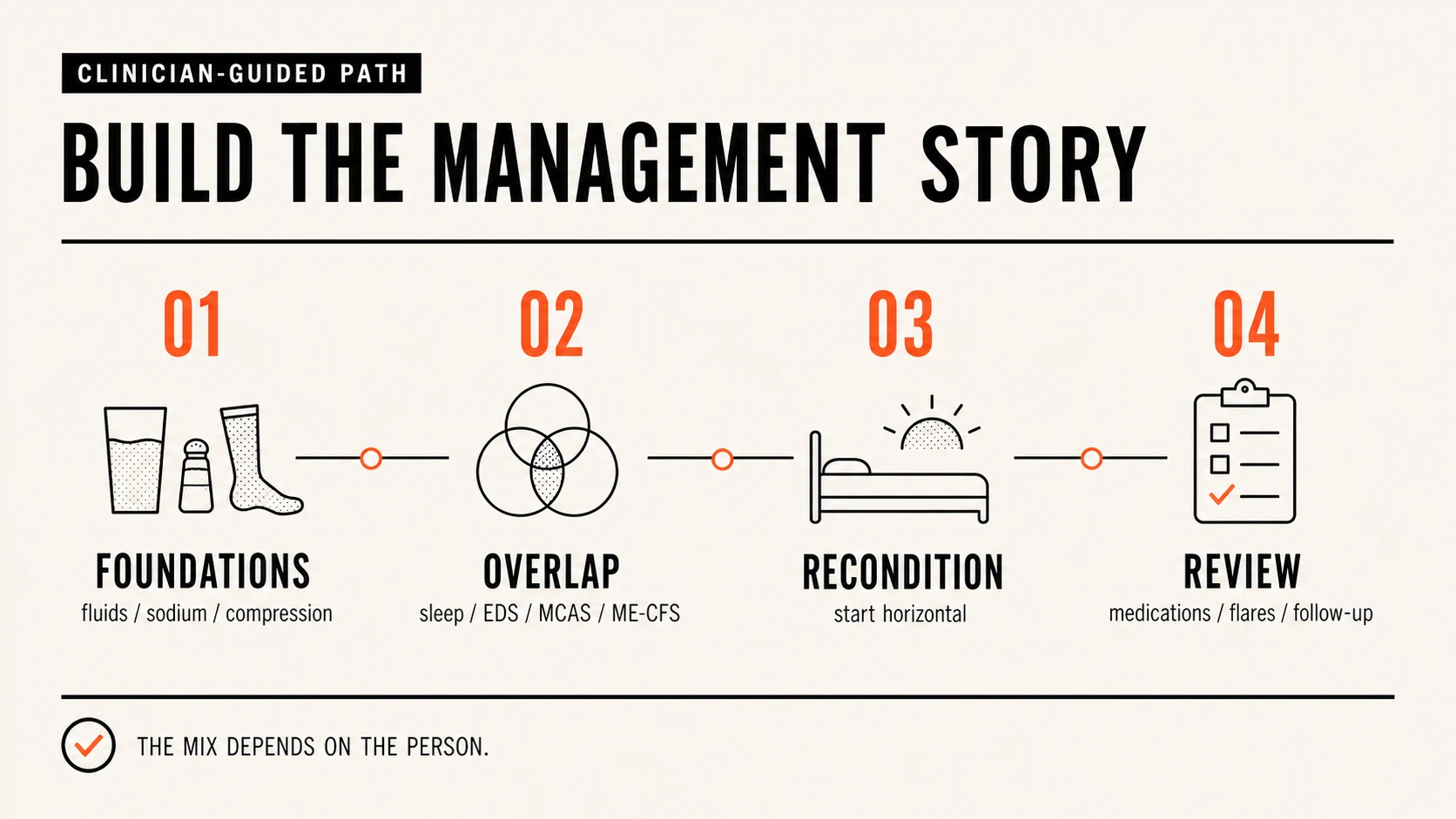
Small POTS studies and rehab programs often start with recumbent (reclined) cycling, rowing, or swimming, then add upright exercise. Some participants feel better and get fitter.
Rest during a post-exertional crash. If activity causes a delayed worsening that lasts into the next day or longer, a fixed build-up may be the wrong place to start, especially with Long COVID or ME/CFS. A 2025 systematic review found that evidence on self-managing POTS is still limited. Newer patient research describes major barriers to standard exercise programs. [Eftekhari 2025] [Walsh 2025]
The CHOP Modified Protocol is for adolescents. The pediatric POTS cutoff is a heart rate rise of 40 bpm, not 30 bpm, within 10 minutes of standing for ages 12 to 19. Both protocols are available from Dysautonomia International.
Build an exercise example
A recumbent-first exercise example
This plan is not graded exercise therapy. If activity causes a delayed crash 24-48 hours later, set this plan aside. Read the ME/CFS guide before deciding how to approach movement.
Many POTS programs begin with exercise lying down or seated, then add upright activity only if you tolerate it. These 12 weeks are an example to discuss and adjust. They aren't a prescription or deadline.
Current fitness level
Available equipment
Resting heart rate (optional note)
Fu Q, Levine BD. Auton Neurosci. 2018;215:20-27. PMID 30001836. The evidence supports recumbent-first, progressively adjusted training for some people with POTS, but the best program and pace are not settled. A 2025 review found that exercise capacity can improve while important evidence gaps remain. PMID 41357159.
Ivabradine
Ivabradine can lower sinus heart rate with less direct effect on blood pressure than some alternatives. Resting heart rate, rhythm, pregnancy, vision effects, and medicine interactions all affect whether it is appropriate.
Midodrine
Midodrine tightens blood vessels. Doctors may suggest it when low blood pressure or blood pooling stands out. Supine hypertension and timing around lying down are important safety issues.
Low-dose beta blockers
Often used for hyperadrenergic presentations, especially when tachycardia is prominent. Dose and fit depend on blood pressure, resting heart rate, asthma history, fatigue, and clinician judgment.
Fludrocortisone
A clinician may consider this when low blood volume still contributes to symptoms. Blood pressure, potassium, swelling, and headache burden all matter before and during use.
Pyridostigmine or droxidopa
Specialists may consider these when nerve problems seem to affect blood-vessel control, symptoms stay severe despite usual treatment, or the first medicines haven't helped enough.
Modafinil and other off-label options
Some specialists consider wake-promoting medicines for severe fatigue or thinking problems. Evidence for POTS brain fog is limited. Heart rate, blood pressure, sleep, anxiety, and drug interactions also matter.
A medicine review can be more useful than a blanket rule. Drugs that raise heart rate or norepinephrine can worsen orthostatic tachycardia in some people. Antidepressants are not one interchangeable group, and a survey report is not enough to tell an individual to stop one. Bring the medicine name, dose timing, and what changed to the prescriber.
When It Gets Worse
What changes during a flare
Flares can last hours to weeks. Common triggers: illness, dehydration, heat, hormonal changes, emotional stress, overexertion.
During a flare: Lying down may relieve orthostatic symptoms. Use only the fluid, sodium, compression, and medication plan already cleared for you. Reduce avoidable standing and return to activity gradually instead of trying to make up for the lost day at once.
When ongoing POTS symptoms need another medical review
Some changes are worth taking beyond home observations, either because the diagnosis is still unclear or because the current plan is not enough.
Fog and a racing heart both worsen after standing
When the same upright change keeps returning and lying down helps, a clinician can repeat the measurements and decide whether you need formal orthostatic testing.
Fainting or repeated near-fainting
Fainting needs medical assessment because POTS is not the only possible explanation and falls can cause injury.
The symptoms began after an infection
POTS can begin after a viral illness, including COVID. The timing helps a clinician understand what changed and what else may be present.
The plan you were given is not helping
If a clinician-guided fluid, sodium, or compression plan hasn't helped, ask for another look at the diagnosis, medicines, treatment plan, and overlapping conditions.
Joint problems, allergic symptoms, poor sleep or low iron
Hypermobility, mast-cell symptoms, broken sleep, and low iron can add separate problems that POTS treatment alone may not fix.
POTS at different ages
POTS at different ages and with other conditions
Post-viral onset (including post-COVID)
In a study of 467 highly symptomatic people with Long COVID who had not been hospitalized, 143 met POTS criteria at assessment. All had at least 50% sick leave, and the median time since infection was 12 months. This describes that selected group, not everyone with Long COVID or the risk of developing POTS.
EDS/hypermobility overlap
POTS and hypermobile Ehlers-Danlos syndrome can occur together. More flexible blood vessels are one proposed explanation for the overlap. Compression and fluids or sodium may help manage POTS. An hEDS diagnosis alone does not tell you whether they will help more than beta-blockers.
Older adults
Doctors may miss POTS in older adults. Many common drugs (blood-pressure pills, diuretics, antidepressants) worsen standing symptoms. Get yours reviewed carefully.
Pregnancy and adolescence
POTS during adolescence and pregnancy
Adolescents
POTS most commonly presents in adolescence, especially during growth spurts. Frequently misdiagnosed as anxiety or school avoidance. Many teens improve with puberty completion, but some transition to chronic adult POTS.
For ages 12 to 19, the diagnostic cutoff is a heart rate rise of at least 40 bpm within 10 minutes of standing.
Pregnancy
POTS is roughly four to five times more common in women than men. Women also wait significantly longer for diagnosis and report more severe symptoms overall. Symptoms often fluctuate with menstrual cycle. Pregnancy can temporarily improve or worsen POTS.
A 2023 community survey found POTS symptoms most often worsened in the first trimester and again late in pregnancy or early postpartum, but the course was still variable. (30)
How POTS research changed
POTS and Brain Fog: A Research Timeline
1871
DaCosta describes 'soldier's heart' in Civil War veterans
Jacob Mendes DaCosta records soldiers with exercise intolerance, pounding hearts, and trouble thinking on standing. It's the earliest clinical description of what doctors later recognized as POTS.
1993
Schondorf and Low name POTS and define diagnostic criteria
At the Mayo Clinic, Schondorf and Low review 16 patients whose heart races on a tilt-table test. They propose the first diagnostic criteria for Postural Orthostatic Tachycardia Syndrome.
Schondorf R & Low PA, Neurology 1993;43(1):132-137
2009
Stewart links POTS to reduced cerebral blood flow
Stewart et al. show that standing lowers brain blood flow in POTS patients and weakens the brain's control of that flow. It's the first explanation of how standing triggers brain fog.
Stewart JM et al., Am J Physiol Heart Circ Physiol 2009;297(4):H1319-H1327
2013
Ross defines brain fog in POTS for the first time
Ross et al. survey 138 POTS patients and characterize brain fog as difficulty focusing, forgetfulness, and cloudy thinking reported by over 95% of patients.
Ross AJ et al., Clin Auton Res 2013;23(6):305-311
2015
Heart Rhythm Society publishes first expert consensus on POTS
Sheldon et al. publish the Heart Rhythm Society expert consensus establishing standardized diagnostic criteria (heart rate increase of 30+ bpm within 10 minutes of standing) and treatment recommendations.
Sheldon RS et al., Heart Rhythm 2015;12(6):e41-63
2019
Antibody findings raise an autoimmune hypothesis
Gunning and colleagues study 55 people with POTS and find antibodies against autonomic receptors in many participants. The findings suggest a possible immune role in POTS.
Gunning WT III et al., J Am Heart Assoc. 2019;8(18):e013602
2021
NIH Expert Consensus Meeting establishes research priorities
The National Institutes of Health (NIH) convenes POTS experts for the first federal consensus meeting, summarizing current understanding and identifying priorities for future research including the post-COVID surge in cases.
Vernino S et al., Auton Neurosci 2021;235:102828
2025
Brain SPECT imaging reveals cerebral perfusion deficits
A 2025 SPECT brain-scan study of POTS patients with thinking problems finds abnormal brain blood flow. It's worst in the front of the brain and movement and touch areas, especially in people who also have joint hypermobility.
Seeley MC et al., Sci Rep 2025;15:3487
2026
RECOVER-AUTONOMIC reports early ivabradine results in Long COVID POTS
Early public results from the RECOVER-AUTONOMIC trial showed ivabradine lowered heart rate in adults with Long COVID POTS but didn't significantly improve overall POTS symptoms. Researchers haven't yet published the full peer-reviewed results.
Common Questions
Common questions about POTS brain fog
Can POTS cause brain fog?
Yes, POTS can make concentration, short-term memory, word finding, and mental stamina worse. It becomes a stronger explanation when those problems build after standing and ease after lying down.
What does POTS brain fog feel like?
People often describe slower thinking, losing the thread of a conversation, difficulty finding words, visual dimming, or a sudden need to sit down. The important part is whether these problems become worse while upright.
Could dehydration cause the same symptoms?
Dehydration can make heart racing, dizziness and brain fog worse. One dehydrated day is not enough to identify POTS. POTS becomes more plausible when the same upright worsening keeps coming back and other explanations have been considered.
Wells CC et al. JAHA. 2020; Björnson M et al. Circ Arrhythm Electrophysiol. 2025
How is POTS brain fog different from anxiety?
Both can cause a racing heart, shakiness, and trouble thinking. POTS is more likely when standing, heat, showers, or long periods upright reliably make symptoms worse and lying down helps. That's true even when you don't feel anxious.
What can a home standing check tell me?
The home check records heart rate, optional blood pressure and time after standing. Write down symptoms separately. It may suggest asking your doctor about a formal standing test, but it can't diagnose POTS by itself.
Wells CC et al. JAHA. 2020; Björnson M et al. Circ Arrhythm Electrophysiol. 2025
Why can brain fog last after the heart rate improves?
Heart rate is only one part of POTS. Thinking problems can remain when low blood volume, poor sleep, migraine, pain, medicine effects, post-viral illness, or post-exertional crashes still contribute. Check these possibilities instead of assuming the POTS diagnosis was wrong.
Sheldon et al., Heart Rhythm Society 2015 Expert Consensus Statement on POTS
How do doctors test for POTS?
Assessment usually begins with heart rate, blood pressure, and symptoms measured after lying down and standing. A tilt-table test or standardized active standing test may be used. Other tests are chosen to rule out conditions such as anemia or thyroid disease, or to investigate a particular POTS presentation.
How quickly can treatment change POTS brain fog?
Lying down or cooling off may change upright symptoms quickly. Compression and a clinician-guided fluid or sodium plan may take longer to judge. Suitable exercise rehab usually takes months to judge. If you get a delayed crash after exertion, ease off.
Sources and related guides
What to read next
Visit prep
Open the POTS doctor handout
Open the public handout now to prepare focused questions for your visit.
This opens in your browser. We don't ask for email or add you to lists.
Supporter: I'm helping someone
Believe the limitation, then offer specific help
You may see someone look well and then suddenly need to sit or lie down. Here is how to help without making them explain everything again.
You may see no warning before the person suddenly needs to sit or lie down. Looking well a few minutes earlier does not mean they can keep standing, talking, shopping, or working.
POTS can make work, school, shopping, showering, and conversation difficult even when the person looks well. If they lose the thread or need to lie down, that is not proof they are bored or avoiding you.
In a 2019 survey of 4,835 people with POTS, 77% of those answering the question said a physician had suggested a psychiatric or psychological cause. Respondents saw an average of seven doctors and waited an average of 4.9 years after their first medical visit for a diagnosis; the median wait was two years.
In an earlier Dysautonomia International survey, 83% reported a prior psychological diagnosis and 59% said someone had told them it was “all in your head.” The survey had 703 respondents, with 684 answering the question about earlier explanations. Both surveys describe participants' own reports, rather than an assessment of whether each earlier diagnosis was correct.
"You don't look sick"
POTS is invisible. Looking fine and being fine aren't the same thing.
"Maybe it's just anxiety"
Many people with POTS have already had physical symptoms blamed on anxiety. Ask what happens after standing before making that assumption again.
"You just need to push through it"
Pushing through can worsen symptoms. If post-exertional malaise is also present, the heavier crash may not arrive until later that day or the next.
"Have you tried drinking more water?"
They may already have a clinician-set fluid and sodium plan. They usually need practical support, not casual advice.
What to say instead: "Do you need to sit down, lie down, cool off, or leave?" A specific offer is easier to answer when speaking already takes effort.
Be flexible with plans. Let them decide without pressure. Accept last-minute cancellations without guilt-tripping. Offer low-key alternatives ("We can just hang out on the couch instead").
Offer specific help. Instead of "let me know if you need anything":
- "I'm going to the store, what do you need?"
- "Can I bring dinner Thursday?"
- "I can drive you to your appointment."
On bad days:
- Bring the fluids or electrolytes they already use to their bedside.
- Help with compression garments (hard to put on when symptomatic).
- Help with meals in a way that follows their existing plan.
- Keep it cool and reduce stimulation.
- If they can't talk much, it isn't about you. Brain fog makes conversation exhausting.
- Just being present and quiet is often enough.
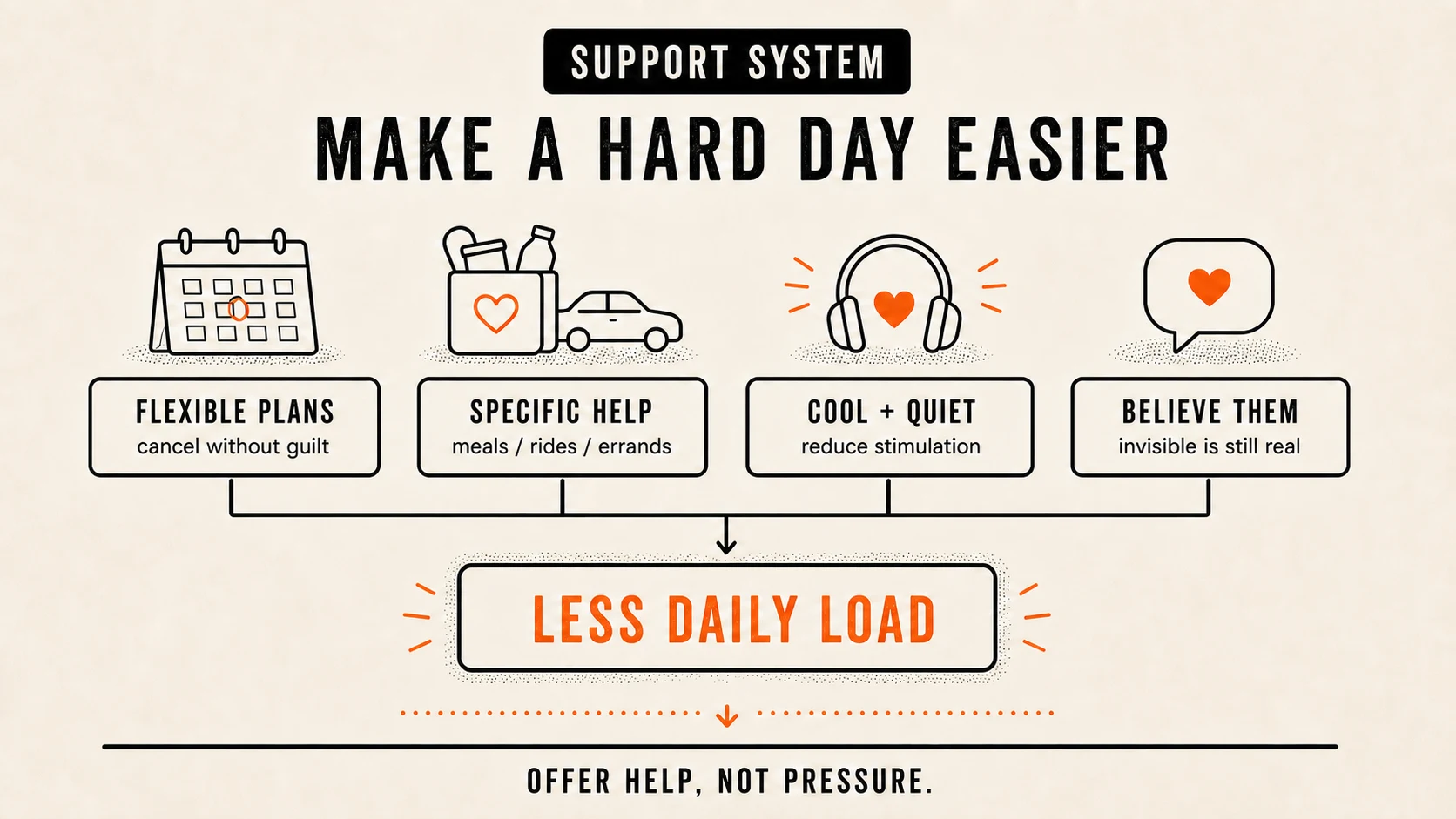
Work and School
Changes that can make the day manageable
In the US, some people with POTS may qualify for ADA accommodations. These include remote work, flexible hours, temperature control, access to fluids, frequent breaks, or the ability to sit or recline.
School accommodations: extra time on tests, permission to eat/drink in class, elevator access, modified PE, excused absences for flares.
The cognitive burden of self-advocacy during a flare is enormous. Help them document their needs, fill out paperwork, and attend meetings.
If you live with someone who has POTS
What the illness can do to a relationship
Grief is real. The person with POTS is grieving their life before POTS. You may be grieving the relationship you expected. Both are valid.
Supporters can become exhausted too. That does not make the illness the person's fault. It means both people may need practical help, boundaries, and support.
Couples counseling or chronic illness support groups can help both partners. Dysautonomia International runs support groups, including some just for family members.
When ongoing POTS symptoms need another medical review
Some changes are worth taking beyond home observations, either because the diagnosis is still unclear or because the current plan is not enough.
Fog and a racing heart both worsen after standing
When the same upright change keeps returning and lying down helps, a clinician can repeat the measurements and decide whether you need formal orthostatic testing.
Fainting or repeated near-fainting
Fainting needs medical assessment because POTS is not the only possible explanation and falls can cause injury.
The symptoms began after an infection
POTS can begin after a viral illness, including COVID. The timing helps a clinician understand what changed and what else may be present.
The plan you were given is not helping
If a clinician-guided fluid, sodium, or compression plan hasn't helped, ask for another look at the diagnosis, medicines, treatment plan, and overlapping conditions.
Joint problems, allergic symptoms, poor sleep or low iron
Hypermobility, mast-cell symptoms, broken sleep, and low iron can add separate problems that POTS treatment alone may not fix.
POTS at different ages
POTS at different ages and with other conditions
Post-viral onset (including post-COVID)
In a study of 467 highly symptomatic people with Long COVID who had not been hospitalized, 143 met POTS criteria at assessment. All had at least 50% sick leave, and the median time since infection was 12 months. This describes that selected group, not everyone with Long COVID or the risk of developing POTS.
EDS/hypermobility overlap
POTS and hypermobile Ehlers-Danlos syndrome can occur together. More flexible blood vessels are one proposed explanation for the overlap. Compression and fluids or sodium may help manage POTS. An hEDS diagnosis alone does not tell you whether they will help more than beta-blockers.
Older adults
Doctors may miss POTS in older adults. Many common drugs (blood-pressure pills, diuretics, antidepressants) worsen standing symptoms. Get yours reviewed carefully.
Pregnancy and adolescence
POTS during adolescence and pregnancy
Adolescents
POTS most commonly presents in adolescence, especially during growth spurts. Frequently misdiagnosed as anxiety or school avoidance. Many teens improve with puberty completion, but some transition to chronic adult POTS.
For ages 12 to 19, the diagnostic cutoff is a heart rate rise of at least 40 bpm within 10 minutes of standing.
Pregnancy
POTS is roughly four to five times more common in women than men. Women also wait significantly longer for diagnosis and report more severe symptoms overall. Symptoms often fluctuate with menstrual cycle. Pregnancy can temporarily improve or worsen POTS.
A 2023 community survey found POTS symptoms most often worsened in the first trimester and again late in pregnancy or early postpartum, but the course was still variable. (30)
How POTS research changed
POTS and Brain Fog: A Research Timeline
1871
DaCosta describes 'soldier's heart' in Civil War veterans
Jacob Mendes DaCosta records soldiers with exercise intolerance, pounding hearts, and trouble thinking on standing. It's the earliest clinical description of what doctors later recognized as POTS.
1993
Schondorf and Low name POTS and define diagnostic criteria
At the Mayo Clinic, Schondorf and Low review 16 patients whose heart races on a tilt-table test. They propose the first diagnostic criteria for Postural Orthostatic Tachycardia Syndrome.
Schondorf R & Low PA, Neurology 1993;43(1):132-137
2009
Stewart links POTS to reduced cerebral blood flow
Stewart et al. show that standing lowers brain blood flow in POTS patients and weakens the brain's control of that flow. It's the first explanation of how standing triggers brain fog.
Stewart JM et al., Am J Physiol Heart Circ Physiol 2009;297(4):H1319-H1327
2013
Ross defines brain fog in POTS for the first time
Ross et al. survey 138 POTS patients and characterize brain fog as difficulty focusing, forgetfulness, and cloudy thinking reported by over 95% of patients.
Ross AJ et al., Clin Auton Res 2013;23(6):305-311
2015
Heart Rhythm Society publishes first expert consensus on POTS
Sheldon et al. publish the Heart Rhythm Society expert consensus establishing standardized diagnostic criteria (heart rate increase of 30+ bpm within 10 minutes of standing) and treatment recommendations.
Sheldon RS et al., Heart Rhythm 2015;12(6):e41-63
2019
Antibody findings raise an autoimmune hypothesis
Gunning and colleagues study 55 people with POTS and find antibodies against autonomic receptors in many participants. The findings suggest a possible immune role in POTS.
Gunning WT III et al., J Am Heart Assoc. 2019;8(18):e013602
2021
NIH Expert Consensus Meeting establishes research priorities
The National Institutes of Health (NIH) convenes POTS experts for the first federal consensus meeting, summarizing current understanding and identifying priorities for future research including the post-COVID surge in cases.
Vernino S et al., Auton Neurosci 2021;235:102828
2025
Brain SPECT imaging reveals cerebral perfusion deficits
A 2025 SPECT brain-scan study of POTS patients with thinking problems finds abnormal brain blood flow. It's worst in the front of the brain and movement and touch areas, especially in people who also have joint hypermobility.
Seeley MC et al., Sci Rep 2025;15:3487
2026
RECOVER-AUTONOMIC reports early ivabradine results in Long COVID POTS
Early public results from the RECOVER-AUTONOMIC trial showed ivabradine lowered heart rate in adults with Long COVID POTS but didn't significantly improve overall POTS symptoms. Researchers haven't yet published the full peer-reviewed results.
Common Questions
Common questions about POTS brain fog
Can POTS cause brain fog?
Yes, POTS can make concentration, short-term memory, word finding, and mental stamina worse. It becomes a stronger explanation when those problems build after standing and ease after lying down.
What does POTS brain fog feel like?
People often describe slower thinking, losing the thread of a conversation, difficulty finding words, visual dimming, or a sudden need to sit down. The important part is whether these problems become worse while upright.
Could dehydration cause the same symptoms?
Dehydration can make heart racing, dizziness and brain fog worse. One dehydrated day is not enough to identify POTS. POTS becomes more plausible when the same upright worsening keeps coming back and other explanations have been considered.
Wells CC et al. JAHA. 2020; Björnson M et al. Circ Arrhythm Electrophysiol. 2025
How is POTS brain fog different from anxiety?
Both can cause a racing heart, shakiness, and trouble thinking. POTS is more likely when standing, heat, showers, or long periods upright reliably make symptoms worse and lying down helps. That's true even when you don't feel anxious.
What can a home standing check tell me?
The home check records heart rate, optional blood pressure and time after standing. Write down symptoms separately. It may suggest asking your doctor about a formal standing test, but it can't diagnose POTS by itself.
Wells CC et al. JAHA. 2020; Björnson M et al. Circ Arrhythm Electrophysiol. 2025
Why can brain fog last after the heart rate improves?
Heart rate is only one part of POTS. Thinking problems can remain when low blood volume, poor sleep, migraine, pain, medicine effects, post-viral illness, or post-exertional crashes still contribute. Check these possibilities instead of assuming the POTS diagnosis was wrong.
Sheldon et al., Heart Rhythm Society 2015 Expert Consensus Statement on POTS
How do doctors test for POTS?
Assessment usually begins with heart rate, blood pressure, and symptoms measured after lying down and standing. A tilt-table test or standardized active standing test may be used. Other tests are chosen to rule out conditions such as anemia or thyroid disease, or to investigate a particular POTS presentation.
How quickly can treatment change POTS brain fog?
Lying down or cooling off may change upright symptoms quickly. Compression and a clinician-guided fluid or sodium plan may take longer to judge. Suitable exercise rehab usually takes months to judge. If you get a delayed crash after exertion, ease off.
Sources and related guides
What to read next
References
Wells R et al. Cerebral Blood Flow and Cognitive Performance in Postural Tachycardia Syndrome: Insights from Sustained Cognitive Stress Test. J Am Heart Assoc. 2020;9(24):e017861. [Wells 2020]
Wells R et al. Brain fog in postural tachycardia syndrome: An objective cerebral blood flow and neurocognitive analysis. J Arrhythm. 2020;36(3):549–552. [doi.org]
Ross AJ et al. What is brain fog? An evaluation of the symptom in POTS. Clin Auton Res. 2013;23(6):305-311 [Ross 2013]
Sheldon RS et al. 2015 Heart Rhythm Society Expert Consensus on POTS. Heart Rhythm. 2015;12(6):e41-63 [PubMed Central]
Björnson M et al. Prevalence and Clinical Impact of POTS in Highly Symptomatic Long COVID. Circ Arrhythm Electrophysiol. 2025;e013629 [Björnson 2025]
Gunning WT III et al. Postural Orthostatic Tachycardia Syndrome Is Associated With Elevated G-Protein Coupled Receptor Autoantibodies. J Am Heart Assoc. 2019;8(18):e013602 [doi.org]
Hall J et al. Detection of G Protein–Coupled Receptor Autoantibodies in Postural Orthostatic Tachycardia Syndrome Using Standard Methodology. Circulation. 2022;146(8):613–622. [doi.org]
Fu Q et al. Exercise training vs propranolol in POTS. Hypertension. 2011;58(2):167-175 [Fu 2011]
Boris JR et al. Long-Term POTS Outcomes Survey: Diagnosis, Therapy, and Clinical Outcomes. J Am Heart Assoc. 2024;13:e033485 [doi.org]
Bourne KM et al. Compression garments reduce orthostatic tachycardia in POTS. J Am Coll Cardiol. 2021;77(3):285-296 [doi.org]
Some POTS cohorts show worsening hemodynamic/autonomic symptoms after glucose or meal challenges, which can mimic metabolic crashes. (B evidence) [Breier 2022] [Habek 2019]
In a survey of 138 people with POTS aged 14–29, 132 (96%) reported brain fog, including difficulty with concentration, memory and word finding. [Ross 2013]
- Sources: [1] [2] [3]
- Sources: [1] [2] [3] [4]
- [Sheldon 2015]
- [Vernino 2021]
- [Seeley 2025]
- POTS diagnostic criteria (CMAJ, 2022)
- [Kwok 2025]
- Sources: [1] [2] [3] [4] [5]
- Boris et al., JAHA 2024; Fu et al., Hypertension 2011; Ross et al., Clin Auton Res 2013
- Sources: [1] [2] [3]
- Sources: [1] [2]
- [Raj 2022]
- [Sheldon 2015]
- [PoTS UK]
- [PoTS UK]
- [Healthdirect Australia]
- [Australian POTS Foundation]
- [Bourne 2023]
- [RECOVER]
- Raj, Fedorowski and Sheldon (2022). Diagnosis and management of postural orthostatic tachycardia syndrome.
- Cortez et al. (2025). Impact of exercise to treat POTS: a systematic review.
- Sivakoti et al. (2026). Postural Orthostatic Tachycardia Syndrome (POTS) and Dysautonomia: International Multidisciplinary Expert Consensus.
- Eftekhari et al. (2025). Supportive self-management in POTS: A systematic review.
- NHS (reviewed July 2026). Postural tachycardia syndrome (PoTS).
- Rodriguez et al. (2019). Orthostatic cognitive dysfunction in POTS after rapid water drinking.
- Breier et al. (2022). Worsening POTS after oral glucose and glucose-dependent insulinotropic polypeptide.
- NICE NG206. ME/CFS: diagnosis and management.
- Ross et al. (2013). What is brain fog? An evaluation of the symptom in POTS.
- NHS. Sleep apnoea.
- Green et al. (2013). Effects of norepinephrine reuptake inhibition on POTS.
- The Benefits of Oral Rehydration on Orthostatic Intolerance in Children with POTS (2019).
- RECOVER (28 March 2026). RECOVER-AUTONOMIC clinical trial results shared at the ACC Conference.
- Coffin et al. (2012). Desmopressin acutely decreases tachycardia and improves symptoms in POTS.
- Sheldon et al. (2015). Heart Rhythm Society consensus: POTS, inappropriate sinus tachycardia and vasovagal syncope.
- Schiweck et al. (online 2025; issue 2026). Systematic literature review: treatment of POTS.
- Randomized Trial of Ivabradine in Patients With Hyperadrenergic POTS (2021).
- Uppal et al. (2026). A Randomized Crossover Trial of Ivabradine, Propranolol, and Placebo in POTS: A Detailed Description. JACC: Advances. DOI 10.1016/j.jacadv.2026.102795.
- Midodrine in neuropathic compared with hyperadrenergic POTS: double-blind crossover study (2014).
- Raj et al. (2009). Propranolol decreases tachycardia and improves symptoms in POTS: less is more.
- Raj et al. (2005). Acetylcholinesterase inhibition improves tachycardia in POTS.
- Ruzieh et al. (2017; online 2016). Droxidopa in the Treatment of POTS.
- Wells et al. (2020). Brain fog in POTS: objective cerebral blood flow and neurocognitive analysis.
- Wells et al. (2020). Cerebral blood flow and cognitive performance in POTS during sustained cognitive stress.
- Vernino et al. (2024). IVIG for autoimmune POTS: iSTAND randomized controlled trial.
- Mar et al. (2014). Acute hemodynamic effects of a selective serotonin reuptake inhibitor in POTS.
- Kpaeyeh Jr et al. (2014). Hemodynamic profiles and tolerability of modafinil in POTS: a randomized, placebo-controlled trial.
- NHS. Fainting: first aid and emergency warning signs.
- Fu et al. (2011). Exercise training versus propranolol in the treatment of POTS.
- Okamoto et al. (2024). Hyperadrenergic POTS: clinical biomarkers and response to guanfacine.
- Snook et al. (2021). British Society of Gastroenterology guidelines for iron deficiency anaemia in adults.
- Bourne et al. (2021). Compression garment effects during orthostatic challenge in POTS.
- Bourne et al. (online 2024). A Community-Based Trial of Commercially Available Compression Tights in Patients With POTS.
- van Dijk et al. (2006). Physical Counterpressure Manoeuvres Trial.
- Garland et al. (2021). Effect of high dietary sodium intake in patients with POTS.
- Stavrakis et al. (2024; online 2023). Noninvasive vagus nerve stimulation in POTS: randomized trial.
Visit prep
Open the POTS doctor handout
Open the public handout now to prepare focused questions for your visit.
This opens in your browser. We don't ask for email or add you to lists.
Related context
Related causes
Ehlers-Danlos syndrome (EDS)
Why it can look similar
Mast cell activation syndrome (MCAS)
Why it can look similar
Neuroinflammation
Why it can look similar
Histamine
Why it can look similar
Across the site
Appointment summary
A short page you can copy or screenshot
Related reading
POTS and Brain Fog
A longer guide to symptoms, testing, treatment, and appointment preparation
Review status
Reviewed: 2026-08-22
By: Dr. Alexandru-Theodor Amarfei, M.D.
How doctors diagnose it
POTS has established diagnostic criteria.
Heart Rhythm Society POTS consensus 2015; Dysautonomia International
Can it improve?
POTS brain fog can often improve, especially if you spot early that standing worsens it and keep up the basics.
What to notice
Compare your heart rate and symptoms after lying down and after standing. Use the guided check on this page if you can safely stand without help.
Free - about 15 minutes
Other causes to consider
POTS can occur alongside hypermobility, migraine, post-viral illness, sleep problems, anemia, and medication effects. More than one may be affecting the same day.
Mast cell activation syndrome (MCAS)