Can anemia cause brain fog?
Where are you now?
Choose the situation that describes you
Quick answer
Evidence and recovery context
Yes, anemia can cause brain fog
Anemia can make thinking slower, concentration harder and mental effort more tiring.
Low iron can cause symptoms even before hemoglobin drops enough for a doctor to call it anemia. Ferritin and the rest of the iron studies help show whether iron stores are low and whether enough iron is available to make red blood cells.
When anemia is more likely
Look for thinking problems alongside low stamina, breathlessness, dizziness, a history of bleeding or an abnormal blood test.
First checks
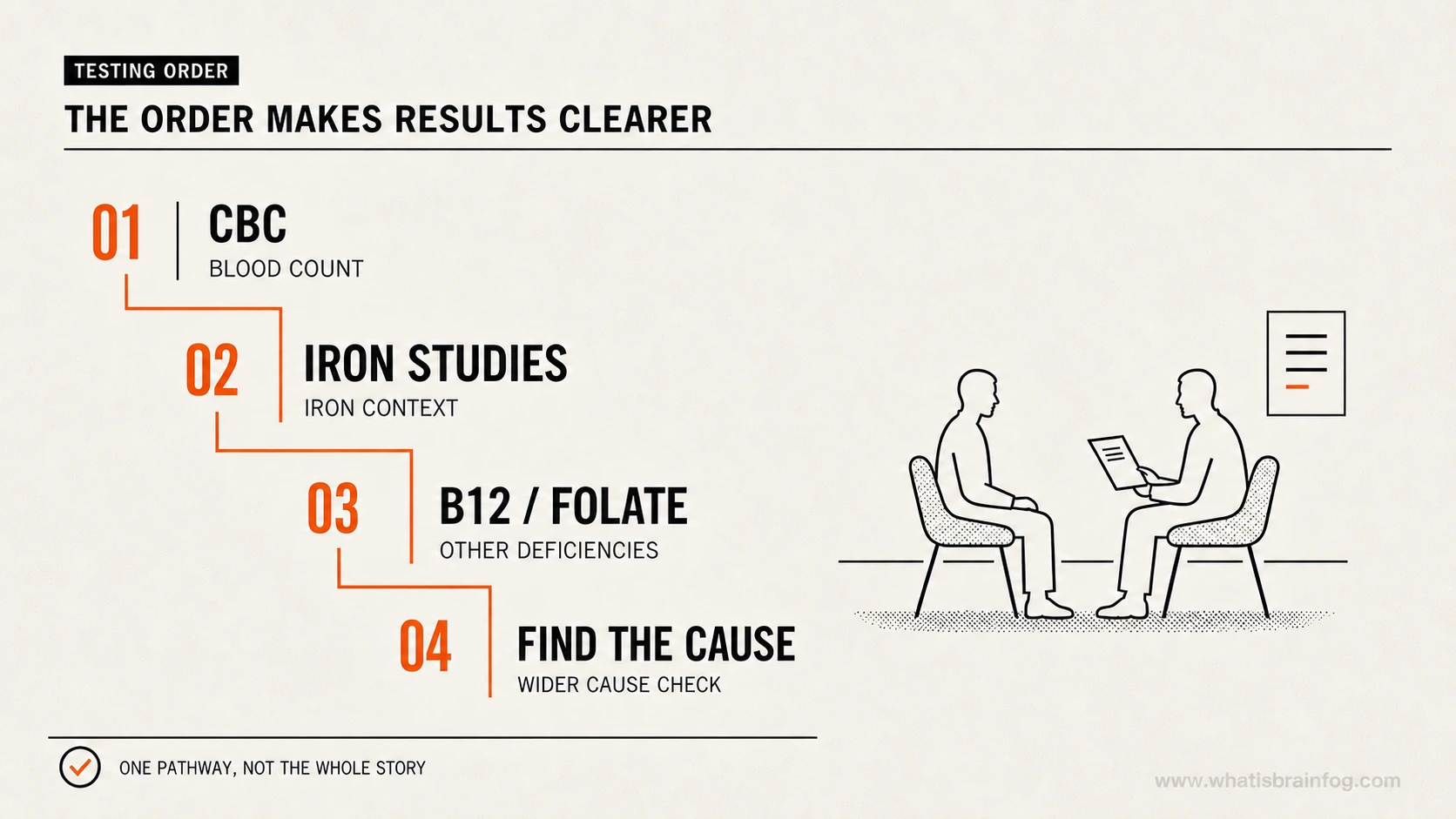
The first tests usually include a complete blood count (CBC), ferritin, iron studies, vitamin B12 and folate. Then find the reason for any blood loss or absorption problem.
Investigating: I think anemia is causing my brain fog
Investigating
Could anemia or low iron be the cause?
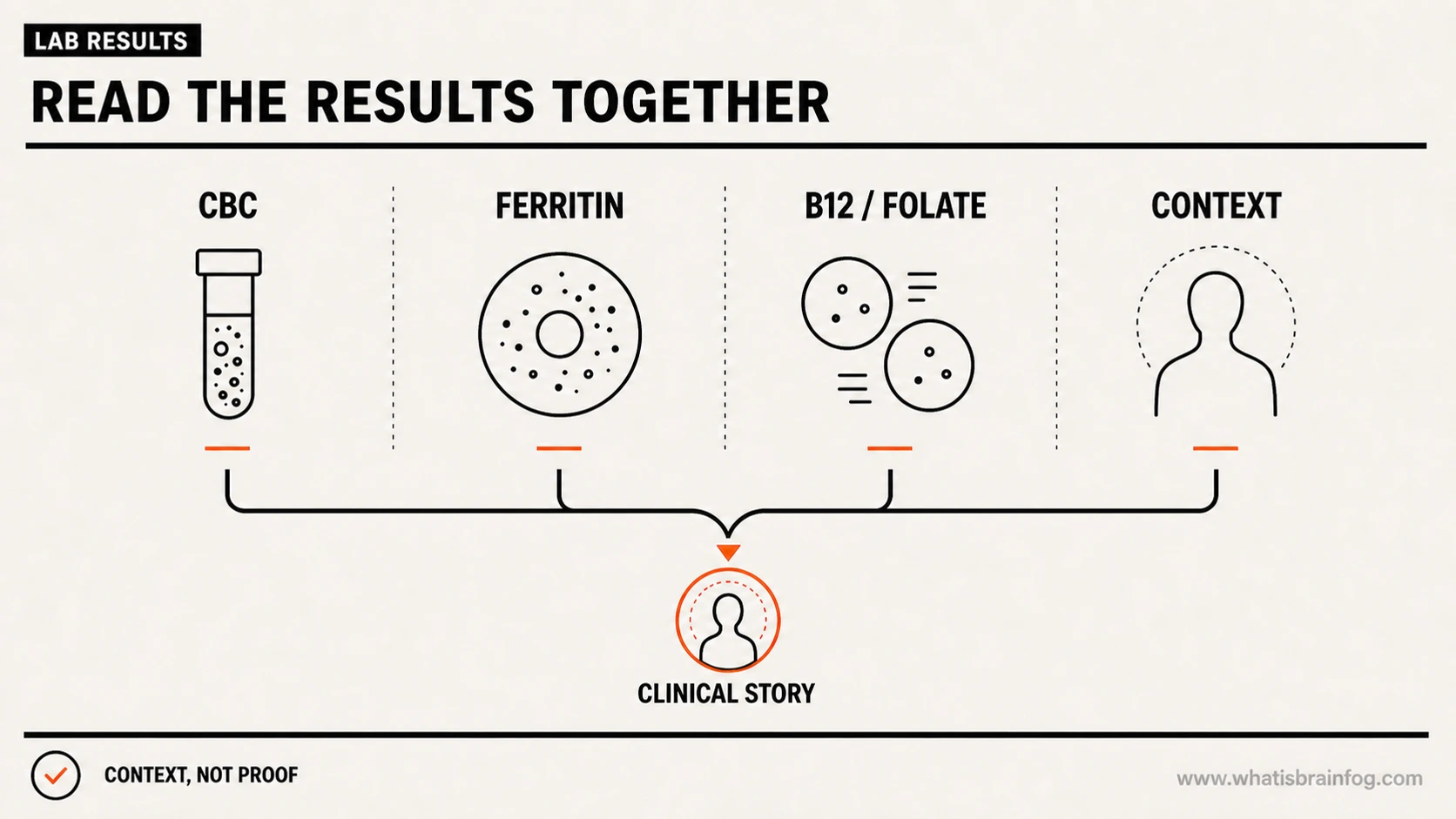
Read the CBC, ferritin and iron studies together, then find what caused abnormal results.
One thing
One value or symptom doesn't settle it.
CBC, ferritin, B12, folate, history, and cause-specific review
Before you assume one cause
Low iron, low B12 or folate, thyroid disease, sleep disorders, medicines, kidney disease, inflammation, pregnancy, gut disease and bleeding can overlap.
Check blood, stamina and thinking separately
Check the blood results, physical stamina and thinking. They may improve at different times. If your hemoglobin and ferritin rise but your focus and memory don't, the treatment fixed the blood problem. That problem just wasn't the whole cause of your brain fog.
Anemia is more likely when poor focus or slower thinking happens alongside a clear drop in stamina.
Climbing stairs may leave you breathless. A shower or short walk may take more out of you than it used to. You may also notice dizziness, headaches, palpitations, paler skin or gums, restless legs, hair loss, a sore tongue, nail changes or a strong craving for ice.
Your history matters too. Anemia or low iron can come from heavy periods, pregnancy and birth, surgery, giving blood, stomach or bowel problems, a restricted diet, kidney disease or poor absorption.
Other conditions can cause these symptoms too. The blood results show whether anemia or a related deficiency is present.
Can low iron cause brain fog without anemia?
Yes, low iron may affect fatigue and some types of thinking before hemoglobin falls.
A 2025 review included 18 studies and 1,408 people, mainly menstruating adults and young people without anemia. In the randomized trials, iron treatment improved fatigue, short-term memory and some other outcomes in people with iron deficiency. It didn't improve attention or depression. The effects disappeared when the review left out people with iron deficiency. That supports treating confirmed iron deficiency, not taking iron for brain fog alone. Fiani et al., 2025
Another study of 209 young people linked low iron, even without anemia, with lower MRI measures of brain iron in some areas. This study looked at teenagers once and didn't test a treatment. So it can't show that the finding applies to every adult, or that taking iron would change thinking. Fiani et al., 2025
Blood tests
Which results should be read together?
A complete blood count shows whether anemia is present. Iron studies, vitamin tests and the history help explain why.
- 01
Complete blood count (CBC or FBC)
Shows hemoglobin, hematocrit and the number and size of red blood cells. It answers whether anemia is present.
- 02
Hemoglobin
Shows how much oxygen-carrying protein is in the blood. It can remain normal after iron stores have started to fall.
- 03
MCV, MCH and RDW
Describe red-cell size, hemoglobin content and variation. Small cells can occur with iron deficiency or thalassemia. Large cells can occur with B12 or folate deficiency, medicines, alcohol, thyroid disease or bone-marrow problems. Mixed deficiencies may hide the expected result.
- 04
Ferritin
Estimates stored iron. A low result supports iron deficiency. Inflammation, infection and liver disease can raise it.
- 05
Serum iron, transferrin or TIBC, and transferrin saturation
Show how blood carries iron and how much is available. Serum iron changes through the day, so read it with other iron results.
- 06
Reticulocyte count
Shows whether the bone marrow is making new red blood cells. It may help once tests confirm anemia or treatment starts.
- 07
Vitamin B12 and folate
Measure two vitamins that can affect blood and thinking when low. B12 can affect the nerves even when hemoglobin and MCV are normal.
- 08
Methylmalonic acid (MMA)
This test may help when your B12 is borderline and your symptoms still fit low B12. Homocysteine may also be used, but folate and other conditions can affect it.
- 09
CRP or other inflammation tests
Help explain why ferritin may be higher than expected and why the body may not be using iron normally.
- 10
Kidney, thyroid, celiac or bleeding tests
These are chosen from the history. They look for a cause rather than confirming every case of anemia.
NHLBI explains the CBC and wider anemia work-up. Healthdirect explains the parts of an iron study.
What does a “normal” ferritin result mean?
Iron can still be low when a result says normal. Read the number alongside hemoglobin, transferrin saturation, inflammation, symptoms and why you were tested.
Different cutoffs answer different questions. The World Health Organization uses ferritin to measure stored iron. It reads the result differently when you have an infection or inflammation. For adults who already have anemia, the American Gastroenterological Association counts a ferritin level under 45 ng/mL as a sign of low iron. These are diagnostic rules for defined situations. They aren't universal brain-fog targets. WHO ferritin guidance AGA guidance
Ask for the actual number, unit and laboratory range. Then ask what the complete set of results means in your case.
Tool
Open the anemia lab interpreter
Use the anemia lab interpreter to read the results together. Enter the values from your report and compare them with the normal ranges. If your report uses a different range, use the range on your report.
Open the interpreter with the anemia tests loaded
Have these ready
- Hemoglobin and the rest of the CBC.
- Ferritin.
- Serum iron, transferrin or TIBC, and transferrin saturation.
- Vitamin B12 and folate.
- Reticulocyte count and inflammation tests, when ordered.
- Dates, units and laboratory ranges.
- Symptoms, bleeding, diet, medicines and treatment dates.
The interpreter helps you read separate results together and prepare questions. It doesn't score your chance of anemia, rank diagnoses or give a treatment target.
Why it happens
How can anemia's causes affect thinking?
Anemia is a blood finding with several possible causes. Those causes don't all affect the brain the same way.
Lower oxygen-carrying capacity
Hemoglobin carries oxygen. When hemoglobin is low, fatigue, breathlessness, headaches, less stamina for exercise and trouble thinking can happen together. The research on anemia and thinking is mixed, so “the brain needs oxygen” doesn't fully explain every case.
Low iron before anemia
Your body also uses iron for cell energy, myelin (the coating on nerves) and brain chemistry. These roles may partly explain why some people low in iron report fatigue or thinking problems before anemia develops. Use your full iron results and history to judge whether low iron is the cause.
Vitamin B12 deficiency
B12 deficiency can affect concentration, short-term memory, vision, sensation, balance and walking.
Inflammation and kidney disease
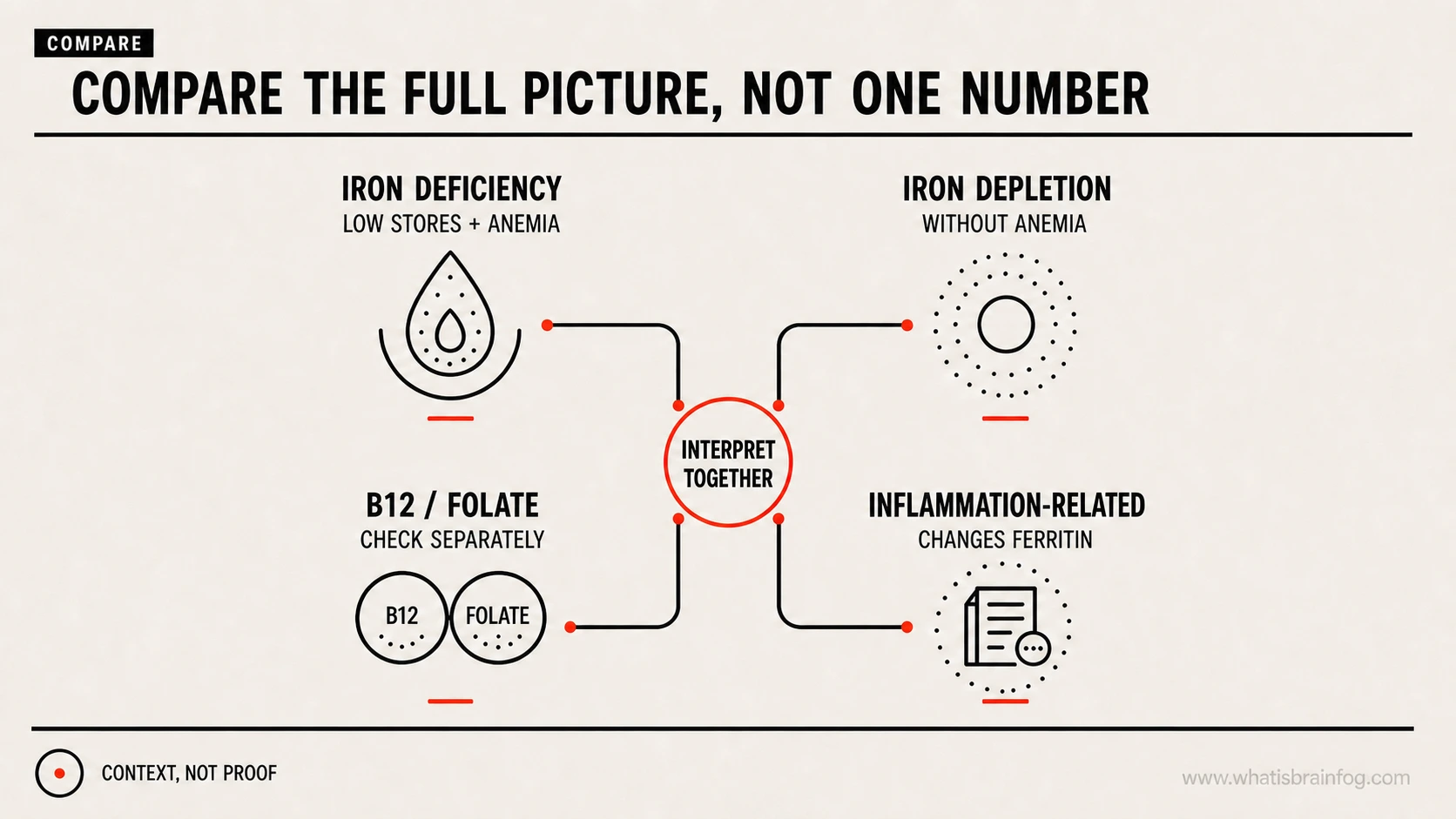
Inflammation can raise ferritin and make iron harder to use. Kidney disease can reduce red-cell production. Low iron, low B12 or folate, blood loss and inflammation may occur at the same time.
How strong is the anemia-cognition evidence?
A 2026 review of anemia and three other conditions found mixed results. Anemia was linked with a higher chance of being classified as cognitively impaired, but cognitive test scores varied widely and weren't significantly different. After the authors corrected for publication bias, the combined four-condition result was no longer statistically significant. Fei et al., 2026
What caused the anemia or low iron?
Heavy periods and other bleeding
Heavy periods are a common cause of iron loss. Bleeding after birth, repeated blood donation, surgery, stomach ulcers, bowel disease, some medicines and bleeding from the urinary tract can also lower iron. If the bleeding continues, iron may fall again after you replace it.
Pregnancy and postpartum blood loss
Pregnancy raises iron needs. Blood loss during birth can lower hemoglobin and iron stores further. Brain fog, low mood, poor sleep and physical exhaustion may overlap after birth, so blood results and the birth history deserve their own review.
Stomach or bowel blood loss
Iron-deficiency anemia without a clear cause may lead to tests for hidden bleeding. Age, sex, periods, symptoms and medical history affect whether doctors consider stool testing, endoscopy or colonoscopy. AGA guidance gives specific routes for adults with confirmed iron-deficiency anemia. AGA guidance
Poor absorption
Celiac disease, inflammatory bowel disease, H. pylori, bariatric surgery and other stomach or bowel problems can stop oral iron from working as expected. Autoimmune gastritis can impair both iron and B12 absorption.
Diet or restricted intake
Low iron intake can contribute, especially when needs are high. Vegan diets also need a dependable source of vitamin B12. Food may be part of the cause, but consider bleeding and poor absorption before blaming diet.
Inflammation, kidney disease or another blood condition
Anemia can come from long-term inflammation, kidney disease, red blood cells breaking down, an inherited blood condition or bone marrow disease. Small red cells (low MCV) with ferritin that isn't low may call for different tests, including thalassemia testing in the right setting. Iron isn't the answer to every small-cell anemia.
Several conditions can cause tiredness, dizziness, poor concentration and lower daily capacity.
Thyroid disease
Thyroid tests answer a different question from the CBC and iron studies. Cold intolerance, weight change and other thyroid symptoms may add context, but symptoms alone cannot separate the two.
POTS or another standing-related problem
If symptoms start after standing and ease after sitting or lying down, a standing-related problem is worth checking. Clinicians also rule out anemia as a cause of a fast heart rate.
Vitamin B12 deficiency
Numbness, pins and needles, balance trouble, walking changes or vision problems make B12 and neurological assessment more important. A normal MCV doesn't rule out B12 deficiency.
Depression
Persistent low mood or loss of interest needs its own assessment. Depression and anemia can occur together. When one is found, still check for the other.
Poor sleep or sleep apnea
Even if you have anemia, poor sleep may be behind your thinking problems. Watch for waking unrefreshed, snoring, pauses in breathing that someone notices, and morning headaches.
Medicines, kidney disease or inflammation
The medicine list, kidney tests, CRP and the rest of the blood count may explain why symptoms or ferritin don't fit simple iron deficiency.
Does timing tell me if anemia is the cause?
No. Morning, meal-linked or effort-linked brain fog doesn't diagnose anemia. Symptoms that keep following meals or standing may have another cause. Tell the doctor.
Appointment
What should I take with me?
Bring the complete reports. A list from memory isn't enough.
- Include dates, units and reference ranges.
- Add medicines and supplements, including antacids and acid-reducing medicines.
- Mention heavy periods, pregnancy, birth, surgery, blood donation, stomach or bowel symptoms and any visible bleeding.
- Mention vegan or restricted diets, bariatric surgery, celiac disease, kidney disease and inflammatory illness.
- Say what changed at work, at home and during physical activity.
I have cognitive and physical symptoms with these blood results. Can we check whether I have anemia or low iron, B12 or folate? What caused it, and what follow-up would show the treatment is working?
Bleeding, chest pain or breathing trouble
Get medical help quickly for chest pain, fainting, breathlessness at rest, a very fast heart rate with severe weakness, bleeding that won't stop, vomiting blood, blood in your stool, or black, tarry stool.
New nerve or vision symptoms
See a doctor soon if you have new or worsening numbness, weakness, balance trouble, problems walking or changes in your vision. Low B12 or another brain or nerve problem could be the cause.
Driving and safety-sensitive work
Hold off on driving and safety-critical work while fainting, severe breathlessness, confusion, vision changes, weakness or poor attention make them unsafe.
History
How anemia care developed
1681
Iron was used before anemia could be measured
Thomas Sydenham described iron as a treatment for chlorosis, an old diagnosis later linked with iron-deficiency anemia. Treatment came before a clear account of the blood change or its cause. Andrews, 2008
1832
The iron pill made treatment repeatable
Pierre Blaud introduced a ferrous-sulfate pill for chlorosis. It made iron treatment easier to repeat long before blood tests could separate iron deficiency from other anemia types. Blaud, 1846 (PMID 38209111); Guggenheim, 1995 (PMID 7616296)
1926 to 1934
Liver treated pernicious anemia
George Minot and William Murphy reported liver treatment for pernicious anemia in 1926, building on George Whipple’s work. The three received the 1934 Nobel Prize. No one had yet identified the active factor as vitamin B12. Nobel Prize
1948
Vitamin B12 was isolated
Researchers isolated the active liver factor. This explained why liver had helped pernicious anemia and opened the way to specific B12 treatment. Nobel Prize history
2001
Hepcidin changed the understanding of iron control
Park and colleagues described hepcidin, a hormone made by the liver. Later research showed how inflammation can restrict iron use and how one iron dose can affect absorption from the next. Park et al., 2001; Nemeth et al., 2004; Moretti et al., 2015
2017
Dosing studies showed why timing matters
Stoffel and colleagues studied women with low iron. Taking iron every day, or twice a day, raised a hormone called hepcidin, and the body then absorbed less of the next dose. The work changed the dosing discussion but did not create one schedule for every patient. Stoffel et al., 2017
2025 to 2026
Research separated blood recovery from cognitive recovery
New work has looked at iron deficiency before anemia, brain iron, fatigue, thinking tests and long-term anemia. Some outcomes improve while others don't. That's why WBF checks blood results, physical stamina and thinking separately.
Questions and sources
Common questions
What ferritin level causes brain fog?
No single ferritin level proves the cause of brain fog or predicts recovery. Ferritin is read with hemoglobin, transferrin saturation, inflammation, symptoms and the reason for testing. Diagnostic cutoffs also change by clinical setting.
Should I start taking iron before I am tested?
Testing first is usually safer unless a clinician has already told you to start. Iron won't treat B12 deficiency, folate deficiency, thalassemia, many inflammation-related anemias or every cause of fatigue. Too much iron can be harmful.
Can B12 deficiency cause brain fog without anemia?
Yes. NICE lists difficulty concentrating and short-term memory loss among possible B12 symptoms. It says doctors should consider B12 deficiency even without anemia or large red cells.
Why is ferritin normal when the other iron results are low?
Inflammation, infection and liver disease can raise ferritin. Transferrin saturation, TIBC or transferrin, CRP, the CBC and the medical history can make an unclear result easier to understand.
Does an iron infusion clear brain fog faster?
An infusion can replace iron faster than oral iron. Correcting your blood faster doesn't guarantee your thinking recovers faster.
What if my ferritin rises but my memory does not improve?
Check whether hemoglobin, transferrin saturation, physical stamina and thinking changed. Then review ongoing blood loss, poor absorption, B12 or folate deficiency, inflammation, kidney disease, sleep, thyroid, medicines, mood and other causes of brain fog.
Can heavy periods keep causing brain fog after treatment?
Yes, if blood and iron loss continues. Replacing iron may improve the blood results for a time, but the heavy bleeding needs its own assessment and treatment.
How long does it take for iron levels to drop after stopping supplements?
About 10 to 18 weeks in one small study. Eleven elite female volleyball players took ferrous sulfate for 11 weeks. Ten weeks after stopping, their iron results matched 11 teammates who took none. By 18 weeks, their ferritin had fallen 52% on average (Mielgo-Ayuso, 2018). Too much iron is different. In 83 elite male cyclists with ferritin above 300 µg/L, iron stores stayed high after supplements stopped (Deugnier, 2002).
What are the symptoms of iron deficiency anemia during pregnancy?
Fatigue, poor concentration, restless legs and eating ice are symptoms of low iron, often dismissed as normal pregnancy (Benson, 2022). Poor concentration can start before anemia appears. Australian specialists count ferritin under 30 µg/L as iron deficiency in pregnancy and advise tests at the first visit and 24 to 28 weeks (Clarke, 2025). By the third trimester, up to 84% of women in high-income countries are iron deficient (Auerbach, 2025).
Can anemia cause low blood pressure?
Lower hemoglobin is linked with only slightly lower blood pressure. In 101,377 healthy blood donors, the top blood pressure number was 1.3 mm Hg lower in men and 1.8 mm Hg lower in women for each 1 mmol/L less hemoglobin (Atsma, 2012). NHLBI lists sudden blood loss as a cause of low blood pressure, which it defines as under 90/60 mm Hg. Low blood pressure can cause dizziness and confusion.
Is anemia brain fog permanent?
Many people improve when the right deficiency and its cause are treated. The time and degree of recovery vary. Long-standing B12-related nerve injury, persistent anemia and an overlapping cause can leave symptoms after the first blood result improves.
Clinical guidance
- 1
- 2
- 3
- 4
- 5
- 6
- 7
- 8
- 9
Research used for the WBF view
- 1
- 2
- 3
- 4
- 5
- 6
- 7
- 8
- 9
- 10
- 11
- 12
WhatIsBrainFog Editorial Team
Published: 2025-01-01
Last updated: 2026-08-25
Medical review: 2026-07-29
Reviewed by: Dr. Alexandru-Theodor Amarfei, M.D.
Open a shorter summary to save, copy or show during an appointment.
Doctor handoutManaging: I have anemia and still have brain fog
Managing
Review blood, stamina and thinking separately
Review which outcome changed, whether the cause is still active and what else may be keeping the brain fog going.
One thing
If fog persists, review the diagnosis, cause, response, absorption, ongoing loss, and overlap.
Follow the clinician's monitoring plan
What actually helps when iron or B12 is part of the cause but you still feel awful?
Pick the problem that matches what's happening now. You'll get three things to do next. The full evidence library is underneath when you want more options.
Chest pain, fainting, breathlessness at rest, uncontrolled bleeding, black or bloody stool, severe weakness, or new neurological symptoms such as worsening numbness, balance trouble or difficulty walking need prompt medical assessment.
What is getting in the way right now?
My ferritin is low but I’m not anemicConfirm you're iron deficient, even without anemia, then decide whether treating it is likely to help your symptoms.
Three places to start
- 1
- 2
- 3
I’m taking iron but it isn’t workingCheck whether your results are improving, then look for ongoing blood loss, poor absorption or a misdiagnosis.
Three places to start
- 1
- 2
- 3
Iron tablets make me feel awfulThe side effects are real. Make the iron easier to take.
Three places to start
- 1
- 2
- 3
My numbers improved but I still feel awfulBlood results and symptoms recover separately, so check each one.
Three places to start
- 1
- 2
- 3
I keep becoming iron deficient againFind why you keep losing iron instead of replacing it forever.
Three places to start
- 1
- 2
- 3
I’m considering an iron infusionConfirm the medical reason, compare products and understand phosphate risk before paying for an infusion.
Three places to start
- 1
- 2
- 3
B12 or folate might be part of the causeA normal CBC can still hide a neurological B12 problem.
Three places to start
- 1
- 2
- 3
My blood results are confusingRead the right tests together. A single ferritin, MCV or serum-iron number can't give you the whole answer.
Three places to start
- 1
- 2
- 3
Pregnancy, restless legs, hair loss or life stage changes the questionUse the evidence for your own situation. One ferritin rule doesn't fit everyone.
Three places to start
- 1
- 2
- 3
What is actually worth paying for?Pay for tests and treatments that can change what you do. Skip premium brands and made-up "optimal" targets.
Three places to start
- 1
- 2
- 3
See the full evidence library 56 options
No matching option.
Confirm deficiency with CBC + ferritin, not serum iron alone
Do this
Look at your CBC, ferritin, units and lab ranges together before deciding what needs treatment.
Why, evidence and sources
Serum iron changes too much to diagnose deficiency by itself.
Why
This separates iron deficiency from anemia and makes the next step more defensible.
Evidence: Strong guideline support · Time: Now · Cost: Low
- ASH Clinical Practice Guidelines on Diagnosis of Iron Deficiency, 2026
guideline · checked 2026-09-25
- British Society of Gastroenterology guidelines for iron deficiency anaemia, 2021
guideline · checked 2026-09-25
- British Society for Haematology laboratory diagnosis of iron deficiency
guideline · checked 2026-09-25
Add transferrin saturation when ferritin may mislead
Do this
Add transferrin saturation or transferrin/TIBC when ferritin doesn't match your symptoms and other findings.
Why, evidence and sources
Ferritin can look normal or high when inflammation is active.
Why
Together they can show low usable iron that ferritin alone hides.
Evidence: Strong guideline support · Time: Now · Cost: Low
- ASH Clinical Practice Guidelines on Diagnosis of Iron Deficiency, 2026
guideline · checked 2026-09-25
- British Society of Gastroenterology guidelines for iron deficiency anaemia, 2021
guideline · checked 2026-09-25
- British Society for Haematology laboratory diagnosis of iron deficiency
guideline · checked 2026-09-25
Read ferritin with inflammation in mind
Do this
When ferritin looks fine but usable iron looks low, factor in CRP or any known inflammatory condition.
Why, evidence and sources
Inflammation can make ferritin read high.
Why
The new ASH guidance diagnoses iron deficiency differently when you have inflammation.
Evidence: Strong guideline support · Time: Now · Cost: Low
- ASH Clinical Practice Guidelines on Diagnosis of Iron Deficiency, 2026
guideline · checked 2026-09-25
- ASH September 2026 diagnostic guideline announcement
guideline update · checked 2026-09-25
- British Society for Haematology laboratory diagnosis of iron deficiency
guideline · checked 2026-09-25
There's no single "optimal ferritin" for everyone
Do this
Use the cutoff that fits your situation, then judge treatment by both blood results and symptoms.
No high-quality evidence supports one ferritin number that guarantees clearer thinking, more hair or less fatigue for everyone.
Why, evidence and sources
A diagnostic cutoff, a treatment target and a symptom-recovery threshold are three different things.
Why
Internet targets such as 70 or 100 can't replace a real diagnosis.
Evidence: Strong guideline support · Time: Now · Cost: Low
- ASH Clinical Practice Guidelines on Diagnosis of Iron Deficiency, 2026
guideline · checked 2026-09-25
- WHO ferritin concentrations guidance
guideline · checked 2026-09-25
Follow trends, not one serum iron result
Do this
When a trend matters, repeat the CBC, ferritin and iron studies under reasonably similar conditions.
Repeat the blood tests only when they can answer a clinical question.
Why, evidence and sources
Serum iron varies with timing and recent intake.
Why
A trend is easier to interpret than one fluctuating serum-iron number.
Evidence: Strong guideline support · Time: Now · Cost: Low
- British Society for Haematology laboratory diagnosis of iron deficiency
guideline · checked 2026-09-25
Find the source of ongoing blood loss
Do this
Go over periods, gut symptoms, NSAIDs, blood donation, surgery and other signs of bleeding, with dates.
Why, evidence and sources
Taking iron will keep failing if you're still losing iron.
Why
Treating the cause reduces recurrence and can matter more than changing the iron product.
Evidence: Strong guideline support · Time: Now · Cost: Low
- British Society of Gastroenterology guidelines for iron deficiency anaemia, 2021
guideline · checked 2026-09-25
- Iron Deficiency in Adults: A Review, JAMA 2025
review · checked 2026-09-25
Treat heavy menstrual bleeding as part of the iron plan
Do this
If heavy periods are causing the deficiency, get the bleeding treated while you replace the iron.
The right bleeding treatment depends on the cause, contraception needs and other health factors.
Why, evidence and sources
Monthly bleeding can undo successful treatment.
Why
Stopping or reducing ongoing loss can prevent the ferritin from dropping again.
Evidence: Strong guideline support · Time: Now · Cost: Low
- ASH Clinical Practice Guidelines on Diagnosis of Iron Deficiency, 2026
guideline · checked 2026-09-25
- NICE NG88 Heavy menstrual bleeding
guideline · checked 2026-09-25
Look for gut bleeding when your situation warrants it
Do this
Ask whether your age, sex, symptoms and guideline risk mean you need gut tests.
Not every low ferritin result calls for invasive tests.
Why, evidence and sources
Iron deficiency can be the first sign of blood loss from the stomach or bowel.
Why
Finding the source can prevent repeated deficiency and catch conditions that iron tablets can't fix.
Evidence: Strong guideline support · Time: Now · Cost: Low
- British Society of Gastroenterology guidelines for iron deficiency anaemia, 2021
guideline · checked 2026-09-25
- AGA Clinical Practice Update on Management of Iron Deficiency Anemia, 2024
expert guidance · checked 2026-09-25
Check for celiac disease when poor absorption is suspected
Do this
Add celiac testing if oral iron underperforms, deficiency returns or your history suggests poor absorption.
Trying a gluten-free diet won't tell you why your ferritin is low.
Why, evidence and sources
Celiac disease can cause iron deficiency and make oral iron underperform.
Why
Treating confirmed celiac disease addresses the absorption problem rather than endlessly escalating iron.
Evidence: Strong guideline support · Time: Now · Cost: Low
- British Society of Gastroenterology guidelines for iron deficiency anaemia, 2021
guideline · checked 2026-09-25
- AGA Clinical Practice Update on Management of Iron Deficiency Anemia, 2024
expert guidance · checked 2026-09-25
Consider H. pylori or upper-GI causes selectively
Do this
Ask whether your gut history and the guidelines call for H. pylori or stomach tests.
Get a targeted medical evaluation. Broad private gut tests can't replace it.
Why, evidence and sources
Upper-gut disease can contribute to iron deficiency in some people.
Why
Clearing or treating a cause that's really there can help stop the deficiency returning.
Evidence: Strong guideline support · Time: Now · Cost: Low
- AGA Clinical Practice Update on Management of Iron Deficiency Anemia, 2024
expert guidance · checked 2026-09-25
- Iron Deficiency in Adults: A Review, JAMA 2025
review · checked 2026-09-25
Review medicines that affect absorption or bleeding risk
Do this
Put PPIs, antacids, NSAIDs and other relevant medicines beside the iron-response timeline.
Keep taking any medicine you need, and bring this information to a medication review.
Why, evidence and sources
Acid reducers and some medicines can change iron absorption or raise bleeding risk.
Why
A medicine review can explain why the result changed without blaming you.
Evidence: Strong guideline support · Time: Now · Cost: Low
- AGA Clinical Practice Update on Management of Iron Deficiency Anemia, 2024
expert guidance · checked 2026-09-25
- Iron Deficiency in Adults: A Review, JAMA 2025
review · checked 2026-09-25
Recognize bariatric and post-gastric-surgery malabsorption
Do this
If you've had stomach surgery, ask for the monitoring that fits your operation.
The right supplement plan depends on which operation you had and your current labs.
Why, evidence and sources
Weight-loss surgery can make long-term iron and B12 deficiency more likely.
Why
Standard oral treatment may fail because the anatomy and absorption have changed.
Evidence: Strong guideline support · Time: Now · Cost: Low
- AGA Clinical Practice Update on Management of Iron Deficiency Anemia, 2024
expert guidance · checked 2026-09-25
- Iron homeostasis in obesity and bariatric surgery review, 2024
review · checked 2026-09-25
Consider thalassemia trait when MCV stays low
Do this
If MCV stays low despite enough iron, or ferritin isn't low, ask about tests for inherited hemoglobin conditions.
You can have iron deficiency and thalassemia at the same time.
Why, evidence and sources
Low MCV (small red cells) isn't always iron deficiency.
Why
Avoiding unnecessary iron matters when small red cells come from thalassemia trait instead.
Evidence: Strong guideline support · Time: Now · Cost: Low
- Alpha- and beta-thalassemia rapid evidence review, 2022
review · checked 2026-09-25
Use oral iron first when it fits the diagnosis
Do this
Pick a well-tested oral iron you can actually keep taking.
Some people need IV iron because of intolerance, malabsorption, ongoing loss or clinical urgency.
Why, evidence and sources
Standard oral iron remains the usual starting treatment for uncomplicated iron deficiency.
Why
Oral iron is cheap, widely studied and avoids an infusion.
Evidence: Strong guideline support · Time: Now · Cost: Low
- British Society of Gastroenterology guidelines for iron deficiency anaemia, 2021
guideline · checked 2026-09-25
- AGA Clinical Practice Update on Management of Iron Deficiency Anemia, 2024
expert guidance · checked 2026-09-25
Several doses a day may not work better
Do this
Follow the schedule your clinician agreed, without automatically splitting iron through the day.
Why, evidence and sources
Iron raises the hormone hepcidin, which can cut absorption from later doses.
Why
A simpler schedule can help absorption and may be easier to follow.
Evidence: Strong guideline support · Time: Now · Cost: Low
- British Society of Gastroenterology guidelines for iron deficiency anaemia, 2021
guideline · checked 2026-09-25
- AGA Clinical Practice Update on Management of Iron Deficiency Anemia, 2024
expert guidance · checked 2026-09-25
- Alternate-day versus daily oral iron randomized trial, 2023
randomized trial · checked 2026-09-25
Ask about alternate-day dosing
Do this
Ask whether less frequent doses could keep you on treatment and still reach the goal.
Why, evidence and sources
Alternate-day dosing is a legitimate, tested option, especially if side effects stop you.
Why
A 2023 randomized trial found that after eight weeks, hemoglobin wasn't significantly lower than with daily dosing.
Evidence: Good randomized evidence · Time: Weeks · Cost: Low
- AGA Clinical Practice Update on Management of Iron Deficiency Anemia, 2024
expert guidance · checked 2026-09-25
- Alternate-day versus daily oral iron randomized trial, 2023
randomized trial · checked 2026-09-25
Make oral iron easier instead of stopping
Do this
If gut side effects cause missed doses, review the dose, frequency and product.
An easier plan still needs enough iron and follow-up to show it's working.
Why, evidence and sources
A treatment you can tolerate and keep taking can beat a stronger plan you stop.
Why
Adherence and tolerability are part of effectiveness.
Evidence: Guideline support · Time: Days · Cost: Low
- British Society of Gastroenterology guidelines for iron deficiency anaemia, 2021
guideline · checked 2026-09-25
- AGA Clinical Practice Update on Management of Iron Deficiency Anemia, 2024
expert guidance · checked 2026-09-25
Use ferrous sulfate as the inexpensive benchmark
Do this
Compare premium products against standard ferrous sulfate on outcomes that matter, not marketing language.
If ferrous sulfate upsets your gut, another product can be worth paying for.
Why, evidence and sources
Ferrous sulfate isn't glamorous, but it's well studied and cheap.
Why
A pricier product has to beat the cheap one that works.
Evidence: Strong practice support · Time: Weeks · Cost: Low
- AGA Clinical Practice Update on Management of Iron Deficiency Anemia, 2024
expert guidance · checked 2026-09-25
- NIH ODS Iron fact sheet, updated 2025
authoritative review · checked 2026-09-25
Compare common ferrous salts by elemental iron and tolerance
Do this
Compare iron products by form, elemental iron and side effects.
Why, evidence and sources
Sulfate, fumarate and gluconate are established oral options with different elemental-iron content and formats.
Why
That tells you more than assuming a familiar brand is stronger.
Evidence: Established treatment · Time: Weeks · Cost: Low
- British Society of Gastroenterology guidelines for iron deficiency anaemia, 2021
guideline · checked 2026-09-25
- NIH ODS Iron fact sheet, updated 2025
authoritative review · checked 2026-09-25
Reserve ferric maltol for selected situations
Do this
Consider ferric maltol when standard oral iron doesn't suit you and its evidence, cost and access make sense.
Why, evidence and sources
Ferric maltol has clinical evidence, but it isn't better than ordinary ferrous salts for everyone.
Why
It can give you one more oral option before an infusion.
Evidence: Moderate evidence · Time: Weeks · Cost: Medium
- Ferric maltol randomized evidence
randomized evidence · checked 2026-09-25
- Ferric maltol real-world effectiveness study, 2021
real-world study · checked 2026-09-25
Separate iron from major absorption interferers where practical
Do this
Where practical, keep iron away from tea, coffee, calcium and medicines that reduce absorption.
Keep the schedule simple enough that you can still follow it.
Why, evidence and sources
Tea, coffee, calcium and some medicines can reduce short-term iron absorption.
Why
This can give oral iron a fair chance to work.
Evidence: Pharmacology + guidance · Time: Days · Cost: Low
- AGA Clinical Practice Update on Management of Iron Deficiency Anemia, 2024
expert guidance · checked 2026-09-25
- NIH ODS Iron fact sheet, updated 2025
authoritative review · checked 2026-09-25
No need to routinely buy vitamin C just to make iron work
Do this
Skip the extra product unless there's another reason to use it.
Vitamin C in food is fine. Oral iron can work without a separate supplement.
Why, evidence and sources
In a randomized trial, routine vitamin C didn't improve blood recovery enough to make it necessary for everyone.
Why
You pay less and take fewer pills without weakening your iron plan.
Evidence: Randomized evidence · Time: Now · Cost: Low
- Oral iron with or without vitamin C randomized trial, 2020
randomized trial · checked 2026-09-25
Weigh empty-stomach absorption against side effects
Do this
If you can't tolerate empty-stomach doses, ask your clinician or pharmacist for a practical compromise.
Food can reduce absorption, so results that don't improve still need follow-up.
Why, evidence and sources
Empty-stomach iron may absorb better, but nausea or pain can make you quit.
Why
The treatment only works if you absorb enough iron and can keep taking it.
Evidence: Guideline support · Time: Days · Cost: Low
- British Society of Gastroenterology guidelines for iron deficiency anaemia, 2021
guideline · checked 2026-09-25
- AGA Clinical Practice Update on Management of Iron Deficiency Anemia, 2024
expert guidance · checked 2026-09-25
Troubleshoot constipation, nausea and abdominal pain
Do this
Name the exact side effect, then review schedule, dose and product instead of quietly stopping.
Get severe pain, vomiting, bleeding or black tarry stool assessed separately. Routine side-effect advice isn't enough.
Why, evidence and sources
Gut side effects are real and they make iron hard to take.
Why
Fixing the side effect can keep treatment going.
Evidence: Guideline support · Time: Days · Cost: Low
- British Society of Gastroenterology guidelines for iron deficiency anaemia, 2021
guideline · checked 2026-09-25
- AGA Clinical Practice Update on Management of Iron Deficiency Anemia, 2024
expert guidance · checked 2026-09-25
Check whether hemoglobin and iron results are actually improving
Do this
At follow-up, compare your new results with where you started.
Why, evidence and sources
Find out whether a treatment is working before you stay on it for months.
Why
A weak response suggests ongoing blood loss, poor absorption, trouble taking iron or another diagnosis.
Evidence: Strong guideline support · Time: Weeks · Cost: Low
- British Society of Gastroenterology guidelines for iron deficiency anaemia, 2021
guideline · checked 2026-09-25
Continue long enough to replenish stores after anemia corrects
Do this
After anemia improves, keep taking iron as agreed, even once your hemoglobin first reads normal.
Why, evidence and sources
Hemoglobin can normalize before iron stores are fully rebuilt.
Why
This makes a quick relapse less likely while stores are still low.
Evidence: Guideline support · Time: Months · Cost: Low
- British Society of Gastroenterology guidelines for iron deficiency anaemia, 2021
guideline · checked 2026-09-25
- NHS iron-deficiency anaemia guidance
patient guidance · checked 2026-09-25
If oral iron fails, check the reason before escalating
Do this
Check the possible reasons before assuming you simply need more iron.
Why, evidence and sources
Reasons include ongoing blood loss, poor absorption, inflammation, side effects, missed doses and the wrong diagnosis.
Why
The cause tells you whether to switch products, look for bleeding, treat poor absorption or use IV iron.
Evidence: Strong guidance · Time: Now · Cost: Low
- British Society of Gastroenterology guidelines for iron deficiency anaemia, 2021
guideline · checked 2026-09-25
- AGA Clinical Practice Update on Management of Iron Deficiency Anemia, 2024
expert guidance · checked 2026-09-25
- Iron Deficiency in Adults: A Review, JAMA 2025
review · checked 2026-09-25
- Iron homeostasis in obesity and bariatric surgery review, 2024
review · checked 2026-09-25
Use IV iron for clear medical reasons, not because it sounds faster
Do this
Confirm the reason for IV treatment before booking or paying for an infusion.
Why, evidence and sources
IV iron is valuable when you can't tolerate oral iron, you're unlikely to absorb it, it's failed, or you medically need iron fast.
Why
A clear reason makes it more worthwhile.
Evidence: Strong guidance · Time: Days to weeks · Cost: High
- AGA Clinical Practice Update on Management of Iron Deficiency Anemia, 2024
expert guidance · checked 2026-09-25
- Cochrane IV iron for non-anaemic iron deficiency, 2019
systematic review · checked 2026-09-25
Refilling iron faster may not speed brain-fog recovery
Do this
After treatment, check fatigue, attention, memory and function separately from ferritin.
Why, evidence and sources
IV iron can raise iron stores quickly, but thinking may not recover as quickly.
Why
Then nobody reads a good lab result as proof that every symptom should already be gone.
Evidence: Limited direct cognition evidence · Time: Weeks to months · Cost: Low
- Iron supplementation in non-anaemic iron-deficient adults: systematic review, 2018
systematic review · checked 2026-09-25
- PREFER ferric carboxymaltose trial in fatigued iron-deficient women
randomized trial · checked 2026-09-25
- Cochrane IV iron for non-anaemic iron deficiency, 2019
systematic review · checked 2026-09-25
Choose the IV product by diagnosis, visits and safety
Do this
Ask which product you'll get, how many visits it needs and which of its risks matter.
Why, evidence and sources
IV iron products differ in visits needed and some safety risks.
Why
The product can change your phosphate risk and the hassle.
Evidence: Strong comparative evidence · Time: Now · Cost: High
- Iron isomaltoside versus ferric carboxymaltose hypophosphatemia trials, JAMA 2020
randomized trials · checked 2026-09-25
- PHOSPHARE-IBD ferric derisomaltose versus ferric carboxymaltose, 2023
randomized trial · checked 2026-09-25
- IV iron hypophosphatemia systematic review and meta-analysis, 2021
systematic review · checked 2026-09-25
Get IV iron where staff can spot and treat a reaction
Do this
Use a clinic with proper monitoring and a reaction plan.
Why, evidence and sources
Severe reactions are uncommon these days, but IV iron still belongs somewhere prepared to treat one.
Why
This keeps a useful treatment from being sold casually.
Evidence: Strong practice guidance · Time: Infusion day · Cost: High
- AGA Clinical Practice Update on Management of Iron Deficiency Anemia, 2024
expert guidance · checked 2026-09-25
Know the ferric-carboxymaltose phosphate risk
Do this
Ask which IV product you'll get and whether phosphate risk changes the choice.
Why, evidence and sources
In comparative trials, low phosphate was much likelier with ferric carboxymaltose than ferric derisomaltose.
Why
Both products correct iron deficiency, but they differ on this risk.
Evidence: Strong RCT + regulator evidence · Time: Before infusion · Cost: High
- Iron isomaltoside versus ferric carboxymaltose hypophosphatemia trials, JAMA 2020
randomized trials · checked 2026-09-25
- PHOSPHARE-IBD ferric derisomaltose versus ferric carboxymaltose, 2023
randomized trial · checked 2026-09-25
- IV iron hypophosphatemia systematic review and meta-analysis, 2021
systematic review · checked 2026-09-25
- EMA PRAC injectable iron safety review, September 2026
regulator · checked 2026-09-25
- MHRA ferric carboxymaltose hypophosphatemia warning
regulator · checked 2026-09-25
Ask about a phosphate check after ferric carboxymaltose
Do this
Ask whether your phosphate needs checking if you have repeat ferric carboxymaltose infusions or risk factors.
Not every infusion needs ongoing phosphate tests. That depends on the product and your risk.
Why, evidence and sources
Repeated or high doses, or risk factors, can make low phosphate matter more.
Why
Low phosphate can feel like the fatigue that led to iron treatment.
Evidence: Regulatory guidance · Time: After infusion · Cost: Medium
- EMA PRAC injectable iron safety review, September 2026
regulator · checked 2026-09-25
- MHRA ferric carboxymaltose hypophosphatemia warning
regulator · checked 2026-09-25
Confirm iron deficiency before paying for private IV iron
Do this
Confirm the diagnosis first.
Why, evidence and sources
Without confirmed iron deficiency, an infusion adds cost and medical risk with nothing proven to treat.
Why
It stops “optimization” clinics treating tiredness with IV iron by default.
Evidence: Strong safety principle · Time: Now · Cost: High
- AGA Clinical Practice Update on Management of Iron Deficiency Anemia, 2024
expert guidance · checked 2026-09-25
- NIH ODS Iron fact sheet, updated 2025
authoritative review · checked 2026-09-25
Treat confirmed iron deficiency without anemia when the context supports it
Do this
With confirmed deficiency and symptoms, ask whether treatment makes sense for you.
Why, evidence and sources
In randomized trials, iron eased fatigue in some iron-deficient people before hemoglobin fell.
Why
You can be iron deficient without being anemic.
Evidence: Moderate evidence · Time: Weeks · Cost: Low
- Iron supplementation in non-anaemic iron-deficient adults: systematic review, 2018
systematic review · checked 2026-09-25
- Vaucher oral-iron fatigue randomized trial
randomized trial · checked 2026-09-25
Judge fatigue and daily function separately from ferritin
Do this
Pick a few everyday tasks and see if they get easier as labs improve.
If your fatigue hasn't changed, ask what else could be causing it.
Why, evidence and sources
Ferritin can improve while the person still can't work, climb stairs or get through the day.
Why
How your days go shows whether treatment changed the problem you came in with.
Evidence: Moderate patient-centered evidence · Time: Weeks · Cost: Low
- Iron supplementation in non-anaemic iron-deficient adults: systematic review, 2018
systematic review · checked 2026-09-25
- PREFER ferric carboxymaltose trial in fatigued iron-deficient women
randomized trial · checked 2026-09-25
- Vaucher oral-iron fatigue randomized trial
randomized trial · checked 2026-09-25
Judge attention and memory separately from blood recovery
Do this
Notice whether your concentration, recall and mental stamina change, whatever the blood result says.
Why, evidence and sources
Studies on thinking are fewer and less consistent than studies on correcting iron deficiency.
Why
You won't overstate what iron did or ignore symptoms that last.
Evidence: Limited direct cognition evidence · Time: Weeks to months · Cost: Low
- PREFER ferric carboxymaltose trial in fatigued iron-deficient women
randomized trial · checked 2026-09-25
Look for other causes when iron stores recover but symptoms don't
Do this
If tests show your iron has recovered but thinking or fatigue hasn't changed, look at the next most likely cause.
Check the likeliest other causes, not another broad panel.
Why, evidence and sources
Iron treatment can work and still leave symptoms that have another cause.
Why
You avoid taking more and more iron after your levels have recovered.
Evidence: Clinical reasoning + guideline support · Time: Now · Cost: Low
- British Society of Gastroenterology guidelines for iron deficiency anaemia, 2021
guideline · checked 2026-09-25
- NICE NG239 Vitamin B12 deficiency in over 16s
guideline · checked 2026-09-25
B12 deficiency is still possible with a normal CBC or MCV
Do this
Ask for B12 testing based on symptoms and risk factors, whatever the blood count shows.
New weakness, walking or balance problems, visual symptoms or neurological decline need prompt medical assessment.
Why, evidence and sources
Low B12 can cause neurological and cognitive symptoms without anemia or large red cells.
Why
A blood count alone can miss B12 deficiency that's already causing symptoms.
Evidence: Strong guideline support · Time: Now · Cost: Low
- NICE NG239 Vitamin B12 deficiency in over 16s
guideline · checked 2026-09-25
- NIH ODS Vitamin B12 fact sheet, updated 2025
authoritative review · checked 2026-09-25
Get blood tests before starting B12 when safe and practical
Do this
Unless neurological symptoms make treatment urgent, have your blood taken before you start B12.
Significant neurological symptoms need urgent treatment first, even if that changes the test result.
Why, evidence and sources
Starting B12 can change the test result.
Why
It makes the cause easier to establish and can prevent long-term uncertainty.
Evidence: Strong guideline support · Time: Now · Cost: Low
- NICE NG239 Vitamin B12 deficiency in over 16s
guideline · checked 2026-09-25
Use MMA to clarify selected borderline B12 results
Do this
Ask whether guidelines support an MMA test as your second step.
Kidney function and other factors can change an MMA result, so read it alongside other results.
Why, evidence and sources
Methylmalonic acid (MMA) can help when your B12 result and overall picture don't settle the question.
Why
It can settle a real doubt without you buying a huge nutrient panel.
Evidence: Guideline support · Time: Days · Cost: Medium
- NICE NG239 Vitamin B12 deficiency in over 16s
guideline · checked 2026-09-25
- MedlinePlus methylmalonic acid test reference
authoritative reference · checked 2026-09-25
Use homocysteine as backup evidence, not proof
Do this
Use it as supporting context, not as a one-number diagnosis.
Folate status, kidney function and other factors can alter homocysteine.
Why, evidence and sources
Homocysteine can rise for reasons beyond B12 deficiency.
Why
Alone, it can make borderline results look certain.
Evidence: Supportive evidence · Time: Days · Cost: Medium
- NICE NG239 Vitamin B12 deficiency in over 16s
guideline · checked 2026-09-25
- NIH ODS Vitamin B12 fact sheet, updated 2025
authoritative review · checked 2026-09-25
Check intrinsic-factor antibodies when autoimmune gastritis is suspected
Do this
Get intrinsic-factor antibodies tested if your history fits autoimmune B12 malabsorption.
You can test negative and still have the condition.
Why, evidence and sources
Having pernicious anemia or autoimmune gastritis changes your long-term B12 treatment.
Why
A permanent absorption problem changes your follow-up and B12 treatment.
Evidence: Strong guideline support · Time: Days · Cost: Medium
- NICE NG239 Vitamin B12 deficiency in over 16s
guideline · checked 2026-09-25
A negative intrinsic-factor antibody test can still miss pernicious anemia
Do this
If suspicion remains, keep weighing your symptoms, history and other test results.
Pernicious anemia takes further tests to diagnose. Symptoms alone aren't enough.
Why, evidence and sources
The test is useful but misses some cases.
Why
So one negative test doesn't rule out a possible absorption problem too early.
Evidence: Strong guideline support · Time: Now · Cost: Low
- NICE NG239 Vitamin B12 deficiency in over 16s
guideline · checked 2026-09-25
Use oral B12 when the cause and clinical situation make it suitable
Do this
Match tablets to the likely cause, severity, and whether you'll absorb and take them.
Severe neurological disease or permanent absorption problems can call for injections.
Why, evidence and sources
High-dose oral B12 can correct deficiency in many patients.
Why
Randomized and comparative evidence supports oral treatment in suitable populations.
Evidence: Good comparative evidence · Time: Weeks · Cost: Low
- NICE NG239 Vitamin B12 deficiency in over 16s
guideline · checked 2026-09-25
- Cochrane oral versus intramuscular vitamin B12 review, 2018
systematic review · checked 2026-09-25
- OB12 oral versus intramuscular vitamin B12 pragmatic trial, 2020
randomized trial · checked 2026-09-25
- Vitamin B12 administration routes network meta-analysis, 2024
network meta-analysis · checked 2026-09-25
Use B12 injections when the cause or severity calls for them
Do this
Take B12 the way that fits your cause and severity. Injections aren't always stronger.
Why, evidence and sources
B12 injections still suit some absorption problems and neurological situations.
Why
The route should solve the absorption and clinical-risk problem.
Evidence: Good comparative evidence · Time: Weeks · Cost: Medium
- NICE NG239 Vitamin B12 deficiency in over 16s
guideline · checked 2026-09-25
- Cochrane oral versus intramuscular vitamin B12 review, 2018
systematic review · checked 2026-09-25
- OB12 oral versus intramuscular vitamin B12 pragmatic trial, 2020
randomized trial · checked 2026-09-25
- Vitamin B12 administration routes network meta-analysis, 2024
network meta-analysis · checked 2026-09-25
Use lifelong B12 replacement when the cause is irreversible
Do this
Plan your B12 around whether the cause is permanent or reversible.
Why, evidence and sources
Some causes of B12 deficiency don't go away when the blood result improves.
Why
This prevents repeated stop-start deficiency in people who can't reliably absorb B12.
Evidence: Strong guideline support · Time: Long term · Cost: Medium
- NICE NG239 Vitamin B12 deficiency in over 16s
guideline · checked 2026-09-25
Follow neurological recovery, not just the serum B12 number
Do this
Watch numbness, walking, balance, memory and function over time.
Long-standing neurological injury may recover slowly or incompletely.
Why, evidence and sources
Nerves and thinking can recover at a different pace from the blood result.
Why
Serum B12 can be high after treatment while neurological recovery is still incomplete.
Evidence: Strong guideline support · Time: Months · Cost: Low
- NICE NG239 Vitamin B12 deficiency in over 16s
guideline · checked 2026-09-25
- NIH ODS Vitamin B12 fact sheet, updated 2025
authoritative review · checked 2026-09-25
Check folate and B12 together when both could be low
Do this
Ask whether to test both, based on your blood results, diet, medicines and risk factors.
Check B12 before taking folate, which can hide a B12 neurological problem.
Why, evidence and sources
Large red cells and neurological symptoms can involve more than one deficiency.
Why
Tests show which deficiency to treat. MCV alone leaves you guessing.
Evidence: Guideline support · Time: Now · Cost: Low
- NICE NG239 Vitamin B12 deficiency in over 16s
guideline · checked 2026-09-25
- NIH ODS Vitamin B12 fact sheet, updated 2025
authoritative review · checked 2026-09-25
Use pregnancy-specific iron diagnosis and treatment
Do this
Get iron tested and treated through your pregnancy care team.
Check with your pregnancy care team before using general adult doses or thresholds.
Why, evidence and sources
Pregnancy changes your iron needs, cutoffs and treatment.
Why
Pregnancy care weighs your symptoms, lab results and the baby's needs.
Evidence: Strong obstetric guidance · Time: Now · Cost: Medium
- ASH Clinical Practice Guidelines on Diagnosis of Iron Deficiency, 2026
guideline · checked 2026-09-25
- ACOG Anemia in Pregnancy
guideline · checked 2026-09-25
- Iron deficiency management during pregnancy guidance
guideline · checked 2026-09-25
Treat postpartum iron deficiency in the context of blood loss and recovery
Do this
Assess blood loss, anemia severity and symptoms together when choosing oral or IV treatment.
Why, evidence and sources
Postpartum fatigue, iron loss, sleep disruption and mood can overlap.
Why
A 2024 trial found IV iron improved lab results faster than oral iron, but fatigue at six weeks wasn't clearly better.
Evidence: Randomized evidence · Time: Weeks · Cost: Medium
- Postpartum anemia oral versus IV iron randomized trial, 2024
randomized trial · checked 2026-09-25
Keep restless-legs iron thresholds separate from brain-fog targets
Do this
If restless legs are the problem, ask for RLS-specific care.
The RLS threshold doesn't justify iron for unrelated fatigue or brain fog.
Why, evidence and sources
Restless legs syndrome (RLS) has its own iron criteria, deliberately different from general guidance.
Why
It keeps a sleep guideline's cutoff from becoming everyone's ferritin target.
Evidence: Strong guideline support · Time: Now · Cost: Low
- AASM restless legs syndrome and PLMD guideline, 2024
guideline · checked 2026-09-25
Correct proven iron deficiency in hair loss, without chasing a magic ferritin target
Do this
Treat real deficiency. Get the hair loss diagnosed separately.
Why, evidence and sources
Studies link low ferritin to some nonscarring hair loss, but none has set one regrowth threshold.
Why
Treating a real deficiency makes sense. Reaching ferritin 50, 70 or 100 doesn't promise regrowth.
Evidence: Association evidence · Time: Months · Cost: Low
- Iron deficiency and nonscarring alopecia in women: systematic review
systematic review · checked 2026-09-25
In menopause, separate heavy menstrual loss from postmenopausal bleeding
Do this
Bring up when you bleed and your menopause stage, so the cause is checked too.
Get new bleeding after menopause checked. Replacing iron isn't enough.
Why, evidence and sources
Perimenopause can cause heavy or irregular bleeding. New bleeding after menopause needs its own assessment.
Why
The source of loss determines what must happen next.
Evidence: Guideline support · Time: Now · Cost: Low
- NICE NG88 Heavy menstrual bleeding
guideline · checked 2026-09-25
Spend money only when the test or treatment can change a decision
Do this
Prioritize CBC/ferritin, targeted TSAT, MMA, cause investigation or specialist care when each can alter management.
Why, evidence and sources
A useful test answers a live clinical question.
Why
This directs money toward diagnosis, cause and treatment rather than panel size.
Evidence: Evidence/value filter · Time: Now · Cost: Variable
- ASH Clinical Practice Guidelines on Diagnosis of Iron Deficiency, 2026
guideline · checked 2026-09-25
- AGA Clinical Practice Update on Management of Iron Deficiency Anemia, 2024
expert guidance · checked 2026-09-25
- NICE NG239 Vitamin B12 deficiency in over 16s
guideline · checked 2026-09-25
Skip expensive “optimization” products without added clinical benefit
Do this
Compare every add-on with the standard evidence-based option and ask what decision it changes.
A gentler product can still be worth paying for if it lets you absorb it or keep taking it.
Why, evidence and sources
Premium methyl-B12, iron patches, broad nutrient panels and optimization programs often charge more than their evidence justifies.
Why
A higher price or more complex brand does not create better evidence.
Evidence: Evidence/value filter · Time: Now · Cost: Variable
- AGA Clinical Practice Update on Management of Iron Deficiency Anemia, 2024
expert guidance · checked 2026-09-25
- NICE NG239 Vitamin B12 deficiency in over 16s
guideline · checked 2026-09-25
- NIH ODS Iron fact sheet, updated 2025
authoritative review · checked 2026-09-25
Questions people actually ask
My ferritin is low but my hemoglobin is normal. Can I still have symptoms?
Yes. Confirmed iron deficiency can add to fatigue before hemoglobin falls. The evidence is stronger for fatigue than brain fog, so treat the deficiency in context and judge your thinking separately.
What ferritin level actually means iron deficiency, and do I really need to get above 100?
The diagnostic cutoff depends on your situation. The September 2026 ASH guidance uses higher diagnostic cutoffs than many older sources, especially with inflammation. That doesn't make 100 a treatment or brain-fog target for everyone.
My ferritin has gone up but I still have fatigue and brain fog. How long should recovery take?
Blood count, iron stores and thinking recover at different speeds. If tests show your iron has recovered but daily function hasn't changed, look for other causes before adding more iron.
Iron tablets wreck my stomach. Is alternate-day dosing or another formulation reasonable?
Yes. Current guidance and trials accept alternate-day dosing. If side effects stop you taking iron, changing the dose, schedule or formulation can be reasonable.
I take iron consistently but ferritin barely moves. What should be checked next?
Check your blood results, then look for ongoing blood loss, malabsorption, inflammation, medicines, bariatric surgery, celiac disease, the wrong diagnosis or a mixed deficiency.
Would an iron infusion work faster, and what are the actual risks?
IV iron can replace iron faster, but correcting your blood faster doesn't guarantee thinking recovers faster. The product matters, especially for low-phosphate risk with ferric carboxymaltose.
Why is ferritin normal or high when transferrin saturation is low?
Inflammation can raise ferritin while usable iron stays low. Read ferritin with transferrin saturation (TSAT) and any inflammation. Neither value is enough alone.
Could heavy periods or perimenopause be undoing treatment every month?
Yes. If heavy bleeding goes untreated, replacing iron can leave you deficient again. The bleeding needs a diagnosis and treatment too.
Could celiac disease, bariatric surgery, stomach problems or medication be stopping absorption?
Yes. Celiac disease, stomach surgery, acid-lowering medicines and other gut problems can explain why iron tablets work poorly for some.
My MCV is low. How do I know this is iron deficiency rather than thalassemia trait?
Low MCV has more than one cause. If red cells stay small despite enough iron, or ferritin isn't low, ask about thalassemia trait.
Can B12 deficiency cause numbness, memory problems or brain fog without anemia?
Yes. NICE says you can have B12 deficiency without anemia or enlarged red cells. Neurological symptoms need their own follow-up.
My B12 is borderline. Do MMA or homocysteine actually help?
MMA can clarify selected borderline B12 results. Homocysteine is less specific and is influenced by other factors.
Do I need B12 injections rather than tablets, and how long can nerve recovery take?
Oral B12 can work in suitable patients. Injections suit some absorption or neurological problems better. Neurological recovery can take weeks to months or longer and may be incomplete after prolonged deficiency.
Do restless legs and hair loss use different ferritin rules from anemia care?
Yes. Restless legs has its own iron criteria, and hair-loss studies haven't set one ferritin regrowth target for everyone. Neither works as a general brain-fog target.
Compare the main options by evidence and burden
| Option | Evidence | Best fit | Burden | Keep in mind |
|---|---|---|---|---|
| Standard oral ferrous salt | High | Most uncomplicated iron deficiency | Low | Cheap benchmark. Gut effects can limit use. |
| Alternate-day oral iron | Good | When daily treatment is hard to tolerate | Low | Legitimate option; not automatic undertreatment. |
| Ferric maltol | Moderate | Selected oral-intolerance or IBD contexts | Medium | Newer doesn't mean better for everyone. |
| IV ferric carboxymaltose | High for replacing iron | Defined IV indications | High | Higher risk of low phosphate. |
| IV ferric derisomaltose | High for replacing iron | Defined IV indications where available | High | Less low phosphate than ferric carboxymaltose in head-to-head trials. |
| Oral B12 | Good | Suitable dietary/reversible causes and selected malabsorption contexts | Low | Route depends on cause and severity. |
| B12 injections | Good | Some absorption or neurological problems | Medium | Not automatically superior for every patient. |
| MMA testing | Guideline-supported | Some borderline B12 results | Medium | Useful second-line test, not a universal panel. |
| Private IV iron without confirmed deficiency | Poor value | No routine role | High | Adds cost and medical risk with no proven deficiency. |
| Premium methyl-B12 / iron patches / broad functional panels | Weak or indirect | Usually no routine role | Variable | Pay only when the product or test changes a real clinical decision. |
New in 2026
ASH changed iron-deficiency diagnostic thresholds in September 2026
The new ASH diagnostic guidance uses ferritin ≤30 ng/mL for general adults and different criteria in specified high-risk or inflammatory contexts. The thresholds are diagnostic cutoffs, not universal treatment targets.
ASH Clinical Practice Guidelines on Diagnosis of Iron Deficiency, 2026
guideline · checked 2026-09-25
ASH September 2026 diagnostic guideline announcement
guideline update · checked 2026-09-25
EMA opened an injectable-iron safety review in September 2026
It's about low phosphate and related bone risk. The review is ongoing, not a ban on IV iron.
EMA PRAC injectable iron safety review, September 2026
regulator · checked 2026-09-25
MHRA ferric carboxymaltose hypophosphatemia warning
regulator · checked 2026-09-25
Evidence labels describe the research behind an action. Reddit only shaped the questions. We never use it as proof that something works or is safe.
Check blood, stamina and thinking separately
Check the blood results, physical stamina and thinking. They may improve at different times. If your hemoglobin and ferritin rise but your focus and memory don't, the treatment fixed the blood problem. That problem just wasn't the whole cause of your brain fog.
Several conditions can cause tiredness, dizziness, poor concentration and lower daily capacity.
Thyroid disease
Thyroid tests answer a different question from the CBC and iron studies. Cold intolerance, weight change and other thyroid symptoms may add context, but symptoms alone cannot separate the two.
POTS or another standing-related problem
If symptoms start after standing and ease after sitting or lying down, a standing-related problem is worth checking. Clinicians also rule out anemia as a cause of a fast heart rate.
Vitamin B12 deficiency
Numbness, pins and needles, balance trouble, walking changes or vision problems make B12 and neurological assessment more important. A normal MCV doesn't rule out B12 deficiency.
Depression
Persistent low mood or loss of interest needs its own assessment. Depression and anemia can occur together. When one is found, still check for the other.
Poor sleep or sleep apnea
Even if you have anemia, poor sleep may be behind your thinking problems. Watch for waking unrefreshed, snoring, pauses in breathing that someone notices, and morning headaches.
Medicines, kidney disease or inflammation
The medicine list, kidney tests, CRP and the rest of the blood count may explain why symptoms or ferritin don't fit simple iron deficiency.
Does timing tell me if anemia is the cause?
No. Morning, meal-linked or effort-linked brain fog doesn't diagnose anemia. Symptoms that keep following meals or standing may have another cause. Tell the doctor.
Appointment
What should I take with me?
Bring the complete reports. A list from memory isn't enough.
- Include dates, units and reference ranges.
- Add medicines and supplements, including antacids and acid-reducing medicines.
- Mention heavy periods, pregnancy, birth, surgery, blood donation, stomach or bowel symptoms and any visible bleeding.
- Mention vegan or restricted diets, bariatric surgery, celiac disease, kidney disease and inflammatory illness.
- Say what changed at work, at home and during physical activity.
I have cognitive and physical symptoms with these blood results. Can we check whether I have anemia or low iron, B12 or folate? What caused it, and what follow-up would show the treatment is working?
Treatment should match the diagnosis and the reason it developed.
What if iron tablets cause constipation, nausea or stomach pain?
These side effects can make oral iron hard to keep taking. Tell the doctor or nurse which product you took, how often you took it and what happened. They can decide whether to change the form, schedule or route.
Clinicians may offer oral forms such as ferrous sulfate, ferrous fumarate, ferrous gluconate and iron bisglycinate. They differ in iron content, cost and side effects. Constipation, nausea, stomach pain, diarrhea and dark stools are common reasons people struggle to continue.
Iron raises hepcidin, a hormone that limits later iron absorption. Studies in iron-depleted women found better absorption from alternate-day single doses than from consecutive or split doses. A separate anemia trial found that more frequent dosing could raise hemoglobin faster but caused more nausea. This is why different people may be given different schedules. Stoffel et al., 2017 Moretti et al., 2015 Kaundal et al., 2020
No oral iron form has proved best for everyone. Some people may tolerate every-other-day treatment better. Clinicians may consider IV iron if you can't tolerate or absorb oral iron, or it doesn't raise iron stores. AGA clinical update
Stick to your own dose. Skip trying iron just to see if brain fog improves. Too much iron can damage the body, and a treatment trial can delay the search for bleeding or another anemia type. Keep iron tablets away from children.
What are the symptoms of taking too much iron?
Gut symptoms come first. The NHS says doses over 20 mg can cause constipation, nausea, vomiting and stomach pain. A large overdose can kill. MedlinePlus lists vomiting blood, drowsiness, dizziness and, 2 to 5 days later, severe liver damage. Call emergency services at once. Slow build-up can cause no symptoms. None of 83 elite male cyclists with ferritin above 300 µg/L had symptoms, and 89% had taken iron (Deugnier, 2002).
Intravenous iron
Your doctor may suggest IV iron if tablets upset you, aren't absorbed or haven't worked. It's also used when blood loss or another condition means iron needs replacing faster. The reason, product and risks should be clear before treatment.
Different IV iron products have different side effects. Ferric carboxymaltose has a higher risk of low phosphate than some other preparations. This risk is most important when symptoms worsen after an infusion or when repeat treatment is planned. Wolf et al., 2020
Vitamin B12
B12 comes as tablets or injections. The choice depends on the cause, the symptoms and whether absorption is impaired. Autoimmune gastritis, removal of the stomach or end of the small bowel, and some forms of malabsorption change the plan. A negative intrinsic-factor antibody result doesn't always rule out autoimmune gastritis. NICE NG239
Folate
Folate replacement is used for confirmed folate deficiency. If you have neurological symptoms, B12 still needs attention, because fixing the blood count doesn't treat nerve damage from low B12.
Bleeding, inflammation and kidney disease
Iron replacement doesn't stop heavy periods, heal a bleeding ulcer, treat bowel disease or correct low red-cell production from kidney disease. The cause needs its own plan.
Follow-up
What should I do while waiting for repeat blood tests?
For iron-deficiency anemia, hemoglobin is often checked within the first four weeks after oral treatment starts. Other causes and treatments may use a different schedule. Without a date, ask when the first check is due. British Society of Gastroenterology guidance
Keep one short record until the test:
- The date treatment started.
- What you took, including missed doses or changes.
- Any constipation, nausea, pain or other side effects.
- Period dates or other continued bleeding.
- Changes in breathlessness, stamina, concentration and memory.
The next result is harder to interpret if side effects stopped the treatment or blood loss continued. Mention early changes like a better mood or easier stairs. But they don't show whether your hemoglobin and iron stores have recovered.
Food and supplements
Which options may help?
Supplements help when a test shows you're low in something. No one mix suits everyone with brain fog.
Vitamin C
Vitamin C can improve the absorption of iron from plant foods. In a randomized trial of 440 adults with iron-deficiency anemia, iron tablets worked just as well with or without vitamin C. Hemoglobin and ferritin rose by about the same amount. So a separate vitamin C pill isn't essential for everyone taking oral iron. Li et al., 2020
Vitamin B12 and folate
B12 or folate treatment is for a confirmed or strongly suspected deficiency. The cause matters too. A poor diet, an autoimmune stomach condition, bowel surgery or a medicine that blocks absorption may each need a different form of treatment, for a different length of time.
Food
Meat, seafood, beans, lentils, tofu, fortified grains and dark-green vegetables can add iron. Fruit and vegetables rich in vitamin C can help the body absorb plant iron. Tea, coffee and calcium-rich foods can reduce iron absorption when taken at the same time.
Food can improve intake. It can't stop bleeding or correct every absorption problem. Liver is high in iron but also high in preformed vitamin A, so it is not a routine pregnancy food. NHS pregnancy guidance
Recovery
How long can the brain fog take to improve?
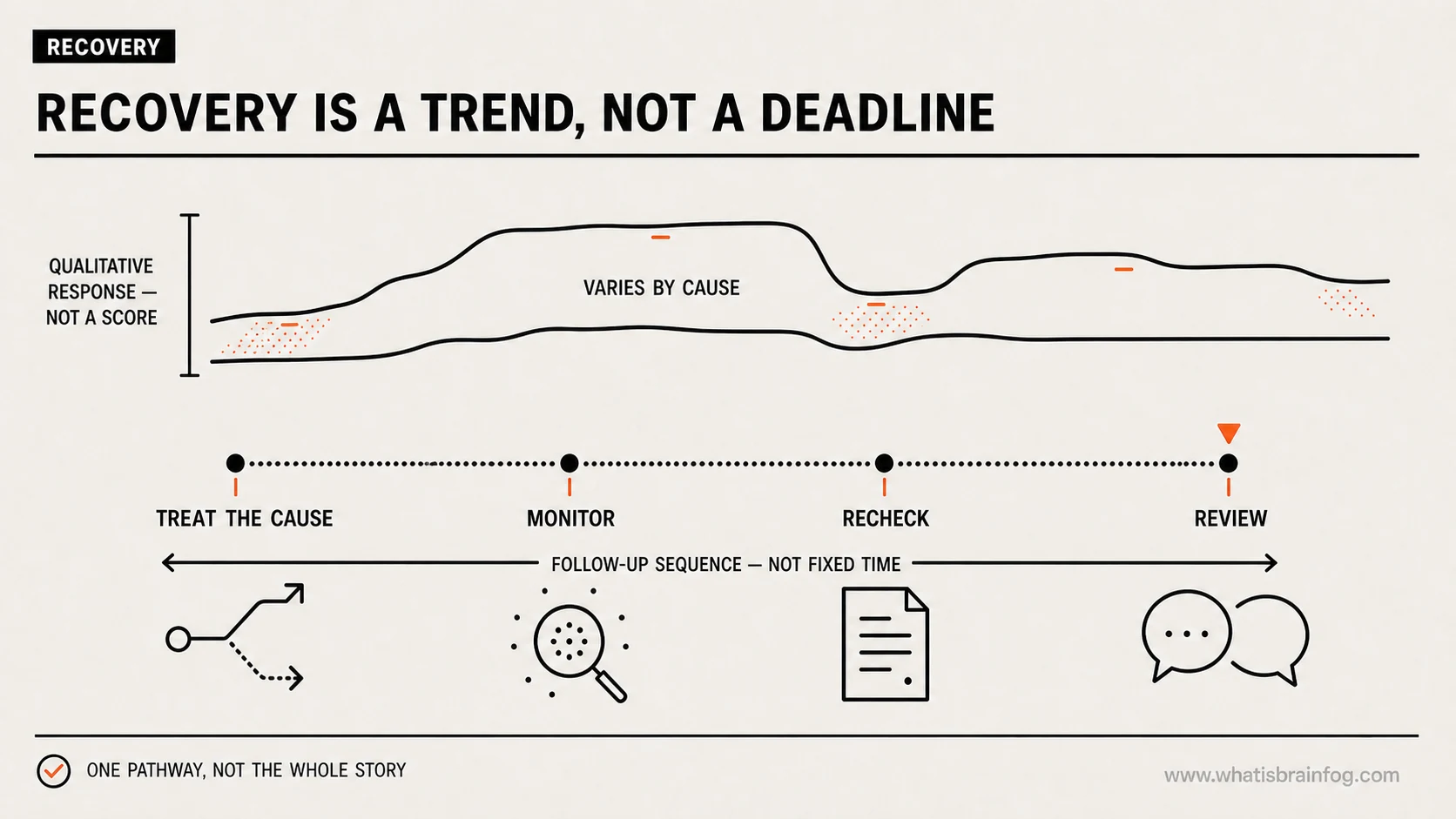
There's no single recovery time, because your blood, physical stamina and thinking may change at different speeds.
26 women
In 26 women with low iron but no anemia, IV iron improved their iron levels, tiredness and running efficiency after four weeks. Mood and quality of life didn't change. The trial was small. Dugan et al., 2025
67 donors
In 67 iron-deficient blood donors, IV iron corrected systemic iron deficiency over about four months. Overall scores on thinking tests were no different from a dummy treatment (placebo). But MRI scans did suggest changes in brain iron, myelin (the insulation around nerves) and brain activity during tasks. Hod et al., 2025
6,364 adults
A 2026 observational study of adults aged 45 and over in China linked long-lasting anemia with a bigger decline in thinking. Anemia remission was linked with improvement, but the improvement was incomplete. The study followed population averages and can't predict one person’s recovery. Cui et al., 2026
Why is my energy better but my brain fog is not?
If stairs are easier but concentration is still poor, energy has improved before thinking.
Your blood results and stamina may improve while your memory and focus don't. If so, anemia is less likely to explain the thinking problems that remain. It may still explain the earlier breathlessness or loss of stamina.
The studies above measured different things. Tiredness, running efficiency, brain scans and thinking-test scores didn't all improve together.
What can change recovery?
- The confirmed anemia or deficiency type.
- Ongoing bleeding or poor absorption.
- Side effects or difficulty continuing treatment.
- Neurological symptoms and other causes of brain fog.
Food when energy is low
Food can help recovery. When cooking is hard, simple meals can make it easier to eat enough. Choose easy, varied foods over an elaborate recovery diet.
Pregnancy, kidney disease, gut disease, allergies and restricted diets may change what's suitable. A dietitian can help when those issues make eating or absorption harder.
If brain fog persists, it's worth reviewing what changed and what didn't.
The iron result may not have changed enough
Side effects, missed doses, poor absorption, the wrong schedule or ongoing blood loss can keep your iron low. Compare the new and old results in the same units, following your clinician's plan.
Hemoglobin improved before iron stores recovered
Hemoglobin and ferritin answer different questions. One may improve before the other. Complete iron studies can show if you're still low on iron.
The iron loss may not have stopped
Iron can fall again when the cause hasn't stopped. Heavy periods, stomach or bowel bleeding, celiac disease, H. pylori, inflammatory bowel disease, surgery and repeated blood donation can keep lowering iron.
Tell your doctor about periods, blood donation, surgery and any bleeding you can see. Ask which cause they're checking for and whether it has its own treatment. NICE heavy-period guidance AGA gastrointestinal guidance
The diagnosis may be incomplete
B12 or folate deficiency, inflammation, kidney disease, thalassemia and other blood conditions need different treatment. B12-related nerve symptoms can remain even when the blood count looks better.
Anemia was only part of the problem
Other problems can carry on after your blood results improve. These include sleep apnea, thyroid disease, depression, medicines, pain, menopause and symptoms that come on when you stand.
Questions to ask at follow-up
- Did the expected blood results change?
- Did physical stamina, breathlessness, dizziness or palpitations improve?
- Did concentration, memory and mental stamina improve?
- Has anyone found and treated the cause of the deficiency?
What can make work and daily life easier?
- Sit for tasks that don't need standing.
- Break shopping, cooking and travel into shorter parts.
- Plan demanding work for the time of day when you're least breathless or tired.
- Use written instructions when memory is unreliable.
- If your body or your thinking is limiting your work, ask for short-term changes to your hours, lifting, travel or safety-sensitive tasks.
These changes help you get through the day while the treatment works.
Care by country
Where does care usually start?
United States
Primary care can review the history, examination, CBC, iron studies, B12, folate and the likely cause. Once tests confirm iron-deficiency anemia, the next question is what caused iron loss or poor absorption.
AGA guidance supports gastrointestinal and celiac investigation in defined adult cases. It doesn't send every person with low iron through the same tests. A hematologist may help with an unclear anemia type, an inherited blood condition or a result that doesn't improve. A gastroenterologist may be involved when stomach or bowel blood loss or poor absorption needs investigation. AGA guidance
Bring the complete reports with dates, units and reference ranges. A result copied into a message without its range can be hard to interpret.
If an insurer denies a test or IV treatment, ask for the written reason and the plan rule used. An internal appeal can include your diagnosis, blood results, treatments you've tried, side effects, poor absorption, and why your clinician thinks you need this treatment. Some plans allow an external review after the internal appeal. CMS appeal guidance
United Kingdom
A GP usually starts with the history and a full blood count. Iron studies, B12, folate, FIT testing, celiac testing or referral may follow when the cause is unclear. The GP may need to check for hidden blood loss instead of blaming diet.
B12 deficiency is a separate question and can occur without anemia or enlarged red cells. Some investigations remain in general practice. Haematology or gastroenterology may become involved when the anemia type, response or suspected source needs specialist review. Ask for the complete results. A one-word normal or abnormal answer isn't enough. NHS guidance NICE NG239
Australia
A GP can request a full blood count and iron studies through a pathology service. The reason for testing can change if you're pregnant, vegetarian or vegan, have internal bleeding, or have a condition that reduces absorption.
The GP may continue the investigation or refer to haematology or gastroenterology. Preparation can differ between tests, so use the instructions supplied with the referral or collection centre. Healthdirect
Bleeding, chest pain or breathing trouble
Get medical help quickly for chest pain, fainting, breathlessness at rest, a very fast heart rate with severe weakness, bleeding that won't stop, vomiting blood, blood in your stool, or black, tarry stool.
New nerve or vision symptoms
See a doctor soon if you have new or worsening numbness, weakness, balance trouble, problems walking or changes in your vision. Low B12 or another brain or nerve problem could be the cause.
Driving and safety-sensitive work
Hold off on driving and safety-critical work while fainting, severe breathlessness, confusion, vision changes, weakness or poor attention make them unsafe.
History
How anemia care developed
1681
Iron was used before anemia could be measured
Thomas Sydenham described iron as a treatment for chlorosis, an old diagnosis later linked with iron-deficiency anemia. Treatment came before a clear account of the blood change or its cause. Andrews, 2008
1832
The iron pill made treatment repeatable
Pierre Blaud introduced a ferrous-sulfate pill for chlorosis. It made iron treatment easier to repeat long before blood tests could separate iron deficiency from other anemia types. Blaud, 1846 (PMID 38209111); Guggenheim, 1995 (PMID 7616296)
1926 to 1934
Liver treated pernicious anemia
George Minot and William Murphy reported liver treatment for pernicious anemia in 1926, building on George Whipple’s work. The three received the 1934 Nobel Prize. No one had yet identified the active factor as vitamin B12. Nobel Prize
1948
Vitamin B12 was isolated
Researchers isolated the active liver factor. This explained why liver had helped pernicious anemia and opened the way to specific B12 treatment. Nobel Prize history
2001
Hepcidin changed the understanding of iron control
Park and colleagues described hepcidin, a hormone made by the liver. Later research showed how inflammation can restrict iron use and how one iron dose can affect absorption from the next. Park et al., 2001; Nemeth et al., 2004; Moretti et al., 2015
2017
Dosing studies showed why timing matters
Stoffel and colleagues studied women with low iron. Taking iron every day, or twice a day, raised a hormone called hepcidin, and the body then absorbed less of the next dose. The work changed the dosing discussion but did not create one schedule for every patient. Stoffel et al., 2017
2025 to 2026
Research separated blood recovery from cognitive recovery
New work has looked at iron deficiency before anemia, brain iron, fatigue, thinking tests and long-term anemia. Some outcomes improve while others don't. That's why WBF checks blood results, physical stamina and thinking separately.
Questions and sources
Common questions
What ferritin level causes brain fog?
No single ferritin level proves the cause of brain fog or predicts recovery. Ferritin is read with hemoglobin, transferrin saturation, inflammation, symptoms and the reason for testing. Diagnostic cutoffs also change by clinical setting.
Should I start taking iron before I am tested?
Testing first is usually safer unless a clinician has already told you to start. Iron won't treat B12 deficiency, folate deficiency, thalassemia, many inflammation-related anemias or every cause of fatigue. Too much iron can be harmful.
Can B12 deficiency cause brain fog without anemia?
Yes. NICE lists difficulty concentrating and short-term memory loss among possible B12 symptoms. It says doctors should consider B12 deficiency even without anemia or large red cells.
Why is ferritin normal when the other iron results are low?
Inflammation, infection and liver disease can raise ferritin. Transferrin saturation, TIBC or transferrin, CRP, the CBC and the medical history can make an unclear result easier to understand.
Does an iron infusion clear brain fog faster?
An infusion can replace iron faster than oral iron. Correcting your blood faster doesn't guarantee your thinking recovers faster.
What if my ferritin rises but my memory does not improve?
Check whether hemoglobin, transferrin saturation, physical stamina and thinking changed. Then review ongoing blood loss, poor absorption, B12 or folate deficiency, inflammation, kidney disease, sleep, thyroid, medicines, mood and other causes of brain fog.
Can heavy periods keep causing brain fog after treatment?
Yes, if blood and iron loss continues. Replacing iron may improve the blood results for a time, but the heavy bleeding needs its own assessment and treatment.
How long does it take for iron levels to drop after stopping supplements?
About 10 to 18 weeks in one small study. Eleven elite female volleyball players took ferrous sulfate for 11 weeks. Ten weeks after stopping, their iron results matched 11 teammates who took none. By 18 weeks, their ferritin had fallen 52% on average (Mielgo-Ayuso, 2018). Too much iron is different. In 83 elite male cyclists with ferritin above 300 µg/L, iron stores stayed high after supplements stopped (Deugnier, 2002).
What are the symptoms of iron deficiency anemia during pregnancy?
Fatigue, poor concentration, restless legs and eating ice are symptoms of low iron, often dismissed as normal pregnancy (Benson, 2022). Poor concentration can start before anemia appears. Australian specialists count ferritin under 30 µg/L as iron deficiency in pregnancy and advise tests at the first visit and 24 to 28 weeks (Clarke, 2025). By the third trimester, up to 84% of women in high-income countries are iron deficient (Auerbach, 2025).
Can anemia cause low blood pressure?
Lower hemoglobin is linked with only slightly lower blood pressure. In 101,377 healthy blood donors, the top blood pressure number was 1.3 mm Hg lower in men and 1.8 mm Hg lower in women for each 1 mmol/L less hemoglobin (Atsma, 2012). NHLBI lists sudden blood loss as a cause of low blood pressure, which it defines as under 90/60 mm Hg. Low blood pressure can cause dizziness and confusion.
Is anemia brain fog permanent?
Many people improve when the right deficiency and its cause are treated. The time and degree of recovery vary. Long-standing B12-related nerve injury, persistent anemia and an overlapping cause can leave symptoms after the first blood result improves.
Clinical guidance
- 1
- 2
- 3
- 4
- 5
- 6
- 7
- 8
- 9
Research used for the WBF view
- 1
- 2
- 3
- 4
- 5
- 6
- 7
- 8
- 9
- 10
- 11
- 12
WhatIsBrainFog Editorial Team
Published: 2025-01-01
Last updated: 2026-08-25
Medical review: 2026-07-29
Reviewed by: Dr. Alexandru-Theodor Amarfei, M.D.
Open a shorter summary to save, copy or show during an appointment.
Doctor handoutSupporter: I'm helping someone
Supporter
Help without taking over
Make bad days less work, keep results and symptom changes together, and back up what the person says.
One thing
Help them cope and communicate, without deciding their diagnosis or treatment.
Get urgent care when warning signs appear
Check blood, stamina and thinking separately
Check the blood results, physical stamina and thinking. They may improve at different times. If your hemoglobin and ferritin rise but your focus and memory don't, the treatment fixed the blood problem. That problem just wasn't the whole cause of your brain fog.
Accept that they can't do as much, then ask what would make the day easier.
Keeping symptom changes beside the blood results helps the doctor compare how each responds to treatment. Practical help means less for the person to manage on a bad day.
Useful help can include cooking, shopping, rides, childcare, reminders when asked, remembering what the doctor said, or a quieter plan after a tiring day. Shorter outings and sitting breaks can help when breathlessness or weakness limits activity.
Offer manageable meals without treating food as the whole answer. Help track the actual ferritin, hemoglobin, B12, folate and iron-study results with their dates. Keep symptom changes beside medicines, supplements, bleeding and digestive problems.
Nausea, constipation and poor absorption are real treatment barriers. Ask what would help instead of treating them as carelessness.
Leave supplement, dose and infusion choices to the person and their clinician. Help them keep the reports, questions and follow-up dates together.
Which remarks get anemia wrong?
“You just need spinach”
Food may add iron, but it can't stop bleeding, fix every absorption problem or treat every anemia type.
“You don't look anemic”
Anemia doesn't always look pale. Reduced stamina, breathlessness and cognitive trouble can still be severe.
“Your tests were normal”
Hemoglobin, ferritin, transferrin saturation, B12 and folate answer different questions. Ask which tests were done and what the numbers were.
“Just push through”
More effort doesn't replace oxygen-carrying capacity, iron or vitamin B12. It can leave the person more breathless and less able to think.
What help is useful at the appointment?
Bring the complete reports with dates and units. Be ready to describe changes you've seen, such as needing to stop on stairs, losing track of conversations, making errors at work or no longer managing a full day.
Support the person’s account. Let them answer, and step in when they ask.
Supporters need care too. Recovery may take months, treatment side effects can make daily life harder, and help with meals, travel and appointments adds up.
Bleeding, chest pain or breathing trouble
Get medical help quickly for chest pain, fainting, breathlessness at rest, a very fast heart rate with severe weakness, bleeding that won't stop, vomiting blood, blood in your stool, or black, tarry stool.
New nerve or vision symptoms
See a doctor soon if you have new or worsening numbness, weakness, balance trouble, problems walking or changes in your vision. Low B12 or another brain or nerve problem could be the cause.
Driving and safety-sensitive work
Hold off on driving and safety-critical work while fainting, severe breathlessness, confusion, vision changes, weakness or poor attention make them unsafe.
1681
Iron was used before anemia could be measured
Thomas Sydenham described iron as a treatment for chlorosis, an old diagnosis later linked with iron-deficiency anemia. Treatment came before a clear account of the blood change or its cause. Andrews, 2008
1832
The iron pill made treatment repeatable
Pierre Blaud introduced a ferrous-sulfate pill for chlorosis. It made iron treatment easier to repeat long before blood tests could separate iron deficiency from other anemia types. Blaud, 1846 (PMID 38209111); Guggenheim, 1995 (PMID 7616296)
1926 to 1934
Liver treated pernicious anemia
George Minot and William Murphy reported liver treatment for pernicious anemia in 1926, building on George Whipple’s work. The three received the 1934 Nobel Prize. No one had yet identified the active factor as vitamin B12. Nobel Prize
1948
Vitamin B12 was isolated
Researchers isolated the active liver factor. This explained why liver had helped pernicious anemia and opened the way to specific B12 treatment. Nobel Prize history
2001
Hepcidin changed the understanding of iron control
Park and colleagues described hepcidin, a hormone made by the liver. Later research showed how inflammation can restrict iron use and how one iron dose can affect absorption from the next. Park et al., 2001; Nemeth et al., 2004; Moretti et al., 2015
2017
Dosing studies showed why timing matters
Stoffel and colleagues studied women with low iron. Taking iron every day, or twice a day, raised a hormone called hepcidin, and the body then absorbed less of the next dose. The work changed the dosing discussion but did not create one schedule for every patient. Stoffel et al., 2017
2025 to 2026
Research separated blood recovery from cognitive recovery
New work has looked at iron deficiency before anemia, brain iron, fatigue, thinking tests and long-term anemia. Some outcomes improve while others don't. That's why WBF checks blood results, physical stamina and thinking separately.
Questions and sources
Common questions
What ferritin level causes brain fog?
No single ferritin level proves the cause of brain fog or predicts recovery. Ferritin is read with hemoglobin, transferrin saturation, inflammation, symptoms and the reason for testing. Diagnostic cutoffs also change by clinical setting.
Should I start taking iron before I am tested?
Testing first is usually safer unless a clinician has already told you to start. Iron won't treat B12 deficiency, folate deficiency, thalassemia, many inflammation-related anemias or every cause of fatigue. Too much iron can be harmful.
Can B12 deficiency cause brain fog without anemia?
Yes. NICE lists difficulty concentrating and short-term memory loss among possible B12 symptoms. It says doctors should consider B12 deficiency even without anemia or large red cells.
Why is ferritin normal when the other iron results are low?
Inflammation, infection and liver disease can raise ferritin. Transferrin saturation, TIBC or transferrin, CRP, the CBC and the medical history can make an unclear result easier to understand.
Does an iron infusion clear brain fog faster?
An infusion can replace iron faster than oral iron. Correcting your blood faster doesn't guarantee your thinking recovers faster.
What if my ferritin rises but my memory does not improve?
Check whether hemoglobin, transferrin saturation, physical stamina and thinking changed. Then review ongoing blood loss, poor absorption, B12 or folate deficiency, inflammation, kidney disease, sleep, thyroid, medicines, mood and other causes of brain fog.
Can heavy periods keep causing brain fog after treatment?
Yes, if blood and iron loss continues. Replacing iron may improve the blood results for a time, but the heavy bleeding needs its own assessment and treatment.
How long does it take for iron levels to drop after stopping supplements?
About 10 to 18 weeks in one small study. Eleven elite female volleyball players took ferrous sulfate for 11 weeks. Ten weeks after stopping, their iron results matched 11 teammates who took none. By 18 weeks, their ferritin had fallen 52% on average (Mielgo-Ayuso, 2018). Too much iron is different. In 83 elite male cyclists with ferritin above 300 µg/L, iron stores stayed high after supplements stopped (Deugnier, 2002).
What are the symptoms of iron deficiency anemia during pregnancy?
Fatigue, poor concentration, restless legs and eating ice are symptoms of low iron, often dismissed as normal pregnancy (Benson, 2022). Poor concentration can start before anemia appears. Australian specialists count ferritin under 30 µg/L as iron deficiency in pregnancy and advise tests at the first visit and 24 to 28 weeks (Clarke, 2025). By the third trimester, up to 84% of women in high-income countries are iron deficient (Auerbach, 2025).
Can anemia cause low blood pressure?
Lower hemoglobin is linked with only slightly lower blood pressure. In 101,377 healthy blood donors, the top blood pressure number was 1.3 mm Hg lower in men and 1.8 mm Hg lower in women for each 1 mmol/L less hemoglobin (Atsma, 2012). NHLBI lists sudden blood loss as a cause of low blood pressure, which it defines as under 90/60 mm Hg. Low blood pressure can cause dizziness and confusion.
Is anemia brain fog permanent?
Many people improve when the right deficiency and its cause are treated. The time and degree of recovery vary. Long-standing B12-related nerve injury, persistent anemia and an overlapping cause can leave symptoms after the first blood result improves.
Clinical guidance
- 1
- 2
- 3
- 4
- 5
- 6
- 7
- 8
- 9
Research used for the WBF view
- 1
- 2
- 3
- 4
- 5
- 6
- 7
- 8
- 9
- 10
- 11
- 12
WhatIsBrainFog Editorial Team
Published: 2025-01-01
Last updated: 2026-08-25
Medical review: 2026-07-29
Reviewed by: Dr. Alexandru-Theodor Amarfei, M.D.
Open a shorter summary to save, copy or show during an appointment.
Doctor handoutRelated context
Related causes
Nutrient Deficiency
Check whether low iron, vitamin B12, folate, or inadequate intake could be contributing.
Gut
Compare gut causes when brain fog happens alongside poor absorption, stool changes or gut inflammation.
Celiac
Compare celiac when low iron occurs with gut symptoms or absorption trouble.
Thyroid
Compare thyroid causes when brain fog happens alongside feeling cold, weight changes or heart-rhythm changes.
More related causes
Menopause
Compare menopause when brain fog starts with bleeding, cycle changes, hot flushes or disrupted sleep.
Postpartum
Compare postpartum causes when brain fog follows birth, blood loss, feeding demands or thyroid changes.
Fibromyalgia
Use when pain, poor recovery, and low capacity are hard to separate.
Review status
Published: 2025-01-01
Reviewed: 2026-07-29
By: Dr. Alexandru-Theodor Amarfei, M.D.
Educational guidance only. It doesn't diagnose anemia or prescribe treatment.