Brain fog exercises
Cognitive rehabilitation and exercises for brain fog
You finish a memory game and get a decent score. Ten minutes later you are in the kitchen and cannot remember what you meant to do next. The game did not train the moment that is costing you. Start with the part of daily life that fails, then check whether the exercise helps without taking the rest of the day from you.
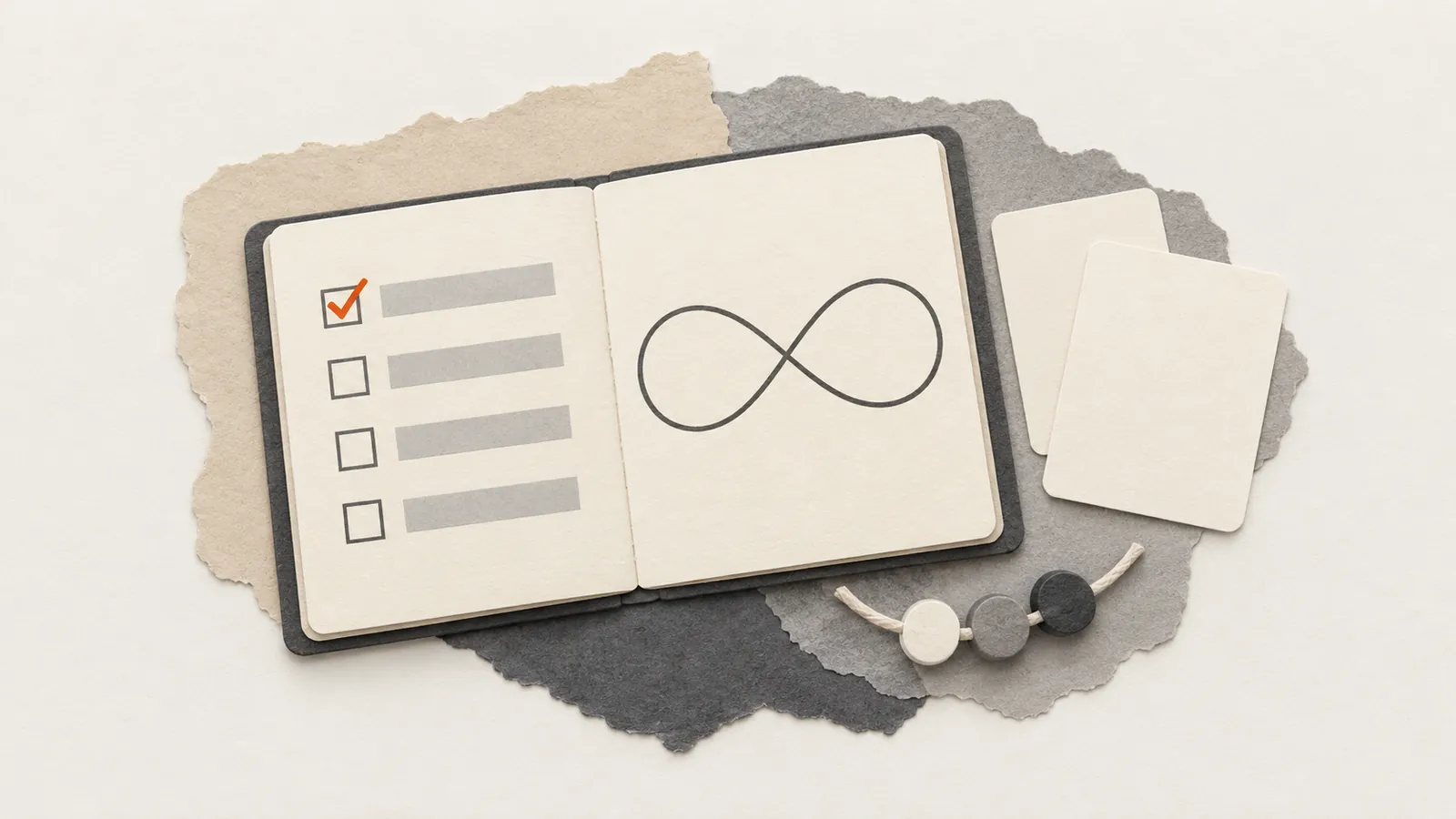
Short answer
If you lose steps in daily tasks, start with one real task and one visible cue. If reading or movement brings on dizziness, blur, or double vision, get the matching eye or balance assessment. If effort leaves you worse later, stop adding drills and look at pacing or the cause first.
The answer in plain words
Do brain exercises help brain fog?
Sometimes. A puzzle score is not the result that matters. Did cooking, reading, work, or conversation get easier? Someone who loses a recipe step needs a different kind of help from someone who gets dizzy while turning in a shop aisle. If an exercise leaves you heavier, nauseous, wired, or muddled later, stop. The exercise, the amount, or what's causing your brain fog may need another look.
Pick one place to start
Choose the exercise that matches the problem
Start with the first section if you lose your place in everyday tasks. The next shows a slow seated movement for a common coordination problem. The last two cover dizziness when you move your head, and eyes that strain to work together for close reading. Before you try the eye or balance exercises, have a clinician check you and show you what suits you.
Daily tasks keep breaking
When you lose the next step in an ordinary task
Use this section when cooking, work, study, paperwork, planning, or conversation keeps failing at the same point.
See the four steps
Use one real task, not a made-up test
The pictures show one kitchen task because the method starts in ordinary life. You can use the same four steps for getting dressed, putting shopping away, making food, or another small task.
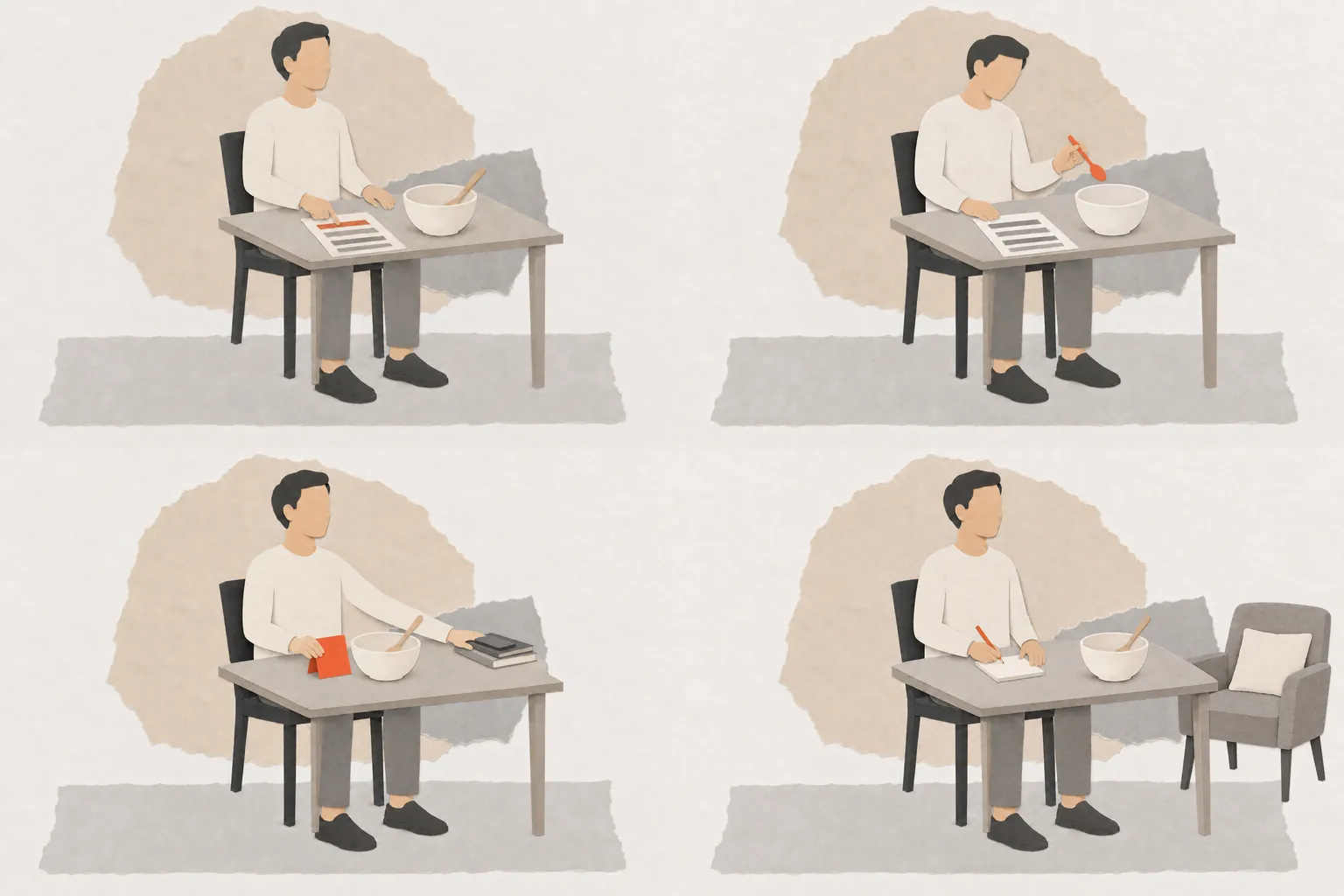
Step 1 of 4
Step 1: Choose one real task
Pick one small task that keeps breaking, such as one recipe step, packing a bag, or putting the washing away.
Step 2 of 4
Step 2: Name where it breaks
Notice the exact failure: losing the next step, forgetting what you read, switching tasks, or running out of stamina.
Step 3 of 4
Step 3: Add one matching support
Use one visible cue, checklist item, timer, closed tab, or planned pause that matches the failure.
Step 4 of 4
Step 4: Check the real result
Compare the same small task later. Count fewer restarts, easier completion, and any delayed symptom cost.
Make the task smaller or stop if: Use one small, familiar task. Stop if symptoms rise or the same effort costs you later.
All 4 steps shown
The whole instruction
Pick one real task that keeps breaking. Make it smaller, remove one avoidable demand, and add one visible support. This is the basic idea behind goal-based cognitive rehabilitation: practice the task you need, then check whether that task becomes easier.
What to remember
- Name what fails: the next step disappears, what you read won't stay, switching tasks makes you lose your place, or your thinking runs out.
- Use one matching support: a written next step, a timer, one checklist item, fewer open tabs, or a planned pause.
- Look at the real task afterward. Mental effort by itself is not proof that the exercise helped.
After you stop: Try the same small task again under similar conditions. Look for less confusion, fewer restarts, or more of the task completed without a worse day afterward.
What the research shows, and what it does not: A 2026 randomized trial supports individualized, goal-oriented cognitive rehabilitation for functional goals in adults with Long COVID cognitive impairment. It doesn't prove one home exercise treats every cause of brain fog.
Vanova et al., JAMA Network Open, 2026: individualized cognitive rehabilitation improved personally meaningful goal attainment at 3 and 6 months. Open the PubMed record
Slow coordination practice
When a familiar movement feels awkward
Use this only for a familiar, stable coordination difference or movement practice already discussed with a therapist. A new or sudden one-sided change needs medical assessment.
Watch the movement first
See one slow figure-eight before you try it
Start seated. The pictures show one comfortable movement and then a pause. They do not set a timer, repetition target, or treatment side.
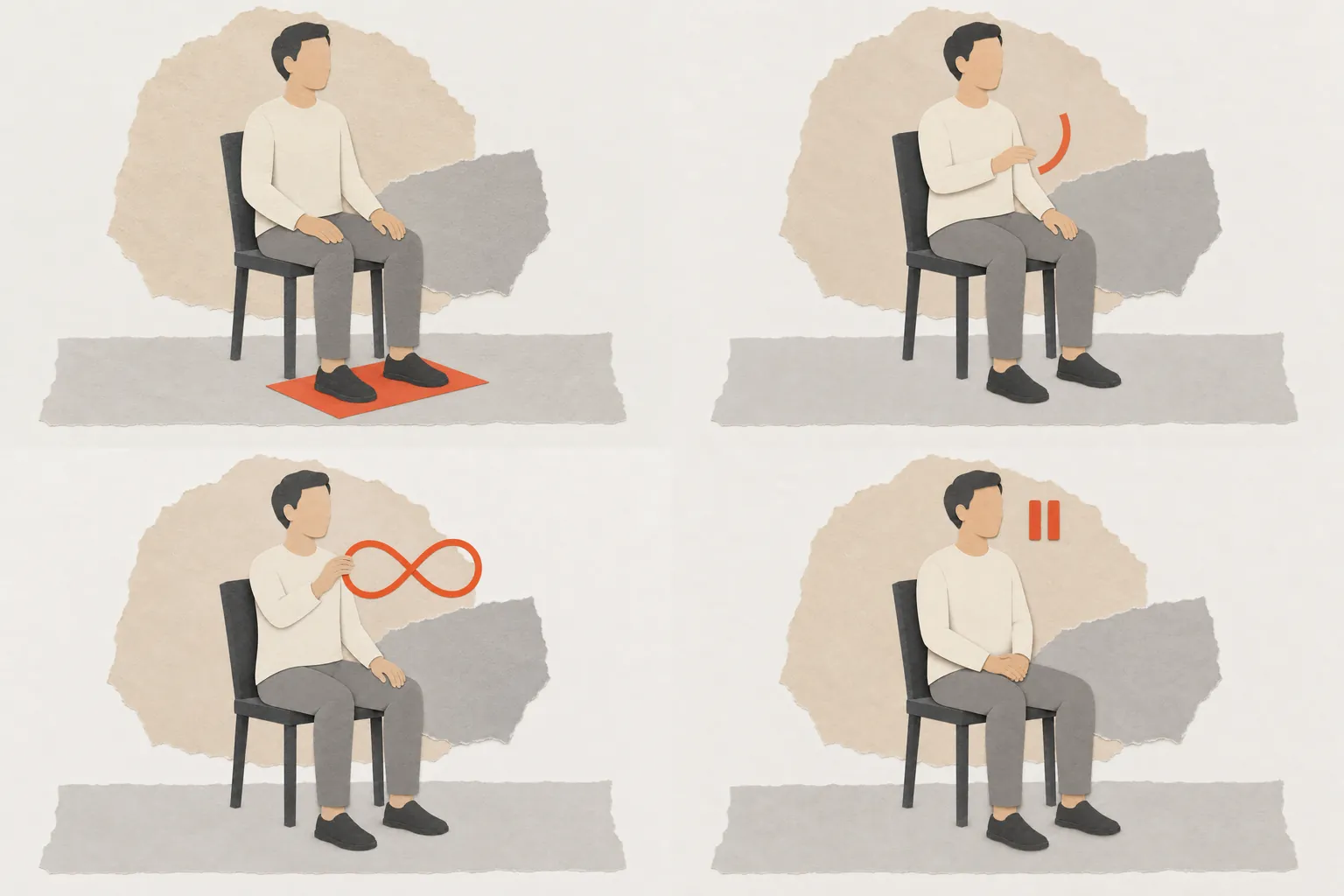
Step 1 of 4
Step 1: Get safely settled
Sit in a stable chair with your feet supported and clear space around you. Keep a table or chair back within reach if you need it.
Step 2 of 4
Step 2: Choose a comfortable range
Lift a relaxed hand or arm only as far as feels easy. A smaller movement is still a valid comparison.
Step 3 of 4
Step 3: Trace one slow shape
Draw one horizontal infinity shape in the air, slowly enough that the movement stays comfortable and controlled.
Step 4 of 4
Step 4: Stop and check
Rest both hands. Notice dizziness, nausea, head heaviness, eye strain, agitation, or confusion before deciding whether to continue.
This movement cannot tell you: Do not use this drill to choose a treatment side or explain a new one-sided change.
All 4 steps shown
The whole instruction
While seated, draw one slow sideways figure-eight in the air through a comfortable range. Stop after the shape and notice how you feel before deciding whether to continue. This is a coordination exercise, not a proven treatment for brain fog.
Movement options, easiest to hardest
Level 1: Shoulder
Whole arm draws the infinity symbol. Biggest, easiest movement.Level 2: Elbow
Forearm only, elbow locked at 90 degrees. Smaller, more precise.Level 3: Wrist
Hand and wrist only, arm still. Fine motor control.Level 4: Foot
Lying down, one foot traces the infinity shape in the air.Level 5: Same side
Hand and same-side foot together. Both draw the shape.Level 6: Opposite side
Hand and opposite foot. Hardest version, cross-body coordination.Use both sides safely
Keep the movement comfortable on both sides. If one side brings symptoms on, stop.
After you stop: After you stop, try the same comfortable movement once more only if you still feel settled. If symptoms worsen, stop rather than making the movement harder.
What the research shows, and what it does not: This is practice-based WBF rehab logic, not a guideline-standard cure. It uses research on movement learning and how practice changes the brain, but no study proves this exact drill works alone.
Pascual-Leone et al., Journal of Neurophysiology, 1995: targeted training can reshape human brain function. Open the PubMed record
Clinician-led eye and balance work
When head movement makes the room or words move
This section explains care for dizziness, motion sensitivity, visual overwhelm, balance trouble, or brain fog that appears with head movement.
Clinician-guided exercise
See what eye-head work looks like before an appointment
These pictures explain the parts of the exercise. They are not a home prescription. The target position, movement, speed, and stopping point come from a vestibular clinician.
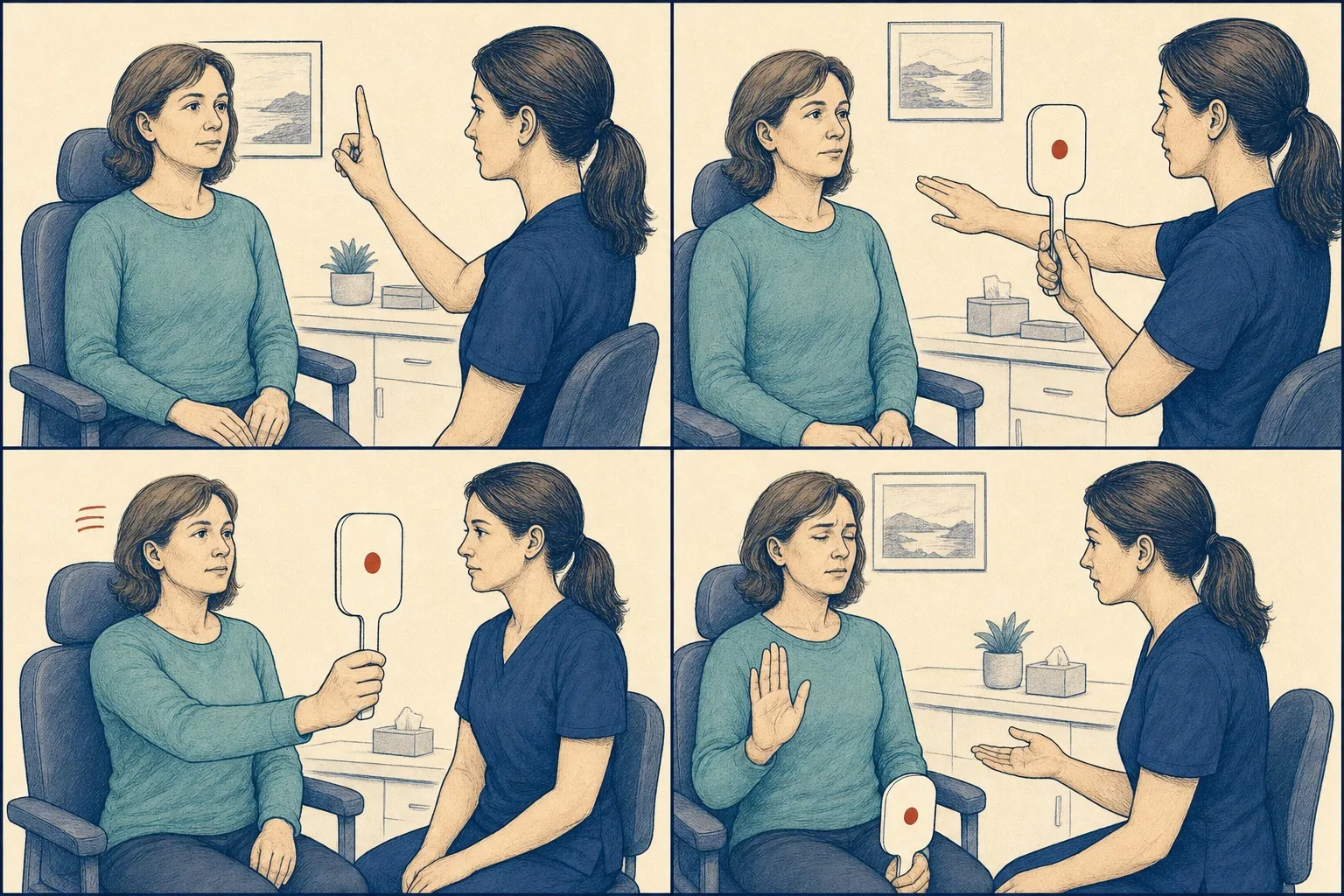
Step 1 of 4
Step 1: Start with an assessment
Only use this after a vestibular clinician has assessed you and prescribed the exercise.
Step 2 of 4
Step 2: Use the target you were shown
Place the target at the position and distance your clinician set. Keep your body supported and the target still.
Step 3 of 4
Step 3: Follow the prescribed movement
Keep your eyes on the target while moving only in the direction and at the speed your clinician prescribed.
Step 4 of 4
Step 4: Stop if clarity or symptoms change
If the target won't stay clear or symptoms rise sharply, stop. New, severe, or unexplained dizziness needs an assessment.
Follow the plan you were given: Use the target position, direction, speed, and stopping point they gave you.
All 4 steps shown
The whole instruction
This exercise asks you to keep a target clear while you turn your head. Clinicians sometimes call it a VOR exercise. A balance clinician should choose the direction, speed, duration, and stopping point after assessing you. If a clinician has already given you an exercise, follow that plan, whatever a website's schedule says.
What to remember
- Keep your eyes on the target your clinician chose.
- Move only in the direction and at the speed they showed you.
- Stop if the target won't stay clear or symptoms rise sharply.
- New, severe, or unexplained dizziness needs assessment, not a harder exercise.
Your eyes need to keep a target clear while your head and body move. Does turning in a shop, scrolling, reading, riding in a car, or looking around while walking bring on dizziness, blur, nausea, or brain fog? An eye and balance assessment may help explain why.
What the research shows, and what it does not: A guideline supports balance rehabilitation for a diagnosed inner-ear problem called peripheral vestibular hypofunction. The guideline does not automatically apply when dizziness is unexplained, comes from the brain, or appears without a matching balance finding.
Hall et al., Journal of Neurologic Physical Therapy, 2022: updated clinical practice guideline for peripheral vestibular hypofunction. Open the PubMed record
Clinician-led near-work care
When close reading brings eye strain or double vision
This section explains care when reading feels unusually hard, words move, close work causes headache or nausea, or an assessment finds your eyes don't come together comfortably up close.
Clinician-guided exercise
See how a Brock string is set up
The pictures show why a clinician must teach the string, beads, distance, and visual target. They do not tell you to set one up without an eye-care assessment.
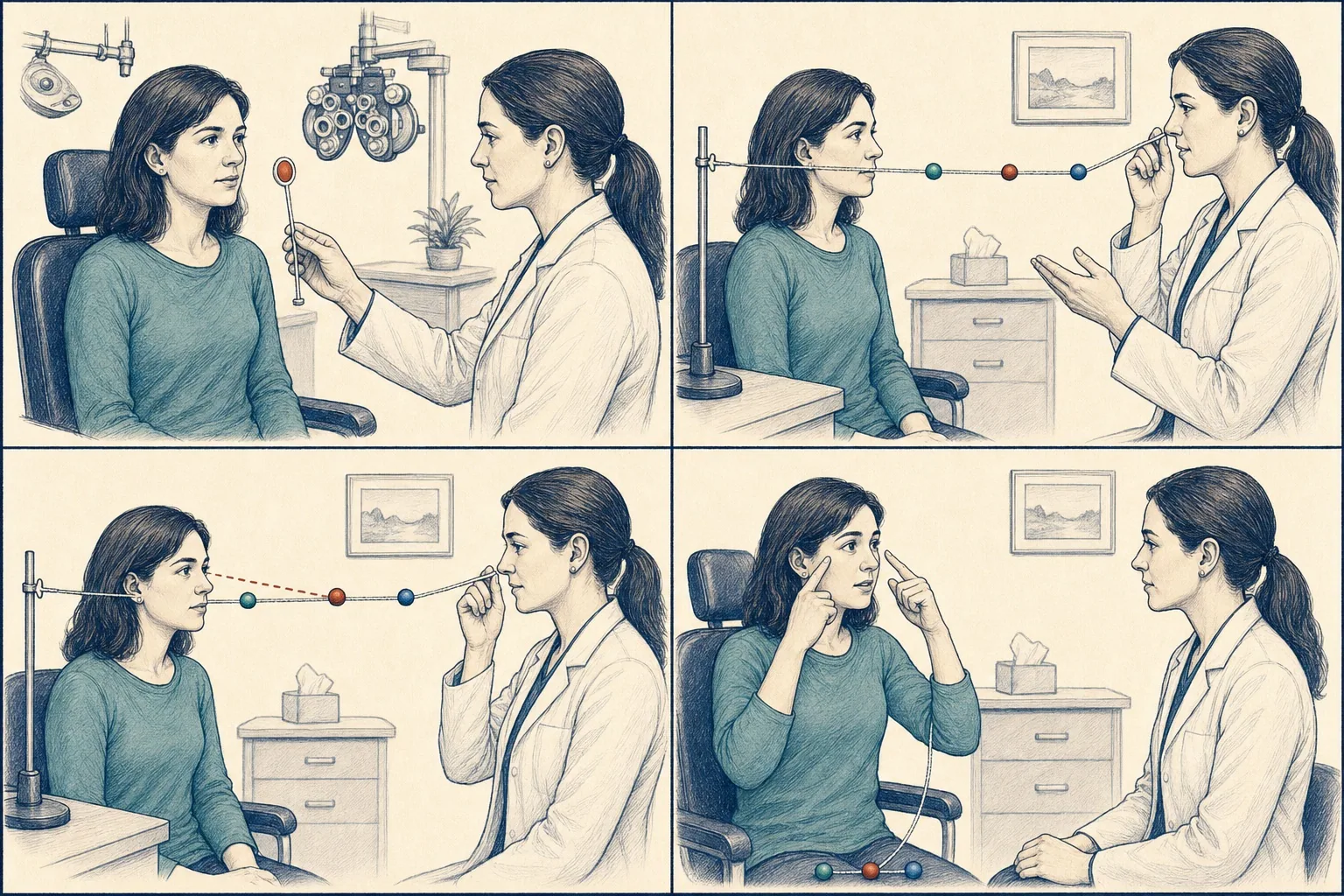
Step 1 of 4
Step 1: Confirm the problem first
Only use this after a clinician has measured a convergence problem and shown you the setup.
Step 2 of 4
Step 2: Copy the demonstrated setup
Set the string and beads exactly as your clinician showed you. Keep the distance and bead position they chose.
Step 3 of 4
Step 3: Use the taught target
Look at the bead your clinician selected and go only by what they said you should see.
Step 4 of 4
Step 4: Stop for a bad response
Stop if symptoms climb quickly or a new visual change continues after you stop. Tell the clinician what happened.
Use only the setup you were taught: Use their target and stopping point, and look for what they said you'd see.
All 4 steps shown
The whole instruction
Both eyes normally turn toward the same point when you look at something nearby. Clinicians call this convergence. You can use a Brock string after a clinician confirms a problem with this movement and shows you the setup. If symptoms rise quickly, stop.
What to remember
- Use the distance, bead, and visual target your clinician selected.
- This trains your eyes, not memory or concentration.
- Tell the clinician if double vision, eye pain, or strong dizziness appears.
If the eyes are fighting to hold a near target, reading can feel like memory failure. The problem may be visual effort before it is a thinking problem.
What the research shows, and what it does not: A 2025 trial supports Brock string therapy after concussion when testing found a problem bringing the eyes together for close work. That doesn't prove it treats every kind of brain fog.
Trbovich et al., Journal of Neurotrauma, 2025: randomized trial of Brock string vision therapy after concussion. Open the PubMed record
Why the match matters
Brain exercise can mean seven different things
A puzzle, physical movement, help with an ordinary task, eye care, balance rehabilitation, coordination practice, and no added exercise yet are not the same plan. Here is what each one is for and when it may be a poor fit.
You want a light mental activity
Puzzles can be enjoyable. Check whether daily life changes too.
Crosswords, memory apps, cards, and word games can give you something contained to do. A better score still may not help you follow a recipe, remember a conversation, drive, shop, or get through work.
Good for: A tolerable activity you enjoy on a steadier day.
Skip it when: Screens or mental effort leave you worse. The game may be another demand rather than help.
Daily tasks keep breaking
Practise the moment where you lose the thread.
Cognitive rehabilitation can start with one real problem: the recipe step you lose, the washing you forget in the machine, the instruction that disappears, or the conversation you can't hold onto. A written next step or a planned pause can carry part of the work.
Useful when: Cooking, work, study, paperwork, planning, conversation, or returning to an unfinished task.
Measure the right result: The useful change may show up in the task before it shows up on a memory or attention test.
Reading brings on symptoms
The page may be making your eyes work too hard.
After concussion or when the eyes do not work together comfortably, close reading can bring eye ache, headache, nausea, moving words, double vision, or dizziness. That can feel like a memory problem because so much effort is going into seeing the page.
Ask about: A discussion with an eye-care or concussion clinician when close work repeatedly brings symptoms on.
Get assessed when: New double vision, eye pain, or strong dizziness appears. Hold off on harder home exercises.
Movement causes dizziness or brain fog
Turning your head or crossing busy shops may point to the problem.
Balance rehabilitation can train the link between your eyes, head movement, and balance. It's meant for an identified balance problem, not as a general concentration trick.
Ask about: Assessment when head movement, scrolling, car travel, busy scenes, or walking brings dizziness, blur, nausea, imbalance, or fog.
Why guidance matters: These exercises can bring symptoms on. A clinician should choose the movement and stopping point.
A familiar movement feels awkward
A slow movement can show you what “clumsy” means today.
A slow figure-eight is a WBF practice-based coordination exercise. It can help you describe whether the movement feels smooth, shaky, rushed, or harder on one side. It can't explain new one-sided clumsiness or why you have brain fog.
Only use it for: A familiar, stable coordination difference or movement practice already discussed with a therapist.
Stop for: Head pressure, nausea, agitation, confusion, or worsening later in the day.
You want to try walking or another physical activity
Physical exercise has stronger evidence than one special brain drill.
A 2025 umbrella review found improvements in general thinking, memory, and planning across many populations. That evidence does not give one safe amount for every cause of brain fog.
Good for: Use the movement guide when you are looking for walking, cycling, strength work, or another form of physical activity.
Use another starting point when: If a walk or workout makes you worse later, use the delayed-worsening choice instead.
Effort costs you later
If a small task takes the rest of the day, do not add another drill.
Sleep disruption, migraine, delayed post-exertional worsening, medication effects, blood sugar swings, low iron or B12, and autonomic problems can make even a short exercise feel punishing. The first job may be finding the cause or protecting recovery time.
Start here instead: Starting with pacing, recovery, or medical review when mental effort, movement, or screens leave you worse.
Do not tell yourself: Delayed worsening is not proof that you should push harder next time.
Five things to notice
Notice what happens without pushing until you fail
Use ordinary life where you can. You're looking for words that describe the problem. Where do you lose your place? What does reading do to your eyes? Do movement and brain fog start together? Has a familiar movement changed? What does the effort cost later?
You lose your place in an ordinary task

Where does the task stop making sense?
Notice this: Choose one small task, such as packing a bag, putting away the shopping, or following one recipe step. Notice where you lose the thread, whether you restart, and whether you finish.
If the same moment keeps breaking: A repeatable task failure gives an occupational therapist, speech-language pathologist, or cognitive rehabilitation clinician something specific to assess. The next step may be a checklist, reminder, written return point, or another support that matches the failure.
One bad attempt means very little: Poor sleep, pain, stress, medication, hunger, or a bad symptom day can cause one. Try again and compare.
Read the source: Vanova et al., 2026Close reading brings on symptoms
What changes when you look at something nearby?
Notice this: Use ordinary reading for a short, comfortable time. Notice eye ache, headache, nausea, double vision, moving words, or the need to close one eye. Stop if symptoms rise.
If reading repeatedly brings this on: An optometrist, ophthalmologist, concussion clinician, or balance clinician can check whether an eye or movement problem matches what you feel during close work.
Do not diagnose your eyes at home: Do not measure your own convergence and turn the number into a diagnosis. Healthy people and different age groups can vary.
Read the source: Mucha et al., 2014Turning or busy places bring on symptoms
Does thinking worsen with dizziness, blur or nausea?
Notice this: Notice what happens in ordinary life when you turn in a shop aisle, scroll, ride in a car, or walk while looking around. Do not create extra symptoms just to test this.
If movement and fog arrive together: A balance or concussion assessment can check whether an eye-head or balance problem matches this. The symptoms alone cannot name the problem.
Do not make yourself severely dizzy: Do not provoke severe dizziness at home. New neurological symptoms, fainting, severe headache, or inability to walk safely need medical assessment.
Read the source: Hall et al., 2022One familiar movement feels different
Is the difference large, repeatable, and already familiar?
Notice this: While seated, compare a comfortable finger-to-thumb tap or one slow figure-eight on each side. Notice rhythm, range, and control. Stop if the movement causes symptoms.
If one side is repeatedly different: A repeatable difference is worth describing to a clinician. It still does not tell you where brain fog comes from or which side to train.
A slower side is not a brain map: Do not convert the slower side into a left-brain, right-brain, or cerebellar score. If the difference is new or sudden, or you have weakness, numbness, speech change, or severe headache, stop testing and seek urgent assessment.
Read the source: Shirani et al., 2017You feel worse hours later
What did the effort cost later today or the next day?
Notice this: Does brain fog, pain, flu-like symptoms, dizziness, sleep, or daily function get worse after a small mental or physical task? Check later that day and 12 to 48 hours later.
If the cost arrives after the task: Delayed, disproportionate worsening changes the plan. Pacing and medical review may come before progressive brain training.
This cannot name the illness: Delayed worsening can happen in ME/CFS and Long COVID but can't diagnose either condition by itself.
Read the source: NICE NG206Important limits
What these checks cannot tell you
A home observation can give you better words for an appointment. It can't map brain fog to one side of your brain, name a diagnosis, or choose a treatment side.
A slower hand can have many explanations. It doesn't map your brain fog to a personality, diagnosis, or treatment side.
Balance depends on what you see, what your inner ear detects, where your feet and joints are, how you stand, and the surface under you. The direction you sway at home cannot choose an exercise or a treatment side.
In one study, which way people turned matched balance test results poorly. It cannot tell you which side to train.
Eye and head-movement screening can be one part of a full assessment. One symptom response is not enough on its own.
If you are still unsure
Use the observations to narrow it down
The exercise pictures above show what each option looks like.
Before you try anything
- Use the five observations above if you are unsure where to start.
- Try one kind of exercise at a time.
- If symptoms rise and don't settle, stop.
- If the cost arrives later, go to Brain Fuel or pacing first.
Check more than the moment
Did the task help, and what did it cost later?

Finishing the exercise is not enough. If you lose the rest of the day to symptoms, the plan needs to change.
A useful result is a real task becoming easier or more reliable without a worse day afterward.
Do not push through these
Stop when the exercise is making you worse
These symptoms are not proof that the exercise is working. The amount, timing, or exercise itself may be wrong for you.
If these appear, stop. If you try again another day, make the task smaller or switch to recovery and pacing first.
The detail is here when you want it
What the research actually found
Rehabilitation built around each person’s daily goals improved those goals in one trial. A larger remote trial did not find one program that clearly worked better than its comparison. A Brock string trial helped people who had a tested problem with bringing the eyes together for close reading after concussion. These results support specific uses, not one brain exercise for all brain fog.
Adults with Long COVID made better progress toward goals they had chosen from ordinary life.
The care involved ten individual sessions with trained staff. It was not a generic home brain-game plan.
No remote program clearly worked better than its comparison on the main everyday-thinking result.
An average group result cannot tell us whether a particular person felt some benefit.
The treatment improved a measured problem with bringing the eyes together at close range.
Participants were 11 to 30 and already had that measured problem after concussion.
The guideline strongly supports vestibular physical therapy for a diagnosed inner-ear balance problem called peripheral vestibular hypofunction.
The guideline warns that this may not apply to unexplained dizziness or balance problems that come from the brain.
Exercise improved general thinking, memory, and planning across many populations.
This supports physical movement. It does not show that one mental or coordination drill clears brain fog.
Offers a simple way to compare motor control and symptom tolerance.
No direct trial shows that this exact drill treats brain fog.
The guideline supports teaching people to notice and manage problems with planning, problem-solving, and ordinary tasks.
It's clinician-led guidance for moderate-to-severe brain injury, not a universal home plan for concussion or unexplained brain fog.
Across the included cancer studies, rehabilitation improved both people’s reports of their thinking and some test results.
Results varied by treatment and population. The oncology or survivorship team remains part of the decision.
Abnormal finger tapping helped clinicians find signs of a movement-pathway problem in the neurological population they studied.
A slower hand at home does not identify a side of the brain or explain brain fog.
Turning direction matched poorly with objective balance findings.
It should not be used to score a side of the brain or choose which side to treat.
One-to-one rehabilitation helped people reach their own daily goals.
A 2026 randomized trial of 78 adults with Long COVID found better progress toward goals each person had chosen, such as getting through an ordinary activity. This was ten individual sessions with trained staff, not a generic brain-game plan.
Find Vanova et al., JAMA Network Open, 2026 in the source listA larger remote Long COVID trial found no clear winner.
RECOVER-NEURO compared online cognitive training, structured rehabilitation, and combinations that included brain stimulation. None clearly beat its comparison on the main everyday-thinking result.
Find Knopman et al., JAMA Neurology, 2026 in the source listBrock string therapy helped a measured eye problem after concussion.
A 2025 randomized trial found improvement when the eyes could not come together normally at close range after concussion. This supports treatment once a test finds that problem. It doesn't support eye exercises for every kind of brain fog.
Find Trbovich et al., Journal of Neurotrauma, 2025 in the source listPhysical exercise and brain exercises answer different questions.
A 2025 umbrella review found benefits for general thinking, memory, and planning across many populations. That evidence belongs mainly with physical movement. It doesn't prove that one mental, eye, balance, or coordination drill clears brain fog.
Find Singh et al., British Journal of Sports Medicine, 2025 in the source listThe cause matters
The same exercise can help one person and be wrong for another
Long COVID, delayed post-exertional worsening, concussion, cancer treatment, and balance or eye problems do not call for the same plan. Find the situation closest to yours, then read the caution beside it.
Get medical help first
Do not test sudden neurological change at home
Sudden confusion, trouble speaking, one-sided weakness or numbness, a new severe headache, seizure, fainting, new double vision, inability to walk safely, or symptoms after a significant head injury need urgent medical assessment. A self-test page isn't the next step.
Book an appointment when
Brain fog is new or worsening, keeps affecting work or safety, happens alongside repeated falls or double vision, follows cancer treatment or concussion, or doesn't improve after a review of sleep, medication, mood, and basic medical causes.
Open the full medical guideWho can help
Ask for help with the thing that is failing
Instead of asking vaguely for brain rehabilitation, say what keeps happening: you lose steps in daily tasks, can't hold onto a conversation, need a fuller check of memory and attention, get dizzy when you turn your head or walk through a busy place, or struggle to read close-up.
Occupational therapist
Daily tasks, returning to work or study, conserving energy, building routines, changing the environment, and using practical supports.
“Can we choose one real task and check whether it becomes easier or more reliable?”
Speech-language pathologist
Attention, memory, planning, word finding, conversation, and thinking strategies after neurological illness or injury.
“Can you assess what goes wrong in conversation, reading, planning, or remembering instructions?”
Neuropsychologist
Detailed testing of thinking strengths and difficulties, questions about possible causes, and planning for rehabilitation or accommodations.
“Would testing change my care, work accommodations, or return-to-work decision?”
Vestibular physical therapist
Dizziness, keeping vision clear during head movement, balance, busy-scene sensitivity, and symptoms brought on by movement.
“Did the assessment find a balance problem, and what should decide the exercise amount and stopping point?”
Eye-care clinician with binocular-vision experience
Double vision, bringing the eyes together at close range, eye teaming, reading symptoms, and visual problems after concussion.
“Is there a measured eye problem that matches my symptoms, and is targeted treatment appropriate?”
One change at a time
Do not stack several exercises at once
If one exercise already makes your head heavy, adding eye, balance, movement, and thinking work can leave you worse and make it harder to tell what helped.
Try this instead
Change one thing at a time. Keep the task small enough that you can judge both the immediate effect and how you feel later that day or the next day.
Why the long routine fails
With a long stack of cognitive, eye, balance, and movement drills, you may not know which demand caused dizziness, fatigue, or worse brain fog.
How we checked this page
Where the advice comes from
Last reviewed July 12, 2026. The slow figure-eight remains practice-based because no direct trial shows that this exact drill treats brain fog. Claims about cognitive rehabilitation, Brock string therapy, and balance rehabilitation come from the trials and clinical guideline listed beside them. This page helps you understand the options. It does not diagnose, prescribe a rehabilitation program, or replace medical care.
Read the original sources
Selected references
- Vanova et al., 2026goal-oriented cognitive rehabilitation in Long COVID
- Knopman et al., 2026RECOVER-NEURO remote cognitive interventions for Long COVID
- Trbovich et al., 2025Brock string therapy after concussion
- Hall et al., 2022vestibular rehabilitation guideline
- Singh et al., 2025exercise and cognition umbrella review
- Jeffay et al., 2023INCOG executive-function rehabilitation guideline
- Wang et al., 2026cognitive rehabilitation for cancer-related cognitive impairment
- Mucha et al., 2014vestibular and ocular motor screening after concussion
- Shirani et al., 2017clinical finger-tapping findings and their limits
- Cohen et al., 2014poor diagnostic utility of Fukuda stepping direction
- NICE NG206post-exertional malaise and energy management
- Pascual-Leone et al., 2005training and human brain plasticity
Common questions
Brain exercises and brain fog
Do brain exercises help brain fog?
Sometimes. The real test is whether ordinary life gets easier. If you finish a memory game but still lose the next step while making lunch, practice the real task instead. If reading or head movement brings on dizziness, blur, or double vision, an eye or balance assessment may be more useful. If effort leaves you worse later, pacing and medical review may need to come first.
What are the best brain exercises for brain fog?
There is no single best exercise. Start with what goes wrong. Losing steps in cooking, work, or conversation points toward practicing that real task with a simple support. Eye strain, dizziness, or moving words need a different assessment. Feeling worse hours later means the amount, timing, or kind of exercise may be wrong.
Are brain games the same as cognitive rehabilitation?
No. A brain game trains the task on the screen. Cognitive rehabilitation starts with something you need to do in ordinary life, such as following a recipe, getting dressed, holding a conversation, or finding your way around a shop. It then uses strategies and practice to make that task easier or more reliable.
Why do brain exercises make my brain fog worse?
The exercise may be too hard, too long, or aimed at the wrong problem. Head heaviness, dizziness, nausea, agitation, new fatigue, or symptoms that continue later that day or the next day are reasons to stop and rethink the plan.
Are eye exercises useful for brain fog?
They can help when an assessment finds that the eyes are not working together comfortably, eye movement brings on symptoms, or a balance problem is present. They do not treat every kind of brain fog. A 2025 trial supports Brock string therapy after concussion when testing found a problem bringing the eyes together for close work.
What should I do first?
Choose one ordinary problem. If you lose steps, practice one real task with one visible cue. If reading or movement brings on symptoms, ask for the matching eye or balance assessment. If effort makes you worse later, stop adding exercises and look at pacing or the cause first.
Which brain games improve memory and concentration?
A game can make you better at that game. It may not make reading, planning, work, or conversation easier. Choose something you tolerate and enjoy, then check a real-life result. If the same ordinary task keeps failing, practice that task with a checklist, reminder, written return point, or other matching support. That's closer to the problem than chasing an app score.
How often should I do brain exercises?
There is no universal schedule for brain fog. A puzzle, daily-task practice, balance exercise, and eye exercise are different things. Follow the plan for the problem being treated, and include later-today or next-day worsening when you decide whether the amount was tolerable.
Should I do brain exercises after a concussion?
Ongoing symptoms after concussion can involve thinking, vision, balance, migraine, the neck, sleep, mood, or automatic body functions such as heart rate and blood pressure. One failed home check cannot sort those apart. Eye or balance exercises make the most sense after an assessment finds the matching problem.
Can cognitive rehabilitation help Long COVID brain fog?
The evidence is mixed. One-to-one rehabilitation built around each person's daily goals improved those goals in a 2026 trial. The larger RECOVER-NEURO trial did not find one remote program that clearly worked better than its comparison. If effort causes delayed worsening, pacing may matter more than steadily adding harder tasks.