
What happens in daily life
Does brain fog build during ordinary driving, desk work, looking down or holding your head still, especially when neck pain, headache, dizziness or eye strain rises?
When the neck may be involved
If your neck really is causing your brain fog, your thinking usually changes with head position, neck load, posture or long periods upright. That matters more than having read about instability online.
See when the neck is more or less likely to be involvedWhat happens in daily life
Does brain fog build during ordinary driving, desk work, looking down or holding your head still, especially when neck pain, headache, dizziness or eye strain rises?
What that would mean
When the same activities bring on neck symptoms and harder thinking together, get your neck examined. Your clinician still has to tell apart strain, migraine, inner-ear trouble, post-concussion effects, pain, autonomic symptoms and structural disease.
What it would not prove
A scan can show a finding without proving it caused brain fog. The finding matters when the location, exam, daily limitations and reason for the scan agree.
Brain fog cause guide
Neck pain, head pressure and harder thinking may worsen together during driving, screen work or other sustained positions.
Safety
Get urgent medical help for sudden thinking problems (over hours or days), new focal neurological symptoms (weakness, numbness, vision or speech changes), seizures, fever with confusion, or rapid decline. These may be an emergency needing immediate care.
Sudden or rapidly worsening neurological symptoms need urgent medical care.
Choose where to begin
The page keeps the same evidence and safety boundaries. The choice only changes which material you see first.
Starting point
Next: Daily life
The neck becomes more relevant when the harder thinking and the neck or head symptoms begin, build, and ease together during ordinary life. It's less convincing when the harder thinking stays the same regardless of neck pain, headache, dizziness, visual strain, position or activity.
Neither result settles the diagnosis. It tells the clinician whether to examine the neck more closely or put another explanation first.
Do not deliberately provoke symptoms or treat positional relief as a diagnostic test. New focal neurological symptoms stay urgent.
the discomfort and the harder thinking build during the same stretch of driving, desk work, or looking down.
headache, base-of-skull pain, dizziness, nausea, visual strain or balance effort may appear with it.
the neck or head symptoms ease and thinking becomes easier at around the same time, without forcing the position as a test.
new weakness, numbness, speech or vision change, severe imbalance, or bladder or bowel change needs clinical assessment. Watching longer at home isn't enough.
Trigger My thinking changes with posture, neck position or how long I have been at a desk.
Symptom Neck tension, head pressure or pain at the base of my skull gets worse as thinking gets harder.
Trigger Screens, driving or holding my head still for a long time can make thinking harder.
You set off feeling clear enough. Later, your neck aches, checking the mirrors takes more effort, and following the road no longer feels automatic. What began as discomfort is now affecting a task that needs steady attention.
The morning may be manageable. By late afternoon, your neck is tight, your head hurts, and replying to one more person feels harder than it did hours earlier. That change can come from posture, pain, visual demand, fatigue, or more than one of them.
Cooking, sewing, paperwork, or using a phone can start with neck discomfort and end with losing your place or needing to stop. The same activity can also bring on migraine, dizziness, pain, or post-concussion symptoms.
You can stop working and still feel no clearer. Then you lie in a comfortable supported position and the head or neck symptoms ease. Tell your clinician about that change. It can happen for more than one reason.
Desk strain, symptoms after whiplash, age-related degeneration, and suspected instability are different problems. Each needs a different examination, and they do not all require the same scan or treatment.
A diagnosed hypermobility disorder means joints move beyond their usual range. It can change how much strain your neck tolerates, how you move and which physical therapy is suitable. It does not by itself establish craniocervical instability or explain brain fog. The examination needs to identify what is happening in your neck, rather than match you to a diagnosis seen online.
After a crash or head injury, neck pain may sit beside concussion, migraine, vestibular symptoms, disturbed sleep, medication effects, and distress. Blaming everything on either the neck or the mind can miss that overlap.
Age-related changes are common, including in people without symptoms. A finding matters only when its location and severity agree with the examination and the problems the person is actually having.
A long screen day can increase muscle fatigue, pain, headache, visual demand, and concentration cost. Improvement after a better setup or normal movement breaks makes those demands worth addressing first.
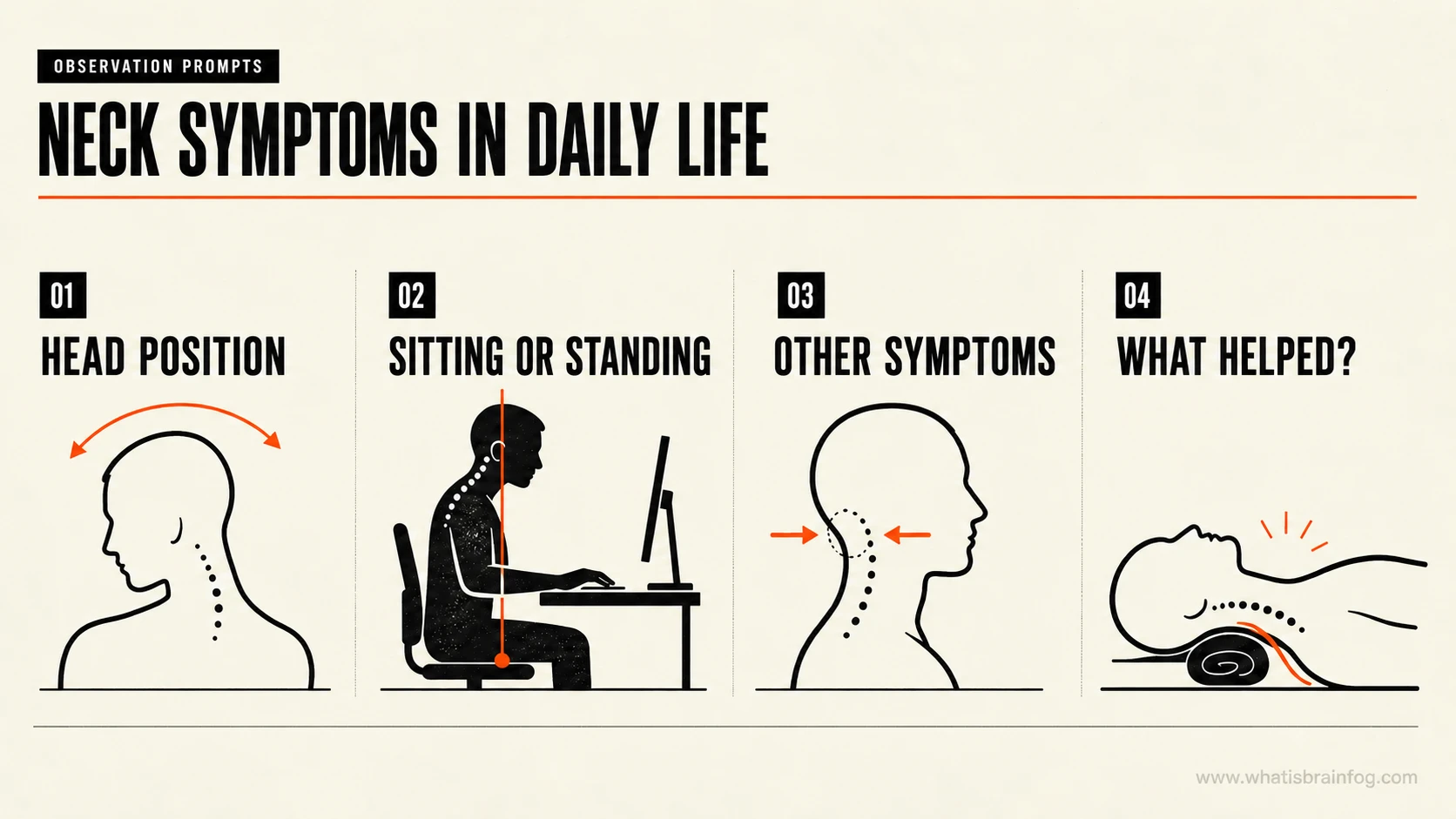
What changed first?
Notice what happens in normal life. Do neck symptoms start before your thinking gets harder, at the same time, or afterward? Answer the prompts without bringing symptoms on deliberately.
During normal activity, do neck pain, headache, dizziness and thinking repeatedly worsen together?
Does prolonged standing, sitting, driving or screen posture make brain fog build?
Do headache, pain, visual strain, dizziness, sleep, or medication effects explain the episode too?
What eased the strain on your neck? Did it help again during normal activity? Do not deliberately bring on symptoms to check.
Note how symptoms change by themselves during sitting, standing, screen work, and rest. If an activity causes new neurological symptoms, stop.
A short timeline can help a clinician compare cervical, migraine, vestibular, pain, sleep, and autonomic explanations.
Skip self-tests using Valsalva (straining with held breath), extreme head positions, or a collar.
Make one comfortable ergonomic adjustment, such as bringing the screen closer to eye level or supporting the arms, then observe whether strain changes.
This is a low-risk comfort experiment.
Until the diagnosis is clear, skip forceful stretching and quick-thrust neck manipulation.
Prepare a one-page visit note: when symptoms began, past injuries, headaches, dizziness, sleep, medications, and any earlier scan reports.
The broader list of possible causes outweighs one positional sign.
Seek urgent care for sudden weakness, numbness, speech or vision change, seizure, fever with confusion, or rapid decline.
Several conditions can cause neck pain, dizziness, headache or position-linked brain fog. Compare what started first and what else happens during the episode before assuming the neck is responsible.
Neck problems overlap with migraine, balance problems, concussion symptoms, screen strain, dysautonomia and jaw tension. Neck position and tension in the upper body can affect dizziness, head pressure, sleep and focus all at once.
Goal: Sort through the most likely overlapping causes before settling on one.
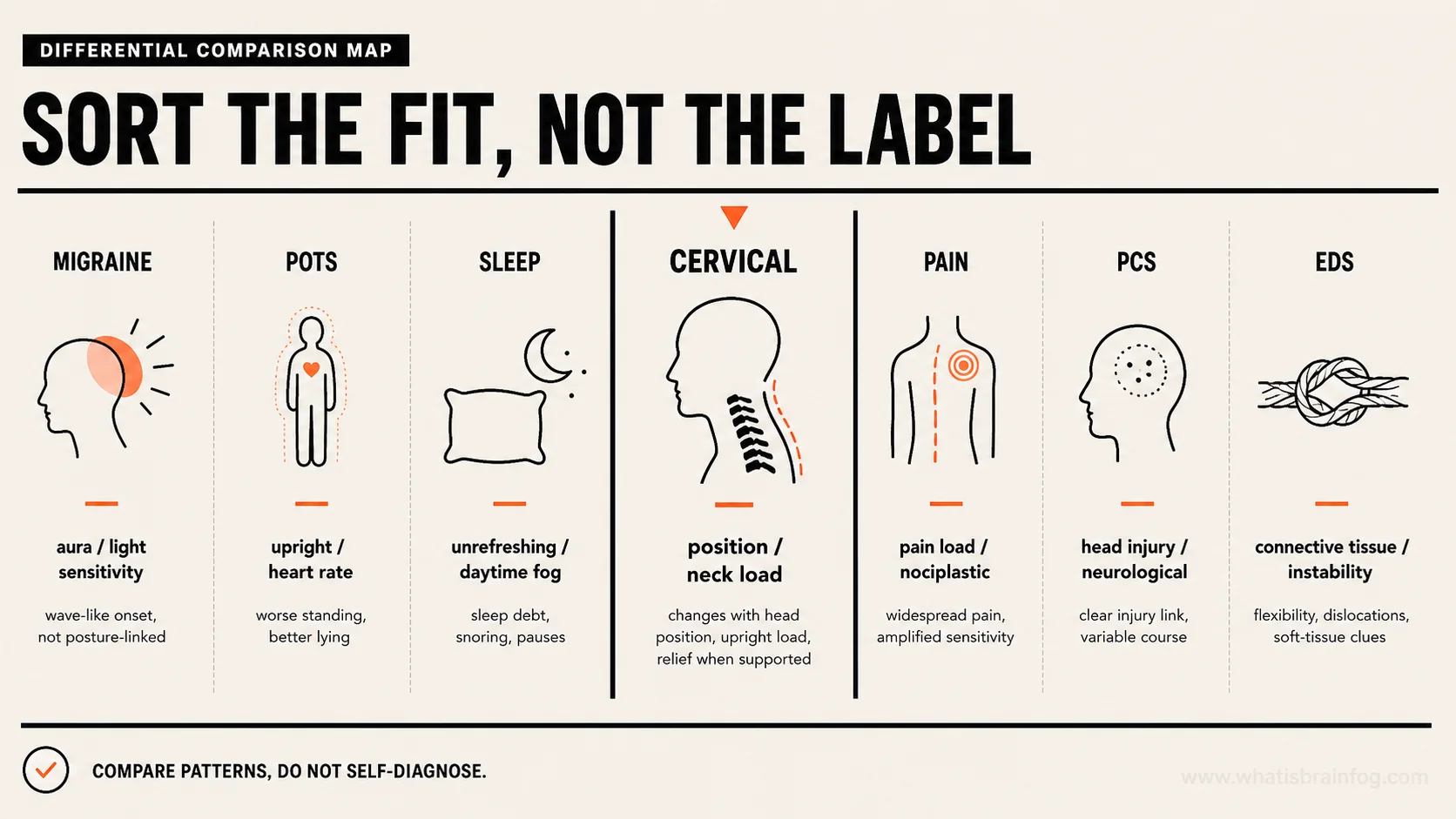
Migraine can include neck pain, dizziness, sensory sensitivity, and cognitive symptoms. Ask whether the episode follows migraine timing, rises with neck load, or does both.
Do light, sound, nausea, aura, headache timing, or migraine treatment explain the episode better than neck mechanics alone?
If standing brings on a racing heart, faintness or heat intolerance, or lying down helps, the problem may be heart-rate and blood-pressure control, not the neck. Get those changes measured properly.
Does upright time matter regardless of neck angle, and are palpitations, faintness, heat, or exertion part of the same episode?
A head or neck injury can cause overlapping headache, dizziness, balance or vision problems, neck pain, disturbed sleep and thinking difficulties. A concussion and a neck injury can happen together. Tell the clinician whether thinking stays difficult when your neck feels comfortable or changes with neck movement and strain. A normal scan does not distinguish these explanations by itself; the injury history and examination matter.
Did symptoms begin after trauma, and which examination findings separate brain, vestibular, migraine, and cervical contributors?
Both can cause fatigue, headaches, and slower thinking. Sleep apnea is more likely when there is loud snoring, witnessed breathing pauses, or mornings that begin unrefreshed. A neck cause is more likely when neck pain, head position or prolonged neck strain repeatedly makes brain fog worse.
Do the symptoms follow sleep and breathing at night, or do they change with neck pain, head position, and time spent looking down or holding the head still?
Pain anywhere in the body can drain attention and disturb sleep. A neck cause becomes more likely when brain fog changes with neck position or load and appears with neck pain, headache, dizziness, visual strain or arm symptoms.
Does brain fog rise with pain anywhere in the body, or specifically when neck symptoms and certain head positions get worse?
Ehlers-Danlos syndrome and other hypermobility conditions can involve neck pain, dizziness, postural orthostatic tachycardia syndrome (POTS), fatigue, and widespread joint symptoms. The neck may be just one part of a wider condition.
Are the symptoms mainly neck-related? Or are they also widespread, affecting joints, skin, standing and automatic body functions (autonomic), which needs a wider hypermobility assessment?
Brain fog after surgery can come from medicines, pain, poor sleep, blood loss, infection, or the strain of recovery. A neck cause needs neck-specific symptoms and an examination that can explain why the neck is being considered.
Did brain fog start with the operation and general recovery, or does it now change specifically with neck pain, head position and neck load?
Blood sugar changes are more likely when brain fog follows meals or missed meals, with shakiness, sweating, hunger or a rapid change after eating. A neck cause is more likely when thinking problems follow head position, desk work, driving or other neck load.
Does brain fog follow food and missed meals, or neck position and how long your neck has been working?
Is brain fog worst on waking, with unrefreshing sleep, snoring or witnessed pauses in breathing?
If yes: Ask about a sleep assessment, even if your neck also hurts.
If no: Describe whether neck pain, headaches or sustained posture repeatedly accompany harder thinking. Those observations can help guide the examination; they cannot exclude sleep apnea or establish instability.
Does thinking get harder as pain becomes stronger or lasts longer, including pain elsewhere in your body?
If yes: Pain itself can interrupt attention and sleep. That effect does not require cervical instability.
If no: If the changes occur mainly during particular neck activities, describe those activities and ask which examination findings would help explain them.
Did the thinking problems begin after a head or neck injury?
If yes: Neck injury and post-concussion symptoms can occur together. Mention whether the thinking problems continue when your neck is comfortable or change with neck movement and strain.
If no: Compare migraine, balance, sleep and pain problems before narrowing the explanation to the neck. Also mention problems while standing, such as a racing heart or feeling faint.
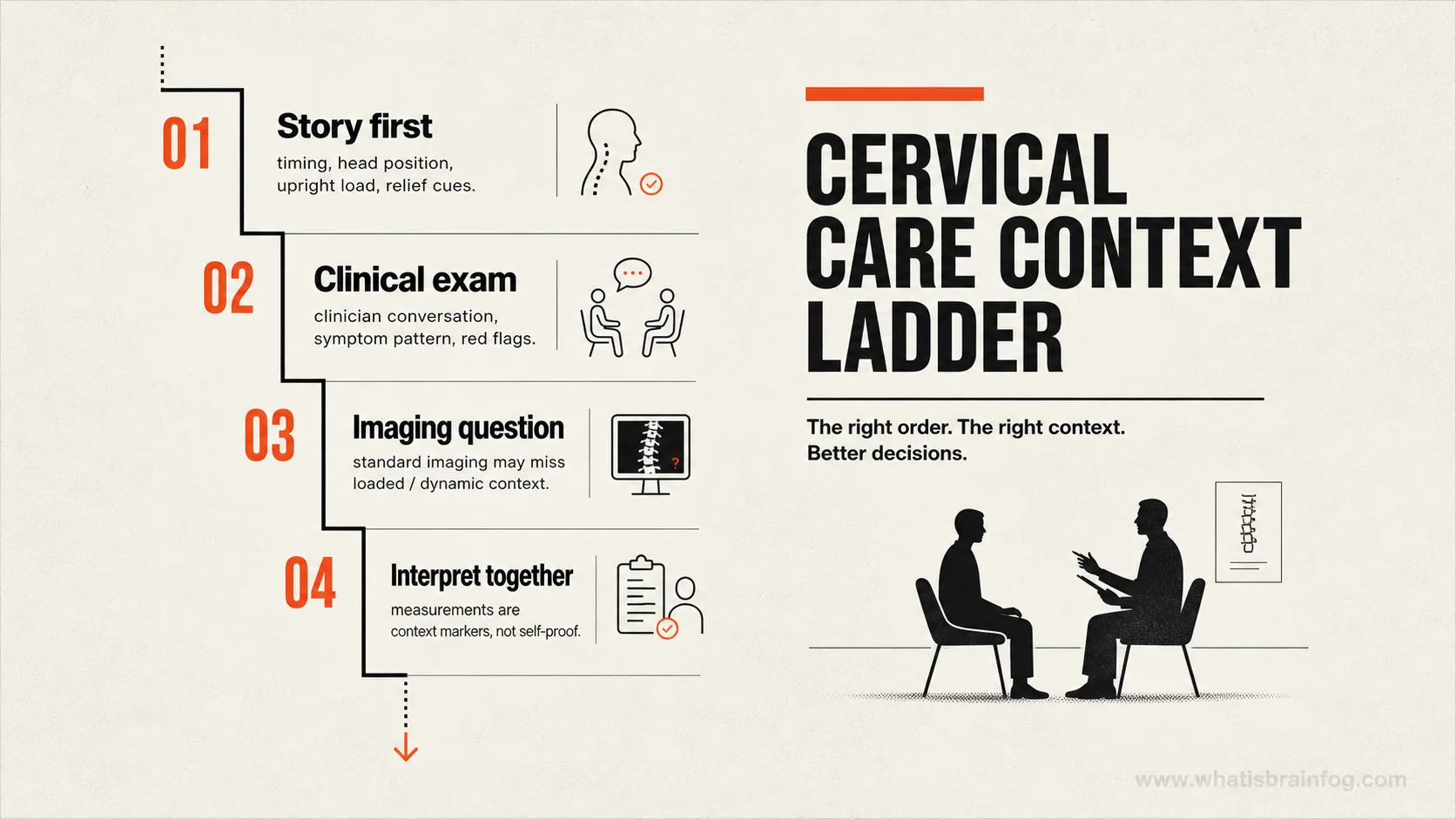
Reading a scan
The history and examination come first. They determine which scan, if any, could answer a useful question.
Start with the symptoms
A clinician first needs to know when symptoms began, whether you were injured, and which neurological signs you have. How pain, headache, dizziness or position affects daily life matters too. Otherwise, a scan finding may be unrelated to your symptoms.
Physical examination
The examination helps distinguish muscle or joint pain from a nerve or spinal-cord problem. A pinched or irritated neck nerve usually causes pain, numbness, tingling or weakness along one arm. Clumsy hands, dropping objects, weak or heavy limbs, poor balance, walking trouble or bladder changes need prompt assessment for a spinal-cord problem.
Choosing the scan
Standard imaging, CT, neck-bending (flexion-extension) studies and weight-bearing studies show different things. Ask what the scan looks for and how it would change your care.
Reading measurements
Angles and distances vary with technique and anatomy. A qualified clinician has to read a measurement beside the symptoms, examination and reason for the scan.
Preparing for an appointment
The supporter section gathers examples, records and questions that can make a neck assessment more specific.
When to talk
Some situations need clinical assessment, not self-management. Seek review when neck and cognitive symptoms persist, limit function, follow trauma, or include neurological signs.
Bring a short timeline of ordinary positions, pain, headache, dizziness, sleep, and relief. Ask which nearby causes and examination findings matter.
Persistent symptoms after trauma deserve a broader concussion, vestibular, migraine, cervical, sleep, and medication review.
Mention diagnosed hypermobility or connective-tissue disease, but do not assume it proves craniocervical instability.
Sudden severe headache, weakness, numbness, speech or vision change, seizure, bladder or bowel dysfunction, fever with confusion, or rapid decline needs urgent medical assessment.
While waiting
Stick to low-risk things that help the clinician. Skip anything meant to diagnose yourself: moves that trigger symptoms, collars, exercises or scans.
Notice what you were doing when symptoms changed, without deliberately turning, straining or holding an uncomfortable position.
Bring imaging reports, trauma history, medication changes, and notes about migraine, dizziness, sleep, pain, and autonomic symptoms.
Reduce sustained strain and take normal movement breaks. If an activity causes new neurological symptoms, stop.
Hold off on quick-thrust neck manipulation until serious neurological or structural concerns are settled.
Angles and distances on a scan
Angles and distances vary with technique, anatomy, and the clinical question. A single internet cutoff can't diagnose instability or explain brain fog.
Imaging choice
Standard, flexion-extension, CT, or other studies answer different questions. The examination and red flags should decide on further imaging.
Start with a licensed clinician and verify the current local referral and imaging options. Access, coverage, and wait times change.
No mainstream screening guideline - specialist diagnosis. Relevant: American Academy of Neurology guidance and neurosurgical consensus
Start with a licensed clinician and verify the current local referral and imaging options. Access, coverage, and wait times change.
No mainstream NHS guideline - specialist diagnosis. Relevant: NICE neck pain guidance, neurosurgical referral criteria
Start with a licensed clinician and verify the current local referral and imaging options. Access, coverage, and wait times change.
No mainstream Royal Australian College of General Practitioners or National Health and Medical Research Council guideline covers craniocervical instability. Specialists diagnose it.
How neck symptoms can affect thinking
Neck pain, headache, vestibular symptoms, sleep disruption, autonomic symptoms, and the effort of sustained posture can all affect concentration. Craniocervical instability means abnormal movement where the skull meets the upper neck. A specialist has to assess it. Structural compression is a separate specialist diagnosis.
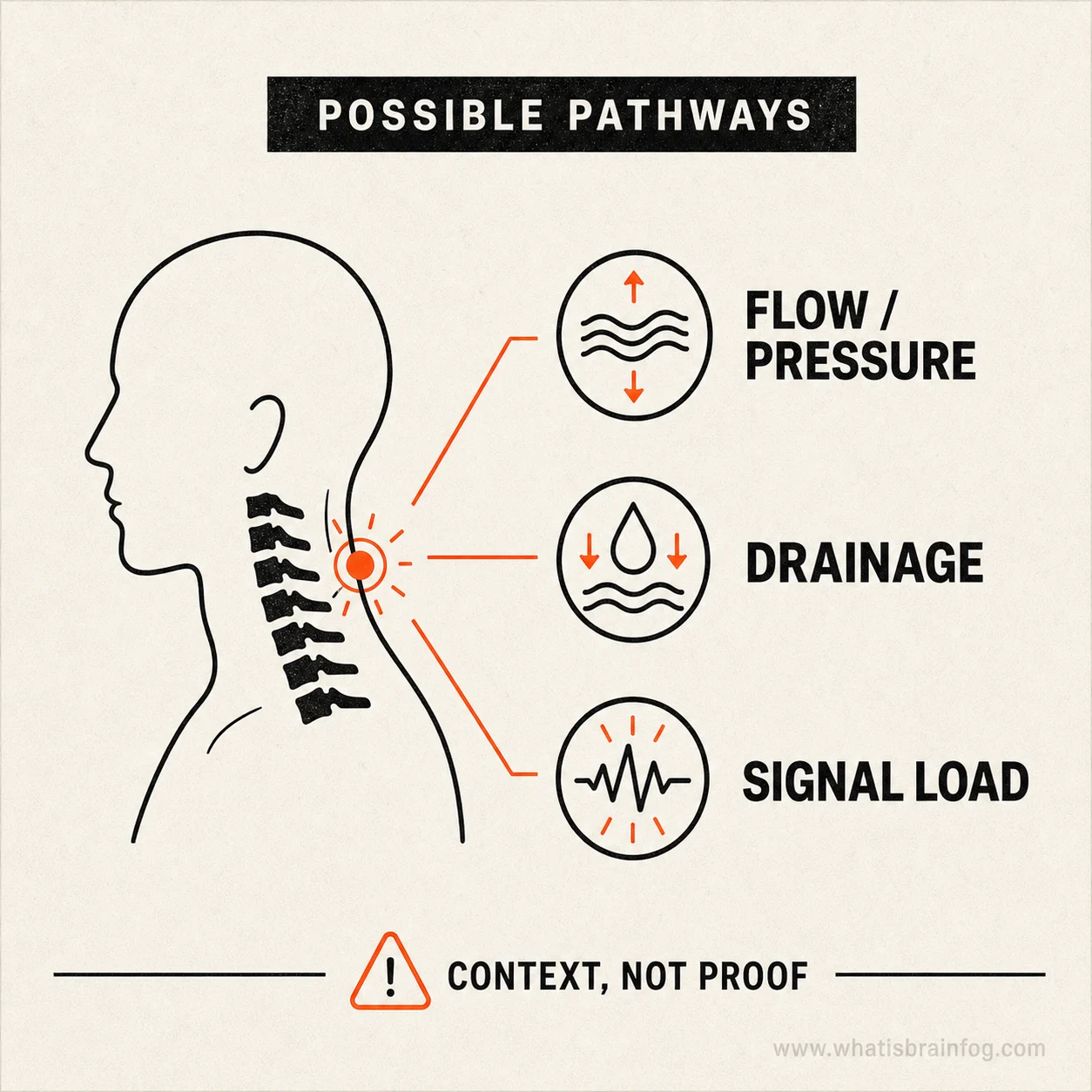
Pain and keeping your neck muscles tense can distract you and make it harder to hold information in mind.
neck symptoms can coexist with migraine or cervicogenic headache, both of which can affect cognition.
Dizziness, sensitivity to moving images and the effort of keeping your balance can take attention away from reading, screen work or other tasks while upright.
Poor sleep and medicine effects can affect thinking alongside neck pain. Problems with automatic body functions, such as heart-rate and blood-pressure control, can also contribute.
Claims about blood vessels, cerebrospinal fluid (CSF), or pressure on the brainstem require specialist examination and appropriate imaging.
Neck pain, dizziness, headache, balance symptoms, and cognitive complaints can overlap, but those symptoms alone do not establish cervical instability, vagus-nerve dysfunction, or vertebral-artery compression.
American College of Radiology Appropriateness Criteria: Cervical Pain or Cervical Radiculopathy (revised 2024). Red flags and the exam should decide whether you need imaging, and the symptom or finding should decide which scan.
Trouble walking, clumsy or weak hands or legs, brisk reflexes, or new bladder or bowel problems need prompt clinical assessment, not home self-testing.
NICE NG127, Suspected neurological conditions: recognition and referral, recommendation 1.10.11.
This history is not one continuous proof of cervical brain fog. It follows several separate questions: cognition after whiplash, posterior-circulation problems, selected surgical cohorts, diagnostic disagreement in Ehlers-Danlos syndrome (EDS), and what weight-bearing imaging may add.
Researchers measured vertebral artery flow in 130 people with vertigo or tinnitus and reported an association with cervical degeneration. The study did not test brain fog and cannot show that an ordinary neck finding caused cognitive symptoms.
A meta-analysis of 22 neuropsychological studies found differences in attention, memory, and related thinking skills after whiplash.
Koçer's review linked vertebrobasilar insufficiency (poor blood flow to the back of the brain) to thinking problems, including memory and visual-spatial ones.
A five-year follow-up described symptom changes after fusion in 22 carefully selected patients with hereditary connective-tissue disorders and craniocervical instability. With no randomized comparison group, it can't predict benefit for someone chosen only because neck symptoms and brain fog occur together.
A review of craniocervical instability in Ehlers-Danlos syndrome found limited evidence and no agreement on the imaging criteria. That's why a measurement only makes sense alongside the exam and the reason for the scan.
Researchers looked back at 53 highly selected people with Ehlers-Danlos syndrome after surgery to fuse the skull to the upper neck. They reported improvements in concentration and several other symptoms. The study had no untreated comparison group. Its authors called for a study that follows patients forward at several medical centers.
A scoping review mapped the available research and found nine small, varied studies. MRI taken upright or in different positions sometimes showed changes under load that were not visible when people lay down. The authors called for larger studies of patient outcomes and standard testing methods before setting routine diagnostic cutoffs.
Hypermobility or Ehlers-Danlos syndrome changes which causes to consider but doesn't prove craniocervical instability or make structural causes the default.
After whiplash, several things may affect your thinking at once: concussion, pain, poor sleep, migraine, vestibular (balance) problems, medicine effects, psychological distress, and neck injury.
Postpone high-velocity neck manipulation while serious vascular, neurological, connective-tissue, or structural concerns remain. Ask a qualified clinician about safer options.
Physical therapy, injections, collars, or surgery must match the diagnosis.
Recent studies have not established one accepted scan or measurement for cervical brain fog. Check current specialist guidance before relying on older summaries or commercial claims.
Managing
Treatment, progress, and what may still be involved
Body comfort Use comfortable neutral positions and change posture gradually. Do not use a collar, manipulation, or exercise as a diagnostic test.
Workstation Reduce sustained strain with screen height, arm support, breaks, and a setup that does not force positions that turn or bend your neck as far as it can go.
Observation note Track naturally occurring changes in fog, pain, headache, dizziness, and position without deliberately provoking symptoms.
Appointments Bring prior reports and a short timeline to a clinician; ask what common alternatives have been considered before pursuing specialist imaging.
Start with an examination, not an internet measurement
The examination starts with what happened to you. Neck pain with a headache differs from new weakness, dizziness after whiplash or symptoms that appear after a long day at a desk. The clinician checks pain, movement and signs of a nerve problem, and asks about injuries. Migraine, balance problems, disrupted sleep and medicine effects also matter. So do problems with automatic body functions, such as heart-rate and blood-pressure control.
This keeps a common strain, migraine, concussion, vestibular problem or pain-related concentration problem from being mistaken for cervical instability.
Use individualized physical therapy when appropriate
Physical therapy should fit the problem found on examination. The therapist may check which movements feel comfortable, how much strain you tolerate, your strength and your work setup. Headaches, dizziness, unusually mobile joints or a past injury can change what is safe. The plan should also account for how symptoms change during ordinary activities.
Feeling different after wearing a collar, stretching hard, doing exercises that tense muscles without moving the neck, or having neck manipulation does not identify the diagnosis. Stop and seek reassessment if care brings on new weakness, numbness, speech or vision changes, balance trouble or other neurological symptoms, or makes you clearly worse.
Further imaging and invasive care need a specific clinical reason
Standard imaging, flexion-extension studies, CT, and weight-bearing imaging do not answer the same question. Further imaging makes sense only when the history and examination raise a defined structural concern and the result could change care. Injections and surgery require an even narrower diagnosis-specific reason.
A scan can show anatomy. It can't prove by itself that a finding is causing brain fog.
Therapy context: Pain-focused therapy may help when fear of movement, anxiety or chronic pain makes daily life harder. Treat therapy and the physical assessment as two separate things.
Pain, nausea or fatigue can make cooking difficult. Choose regular meals you can tolerate and prepare. Adapt food choices to your budget, culture and preferences; they do not need to be perfect. Include plant foods and unsaturated fats where practical, and rely less on highly processed foods.
For general wellbeing, you might practice breathing exercises, spend time in daylight, drink water or do gentle activity. Keep your neck comfortable, and stop an activity if symptoms worsen.
These are ways to manage daily needs. They do not replace an examination or treat cervical instability.
Improvement depends on what the evaluation finds. Posture-related strain, pain, headache or dizziness may ease with non-surgical care. Lost neurological function or confirmed structural disease needs its own treatment.
There's no reliable recovery time that fits everyone, because "neck-related brain fog" can mean several different problems.
Community experiences can suggest questions, but they cannot validate a self-test, imaging cutoff, or treatment plan.
What helped
What did not help
Common mistakes
Surprises
Yes. Snoring, witnessed breathing pauses and waking unrefreshed are reasons to check for sleep apnea, especially when thinking is hardest in the morning. Also describe whether thinking gets harder as neck pain or a headache builds during driving, desk work or another sustained position. Both problems can occur together; these observations help decide what to assess.
Reduce long periods of neck strain with a comfortable screen height, arm support and ordinary movement breaks. Note what you were doing when symptoms changed, without deliberately bringing them on. Bring a short timeline and any earlier scan reports. Avoid forceful stretching and quick-thrust neck manipulation. Do not pull on your neck or wear a collar to test a diagnosis.
Improvement depends on what the assessment finds. Posture-related strain, pain, headaches or dizziness may improve with nonsurgical care. Weakness, trouble walking or a diagnosed structural problem requires its own assessment and treatment. There is no reliable recovery timetable for everyone with neck symptoms and brain fog. As care proceeds, note whether you can think more clearly and manage daily tasks more easily, and whether pain, migraine, sleep or balance changes at the same time.
Arrange an assessment when symptoms persist, limit daily activities or follow a head or neck injury. Go to an emergency department for sudden major arm or leg weakness, rapidly worsening walking, repeated falls, or new loss of bladder or bowel control. An inability to pass urine or numbness around the genitals or bottom also needs emergency assessment. Sudden facial droop, one-sided weakness, trouble speaking, severe new dizziness, loss of vision, collapse or a sudden severe headache may be a stroke: call emergency services. Other new numbness or severe imbalance needs urgent medical assessment. Do not wait to finish a symptom diary.
A normal scan doesn't explain every symptom, but it doesn't prove hidden instability either. Seek review when symptoms persist, follow trauma, limit function, or include neurological signs. Ask what clinical question any additional imaging would answer and how the result would change care.
Neck pain, headache, vestibular (balance) symptoms, poor sleep, long-held postures and coping with pain can make thinking harder. Only a specialist can diagnose craniocervical instability.
People may describe brain fog that rises with neck pain, headache, dizziness, screens, driving or sustained posture. The same experience can happen with migraine, vestibular disorders, concussion, POTS, sleep problems, pain and medicines. So mention it at a visit.
Recent studies have reported improvements in selected patients and additional findings on upright scans, but they have not established a general test or treatment for neck-related brain fog. In 2024, a study of 53 highly selected people with Ehlers-Danlos syndrome reported better concentration after surgery to fuse the upper neck. It had no untreated comparison group. A 2025 review found nine small, varied studies of upright or dynamic MRI, which takes images in different body or neck positions. Larger studies must show whether the extra findings improve care.
Supporter
What to notice, appointment notes, and safety
They may describe pain at the base of the skull, head pressure and harder thinking after looking down, driving or holding one position for a long time. Notice what they were doing, what changed and whether rest helped. Those details are more useful at an appointment than assuming that one neck position identifies the cause.
When my neck is bad, my thinking is worse too.
Turning my head or staying upright too long can make my thinking noticeably worse.
Lying flat sometimes helps in a way that regular rest doesn't.
Use the parts that describe your experience.
Opening: My thinking gets harder when [describe what happens to your neck and what you were doing]. This began [when, and after any injury or operation]. Could we examine my neck and check what else might explain these symptoms? Would a scan change my care, and what would it need to show?
Get urgent medical help for sudden thinking problems (over hours or days), new focal neurological symptoms (weakness, numbness, vision or speech changes), seizures, fever with confusion, or rapid decline. These may be an emergency needing immediate care.
If you experience red-flag symptoms, seek emergency or urgent medical care immediately.
Let someone else drive when dizziness, fainting, vision changes, weakness, numbness, or poor concentration makes it unsafe. Get new neurological symptoms checked.
Ergonomic or schedule adjustments may help when sitting, screens, pain, or dizziness limit function. Occupational health can help define accommodations.
Discuss significant neck, neurological, or mobility symptoms with the obstetric and anesthesia teams.
Neck-linked or position-linked thinking changes are something to discuss, not a diagnosis.
Migraine, pain, POTS, vestibular, sleep, medication, and post-concussion causes can overlap.
Ordinary activity notes are more useful than deliberate symptom provocation.
Imaging findings must match the examination and clinical question.
What this page covers
This page separates ordinary neck strain, post-injury symptoms, hypermobility, age-related wear, and structural problems for specialists. They can sound alike. Each needs its own exam and care.
Working definition: Cervical spine problems including instability, degenerative change, or structural strain that may affect pain, blood flow, or nerve signaling enough to worsen cognition. The strongest sign is that brain symptoms follow neck position or neck symptoms.
No single symptom, position, measurement, scan, or response to treatment is presented as proof that the neck caused brain fog.
Review status
Published 2026-02-25. Last reviewed 2026-03-23. Reviewed by Dr. Alexandru-Theodor Amarfei, M.D.
Source notes