Sleep Apnea and Brain Fog
What brought you here?
Which situation describes you?
When to consider a sleep test
Evidence and recovery context
What makes it different
Enough time in bed isn't the same as restful sleep
Breathing problems can repeatedly disturb your sleep, even if you don't remember waking.
What testing changes
Home and lab tests don't measure the same things
The test type, denominator, scoring rules, oxygen, sleep stage, position, and arousals all affect the report.
If treatment has started
Hours of mask use do not show whether sleep improved
Leaks, discomfort, repeated waking or leftover breathing problems can leave you exhausted even with the mask on all night.
Sleep apnea and cognition
Adult sleep-medicine guide
Diagnosis should follow a full sleep evaluation. Polysomnography is the standard test. Some otherwise healthy adults can use a clinician-ordered home test instead. If it's negative or unclear but apnea still seems likely, you may need a lab study.
How sleep apnea can cause brain fog
You slept, but you still woke up exhausted
See which symptoms belong together
What raises suspicion
Snoring, witnessed pauses, gasping, dry mouth, morning headache, or waking exhausted after enough time in bed.
What confirms it
A full sleep evaluation plus the right test. A screener, phone app, wearable or partner recording can't diagnose sleep apnea.
What treatment does not settle
Leaks, discomfort, repeated waking or leftover breathing problems can mean your days don't improve, even with the device running all night.
Investigating: I think I might have sleep apnea
Investigating
I think sleep apnea may be involved
Begin with the night, morning, and daytime symptoms. Then use the screeners and read what a home or laboratory study can actually tell you.
Sleep apnea can hurt attention, memory, thinking speed and daytime alertness, but some people with apnea test normal.
Enough hours in bed don't guarantee restful sleep if breathing problems keep disturbing it.
Home tests and in-lab polysomnography collect different information. A negative home test can miss sleep apnea.
Treatment can help, but improvement is not guaranteed or identical. If brain fog lasts, get treatment quality and other causes checked.
Safety boundary
Sleepy driving isn't ordinary brain fog.
Stop if sleepy
If sleepiness affects your driving, work safety, or pregnancy care, get medical help before you try ordinary productivity advice.
Full driving, work, and pregnancy notes
Driving and work
If sleepiness or impaired attention makes driving or safety-critical work unsafe, stop and get prompt clinical help.
Urgent symptoms
Severe breathing difficulty, chest pain, fainting, confusion, or new neurological symptoms need urgent assessment.
Timely evaluation
Witnessed pauses, gasping, persistent unrefreshing sleep, or uncontrolled daytime sleepiness deserve clinical assessment.
The hidden distinction
You can spend eight hours in bed and still wake up exhausted
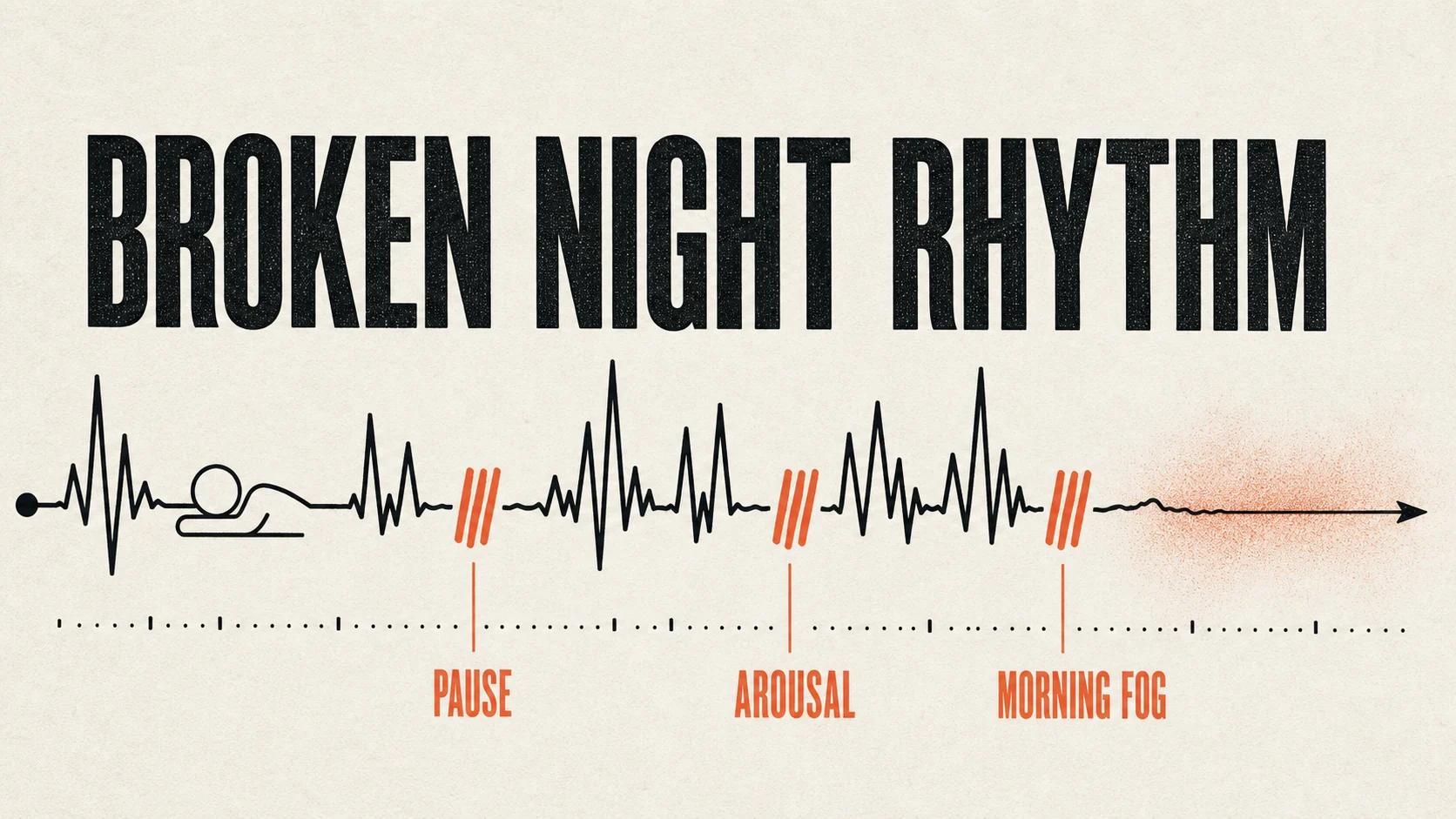
The mistake is treating time in bed as proof that sleep restored you. Breathing events can interrupt the night repeatedly without leaving a memory of each awakening.
What someone else may hear
Snoring, pauses, choking, gasping, or sudden snorts can happen while the sleeper remains unaware.
What you may notice on waking
Dry mouth, headache, heavy sleepiness, irritability, or needing a long time before you can think clearly.
What the day may cost
Missed details, slower decisions, memory errors, falling asleep unintentionally, or losing confidence at work and while driving.
Who the stereotype misses
Women, normal-weight adults, and people with insomnia or quieter breathing symptoms can still need care for sleep-disordered breathing.
Night
Someone beside you hears the pause, then the gasp. You may sleep through it and wake with a headache, needing much longer to get dressed or begin work.
Memory
You remember being told something, but when you need the detail later, it's gone. Forgetting is only part of it. You also lose confidence at work and in everyday decisions.
Morning
You have been in bed all night, but getting dressed or answering the first question of the day feels harder than it should.
Work
At the first meeting, you lose track of the question before you can answer. You ask for it again, then worry that other people noticed.
Safety
You stop at a red light and have to fight to keep your eyes open. Driving has gone from tiring to unsafe.
What happens during sleep
Why you can wake exhausted without remembering an awakening
The sleeper may remember an ordinary night. The body can still have repeated breathing events, brief arousals, and shifts in oxygen or heart rate that break up restorative sleep.
How interrupted breathing affects attention and memory
Sleep fragmentation can reduce continuous deep sleep and rapid eye movement (REM) sleep, leaving attention and memory less reliable the next day.
Repeated oxygen drops strain some people's bodies. But oxygen readings alone can miss people who keep waking up.
Heart-rate and blood-pressure surges, short sleep, insomnia, medicines, and other conditions can change the same daytime symptoms.
This explains why one apnea-hypopnea index (AHI) number cannot tell you exactly how a person will feel or how completely cognition will recover.
Symptom criteria and timing notes
What's needed before blaming sleep apnea
Diagnosis requires appropriate sleep testing interpreted with the symptoms and medical history.
Makes sleep apnea more plausible
Snoring, witnessed events, gasping, sleepiness, morning symptoms, and relevant risk factors support evaluation but are not diagnostic.
Signs that point toward another cause
Another cause better explains the daytime symptoms: Insufficient sleep, insomnia, medicines, mood, pain, circadian disruption, and other medical or sleep disorders may dominate.
When the symptoms happen
Morning or position-linked symptoms can inform testing, but timing alone does not confirm obstructive sleep apnea (OSA).
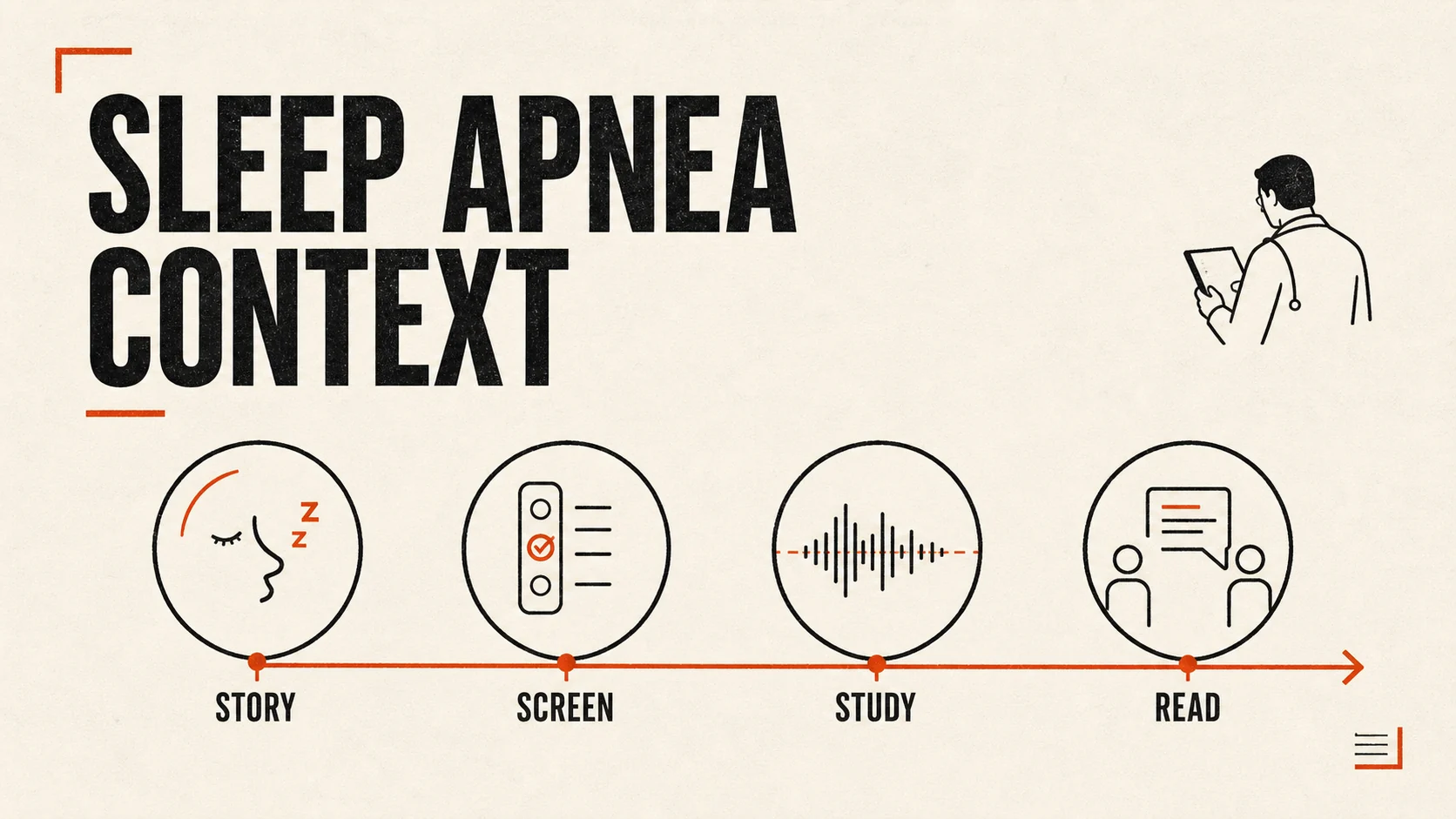
STOP-BANG lists common risk factors for obstructive sleep apnea, and Epworth rates how sleepy you get during the day.
If a device copy is available, it stays in this browser. When you are signed in, My Fog is a separate request for each result. Open My Fog to check it saved the result. STOP-BANG and Epworth can both appear on the same day without replacing each other.
A questionnaire can show whether the symptoms deserve a closer look.
How to use a screening result
Bring the completed questionnaire plus the sleep history, witness observations, medicines, and safety concerns to a clinician. Ask which test fits and what a negative home test would mean in your situation.
Open the STOP-BANG and Epworth tools
STOP-BANG
Eight yes/no risk checks
The total estimates OSA risk.
Epworth
Sleepiness in everyday situations
The total describes the chance of dozing in ordinary situations. It does not measure every kind of fatigue or diagnose the cause.
Daytime sleepiness check
Epworth Sleepiness Scale
Answer how likely you are to doze off in each situation, based on how you've been recently. This scale measures how sleepy you are during the day, but it doesn't tell you why.
1. Sitting and reading
2. Watching TV
3. Sitting inactive in a public place (e.g., a theater or meeting)
4. As a passenger in a car for an hour without a break
5. Lying down to rest in the afternoon when circumstances permit
6. Sitting and talking to someone
7. Sitting quietly after a lunch without alcohol
8. In a car, while stopped for a few minutes in traffic
A signed-in My Fog request includes only the score and short summary, not each individual answer. The status above tells you what happened.
The night
Snoring, pauses, choking, gasping, repeated movement, mouth breathing, or worse events on the back.
Someone watching you sleep can tell you what you can't see, but that isn't a diagnosis.
The morning
Dry mouth, headache, heavy waking, irritability, or needing a long time before thinking feels dependable.
Morning symptoms overlap with other sleep and medical problems.
The day
Dozing, losing attention in meetings, slowed decisions, memory slips, or unsafe sleepiness while driving.
Sleep-study sequence
A negative home test does not always rule out sleep apnea
A home study records less than an in-lab study. If the result is negative or unclear but the symptoms still strongly suggest sleep apnea, ask whether an in-lab study is the appropriate next test.
Before the test
Doctors weigh snoring, witnessed pauses, morning grogginess, headache, dry mouth, and risk factors to decide on testing.
Home sleep apnea test (HSAT)
For some adults, this can be an appropriate first test. Many devices do not measure sleep stages or cortical arousals, so the clinician should explain what a weak or conflicting result means.
In-lab polysomnography (PSG)
Measures sleep stages, respiratory effort, oxygen, limb movements, position, rapid eye movement sleep, and arousals.
What one sleep-study number cannot tell you
Clinicians read the report with symptoms, medication effects, insomnia, nasal obstruction, and overlapping causes.
Optional report organizer
Put the report terms into one place
The full report values can be saved on this device. If you are signed in, the tool also tries to save a short summary to My Fog with your AHI and the number of report notes. Check the save message to see what was saved. The tool shows which questions the numbers raise; it cannot decide whether the test was adequate or whether the report explains your symptoms.
Results Tool
Sleep study report organizer
Enter the numbers printed on your report. AHI is required. The organizer explains what each number measures and what it may miss, then saves a short My Fog summary.
Apnea-hypopnea index (AHI)
Apneas and hypopneas per hour of measured sleep in polysomnography. The scoring rule used can change the count.
Respiratory event index (REI)
Respiratory events divided by recording or monitoring time on many home tests. More time counted as sleep can make the index look lower than an AHI based on measured sleep.
Oxygen desaturation index (ODI) and oxygen
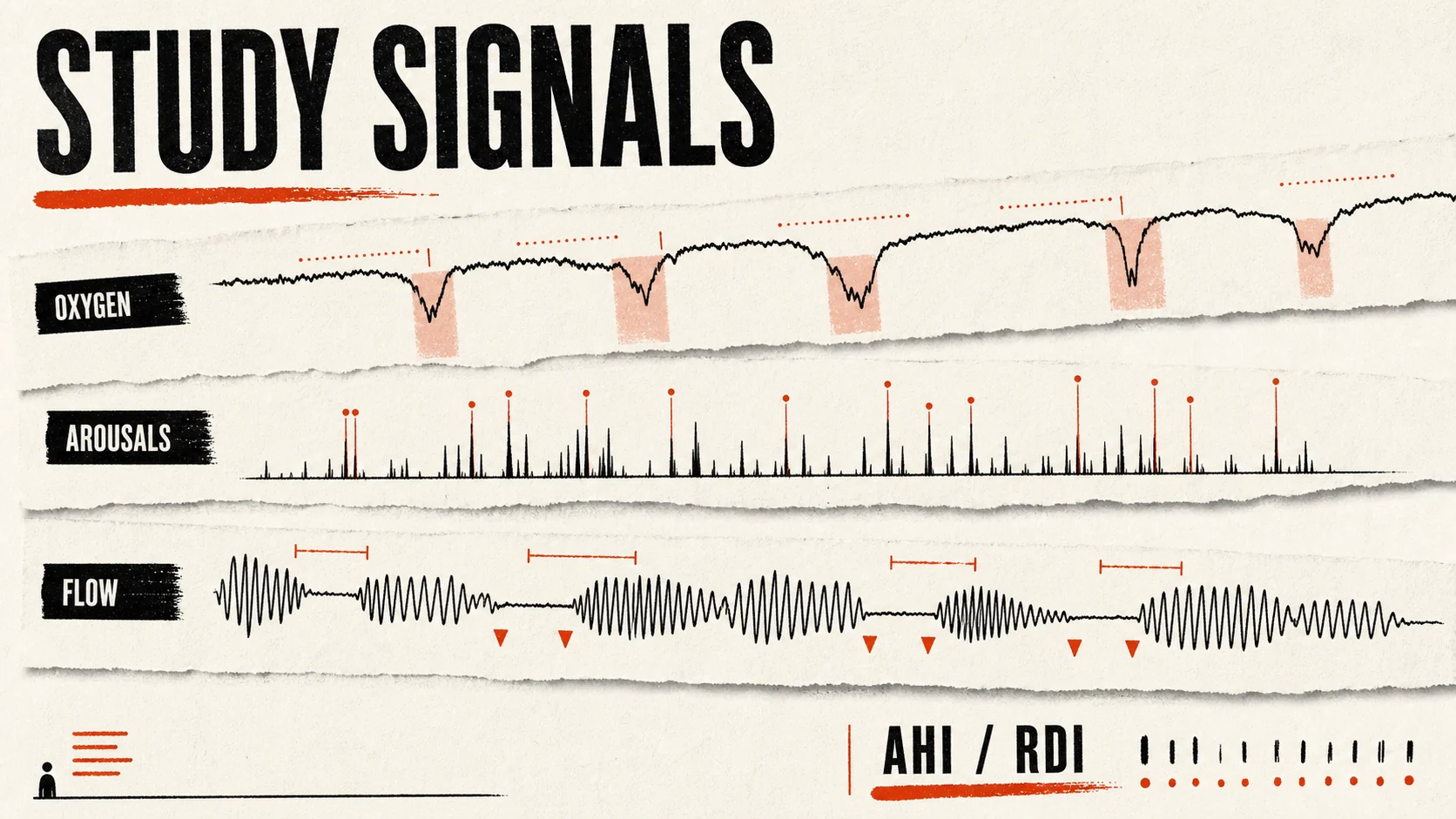
ODI counts oxygen drops. The depth and duration of each drop still matter, but ODI cannot show every breathing-related awakening.
Respiratory disturbance index (RDI) and respiratory-effort arousals
RDI may include respiratory-effort arousals beyond apneas and hypopneas. Ask what the laboratory counted, because reports can use different definitions.
REM and position
An overall average can hide events concentrated in REM sleep or while lying on the back. The stage and position breakdown can change the treatment conversation.
What a sleep study is looking for
Breathing events
The report counts and characterizes obstructive, central, and mixed breathing events in the context of the test used.
Oxygen and arousals
Oxygen drops and broken sleep add detail, but one number can't replace reading the whole report.
Testing and care in the US, UK, and Australia
United States: sleep-medicine clinician
Guideline: American Academy of Sleep Medicine adult diagnostic-testing guideline
- The medical history helps determine whether home or laboratory testing is appropriate.
- When the symptoms and a home result disagree, ask what follow-up the guideline supports.
Local terms: primary care clinician; sleep-medicine clinician; insurer or equipment supplier.
Testing and equipment coverage vary. Ask which test your plan covers, who reads the complete study, and whether the equipment supplier expects proof of use by a deadline.
Clinical evaluation
Home or in-lab testing depends on your history, medicines, driving risk, exam, and the chance of complicated sleep-disordered breathing.
Diagnostic test
Your doctor or sleep service should read the raw study with your symptoms and history. Computer scoring alone isn't enough.
Treatment and follow-up
Coverage rules can affect equipment access, but a coverage threshold is not proof that symptoms or breathing events are controlled.
United Kingdom: sleep or respiratory service
Guideline: NICE guideline NG202: obstructive sleep apnea and hypopnea syndrome, and obesity hypoventilation syndrome
- Assessment and treatment depend on symptom burden and objective testing.
- CPAP, mandibular advancement, position, and weight-related care have different roles.
Local terms: GP; sleep or respiratory service; NHS.
A GP can document sleepiness, snoring, witnessed events, driving risk, and work impact before referral. Local services differ in whether home respiratory testing or laboratory testing comes first.
Referral
Besides saying you sleep poorly, describe the daytime effects and what a witness noticed.
Testing
Ask what the test measured and what happens if the result is negative but the clinical concern remains.
Treatment review
Take mask or equipment problems back to the sleep service. They aren't your fault.
Australia: sleep physician
Guideline: Sleep-medicine assessment through GP and specialist pathways
- Medicare and private pathways differ.
- Your health needs and local services affect which test you receive and how you get equipment.
Local terms: GP; sleep physician; Medicare or private health.
Ask whether the proposed study is a home respiratory test or full polysomnography, who interprets it, and what follow-up it includes.
Assessment
Risk screeners can support the referral, but objective testing and clinical interpretation establish the diagnosis.
Equipment
Supplier access and reimbursement vary. Before paying, ask if the equipment price includes a trial, mask fitting, follow-up review, and replacement support.
Sleep apnea and nearby look-alikes
Compare when the symptoms happen, what type of sleep test was used, and which other conditions could cause the same problems.
Obstructive sleep apnea or insomnia
Unrefreshing sleep along with breathing events, snoring, dry mouth, or witnessed pauses makes OSA more likely. Insomnia is more likely to dominate when the central problem is falling asleep, staying asleep, or waking too early. Both can exist together.
Obstructive or central sleep apnea
Obstructive events come from upper-airway narrowing or collapse. Central events involve reduced breathing drive and can be linked to heart failure, medicines or substances, altitude, or other conditions. The report and clinical history separate them.
Sleepiness or fatigue
Sleepiness is the tendency to doze. Fatigue can feel like low capacity without being able to sleep. People can have either or both, and Epworth does not capture every form of cognitive or physical exhaustion.
Treated sleep apnea or another cause
A good airway result can coexist with another problem that still ruins the day. If you still wake exhausted or cannot think clearly, insomnia, restless legs, medicine effects, pain, endocrine problems, and post-viral illness may still need their own review.
Sleep apnea or insomnia?
Is your main problem waking unrefreshed after sleep, or trouble falling or staying asleep?
If the first description is closer: Snoring, pauses, gasping, dry mouth, and morning headache make sleep-disordered breathing more relevant.
If the second description is closer: Long sleep-onset delay, repeated conscious waking, or early waking may make insomnia or circadian timing more central.
Insomnia and sleep apnea can coexist, so one does not rule out the other.
Sleep apnea or chronic nasal obstruction?
Congestion, mouth breathing and symptoms that vary by season or room make nasal problems worth checking.
Breathing pauses and sleep-study findings can still support sleep apnea when your nose feels clear.
Nasal blockage can also worsen apnea or mask leak without explaining every symptom.
Sleep apnea or menopause-related sleep disruption?
Hot flashes, insomnia and changes in thinking may occur during the menopause transition. Sleep-apnea risk also rises after menopause.
Breathing symptoms and sleep-study findings can support apnea at other life stages too.
Ask your doctor to assess both problems when they occur together.
Sleep apnea or Long COVID and ME/CFS?
Is your day worst after an unrefreshing night, or does effort bring a delayed crash?
If the first is closer, morning sleepiness and airway symptoms support a sleep evaluation.
If the second description is closer: That delayed crash can point to post-exertional malaise rather than ordinary sleepiness.
Post-viral illness and OSA can coexist.
Clinician conversation script
I am spending enough time in bed but waking unrefreshed, and the daytime sleepiness or cognitive problems are affecting daily life. I also have these nighttime or morning symptoms: [add what applies]. Which sleep test is appropriate, and what would a negative home test mean in my case?
Key point: Describe the exact daytime consequence, including driving or work safety.
Key point: Bring witness observations and the full report from any prior sleep test.
Key point: Ask whether the report separated AHI or REI, oxygen, sleep stage, position, arousals, and central events.
Visit-prep notes
Open the sleep apnea doctor handoutTests to discuss
Given my history, should I have polysomnography or a clinician-directed home sleep apnea test?; After a negative or unclear home test, when would an in-lab study make sense?; How do the apnea-hypopnea index (AHI), respiratory event index (REI), oxygen, sleep stage, body position, and arousal-based events change how you read my report?
What to bring
Bring prior reports, your medicine list, screening scores, what another person noticed during sleep, any CPAP report, and examples of how your thinking changes during the day.
Red flags
Unsafe sleepiness, severe breathing difficulty, chest pain, fainting, confusion, or new neurological symptoms.
Recent research
What the evidence says about cognition, CPAP, women, and newer treatment
Where the research agrees and where it does not
Sleep apnea can affect cognition, but thinking does not improve at the same rate for everyone
Recent reviews agree that cognitive impairment is common enough to matter. The evidence does not show the same improvement in every cognitive domain after CPAP, and a pooled result cannot predict one person's recovery.
How sleep apnea is diagnosed
Polysomnography is the standard diagnostic test. A clinician-directed home test can be an alternative for some adults without complicating conditions.
Your doctor uses your medical history to decide whether you need a home sleep test or a study in a sleep lab. If a home result doesn't match your symptoms, American Academy of Sleep Medicine guidance says when you need lab follow-up.
Kapur et al., American Academy of Sleep Medicine guideline, 2017
How often thinking is affected
A 2025 meta-analysis found thinking problems in a large minority of adults with test-confirmed obstructive sleep apnea.
The pooled estimate was 36.9%, but results varied widely by cognitive test, sleep apnea severity, diagnostic method, and region. It isn't a prediction for any one person.
Thinking after CPAP treatment
A 2025 review of randomized trials reported improvement in daytime sleepiness and on tests of thinking speed and finding visual targets after CPAP.
A 2024 Journal of Clinical Sleep Medicine systematic review called the longer-term evidence weak. Across its trials, it found no effect on thinking big enough to matter. Some people still improve.
Che et al., 2026, PMID 41157896; Balk et al., 2024, PMID 38300818
Women and missed diagnosis
Women may see doctors for fatigue, insomnia, mood or thinking problems, not the classic symptoms seen in men.
A 2026 review describes women being referred later and standard severity scores that fit them less well. The evidence says doctors should ask women more questions.
Obesity-related treatment
Tirzepatide reduced OSA severity in adults with obesity and moderate-to-severe OSA in two phase 3 trials.
For OSA, the FDA approved tirzepatide only for adults with obesity and moderate-to-severe disease. It doesn't replace an airway check or cover every form of sleep apnea.
Central sleep apnea
Central sleep apnea is a different condition from obstructive sleep apnea. It can happen with heart failure, medicines or substances, high altitude, or other disorders.
The 2025 American Academy of Sleep Medicine (AASM) treatment guideline uses conditional recommendations and calls for experienced-center monitoring for adaptive servo-ventilation in heart failure with reduced ejection fraction.
Only loud snorers with obesity get sleep apnea
Weight and snoring matter, but neither is required. Airway anatomy, menopause, nasal obstruction, REM-related disease, and other factors can produce a quieter presentation.
National Heart, Lung, and Blood Institute; Bouloukaki et al., 2026
A normal home test means no further review is needed
That conclusion can be premature. Home testing has a defined role and records less than a laboratory study. If the symptoms still strongly suggest sleep apnea, the result may need clinical review and in-lab follow-up.
Kapur et al., 2017
Four hours of CPAP means the apnea is treated
An administrative use threshold is not a clinical outcome. Leak, residual events, pressure, actual sleep duration, insomnia, and daytime function still matter.
AASM PAP guidance
If CPAP doesn't fix your brain fog, the diagnosis was wrong
Obstructive sleep apnea may be real while another sleep or medical problem remains. Treatment quality, coexisting insomnia, medicines, central events, and nearby causes need separate review.
Balk et al., 2024; Che et al., 2026
Sources
Sources and review notes
- Page updated
- July 16, 2026. New research was added after the last recorded clinical review.
- Medical review
- 2026-03-23 by Dr. Alexandru-Theodor Amarfei, M.D.
- Diagnostic boundary
- Polysomnography remains the standard diagnostic test. Home testing is for selected adults and may need laboratory follow-up when its result doesn't explain the symptoms.
- Scope
- This page covers adult obstructive sleep apnea and the thinking or daytime problems that can appear with it. Central sleep apnea is explained only where the distinction changes safety or treatment.
- Educational boundary
- This information cannot diagnose sleep apnea, select a device setting, prescribe medicine, or replace individualized care.
- Primary sources
Common questions
Can sleep apnea cause brain fog?
Yes. Obstructive sleep apnea can contribute to poor attention, slower thinking, memory difficulty, headache, and daytime sleepiness. Repeated sleep disruption is central, and oxygen stress may add to the effect in some people. These symptoms are not specific to apnea, so the diagnosis still depends on a proper sleep evaluation and test.
What does sleep apnea brain fog feel like?
A common description is sleeping for long enough but waking as if the night didn't restore anything. Morning headache, dry mouth, slowed recall, irritability, heavy sleepiness, or mistakes during the first part of the day can appear with it. Some people aren't obviously sleepy and mainly notice that attention and memory have become less dependable.
Can a home sleep study miss sleep apnea?
Yes. A home test can diagnose obstructive sleep apnea in some adults, but it does not record everything measured in a laboratory. When the result is negative, unclear, or technically inadequate and sleep apnea is still suspected, American Academy of Sleep Medicine guidance recommends an in-lab study.
What if my CPAP numbers look good but the brain fog remains?
Usage hours show how long the device ran. If your thinking stays slow, the sleep clinic can check for mask leak, leftover or central breathing pauses, comfort, actual sleep time, insomnia, medicine effects, and other causes of daytime symptoms.
Can you have sleep apnea without loud snoring or obesity?
Yes. Body weight and loud snoring can raise risk, but neither is required. Airway anatomy, menopause, nasal obstruction, REM-related events, and other factors can produce a less stereotypical presentation. Women are also more likely to reach care with fatigue, insomnia, mood symptoms, or poor concentration rather than the classic description.
How long does brain fog take to improve after sleep apnea treatment?
There is no reliable fixed timetable. Some people notice sleepiness or morning function improve first. Attention and memory may change later, unevenly, or not at all when another sleep or medical problem remains. Recent trials suggest benefit in some cognitive domains, while longer-term reviews remain inconsistent.
Managing: I use CPAP but still have brain fog
Managing
I use continuous positive airway pressure (CPAP) or another treatment, but my mind's still slow
Start with comfort, leak, residual events, actual sleep time, and insomnia. Then compare the parts of the day that treatment has not changed.
Sleep apnea is being treated. What actually helps?
Start with the symptoms that remain. Check whether treatment controls your breathing and address anything that makes it hard to use. Before adding or changing treatment, ask what it could improve and whether the research supports using it in your situation.
Do not drive or do safety-critical work while you cannot stay awake. Ask for a residual-sleepiness review instead of masking it with more caffeine.
Which symptom has not improved?
- Sleepiness: I could fall asleep.
- Fatigue: I have no energy.
- Brain fog: my thinking is impaired.
- Insomnia: I cannot sleep well even though the airway is treated.
Start with what is still going wrong.
My AHI looks good but I still feel exhausted or foggyCheck that you're treated for the whole night, then look for what AHI misses.
Three places to start
- 1
- 2
- 3
My mask leaks, dries me out or blows air into my eyesSeparate seal leak, mouth leak and dryness before changing the whole treatment.
Three places to start
- 1
- 2
- 3
The pressure feels awful or CPAP fills me with airCheck how pressure changes and what feels wrong before assuming you need a fancier machine.
Three places to start
- 1
- 2
- 3
I keep taking CPAP off or can't fall asleep with itFix what's stopping you: equipment intolerance, blocked nose, leak or insomnia.
Three places to start
- 1
- 2
- 3
CPAP controls the apnea but insomnia still wrecks my sleepTreat insomnia as its own problem. Better PAP numbers won't fix it.
Where to start
- 1
- 2
My test or machine says normal, but my sleep still feels fragmentedAsk what the original test measured and whether a lab sleep study (PSG) could show more.
Three places to start
- 1
- 2
- 3
I still fall asleep uncontrollably despite effective treatmentConfirm it's sleepiness, rule out other causes, then discuss evidence-based wake treatment.
Three places to start
- 1
- 2
- 3
My weight is driving my apnea and I want to treat the causeTreat obesity directly when it contributes, then retest before changing effective airway treatment.
Three places to start
- 1
- 2
- 3
I can't use PAP and need a real alternativeMatch the alternative to your apnea type: oral appliance, position, anatomy or HNS.
Three places to start
- 1
- 2
- 3
PAP brought out central apneas or my breathing data became strangerLeave the pressure settings alone when central events appear. Ask for a central-apnea review.
Three places to start
- 1
- 2
- 3
Search the full evidence library 52 options
No matching option.
Wear PAP the whole time you sleep, not only the first few hours
Your insurer's minimum hours are a paperwork rule. Wear PAP for all your sleep when you can.
Why, evidence and sources
Partial-night use
Why
Effective PAP depends on treating the whole sleep period with a tolerable interface, controlled leak and settings that actually control breathing without wrecking sleep.
Evidence: A · Status: recommended
Check your machine's data when symptoms persist
If the data look fine, ask about wake-ups, sleep stages and other disorders.
Why, evidence and sources
“Numbers look fine but I feel awful”
Why
Effective PAP depends on treating the whole sleep period with a tolerable interface, controlled leak and settings that actually control breathing without wrecking sleep.
Evidence: A · Status: recommended
Check for large leaks before blaming pressure or apnea
If the machine flags a leak, find out if it's the seal, your mouth or the pressure.
Why, evidence and sources
Leak / dry mouth / eye leak
Why
Effective PAP depends on treating the whole sleep period with a tolerable interface, controlled leak and settings that actually control breathing without wrecking sleep.
Evidence: A · Status: recommended
- (12)
guideline
If leaks wake you, refit the mask or try another one
Tighter straps won't fix every leak. Try a different mask.
Why, evidence and sources
Mask problems
Why
Effective PAP depends on treating the whole sleep period with a tolerable interface, controlled leak and settings that actually control breathing without wrecking sleep.
Evidence: A · Status: recommended
- (12)
guideline
Try a nasal mask first if you can breathe through your nose
A nasal mask only works when nose breathing and mouth leak are manageable.
Why, evidence and sources
Uncomplicated PAP
Why
Effective PAP depends on treating the whole sleep period with a tolerable interface, controlled leak and settings that actually control breathing without wrecking sleep.
Evidence: B · Status: consider
- (12)
guideline
Waking with a very dry mouth? Check for mouth leak
No mouth leak? Look for another cause of dryness.
Why, evidence and sources
Nasal-mask users
Why
Effective PAP depends on treating the whole sleep period with a tolerable interface, controlled leak and settings that actually control breathing without wrecking sleep.
Evidence: B · Status: consider
- (12)
guideline
Treat nasal congestion or blockage that undermines PAP
Nasal treatment can make PAP easier, but the apnea remains.
Why, evidence and sources
Congestion / PAP intolerance
Why
Effective PAP depends on treating the whole sleep period with a tolerable interface, controlled leak and settings that actually control breathing without wrecking sleep.
Evidence: A · Status: recommended
- (16)
guideline
Add heated humidity when PAP dries you out
Humidity helps comfort more reliably than it raises PAP use or eases apnea.
Why, evidence and sources
Dry nose/mouth
Why
Effective PAP depends on treating the whole sleep period with a tolerable interface, controlled leak and settings that actually control breathing without wrecking sleep.
Evidence: B · Status: consider
- (12)
guideline
Add or adjust heated tubing when humidity causes condensation
Why, evidence and sources
Rainout
Why
A heated tube can reduce condensation while you keep enough humidity for comfort.
Evidence: C · Status: conditional
- (12)
guideline
Review a too-wide or uncomfortable APAP pressure range with the sleep team
Leave pressure changes to the sleep team.
Why, evidence and sources
Pressure swings / leak
Why
Effective PAP depends on treating the whole sleep period with a tolerable interface, controlled leak and settings that actually control breathing without wrecking sleep.
Evidence: C · Status: conditional
Try fixed CPAP when the changing pressure itself disrupts sleep and data support it
Evidence supports both APAP and CPAP. Fixed CPAP isn't automatically better.
Why, evidence and sources
APAP intolerance
Why
Effective PAP depends on treating the whole sleep period with a tolerable interface, controlled leak and settings that actually control breathing without wrecking sleep.
Evidence: B · Status: consider
- (15)
guideline
Get in-lab pressure testing when home data can't explain treatment failure
Repeat the pressure testing only when the result can change your treatment.
Why, evidence and sources
Complex persistent symptoms
Why
Effective PAP depends on treating the whole sleep period with a tolerable interface, controlled leak and settings that actually control breathing without wrecking sleep.
Evidence: A · Status: recommended
Skip bilevel PAP if persistent fatigue is your only reason
Why, evidence and sources
“Should I buy BiPAP?”
Why
Bilevel is not a routine upgrade from CPAP or APAP. It needs a specific reason, such as pressure intolerance or a ventilation problem.
Evidence: A · Status: recommended
- (15)
guideline
Consider bilevel for pressure you can't tolerate or a specific ventilation problem
Bilevel needs a specific pressure, ventilation or central-apnea reason.
Why, evidence and sources
Selected PAP intolerance
Why
Effective PAP depends on treating the whole sleep period with a tolerable interface, controlled leak and settings that actually control breathing without wrecking sleep.
Evidence: B · Status: consider
Use remote monitoring early, when available, to spot leaks, nonuse and treatment problems
Remote monitoring helps troubleshooting most clearly early in treatment. Long-term gains are less certain.
Why, evidence and sources
Starting PAP
Why
Effective PAP depends on treating the whole sleep period with a tolerable interface, controlled leak and settings that actually control breathing without wrecking sleep.
Evidence: B · Status: consider
Start PAP with structured training and troubleshooting help
Training works best when it fixes your problems instead of pressuring you.
Why, evidence and sources
New PAP users
Why
Effective PAP depends on treating the whole sleep period with a tolerable interface, controlled leak and settings that actually control breathing without wrecking sleep.
Evidence: A · Status: recommended
- (15)
guideline
Ease into PAP if claustrophobia or how it feels stops you
Easing in should reduce equipment fear, not force anyone through unbearable treatment.
Why, evidence and sources
Mask aversion
Why
Effective PAP depends on treating the whole sleep period with a tolerable interface, controlled leak and settings that actually control breathing without wrecking sleep.
Evidence: B · Status: consider
- (15)
guideline
Use PAP during naps as well as overnight sleep
Naps count as sleep. Use PAP for them where it's practical and safe.
Why, evidence and sources
Frequent nappers / partial treatment
Why
Effective PAP depends on treating the whole sleep period with a tolerable interface, controlled leak and settings that actually control breathing without wrecking sleep.
Evidence: B · Status: consider
Get PSG when a negative or unclear home test leaves doubt
Retest after a negative home test only if there's still reason to suspect apnea.
Why, evidence and sources
Doubtful home test
Why
Machine AHI and home testing answer only part of the question. PSG can measure sleep stages, arousals, limb movements and other physiology that home data may miss.
Evidence: A · Status: recommended
Prefer PSG if you also have severe insomnia
Severe insomnia can make PSG more useful than home testing, but the sleep clinician should choose the test.
Why, evidence and sources
Insomnia / broken sleep
Why
Machine AHI and home testing answer only part of the question. PSG can measure sleep stages, arousals, limb movements and other physiology that home data may miss.
Evidence: A · Status: recommended
- (17)
guideline
Prefer PSG with major heart-lung or neuromuscular disease, opioids or hypoventilation
With these conditions, a clinician should direct testing.
Why, evidence and sources
Complex patients
Why
Machine AHI and home testing answer only part of the question. PSG can measure sleep stages, arousals, limb movements and other physiology that home data may miss.
Evidence: A · Status: recommended
If AHI doesn't explain symptoms, ask whether your test measured RDI/RERAs
Symptoms or a PAP flow screenshot alone can't diagnose UARS.
Why, evidence and sources
Suspected airway narrowing
Why
Machine AHI and home testing answer only part of the question. PSG can measure sleep stages, arousals, limb movements and other physiology that home data may miss.
Evidence: C · Status: conditional
Treat your insomnia with CBT-I
Use evidence-based CBT-I, not generic sleep-hygiene advice alone.
Why, evidence and sources
Insomnia
Why
Apnea can be controlled while insomnia, restless legs or limb movements still break up sleep and spoil the next day.
Evidence: A · Status: recommended
Treat independent insomnia directly. CPAP alone won't cure it
Raising PAP pressure won't treat independent insomnia.
Why, evidence and sources
Insomnia
Why
Apnea can be controlled while insomnia, restless legs or limb movements still break up sleep and spoil the next day.
Evidence: A · Status: recommended
Check for restless legs and limb movements if sleep stays broken
Why, evidence and sources
Low AHI + unrefreshing sleep
Why
Apnea can be controlled while insomnia, restless legs or limb movements still break up sleep and spoil the next day.
Evidence: A · Status: recommended
- (24)
guideline
Suspect restless legs? Get the right iron tests before taking iron
Wait for a clinical restless-legs assessment and the right iron tests before taking iron.
Why, evidence and sources
Restless legs
Why
Apnea can be controlled while insomnia, restless legs or limb movements still break up sleep and spoil the next day.
Evidence: A · Status: recommended
- (24)
guideline
Check how much sleep you get before blaming leftover apnea
Short sleep, fatigue and sleepiness are different problems.
Why, evidence and sources
Fatigue / sleepiness
Why
CPAP treats breathing interruptions, but it cannot make up for too little sleep.
Evidence: A · Status: recommended
- (13)
guideline
Review sedating medication, alcohol and other substances when daytime sleepiness persists
Review sedating medicines and substances without stopping prescribed drugs abruptly.
Why, evidence and sources
Sleepiness
Why
Wake-promoting treatment targets true excessive daytime sleepiness after the airway treatment and sleep opportunity have been optimized. It does not treat obstruction.
Evidence: A · Status: recommended
- (13)
guideline
Still extremely sleepy with apnea well treated? Get checked for another sleepiness disorder
Why, evidence and sources
Sleep attacks / severe sleepiness
Why
Wake-promoting treatment targets true excessive daytime sleepiness after the airway treatment and sleep opportunity have been optimized. It does not treat obstruction.
Evidence: B · Status: consider
- (13)
guideline
Ask about solriamfetol for confirmed leftover sleepiness once apnea treatment is working
Blood pressure and heart rate need watching on solriamfetol.
Why, evidence and sources
Leftover sleepiness
Why
Wake-promoting medicine is for true excessive daytime sleepiness that's still there after airway treatment and sleep hours are as good as possible.
Evidence: A · Status: recommended
Consider pitolisant where available and clinically appropriate
Pitolisant availability and interaction rules vary by country.
Why, evidence and sources
Leftover sleepiness
Why
Wake-promoting medicine is for true excessive daytime sleepiness that's still there after airway treatment and sleep hours are as good as possible.
Evidence: A · Status: recommended
Consider modafinil/armodafinil only within current regional prescribing guidance
Do this
Ask if current local rules allow modafinil/armodafinil.
Modafinil and armodafinil have regional regulatory and interaction differences.
Why, evidence and sources
Leftover sleepiness
Why
Once your airway treatment works well and you give yourself enough time to sleep, these medicines treat real daytime sleepiness that remains.
Evidence: B · Status: consider
Treat the blocked airway before you add a wake-promoting drug
Do not use wake-promoting medication to mask untreated OSA.
Why, evidence and sources
Any daytime sleepiness
Why
Wake-promoting medicines don't open the airway. They're for real daytime sleepiness left after airway treatment works well and you allow enough sleep.
Evidence: A · Status: recommended
Use a custom mandibular advancement device if it suits your apnea
Do this
Get a custom jaw-advancing mouthpiece (MAD) if it suits your apnea.
Choose a custom, adjustable MAD. A store-bought mouth guard won't do the same job.
Why, evidence and sources
PAP intolerance / mild–moderate OSA
Why
An oral appliance works best for the kind of apnea it's made to treat. A sleep test has to confirm it works.
Evidence: A · Status: recommended
Test whether your oral appliance works
You can feel better while the appliance only partly controls OSA.
Why, evidence and sources
Oral-appliance users
Why
A sleep test has to confirm an oral appliance works. It works best for the kind of apnea it's made to treat.
Evidence: B · Status: consider
Use positional therapy when testing shows position-dependent OSA
Why, evidence and sources
Back-sleeping apnea
Why
Positional therapy works best for apnea that happens mostly on your back. A sleep test has to confirm it works.
Evidence: B · Status: consider
Ask for another treatment if substantial apnea continues off your back
Substantial apnea off your back means side sleeping alone isn't enough.
Why, evidence and sources
Nonpositional OSA
Why
A sleep test has to confirm positional therapy works. It works best for apnea that happens mostly on your back.
Evidence: A · Status: recommended
- (32)
guideline
Treat obesity directly when it contributes to OSA
Some OSA isn't caused by weight, and weight care should come without blame.
Why, evidence and sources
OSA + obesity
Why
When obesity adds to OSA, treating the obesity can make the OSA milder. Weight loss can change the treatment you need, but the airway problem can remain.
Evidence: A · Status: recommended
Discuss tirzepatide for eligible adults with obesity and moderate-to-severe OSA
Do this
Ask about tirzepatide if you have obesity and moderate-to-severe OSA.
The tirzepatide evidence comes from studies of adults with obesity and moderate-to-severe OSA.
Why, evidence and sources
OSA + obesity
Why
When obesity adds to OSA, treating the obesity can make the OSA milder. Weight loss can change the treatment you need, but the airway problem can remain.
Evidence: A · Status: recommended
Get retested after major weight loss before you stop treatment
If your weight changed, keep effective PAP going until you retest.
Why, evidence and sources
Post-weight-loss OSA
Why
Weight loss can change the treatment you need, but the airway problem can remain. When obesity adds to OSA, treating the obesity can make the OSA milder.
Evidence: A · Status: recommended
- (14)
guideline
Ask about hypoglossal nerve stimulation if you truly can't tolerate PAP and qualify
HNS takes surgery, suitable anatomy and long-term device care.
Why, evidence and sources
PAP-intolerant moderate–severe OSA
Why
HNS can work well if you can't tolerate PAP and your anatomy suits it. It means surgery and follow-up testing.
Evidence: A/B · Status: consider
Complete anatomic evaluation before HNS or major upper-airway surgery
Choose the procedure by anatomy, not marketing.
Why, evidence and sources
Considering surgery
Why
These treatments can work well when your anatomy suits them and you can't tolerate PAP. They take surgery and follow-up testing.
Evidence: A · Status: recommended
- (32)
guideline
Consider targeted tonsil/palatal/multilevel surgery when anatomy supports it
Results vary by operation and where your airway collapses.
Why, evidence and sources
Structural obstruction
Why
These treatments can work well when your anatomy suits them and you can't tolerate PAP. They take surgery and follow-up testing.
Evidence: B · Status: consider
- (32)
guideline
Consider maxillomandibular advancement for selected severe/anatomically driven OSA
MMA can work very well, but it's major surgery with possible sensory/facial complications.
Why, evidence and sources
Craniofacial restriction / refractory OSA
Why
These treatments can work well when your anatomy suits them and you can't tolerate PAP. They take surgery and follow-up testing.
Evidence: B · Status: consider
- (41)
research
Treat nasal disease or consider a nasal procedure, mainly to breathe better and use your treatment
Nasal surgery often helps you use treatment more than it cures multilevel OSA.
Why, evidence and sources
Blocked nose
Why
These treatments can work well when your anatomy suits them and you can't tolerate PAP. They involve procedures and follow-up testing.
Evidence: B · Status: consider
- (16)
guideline
Watch selected early TECSA with close follow-up, and stay calm at the first central-event spike
Some early treatment-emergent central apnea settles. Get persistent events reviewed.
Why, evidence and sources
New central events on PAP
Why
Central events and blood oxygen that stays low need different care from ordinary blocked-airway events. More pressure or oxygen won't always fix them.
Evidence: B · Status: consider
If clinically important TECSA persists, get specialist PAP-mode evaluation
Take persistent TECSA to a specialist, and leave pressure increases to them.
Why, evidence and sources
Persistent TECSA
Why
Central events and blood oxygen that stays low need different care from ordinary blocked-airway events. More pressure or oxygen won't always fix them.
Evidence: A · Status: recommended
Oxygen alone isn't routine treatment for obstructive airway collapse
Do this
Treat the airway collapse itself. Oxygen alone isn't routine treatment for it.
Oxygen can raise saturation while the airway still collapses.
Why, evidence and sources
OSA + desaturation
Why
Blood oxygen that stays low and central events need different care from ordinary blocked-airway events. More pressure or oxygen won't always fix them.
Evidence: B · Status: consider
- (45)
research
Use oxygen only for a reason your clinician defines
Why, evidence and sources
Persistent hypoxemia / selected CSA or overlap contexts
Why
Blood oxygen that stays low and central events need different care from ordinary blocked-airway events. More pressure or oxygen won't always fix them.
Evidence: A/B · Status: consider
Follow the manufacturer's cleaning instructions; ozone/UV cleaners aren't proven to improve therapy
Do this
Follow the manufacturer's cleaning instructions. An ozone/UV cleaner isn't proven to improve therapy.
Follow current manufacturer/FDA guidance for your exact cleaning device. The rules can change.
Why, evidence and sources
CPAP maintenance
Why
Maintenance keeps your equipment safe and usable. An accessory or unproven cleaner isn't a treatment.
Evidence: A · Status: recommended
Check sleepiness, fatigue and thinking separately from AHI
Why, evidence and sources
“AHI good, symptoms bad”
Why
AHI, sleepiness, fatigue and thinking can change separately. Watch the symptom that still limits you, and treat dangerous sleepiness as a safety problem.
Evidence: B · Status: consider
Stop driving or other safety-critical activity when uncontrollable sleepiness makes it unsafe and seek clinical review
If you cannot stay reliably awake, do not drive or perform safety-critical work.
Why, evidence and sources
Severe residual sleepiness
Why
Treat dangerous sleepiness as a safety problem. AHI, sleepiness, fatigue and thinking can change separately, so watch the symptom that still limits you.
Evidence: A · Status: recommended
Questions people actually ask
My machine says AHI 1.2. Why am I still exhausted?
Because machine AHI measures only one thing. Check whole-night use and leak first, then look for insomnia, limb movements, body-clock problems, medication effects or another sleepiness disorder.
How long should CPAP take to make me feel better?
No research-backed timeline fits everyone. If your data show good control but you don't function better, investigate instead of waiting indefinitely.
Is four hours of CPAP enough?
Four hours can be an administrative rule. Any sleep you get without PAP goes untreated.
Would APAP work better than CPAP?
Not automatically. Research supports both. Choose by control, comfort, leak and how your pressure needs vary.
Would BiPAP fix my fatigue?
A more complex machine alone won't fix fatigue. Bilevel makes sense for a specific pressure, ventilation or central-apnea problem.
Should I get another sleep study?
It makes sense when the result can change your treatment, especially after a negative or unclear home test or when machine data can't explain persistent symptoms.
Can medication fix the remaining sleepiness?
Sometimes, when real daytime sleepiness stays after OSA treatment works well, you allow enough sleep and other causes are checked.
Should I buy Inspire?
First ask whether you qualify. HNS can work well in properly selected PAP-intolerant people, but it takes surgery, anatomy checks and long-term management.
Is a mouthpiece a real treatment?
A properly fitted custom mandibular advancement device is a real guideline-supported treatment for selected OSA. A generic mouth guard is not equivalent.
Can tirzepatide actually improve sleep apnea?
Yes, in the studied adults with obesity and moderate-to-severe OSA. Keep effective airway treatment going until a retest supports a change.
Would oxygen at night fix this?
Not as a routine replacement for airway treatment. Oxygen can raise your blood oxygen while the airway still collapses.
Could this be UARS or RERAs even though my AHI is low?
Possibly, but symptoms or a PAP graph can't diagnose it. Ask what your original test measured and whether PSG would change treatment.
Compare the main treatment routes
| Option | Evidence | Best fit | Burden | Key limit |
|---|---|---|---|---|
| CPAP | Strong | Most adults with OSA who tolerate PAP | Nightly device use | Controls the airway very well. Comfort and use decide your benefit. |
| APAP | Strong | Uncomplicated OSA with variable pressure needs | Nightly device use | Not automatically better than fixed CPAP; improve the range and comfort. |
| Bilevel PAP | Conditional | Selected pressure-intolerant or ventilation/central-apnea indications | More complex/costly | Not a routine upgrade for fatigue. |
| Custom MAD | Strong for selected patients | PAP intolerance, often mild to moderate OSA | Dental fitting/adjustment | Get tested once it's adjusted. |
| Positional therapy | Good for position-dependent OSA | Back-sleeping apnea | Nightly positional device/strategy | Weak choice when nonsupine OSA remains substantial. |
| Tirzepatide | Phase 3 strong for studied population | Adults with obesity and moderate-to-severe OSA | Medication cost/side effects | Treats a major cause; retest before stopping airway treatment. |
| HNS / Inspire | Good in selected PAP-intolerant patients | Anatomically suitable moderate-to-severe OSA | Surgery/device management | Candidacy matters more than device novelty. |
| MMA | Good surgical evidence | Selected severe/anatomically driven OSA | Major surgery | Potentially powerful but high-burden. |
| Wake-promoting medication | Strong for leftover sleepiness | True residual sleepiness after optimized OSA treatment | Drug monitoring/side effects | Does not treat airway obstruction. |
| Nocturnal oxygen | Conditional | Defined clinician-directed oxygenation/selected central-breathing indication | Equipment/monitoring | Not a routine substitute for upper-airway treatment. |
What is actually worth paying for?
Professional mask fitting / access to multiple mask styles
Usually worth it when leak or discomfort limits use
Interface problems directly undermine PAP use.
The most expensive premium mask
Not automatically
Fit and leak matter more than price or branding.
Heated humidifier
Worth it for dryness or congestion
It improves PAP-related upper-airway comfort more reliably than it changes OSA severity.
Heated hose
Worth it when condensation is the problem
It helps preserve humidity without rainout.
Ozone/UV CPAP cleaner
Usually poor value as an OSA intervention
Follow manufacturer cleaning instructions and current FDA guidance.
Custom mandibular advancement device
Potentially high value for the right patient
It is a guideline-supported non-PAP treatment when properly assessed and titrated.
Cheap OTC anti-snoring mouthpiece
Low confidence
It is not equivalent to a clinically managed MAD.
Private sleep study
Worth it when it answers a management question
PSG can capture information a home test or PAP download cannot.
Consumer sleep tracker / smart ring
Useful for trends, not treatment verification
Consumer data cannot replace validated sleep testing or PAP efficacy assessment.
Home pulse-oximeter ring
Conditional
It can show an oxygen trend worth discussing but cannot diagnose the mechanism.
Positional vibration device
Worth considering for proven positional OSA
The phenotype has to fit.
Mouth tape
Do not make it the default
Patient anecdotes are stronger than broad safety and efficacy evidence.
Inspire / HNS
High value for a well-selected candidate, poor impulse purchase
Selection, surgery and long-term device management determine value.
Nasal surgery purely to cure apnea
Do not assume that outcome
Nasal treatment often enables other therapy rather than curing multilevel OSA.
Weight-loss medication when obesity drives OSA
Evidence-backed discussion
Tirzepatide has direct phase 3 OSA evidence in the studied population.
What changed in 2025–2026?
A newer trial supports treatment for persistent sleepiness
In a 12-week trial of 204 adults in China with obstructive sleep apnea and excessive daytime sleepiness, solriamfetol improved wakefulness and reported sleepiness more than placebo. These results concern sleepiness; they do not show that the medicine reverses brain fog or treats airway obstruction.
research
Sulthiame is promising, not standard care
The FLOW phase 2 dose-finding trial reduced breathing events and improved oxygenation. It is not ready to replace established OSA treatments.
research
Hypoglossal stimulation keeps evolving
An early trial tested oxygen with an oral appliance
A 2026 crossover trial of oxygen plus a mandibular advancement device is an early example of physiology-targeted combination treatment.
research
Telemonitoring helps most as an early troubleshooting tool
Evidence grades are our own summary of the research. We used Reddit only to find the questions people ask.
Sleep apnea can hurt attention, memory, thinking speed and daytime alertness, but some people with apnea test normal.
Enough hours in bed don't guarantee restful sleep if breathing problems keep disturbing it.
Home tests and in-lab polysomnography collect different information. A negative home test can miss sleep apnea.
Treatment can help, but improvement is not guaranteed or identical. If brain fog lasts, get treatment quality and other causes checked.
Safety boundary
Sleepy driving isn't ordinary brain fog.
Stop if sleepy
If sleepiness affects your driving, work safety, or pregnancy care, get medical help before you try ordinary productivity advice.
Full driving, work, and pregnancy notes
Driving and work
If sleepiness or impaired attention makes driving or safety-critical work unsafe, stop and get prompt clinical help.
Urgent symptoms
Severe breathing difficulty, chest pain, fainting, confusion, or new neurological symptoms need urgent assessment.
Timely evaluation
Witnessed pauses, gasping, persistent unrefreshing sleep, or uncontrolled daytime sleepiness deserve clinical assessment.
When CPAP is not yet working well
The mask can be on while the treatment is still going wrong
The troubleshooter keeps the problem you choose, not device settings or a diagnosis. Its job is to name what stops treatment from working well enough for a full night.
Open the CPAP troubleshooter
CPAP Troubleshooter
What's your main CPAP issue?
Choose the problem that most often stops a full night of treatment. You can return for the others.
Leak, comfort, and actual sleep
The device may show hours of use while mask leak, mouth breathing, dryness, pressure discomfort, or long periods awake still break up the night.
Residual or different events
Residual obstruction, events concentrated in REM or on the back, and treatment-emergent central apneas raise different questions. Ask the treating team before changing pressure settings.
Insomnia and sleep apnea together
CPAP can control your breathing while you still struggle to fall asleep or stay asleep. Insomnia may need treatment of its own.
The day still matters
The device number isn't the only result that matters. Ask whether sleepiness, headaches, attention, memory, and safety are changing, and what else could explain the parts that are not.
Positive airway pressure 1 option
CPAP or another positive airway pressure (PAP) mode
Positive airway pressure keeps the upper airway open. The prescribed mode depends on the diagnosis, report, response, and whether obstructive, central, or treatment-emergent events are present.
Evidence: PAP is a standard treatment for obstructive sleep apnea. Using it well depends on comfort, fit, enough sleep time and follow-up, not on recorded hours alone.
Alternatives to a mask 2 options
Custom oral appliance
A sleep-trained dentist may fit a mandibular advancement device (a jaw-forward mouthpiece) for some people with OSA or CPAP intolerance.
Evidence: This requires follow-up testing; a retail mouthguard is not equivalent.
Position, anatomy, and surgery
Where and when your airway closes helps your doctor choose the next assessment or treatment: positional therapy, an ENT (ear, nose, and throat) or dental exam, surgery, or tongue-nerve stimulation.
Evidence: Each option suits certain people, and there's no fixed order for trying them.
When weight is part of the diagnosis 1 option
Weight treatment can be part of OSA treatment
Losing weight may make obstructive sleep apnea milder when obesity plays a part. The US FDA approved the weight-loss medicine tirzepatide for moderate-to-severe OSA in adults with obesity, alongside eating less and moving more.
Evidence: The SURMOUNT-OSA trials and FDA indication apply to that specific group. They do not make tirzepatide a general brain-fog treatment or a treatment for every person with OSA.
Ongoing sleepiness after airway treatment 1 option
Treat the airway before treating wakefulness
If you're still very sleepy, doctors first check that airway treatment works, plus sleep time, insomnia, medicines, and other causes.
Evidence: Doctors may consider wake-promoting medicines for some adults. These medicines don't treat the blocked airway, and this page doesn't give doses or a self-treatment plan.
Keep a short CPAP history in My Fog
Use this only if you want to compare device use with the following morning. Insurance use rules and clinical recovery are not the same thing.
Optional night note
CPAP use and next-morning thinking
Add a night when the result is worth remembering. The detailed note stays private in this browser.
CPAP used last night?
What you can do while waiting for follow-up
The full sleep-study report contains more than the headline result
The full report shows whether the study used measured sleep time or recording time and whether it recorded position, REM sleep, arousals, and central events.
Describe the consequence
Say what the problem causes: falling asleep at red lights, mistakes at work, morning headaches, memory lapses, or being unable to stay awake in everyday situations.
Explain whether treatment changed the day
If treatment is active, bring mask or device problems, leak, residual events, actual sleep duration, and what has or has not changed during the day.
Ways to help without adding pressure
Observation
With consent, note snoring, pauses, gasping, body position, and daytime sleepiness without trying to diagnose the sleeper.
Practical support
Help gather reports, arrange follow-up, or troubleshoot prescribed equipment without pressure or blame.
Safety
Take unsafe driving sleepiness seriously and help arrange another way to travel.
After treatment starts
Why recovery can be quick, slow, partial, or absent
What recovery can look like
Better breathing does not guarantee that every daytime problem disappears
Treatment that works can ease sleepiness and some thinking problems, but recovery varies across people and studies.
- Some randomized-trial evidence suggests CPAP can improve daytime sleepiness and performance on tests of thinking speed or finding a visual target.
- Longer-term studies have found mixed results for thinking and memory, so they cannot give everyone the same recovery timetable.
- If your thinking has not improved, ask whether treatment controls your breathing and whether another condition needs attention.
Improvement can be partial, uneven, or delayed. No single device number tells you that your thinking has recovered.
When insomnia and apnea are both present
Clinicians call this comorbid insomnia and sleep apnea (COMISA). The airway can be treated while long sleep-onset delay, repeated conscious waking, or early waking still damages the night. Recent research continues to link the combination with worse daytime function, while early trials suggest insomnia treatment can improve some symptoms. It is not proof that one treatment sequence works for everyone.
- The mask is on, but you remain awake for long periods or wake repeatedly and remember it.
- Breathing-event numbers improve while sleep still feels tense, shallow, or broken.
- Insomnia treatment helps sleep begin, but snoring, gasping, or unrefreshing mornings remain.
- Sedating medicine makes sleep begin sooner without resolving the daytime sleepiness or breathing concern.
When another problem is still active
Sleep apnea can be real without being the whole explanation. Let the remaining symptom decide what you compare next: insomnia, mask-blocking congestion, restless legs, post-viral crashes, medicine effects, or another cause.
Insomnia or short sleep
A treated airway cannot restore sleep that is still too short or repeatedly interrupted by insomnia. Actual sleep time matters more than time wearing the mask while awake.
Nasal obstruction
Congestion can make breathing less comfortable, increase mouth breathing, and make a mask harder to tolerate. It may worsen the problem without being the whole cause.
Restless legs and low iron can disturb sleep too
Leg discomfort and repeated movement can keep sleep fragmented even when breathing improves. Your doctor should check leg movement and airway treatment separately.
Endocrine or medication effects
Persistent fatigue, cold intolerance, weight change, or a medicine change can point beyond the airway. The symptom history decides whether those questions belong in the review.
Post-viral illness
Delayed worsening after exertion is not explained by ordinary sleepiness. OSA and post-viral illness can coexist, so improvement in one does not show that the other is absent.
What people often say changed the treatment experience
What helped
- Returning to the sleep team with one exact problem: leak, dryness, pressure discomfort, claustrophobia, or waking with the mask removed.
- Reviewing residual events and actual sleep time instead of treating a use threshold as the final result.
- Treating insomnia when CPAP controlled breathing but falling asleep or staying asleep was still difficult.
- Treating nasal blockage that still disturbed sleep or made CPAP hard to use.
- Looking for another explanation when headaches or sleepiness improved but memory, exertion tolerance, or mood did not.
What harmed
- Being told to try harder without anyone asking what made the equipment intolerable.
- Changing pressure without reviewing the report and the symptoms.
- Adding stimulants or sedating medicine without reviewing airway treatment and other causes of the symptoms.
- Assuming every remaining symptom means permanent damage or means the diagnosis was wrong.
- Letting an insurance deadline replace the clinical follow-up needed to make treatment work.
Questions for a treatment review
I am using the prescribed treatment, but these daytime problems remain: [name the exact problems]. Can we review whether breathing is controlled, whether insomnia or another sleep disorder is still active, and whether a separate medical cause needs attention?
- Is my residual AHI on CPAP controlled, and does the pressure or mask setup need review?
- Are central apneas emerging on treatment?
- Should we check for insomnia too, and consider adding cognitive behavioral therapy for insomnia (CBT-I) to airway treatment?
- Could thyroid disease, iron deficiency, or another condition be contributing enough to justify testing?
- Is my sleep architecture recovering, including enough deep sleep and REM?
- Should we check if depression or another cause adds to this?
Sleep apnea and nearby look-alikes
Compare when the symptoms happen, what type of sleep test was used, and which other conditions could cause the same problems.
Obstructive sleep apnea or insomnia
Unrefreshing sleep along with breathing events, snoring, dry mouth, or witnessed pauses makes OSA more likely. Insomnia is more likely to dominate when the central problem is falling asleep, staying asleep, or waking too early. Both can exist together.
Obstructive or central sleep apnea
Obstructive events come from upper-airway narrowing or collapse. Central events involve reduced breathing drive and can be linked to heart failure, medicines or substances, altitude, or other conditions. The report and clinical history separate them.
Sleepiness or fatigue
Sleepiness is the tendency to doze. Fatigue can feel like low capacity without being able to sleep. People can have either or both, and Epworth does not capture every form of cognitive or physical exhaustion.
Treated sleep apnea or another cause
A good airway result can coexist with another problem that still ruins the day. If you still wake exhausted or cannot think clearly, insomnia, restless legs, medicine effects, pain, endocrine problems, and post-viral illness may still need their own review.
Sleep apnea or insomnia?
Is your main problem waking unrefreshed after sleep, or trouble falling or staying asleep?
If the first description is closer: Snoring, pauses, gasping, dry mouth, and morning headache make sleep-disordered breathing more relevant.
If the second description is closer: Long sleep-onset delay, repeated conscious waking, or early waking may make insomnia or circadian timing more central.
Insomnia and sleep apnea can coexist, so one does not rule out the other.
Sleep apnea or chronic nasal obstruction?
Congestion, mouth breathing and symptoms that vary by season or room make nasal problems worth checking.
Breathing pauses and sleep-study findings can still support sleep apnea when your nose feels clear.
Nasal blockage can also worsen apnea or mask leak without explaining every symptom.
Sleep apnea or menopause-related sleep disruption?
Hot flashes, insomnia and changes in thinking may occur during the menopause transition. Sleep-apnea risk also rises after menopause.
Breathing symptoms and sleep-study findings can support apnea at other life stages too.
Ask your doctor to assess both problems when they occur together.
Sleep apnea or Long COVID and ME/CFS?
Is your day worst after an unrefreshing night, or does effort bring a delayed crash?
If the first is closer, morning sleepiness and airway symptoms support a sleep evaluation.
If the second description is closer: That delayed crash can point to post-exertional malaise rather than ordinary sleepiness.
Post-viral illness and OSA can coexist.
Clinician conversation script
I am spending enough time in bed but waking unrefreshed, and the daytime sleepiness or cognitive problems are affecting daily life. I also have these nighttime or morning symptoms: [add what applies]. Which sleep test is appropriate, and what would a negative home test mean in my case?
Key point: Describe the exact daytime consequence, including driving or work safety.
Key point: Bring witness observations and the full report from any prior sleep test.
Key point: Ask whether the report separated AHI or REI, oxygen, sleep stage, position, arousals, and central events.
Visit-prep notes
Open the sleep apnea doctor handoutTests to discuss
Given my history, should I have polysomnography or a clinician-directed home sleep apnea test?; After a negative or unclear home test, when would an in-lab study make sense?; How do the apnea-hypopnea index (AHI), respiratory event index (REI), oxygen, sleep stage, body position, and arousal-based events change how you read my report?
What to bring
Bring prior reports, your medicine list, screening scores, what another person noticed during sleep, any CPAP report, and examples of how your thinking changes during the day.
Red flags
Unsafe sleepiness, severe breathing difficulty, chest pain, fainting, confusion, or new neurological symptoms.
Recent research
What the evidence says about cognition, CPAP, women, and newer treatment
Where the research agrees and where it does not
Sleep apnea can affect cognition, but thinking does not improve at the same rate for everyone
Recent reviews agree that cognitive impairment is common enough to matter. The evidence does not show the same improvement in every cognitive domain after CPAP, and a pooled result cannot predict one person's recovery.
How sleep apnea is diagnosed
Polysomnography is the standard diagnostic test. A clinician-directed home test can be an alternative for some adults without complicating conditions.
Your doctor uses your medical history to decide whether you need a home sleep test or a study in a sleep lab. If a home result doesn't match your symptoms, American Academy of Sleep Medicine guidance says when you need lab follow-up.
Kapur et al., American Academy of Sleep Medicine guideline, 2017
How often thinking is affected
A 2025 meta-analysis found thinking problems in a large minority of adults with test-confirmed obstructive sleep apnea.
The pooled estimate was 36.9%, but results varied widely by cognitive test, sleep apnea severity, diagnostic method, and region. It isn't a prediction for any one person.
Thinking after CPAP treatment
A 2025 review of randomized trials reported improvement in daytime sleepiness and on tests of thinking speed and finding visual targets after CPAP.
A 2024 Journal of Clinical Sleep Medicine systematic review called the longer-term evidence weak. Across its trials, it found no effect on thinking big enough to matter. Some people still improve.
Che et al., 2026, PMID 41157896; Balk et al., 2024, PMID 38300818
Women and missed diagnosis
Women may see doctors for fatigue, insomnia, mood or thinking problems, not the classic symptoms seen in men.
A 2026 review describes women being referred later and standard severity scores that fit them less well. The evidence says doctors should ask women more questions.
Obesity-related treatment
Tirzepatide reduced OSA severity in adults with obesity and moderate-to-severe OSA in two phase 3 trials.
For OSA, the FDA approved tirzepatide only for adults with obesity and moderate-to-severe disease. It doesn't replace an airway check or cover every form of sleep apnea.
Central sleep apnea
Central sleep apnea is a different condition from obstructive sleep apnea. It can happen with heart failure, medicines or substances, high altitude, or other disorders.
The 2025 American Academy of Sleep Medicine (AASM) treatment guideline uses conditional recommendations and calls for experienced-center monitoring for adaptive servo-ventilation in heart failure with reduced ejection fraction.
Only loud snorers with obesity get sleep apnea
Weight and snoring matter, but neither is required. Airway anatomy, menopause, nasal obstruction, REM-related disease, and other factors can produce a quieter presentation.
National Heart, Lung, and Blood Institute; Bouloukaki et al., 2026
A normal home test means no further review is needed
That conclusion can be premature. Home testing has a defined role and records less than a laboratory study. If the symptoms still strongly suggest sleep apnea, the result may need clinical review and in-lab follow-up.
Kapur et al., 2017
Four hours of CPAP means the apnea is treated
An administrative use threshold is not a clinical outcome. Leak, residual events, pressure, actual sleep duration, insomnia, and daytime function still matter.
AASM PAP guidance
If CPAP doesn't fix your brain fog, the diagnosis was wrong
Obstructive sleep apnea may be real while another sleep or medical problem remains. Treatment quality, coexisting insomnia, medicines, central events, and nearby causes need separate review.
Balk et al., 2024; Che et al., 2026
Sources
Sources and review notes
- Page updated
- July 16, 2026. New research was added after the last recorded clinical review.
- Medical review
- 2026-03-23 by Dr. Alexandru-Theodor Amarfei, M.D.
- Diagnostic boundary
- Polysomnography remains the standard diagnostic test. Home testing is for selected adults and may need laboratory follow-up when its result doesn't explain the symptoms.
- Scope
- This page covers adult obstructive sleep apnea and the thinking or daytime problems that can appear with it. Central sleep apnea is explained only where the distinction changes safety or treatment.
- Educational boundary
- This information cannot diagnose sleep apnea, select a device setting, prescribe medicine, or replace individualized care.
- Primary sources
Common questions
Can sleep apnea cause brain fog?
Yes. Obstructive sleep apnea can contribute to poor attention, slower thinking, memory difficulty, headache, and daytime sleepiness. Repeated sleep disruption is central, and oxygen stress may add to the effect in some people. These symptoms are not specific to apnea, so the diagnosis still depends on a proper sleep evaluation and test.
What does sleep apnea brain fog feel like?
A common description is sleeping for long enough but waking as if the night didn't restore anything. Morning headache, dry mouth, slowed recall, irritability, heavy sleepiness, or mistakes during the first part of the day can appear with it. Some people aren't obviously sleepy and mainly notice that attention and memory have become less dependable.
Can a home sleep study miss sleep apnea?
Yes. A home test can diagnose obstructive sleep apnea in some adults, but it does not record everything measured in a laboratory. When the result is negative, unclear, or technically inadequate and sleep apnea is still suspected, American Academy of Sleep Medicine guidance recommends an in-lab study.
What if my CPAP numbers look good but the brain fog remains?
Usage hours show how long the device ran. If your thinking stays slow, the sleep clinic can check for mask leak, leftover or central breathing pauses, comfort, actual sleep time, insomnia, medicine effects, and other causes of daytime symptoms.
Can you have sleep apnea without loud snoring or obesity?
Yes. Body weight and loud snoring can raise risk, but neither is required. Airway anatomy, menopause, nasal obstruction, REM-related events, and other factors can produce a less stereotypical presentation. Women are also more likely to reach care with fatigue, insomnia, mood symptoms, or poor concentration rather than the classic description.
How long does brain fog take to improve after sleep apnea treatment?
There is no reliable fixed timetable. Some people notice sleepiness or morning function improve first. Attention and memory may change later, unevenly, or not at all when another sleep or medical problem remains. Recent trials suggest benefit in some cognitive domains, while longer-term reviews remain inconsistent.
Supporter: I'm helping someone
Supporter
I notice things the sleeper cannot
Describe what you actually hear or see: pauses, gasping, body position, mask problems, or dangerous daytime sleepiness. Specific observations help more than pressure or blame.
Sleep apnea can hurt attention, memory, thinking speed and daytime alertness, but some people with apnea test normal.
Enough hours in bed don't guarantee restful sleep if breathing problems keep disturbing it.
Home tests and in-lab polysomnography collect different information. A negative home test can miss sleep apnea.
Treatment can help, but improvement is not guaranteed or identical. If brain fog lasts, get treatment quality and other causes checked.
Safety boundary
Sleepy driving isn't ordinary brain fog.
Stop if sleepy
If sleepiness affects your driving, work safety, or pregnancy care, get medical help before you try ordinary productivity advice.
Full driving, work, and pregnancy notes
Driving and work
If sleepiness or impaired attention makes driving or safety-critical work unsafe, stop and get prompt clinical help.
Urgent symptoms
Severe breathing difficulty, chest pain, fainting, confusion, or new neurological symptoms need urgent assessment.
Timely evaluation
Witnessed pauses, gasping, persistent unrefreshing sleep, or uncontrolled daytime sleepiness deserve clinical assessment.
Sleep apnea and nearby look-alikes
Compare when the symptoms happen, what type of sleep test was used, and which other conditions could cause the same problems.
Obstructive sleep apnea or insomnia
Unrefreshing sleep along with breathing events, snoring, dry mouth, or witnessed pauses makes OSA more likely. Insomnia is more likely to dominate when the central problem is falling asleep, staying asleep, or waking too early. Both can exist together.
Obstructive or central sleep apnea
Obstructive events come from upper-airway narrowing or collapse. Central events involve reduced breathing drive and can be linked to heart failure, medicines or substances, altitude, or other conditions. The report and clinical history separate them.
Sleepiness or fatigue
Sleepiness is the tendency to doze. Fatigue can feel like low capacity without being able to sleep. People can have either or both, and Epworth does not capture every form of cognitive or physical exhaustion.
Treated sleep apnea or another cause
A good airway result can coexist with another problem that still ruins the day. If you still wake exhausted or cannot think clearly, insomnia, restless legs, medicine effects, pain, endocrine problems, and post-viral illness may still need their own review.
Sleep apnea or insomnia?
Is your main problem waking unrefreshed after sleep, or trouble falling or staying asleep?
If the first description is closer: Snoring, pauses, gasping, dry mouth, and morning headache make sleep-disordered breathing more relevant.
If the second description is closer: Long sleep-onset delay, repeated conscious waking, or early waking may make insomnia or circadian timing more central.
Insomnia and sleep apnea can coexist, so one does not rule out the other.
Sleep apnea or chronic nasal obstruction?
Congestion, mouth breathing and symptoms that vary by season or room make nasal problems worth checking.
Breathing pauses and sleep-study findings can still support sleep apnea when your nose feels clear.
Nasal blockage can also worsen apnea or mask leak without explaining every symptom.
Sleep apnea or menopause-related sleep disruption?
Hot flashes, insomnia and changes in thinking may occur during the menopause transition. Sleep-apnea risk also rises after menopause.
Breathing symptoms and sleep-study findings can support apnea at other life stages too.
Ask your doctor to assess both problems when they occur together.
Sleep apnea or Long COVID and ME/CFS?
Is your day worst after an unrefreshing night, or does effort bring a delayed crash?
If the first is closer, morning sleepiness and airway symptoms support a sleep evaluation.
If the second description is closer: That delayed crash can point to post-exertional malaise rather than ordinary sleepiness.
Post-viral illness and OSA can coexist.
Clinician conversation script
I am spending enough time in bed but waking unrefreshed, and the daytime sleepiness or cognitive problems are affecting daily life. I also have these nighttime or morning symptoms: [add what applies]. Which sleep test is appropriate, and what would a negative home test mean in my case?
Key point: Describe the exact daytime consequence, including driving or work safety.
Key point: Bring witness observations and the full report from any prior sleep test.
Key point: Ask whether the report separated AHI or REI, oxygen, sleep stage, position, arousals, and central events.
Visit-prep notes
Open the sleep apnea doctor handoutTests to discuss
Given my history, should I have polysomnography or a clinician-directed home sleep apnea test?; After a negative or unclear home test, when would an in-lab study make sense?; How do the apnea-hypopnea index (AHI), respiratory event index (REI), oxygen, sleep stage, body position, and arousal-based events change how you read my report?
What to bring
Bring prior reports, your medicine list, screening scores, what another person noticed during sleep, any CPAP report, and examples of how your thinking changes during the day.
Red flags
Unsafe sleepiness, severe breathing difficulty, chest pain, fainting, confusion, or new neurological symptoms.
Who gets missed
The old sleep-apnea stereotype still leaves people out
Use these notes to describe what you have observed without turning a supporter into a monitor or a clinician.
Partners, family, and friends
Many people do not know what happens while they are asleep. A person nearby may be the first to notice snoring, breathing pauses, gasping, or repeated movement. Share specific observations without framing the problem as blame.
How to bring it up
- I've heard pauses followed by gasping while you sleep. I'm not trying to diagnose you, but I think it's worth telling a doctor exactly what I heard.
- You have mentioned waking exhausted and struggling to think in the morning. I have also noticed the snoring or pauses. Could those facts belong in the same conversation?
- Would it help if I wrote down what I notice, including whether it's worse on your back, so you don't have to remember it all at the appointment?
What to observe and record
Observations from outside sleep can help a clinician understand nighttime events the sleeper cannot directly observe.
Watch for
- Pauses in breathing, gasping, choking, or sudden loud snorts.
- Restless legs, repeated movement, or frequent position changes.
- Mouth breathing or dry mouth on waking.
Record
- Approximate times of the worst episodes.
- Whether events are worse on the back than on the side.
- Whether alcohol made the night noticeably worse.
- A short audio or video sample if the sleeper agrees and the clinician says it would help.
Supporting CPAP adoption
Support is not nagging. The useful role is to make adjustment easier, notice changes, and help the person bring concrete problems back to the sleep team.
Normalize it
Treat the machine like glasses or a retainer: a medical tool, nothing to be embarrassed about.
Help with mask fitting
Offer to help check for leaks, adjust straps, or try another mask style. The first mask is often not the right one.
Notice improvements
If they seem sharper, less irritable, or more present after a better night, say so. Specific encouragement helps more than criticism.
Be patient with adjustment
The first nights can be rough. Comfort and fit usually need active follow-up, without blame.
Your own sleep matters too
Snoring, gasping, and movement can fragment a partner's sleep as well. Earplugs, white noise, or sleeping apart for now can help you cope while care gets sorted. Your partner still needs a doctor to check their breathing.
When to press for faster medical evaluation
- You witness breathing pauses or choking at night.
- They fall asleep in situations where alertness matters, including driving.
- Their thinking is clearly worsening over months.
- They are using alcohol, sleep aids, or stimulants to manage the cycle.
- Morning headaches have become regular.
- Blood pressure is poorly controlled despite treatment.
Frame it as: I have been noticing these specific sleep and morning symptoms. I think it is worth asking a clinician about a sleep study.
Who the old stereotype misses
The loud-snoring man with obesity is only one recognizable form of sleep apnea.
Women
Women may report insomnia, fatigue, mood change, headache, or poor concentration. Doctors may refer them late because their story sounds less typical.
After menopause
OSA risk rises after menopause. When snoring, unrefreshing sleep, or thinking changes are new, ask about causes besides hormones.
Normal-weight adults
Jaw position, palate and airway shape, nasal blockage, REM-sleep events, and sleep position can matter at any weight.
Older adults
They may mention memory, attention, dips in daytime alertness, or blood pressure problems. They may not mention breathing pauses at night.
Question: Given my history, should I have polysomnography or a clinician-directed home sleep apnea test?
Question: After a negative or unclear home test, when would an in-lab study make sense?
Question: How do the apnea-hypopnea index (AHI), respiratory event index (REI), oxygen, sleep stage, body position, and arousal-based events change how you read my report?
How sleep apnea moved from observation to measurable treatment
- 1837
Loud sleep and severe daytime sleepiness enter public culture
Doctors later named 'Pickwickian syndrome' after Joe, a character in Dickens's The Pickwick Papers. Joe was fiction, but Dickens connected loud sleep with severe daytime sleepiness long before modern testing.
- 1956
Pickwickian syndrome is described clinically
Burwell's team linked obesity, hypoventilation (shallow breathing) and excessive sleepiness as a medical syndrome, not a moral failure.
- 1981
CPAP changes treatment
Sullivan and colleagues used continuous positive airway pressure through a nasal mask in five patients with severe OSA. The pressure held the airway open without tracheostomy.
Sullivan et al., Lancet 1981
Open PubMed source - 1993
Population research shows OSA was widely missed
The Wisconsin Sleep Cohort showed sleep-disordered breathing was far more common than clinical diagnosis rates suggested.
Young et al., NEJM 1993
Open PubMed source - 2008
STOP-BANG is validated
The eight-question screener became a fast way to organize risk before diagnostic testing.
Chung et al., Anesthesiology 2008
Open PubMed source - 2024
The first US medication indication for OSA
In December 2024, the FDA approved a medicine, but only for adults with obesity and moderate-to-severe OSA.
Malhotra et al., NEJM 2024
Open PubMed source - 2025-2026
Research gets more specific about cognition and missed presentations
New reviews quantify cognitive impairment, test CPAP effects across domains, and describe why women and less stereotypical presentations are still missed. They also show why one universal recovery claim is not justified.
Su 2025; Che 2026; Bouloukaki 2026
Key terms
- AHI
- Apnea-hypopnea index calculated using measured sleep time in polysomnography.
- REI
- Respiratory event index. It's often calculated from a home test's recording or monitoring time. It doesn't always match AHI.
- HSAT
- A clinician-directed home sleep apnea test used for selected adults; device capabilities and limitations vary.
- RDI
- Respiratory disturbance index. Some labs and scoring methods add respiratory-effort arousals (wake-ups from hard breathing) to apneas and hypopneas.
- COMISA
- Comorbid insomnia and sleep apnea. Opening the airway does not automatically resolve difficulty falling or staying asleep.
Useful cause comparisons
Compare other causes if breathing-related sleep disruption doesn't explain when your brain fog shows up or why it lasts.
Recent research
What the evidence says about cognition, CPAP, women, and newer treatment
Where the research agrees and where it does not
Sleep apnea can affect cognition, but thinking does not improve at the same rate for everyone
Recent reviews agree that cognitive impairment is common enough to matter. The evidence does not show the same improvement in every cognitive domain after CPAP, and a pooled result cannot predict one person's recovery.
How sleep apnea is diagnosed
Polysomnography is the standard diagnostic test. A clinician-directed home test can be an alternative for some adults without complicating conditions.
Your doctor uses your medical history to decide whether you need a home sleep test or a study in a sleep lab. If a home result doesn't match your symptoms, American Academy of Sleep Medicine guidance says when you need lab follow-up.
Kapur et al., American Academy of Sleep Medicine guideline, 2017
How often thinking is affected
A 2025 meta-analysis found thinking problems in a large minority of adults with test-confirmed obstructive sleep apnea.
The pooled estimate was 36.9%, but results varied widely by cognitive test, sleep apnea severity, diagnostic method, and region. It isn't a prediction for any one person.
Thinking after CPAP treatment
A 2025 review of randomized trials reported improvement in daytime sleepiness and on tests of thinking speed and finding visual targets after CPAP.
A 2024 Journal of Clinical Sleep Medicine systematic review called the longer-term evidence weak. Across its trials, it found no effect on thinking big enough to matter. Some people still improve.
Che et al., 2026, PMID 41157896; Balk et al., 2024, PMID 38300818
Women and missed diagnosis
Women may see doctors for fatigue, insomnia, mood or thinking problems, not the classic symptoms seen in men.
A 2026 review describes women being referred later and standard severity scores that fit them less well. The evidence says doctors should ask women more questions.
Obesity-related treatment
Tirzepatide reduced OSA severity in adults with obesity and moderate-to-severe OSA in two phase 3 trials.
For OSA, the FDA approved tirzepatide only for adults with obesity and moderate-to-severe disease. It doesn't replace an airway check or cover every form of sleep apnea.
Central sleep apnea
Central sleep apnea is a different condition from obstructive sleep apnea. It can happen with heart failure, medicines or substances, high altitude, or other disorders.
The 2025 American Academy of Sleep Medicine (AASM) treatment guideline uses conditional recommendations and calls for experienced-center monitoring for adaptive servo-ventilation in heart failure with reduced ejection fraction.
Only loud snorers with obesity get sleep apnea
Weight and snoring matter, but neither is required. Airway anatomy, menopause, nasal obstruction, REM-related disease, and other factors can produce a quieter presentation.
National Heart, Lung, and Blood Institute; Bouloukaki et al., 2026
A normal home test means no further review is needed
That conclusion can be premature. Home testing has a defined role and records less than a laboratory study. If the symptoms still strongly suggest sleep apnea, the result may need clinical review and in-lab follow-up.
Kapur et al., 2017
Four hours of CPAP means the apnea is treated
An administrative use threshold is not a clinical outcome. Leak, residual events, pressure, actual sleep duration, insomnia, and daytime function still matter.
AASM PAP guidance
If CPAP doesn't fix your brain fog, the diagnosis was wrong
Obstructive sleep apnea may be real while another sleep or medical problem remains. Treatment quality, coexisting insomnia, medicines, central events, and nearby causes need separate review.
Balk et al., 2024; Che et al., 2026
Sources
Sources and review notes
- Page updated
- July 16, 2026. New research was added after the last recorded clinical review.
- Medical review
- 2026-03-23 by Dr. Alexandru-Theodor Amarfei, M.D.
- Diagnostic boundary
- Polysomnography remains the standard diagnostic test. Home testing is for selected adults and may need laboratory follow-up when its result doesn't explain the symptoms.
- Scope
- This page covers adult obstructive sleep apnea and the thinking or daytime problems that can appear with it. Central sleep apnea is explained only where the distinction changes safety or treatment.
- Educational boundary
- This information cannot diagnose sleep apnea, select a device setting, prescribe medicine, or replace individualized care.
- Primary sources
-
References
- Kapur et al. American Academy of Sleep Medicine diagnostic-testing guideline for adult obstructive sleep apnea, 2017 Link
- Rosen et al. American Academy of Sleep Medicine position statement on clinical use of home sleep apnea testing Link
- Su et al. Prevalence of cognitive impairment among adults with obstructive sleep apnea, 2025 Link
- Che et al. CPAP and cognitive impairment, meta-analysis of randomized trials, 2026 Link
- Balk et al. Long-term cognitive and behavioral outcomes in obstructive sleep apnea, American Academy of Sleep Medicine systematic review, 2024 Link
- Bouloukaki et al. Diagnosis and treatment of OSA in women, 2026 Link
- Malhotra et al. SURMOUNT-OSA tirzepatide trials, 2024 Link
- FDA approval of tirzepatide for moderate-to-severe OSA in adults with obesity, 2024 Link
- Badr et al. AASM central sleep apnea treatment guideline, 2025 Link
- NICE NG202: obstructive sleep apnea and hypopnea syndrome, and obesity hypoventilation syndrome Link
- Sweetman et al., 2023, PMID 37642477
- AASM PAP treatment evidence review
- American Thoracic Society clinical review of residual sleepiness in treated OSA
- AASM follow-up PSG/HSAT clinical guidance
- AASM clinical practice guideline for PAP treatment of adult OSA
- NICE NG202 rhinitis evidence review
- AASM diagnostic testing guideline full text
- 2025 evidence on PAP telemonitoring and adherence
- AASM diagnostic testing guideline for adult OSA
- Clinical review of upper airway resistance syndrome
- MATRICS randomized trial: CBT-I plus PAP for COMISA
- Randomized trial of CBT-I before CPAP in COMISA
- COMISA trial analysis of sleep and daytime outcomes
- AASM 2025 guideline for restless legs syndrome and PLMD
- TONES 3 randomized trial of solriamfetol for residual sleepiness in OSA
- Solriamfetol for excessive daytime sleepiness in Chinese adults with obstructive sleep apnea: randomized trial
- HAROSA randomized pitolisant trial in OSA
- 2025 phase 3 pitolisant study in OSA
- European Respiratory Journal evidence on wake-promoting therapy in OSA
- Systematic evidence for modafinil/armodafinil in residual OSA sleepiness
- Solriamfetol OSA evidence review
- European Respiratory Society guideline on non-CPAP OSA therapies
- NICE NG202 rationale and impact
- PubMed study PMID 40826110
- SURMOUNT-OSA phase 3 tirzepatide trials
- NICE NG202 obstructive sleep apnoea/hypopnoea syndrome recommendations
- FDA approval of tirzepatide for OSA in adults with obesity
- Controlled hypoglossal nerve stimulation outcome evidence
- ADHERE registry outcomes for hypoglossal nerve stimulation
- FDA expanded Inspire upper-airway stimulation labeling
- Systematic evidence for maxillomandibular advancement in OSA
- PubMed Central article PMC7725531
- PubMed study PMID 33009018
- journal.chestnet.org
- 2024 meta-analysis of nocturnal oxygen therapy in OSA
- FDA consumer guidance on CPAP cleaning devices
- fda.gov
- FLOW phase 2 trial of sulthiame for OSA
- 2025 pivotal bilateral hypoglossal stimulation study
- 2026 hypoglossal stimulation outcomes beyond AHI
- 2026 randomized oxygen plus mandibular advancement device study
- 2025 PAP telemonitoring analysis full text
Common questions
Can sleep apnea cause brain fog?
Yes. Obstructive sleep apnea can contribute to poor attention, slower thinking, memory difficulty, headache, and daytime sleepiness. Repeated sleep disruption is central, and oxygen stress may add to the effect in some people. These symptoms are not specific to apnea, so the diagnosis still depends on a proper sleep evaluation and test.
What does sleep apnea brain fog feel like?
A common description is sleeping for long enough but waking as if the night didn't restore anything. Morning headache, dry mouth, slowed recall, irritability, heavy sleepiness, or mistakes during the first part of the day can appear with it. Some people aren't obviously sleepy and mainly notice that attention and memory have become less dependable.
Can a home sleep study miss sleep apnea?
Yes. A home test can diagnose obstructive sleep apnea in some adults, but it does not record everything measured in a laboratory. When the result is negative, unclear, or technically inadequate and sleep apnea is still suspected, American Academy of Sleep Medicine guidance recommends an in-lab study.
What if my CPAP numbers look good but the brain fog remains?
Usage hours show how long the device ran. If your thinking stays slow, the sleep clinic can check for mask leak, leftover or central breathing pauses, comfort, actual sleep time, insomnia, medicine effects, and other causes of daytime symptoms.
Can you have sleep apnea without loud snoring or obesity?
Yes. Body weight and loud snoring can raise risk, but neither is required. Airway anatomy, menopause, nasal obstruction, REM-related events, and other factors can produce a less stereotypical presentation. Women are also more likely to reach care with fatigue, insomnia, mood symptoms, or poor concentration rather than the classic description.
How long does brain fog take to improve after sleep apnea treatment?
There is no reliable fixed timetable. Some people notice sleepiness or morning function improve first. Attention and memory may change later, unevenly, or not at all when another sleep or medical problem remains. Recent trials suggest benefit in some cognitive domains, while longer-term reviews remain inconsistent.
Related context
Nearby causes
Chronic Sinus & Nasal Problems
Nasal blockage can fragment sleep and mimic airway fatigue.
Sleep
Insomnia or sleep debt can leave the same unrested morning.
Hypoperfusion
Circulation problems can also cause fatigue or harder thinking while upright.
Depression
Low energy and poor sleep can look similar from a distance.
Sugar
Glucose swings can worsen morning fog and fatigue.
Menopause
Hot flashes, hormones, and sleep disruption can stack with apnea.