Trauma and Brain Fog
Choose what brings you here
Where are you starting?
Quick answer
Evidence consensus
High - trauma effects on cognition well-established; treatment approaches evidence-based
NICE NG116 PTSD; CDC ACE Study
Evidence and recovery context
Brain fog cause guide
Release review 2026-07-29 | Updated 2026-07-15
Someone with a trauma history may also be dealing with a head injury, broken sleep, pain, depression, a medicine change, alcohol, or drug use. Those problems can cause similar memory and concentration trouble, but they don't all need the same assessment or treatment.
When trauma is worth assessing
Thinking gets harder after a reminder or a moment that feels unsafe
It's more likely trauma if you also have nightmares, avoid things, feel constantly on guard, or go numb.
When treatment helps, but thinking does not
The nightmares improve, but the memory and concentration problems stay
Head injury, broken sleep, pain, depression, medicine changes, alcohol, or drug use can each keep thinking unreliable after trauma symptoms improve.
How trauma can affect thinking
Could trauma explain brain fog?
It can. Trauma is likelier if you also have nightmares, avoid things, feel constantly on guard, or sometimes feel numb or detached.
When thinking gets harder
Thinking may get worse after a reminder, an argument, a nightmare, a particular place, or a moment when you suddenly feel unsafe.
Other symptoms to notice
Nightmares, avoiding things, feeling constantly on edge, or going numb tell your doctor more than concentration trouble alone.
What else deserves review
Head injury, migraine, broken sleep, pain, depression, medicine changes, alcohol or drug use, and medical conditions can cause some of the same problems.
Next, skim the symptoms or jump straight to the optional self-checks.
What research found
Research links post-traumatic stress disorder (PTSD) with attention, learning, memory, processing-speed, and sleep difficulties
Group-level research finds real effects on thinking. These symptoms have many causes. You can have trauma-related symptoms and a separate sleep, neurological, medication, pain, mood, or medical problem at the same time.
Investigate: I think trauma might be causing my fog
Can trauma cause brain fog?
Trauma-related conditions can leave you blank, detached, on edge, sleeping badly, forgetful and struggling to concentrate. So can medical, neurological, sleep, medication, mood and substance problems. Everyone's experience differs.
Evidence-based care can help when a trauma-related diagnosis fits. If thinking problems last, get rechecked instead of assuming they'll pass.
What to know first
- Trauma-related symptoms can leave you losing track of instructions, forgetting what was just agreed, reaching for familiar words, or thinking slowly after a bad night.
- A sudden worsening around reminders, nightmares, conflict, feeling on guard or going numb tells your clinician more than brain fog alone.
- Your brain fog can have more than one cause at once. If it stays while nightmares, avoidance, or feeling constantly on guard improve, another problem deserves its own assessment.
What it can feel like
How trauma brain fog can feel day to day
A meeting ends and you realise you were watching who moved, who sounded angry, and where the door was. You remember almost none of the decisions.
A reminder, argument, nightmare, smell, date, or place can leave you foggier than you were minutes earlier.
Sometimes the problem is not racing thoughts. You go blank, lose time, or feel detached from what is happening.
Poor sleep can leave you exhausted and slow the next day, whether the disruption comes from nightmares, insomnia, pain, or sleep apnea.
Some clinicians use this model to discuss shifts in activation and access to coping or thinking. It does not measure a person's nervous system or establish a trauma diagnosis.
When trauma is worth assessing
Assessment foundation
A qualified clinician checks trauma exposure, symptoms, duration, impairment, safety, and whether a formal diagnosis fits.
Brain fog alone isn't a diagnostic criterion and can't identify PTSD or another trauma-related condition.
Symptoms and timing that support assessment
Intrusions, avoidance, hyperarousal, nightmares, or dissociation may support further assessment when they happen together and keep affecting daily life.
Get these checked
New focal neurological symptoms, acute confusion, severe headache, intoxication or withdrawal, or immediate safety risk need urgent assessment.
Trauma doesn't rule out sleep disorders, concussion, migraine, pain, depression, medication effects, substance use, or medical causes. Keep them in mind.
Differential
Trauma vs Other Causes
Use these comparisons to prepare questions, not to diagnose yourself. More than one condition can contribute at the same time.
Trauma and anxiety overlap
Worry, hyperarousal, poor sleep, and concentration difficulty occur in both. Intrusions, avoidance, and trauma-linked symptoms may support PTSD assessment, but the conditions can coexist.
Trauma and depression overlap
Low mood, withdrawal, slowing, sleep change, and poor concentration may reflect depression, trauma-related symptoms, or both. Ask which explanation better matches the symptom cluster and timeline.
Trauma and burnout overlap
Both can leave a person exhausted, withdrawn, less able to concentrate, and unable to keep up with ordinary demands. Burnout often follows sustained workload or caregiving pressure. Trauma-related symptoms may also shift around reminders, threat, nightmares, or dissociation. They can exist together.
Trauma and concussion overlap
After a head injury, symptoms like headache, dizziness, sensory sensitivity, sleep changes, or worsening with effort need concussion and neurological checks, even alongside trauma symptoms.
Trauma and sleep overlap
Nightmares and hyperarousal can disrupt sleep, while sleep apnea, insomnia, medicines, pain, and alcohol can independently impair cognition.
Before you narrow the cause
Sleep disorders, concussion, pain, depression, medicines, substance use, and medical causes can overlap with trauma-related symptoms.
Symptoms in context
Trauma brain fog symptoms and what can look similar
Trauma and PTSD can affect concentration, memory, sleep, and the ability to stay present. Some people become watchful and unable to focus. Others go blank or feel detached. These difficulties are real, but they are not unique to trauma.
| Symptom cluster | Type | Interpretation |
|---|---|---|
| Losing the thread, struggling for words, or forgetting what comes next | Thinking and language | These problems can happen with trauma, but they are also common in sleep, neurological, medication, mood, pain, and medical conditions. |
| Watching the room, startling easily, or being unable to settle | Feeling on guard | This becomes more relevant when it appears with nightmares, avoidance, intrusive memories, and a clear change in daily function. |
| Going blank, losing time, or feeling detached from what is happening | Dissociation or shutdown | Similar experiences can occur with panic, migraine, seizures, medicines, alcohol or drugs, and other conditions, so context matters. |
| Nightmares, broken sleep, waking exhausted, or struggling to stay awake | Sleep and exhaustion | Snoring, breathing pauses, insomnia, pain, medicines, and alcohol can each worsen next-day thinking and may need a separate sleep review. |
| Avoiding places, conversations, tasks, or people because they feel overwhelming | Daily function | Avoidance can shrink work, relationships, and ordinary routines. An assessment asks what you avoid, why, and what it costs you. |
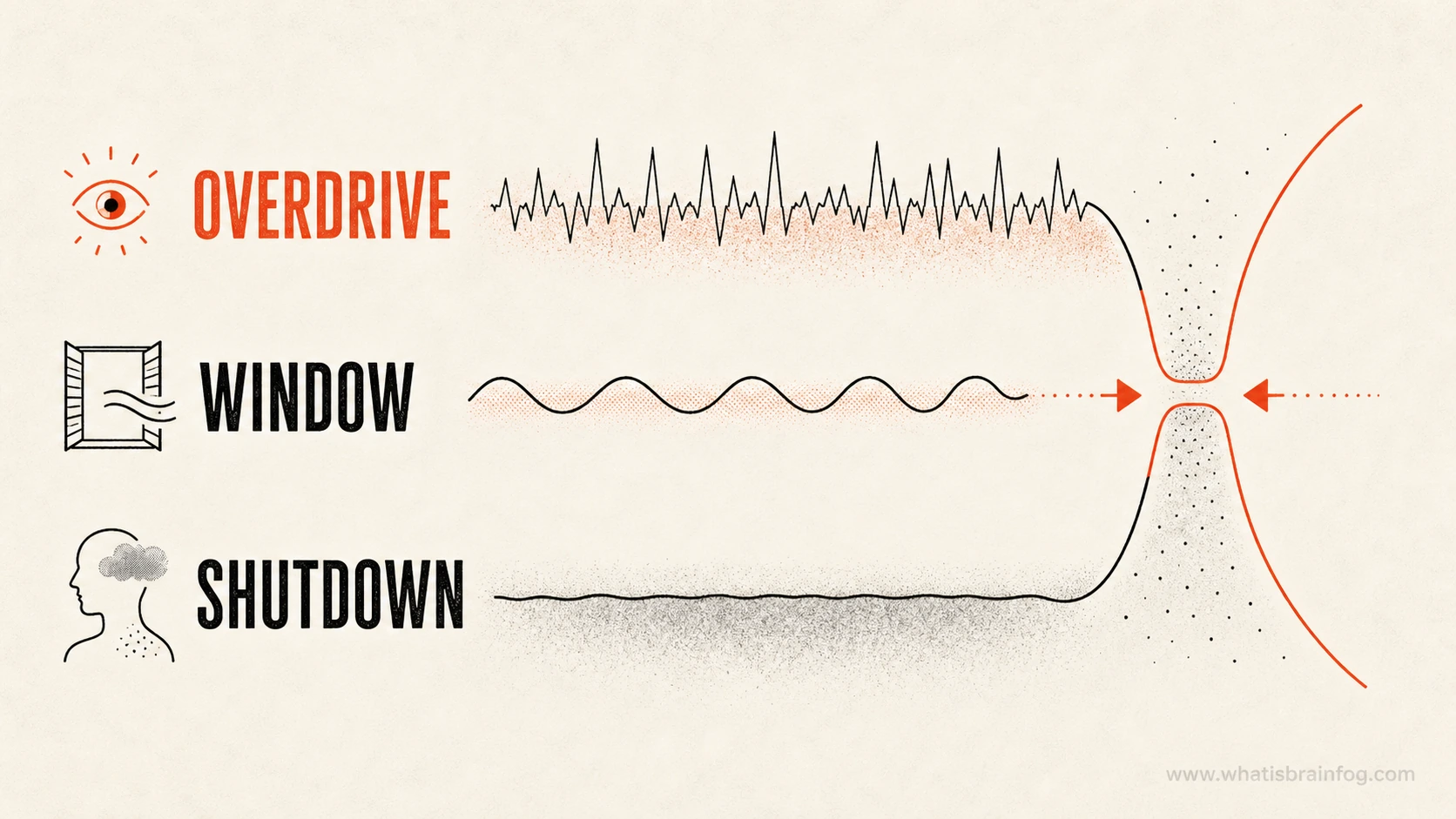
If your thinking keeps changing around reminders, conflict, nightmares, feeling unsafe, or going numb, tell a clinician about that timing. It doesn't prove PTSD or rule out another cause.
Timing and triggers
What happens just before thinking gets harder
One sequence to report
Some people notice thinking problems around reminders, conflict, nightmares, overwhelm, or dissociation. When symptoms last or seem unrelated to those, doctors should look harder for sleep, injury, neurological, medication, mood, substance-use, pain, and medical causes.
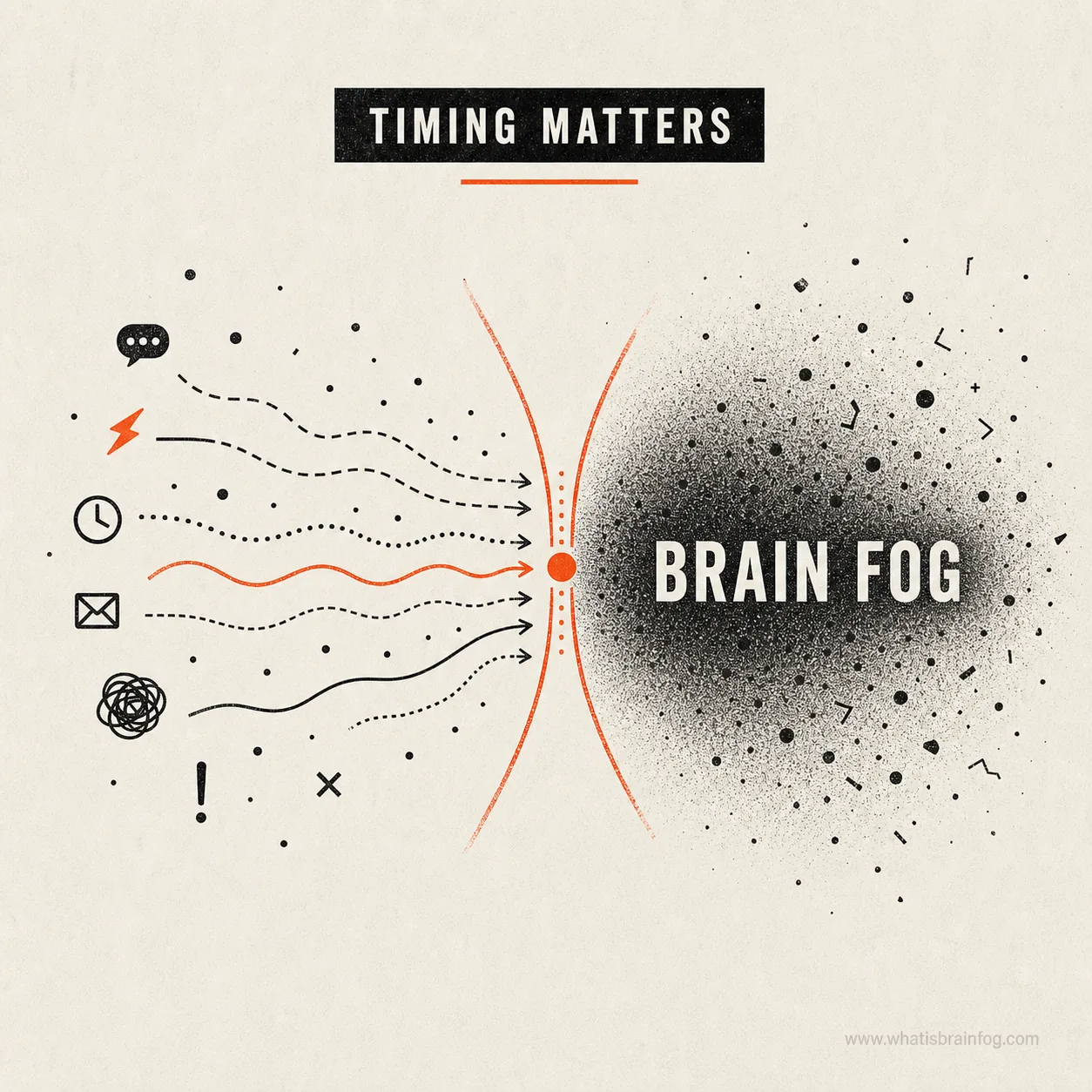
Changes around reminders
Reminders, conflict, nightmares, or feeling threatened may make thinking harder. This supports assessment but is not specific to trauma.
Changes with activation or shutdown
Some people notice different cognition during hyperarousal, overwhelm, or dissociation. Similar shifts can occur with anxiety, migraine, pain, sleep loss, and other conditions.
Constant or unrelated to reminders
If it's constant, worsening, or unrelated to reminders, ask about separate medical, neurological, sleep, medication, mood, or substance-use checks.
Hard to think right now?
Body
Try a short, comfortable movement, or name a few things you can see around you, only if it feels settling. End it if symptoms worsen.
Food and water
Regular food and hydration support general wellbeing, but a short-term response does not identify the cause of brain fog.
Environment
Reduce noise, conflict, or sensory load where it is safe and practical to do so.
Connection
Contact a trusted person or qualified clinician. In immediate danger? Contact emergency or crisis services.
Notes
Notice what was going on when it started. Trauma details can wait until you're calmer.
Optional self-check
Adverse Childhood Experiences (ACE) questionnaire
Optional questionnaire
This counts the ten childhood-adversity categories used in the original ACE study. It does not diagnose PTSD or explain current brain fog. My Fog saves only the total and skipped count, never your individual answers.
How to read an ACE count
It can describe
Categories selected
The questionnaire records whether several childhood-adversity categories were present and can add context to a clinical conversation.
It cannot determine
What the ACE score cannot tell you
The count omits many experiences, does not measure timing or severity, and cannot explain current brain fog or predict one person's outcome.
Felitti et al., Am J Prev Med 1998. Population associations require careful interpretation and do not turn an ACE count into an individual risk calculator.
Treatment and support
Treatments recommended in guidelines, and options with less evidence
These treatments are often grouped together, but they ask a person to do different work. That difference matters when avoidance, guilt, dissociation, memory detail, or readiness makes one approach feel more possible than another. No single method is best for everyone.
Treatments recommended in clinical guidelines Options to discuss with a qualified clinician
Cognitive Processing Therapy (CPT)
CPT focuses on the conclusions that can settle around trauma, including self-blame, guilt, danger, trust, control, and intimacy. In structured sessions, you check whether those conclusions still fit the evidence.
US Department of Veterans Affairs and Department of Defense guidance strongly recommends CPT for PTSD. It is one of the best-supported options when stuck meanings, guilt, or self-blame are central to the work.
This is more specific than supportive counselling or just being told to think differently.
Prolonged Exposure (PE)
PE works directly with avoidance. With a trained clinician, the person gradually approaches trauma memories, feelings, and safe places or activities that they have avoided since the trauma.
The same guidance strongly recommends PE for PTSD. Its defining work is planned exposure to memories and safe situations that avoidance has made difficult.
Your clinician plans the exposure. That isn't the same as someone pushing you into a reminder without consent or preparation.
Eye Movement Desensitization and Reprocessing (EMDR)
In EMDR, you recall specific memories while a trained clinician uses side-to-side stimulation, usually eye movements, taps, or tones, within a staged treatment.
US Department of Veterans Affairs and Department of Defense guidance, along with NICE guidance, recommends EMDR for appropriate people with PTSD.
EMDR isn't simply following a light, using bilateral audio alone, or trying to process trauma without clinical support.
Trauma-focused cognitive behavioral therapy
Trauma-focused cognitive behavioral therapy, often shortened to trauma-focused CBT, covers several structured treatments. They work directly with trauma memories, what the trauma means to you, emotions, avoidance, and getting back to ordinary life.
NICE recommends trauma-focused CBT in specific situations for children, young people, and adults with PTSD or clinically important symptoms.
Ask which specific model the clinician is offering, what training they have, and how the approach fits the diagnosis and age group.
Body-based and supportive approaches
Grounding, paced breathing, movement, and body-oriented therapies can be coping tools or support alongside treatment, if they feel manageable.
Evidence and guideline status vary by approach and are generally less established than for recommended trauma-focused psychotherapies.
End any exercise that increases distress, dissociation, dizziness, pain, or breathing difficulty.
Medication, when indicated
Medication choices require a prescriber and should follow the diagnosis, target symptoms, other medicines, risks, and preferences. They do not replace trauma-focused psychotherapy when that care is appropriate and available.
US Department of Veterans Affairs and Department of Defense guidance supports selected antidepressants for PTSD and suggests prazosin only for PTSD-associated nightmares, not for overall PTSD treatment.
Ask your prescriber before starting, stopping, or changing psychiatric medication.
US Department of Veterans Affairs and Department of Defense Clinical Practice Guideline for PTSD and Acute Stress Disorder, 2023.
MDMA-assisted therapy (restricted and unapproved)
The US Food and Drug Administration (FDA) hasn't approved MDMA for PTSD. In Australia, only specifically authorized psychiatrists can prescribe it, using unapproved products under the Therapeutic Goods Administration (TGA) Authorised Prescriber pathway.
The FDA's 2024 complete response letter said the application hadn't proved MDMA works or is safe. Australia requires an authorized specialist and regulated clinical safeguards.
Leave MDMA to regulated clinical settings. It isn't for self-treatment.
FDA Complete Response Letter for New Drug Application 215455; Australian TGA access guidance, updated June 2026.
Day-to-day support Support while you wait or alongside treatment
Current safety and practical support
Address ongoing danger, housing, violence, coercion, or crisis needs before asking someone to process trauma memories.
Safety planning and practical support are care priorities. They aren't a test of whether symptoms are trauma-based.
Optional regulation skills
Try a brief grounding, orientation, or paced-breathing exercise only if it is comfortable and helps you remain present.
These skills may lower distress for some people but do not diagnose or treat every cause of brain fog.
Sleep and daily-load review
Note sleep opportunity, nightmares, snoring, medicines, alcohol, pain, and late-evening stimulation, then bring persistent problems to care.
Sleep and daily thinking load can maintain brain fog regardless of trauma symptoms.
Stability First
While you're waiting for care
Keep the plan low-pressure and safety-first. Try optional coping steps without delaying assessment or forcing trauma processing.
Choose one optional grounding tool
Try a brief orientation or paced-breathing exercise only if it helps you remain present. End it if distress, dizziness, pain, or dissociation increase.
Notice what happened before your brain fog got worse
Record timing, sleep, medicines, pain, injury details, and what was happening without writing a detailed trauma narrative.
Protect sleep opportunity
Reduce late-evening stimulation where practical and seek sleep assessment when snoring, breathing pauses, nightmares, or unrefreshing sleep persist.
Make contact easier
Save the clinician, service, or trusted person's details and write one sentence you can use to ask for help.
Keep crisis routes current
Use official local emergency and crisis services for immediate danger. Check your country's current crisis phone and text numbers. An old saved number may have changed.
Lived experience
How people describe the experience
We've paraphrased these accounts from people with trauma-related brain fog. They show what the experience can cost in ordinary life. They are not diagnostic criteria, and no single scene proves trauma is the cause.
The brain fog doesn't switch off
After a traumatic event, some people describe constant brain fog and feeling cut off from themselves or the room around them. Constant brain fog doesn't prove trauma is the cause, especially if medicine withdrawal, sleep, pain, or illness changed at the same time.
I can scroll, but I cannot start
A person can spend hours on the phone and still be unable to begin a shower, make food, answer someone, or leave for an appointment. They may feel mentally stuck without looking frightened.
A trauma dream can follow them into the day
After a trauma-related dream, some people lose much of the day to detachment and unclear thinking. Planning or purposeful thought may stay difficult until later, or until after another sleep.
New information will not stay
After retraumatization or intense dissociation, some people report that learning becomes harder and new memories do not form as reliably. That change needs checking. It shouldn't be written off as ordinary stress.
Speech becomes the frightening part
They know what they meant to say, but a different word comes out. Repeated mistakes can make calls and family conversations frightening because they start wondering whether they are losing their mind.
What helped
- Finding a clinician trained in the diagnosis and the treatment they offered
- Using specific examples of cognitive and sleep problems during assessment
- Addressing sleep, pain, medication, depression, or concussion alongside trauma symptoms
What did not help
- Clinicians calling every physical or cognitive symptom psychological without checking for other causes
- Forcing disclosure or detailed trauma processing before someone was safe and ready
- Treating one coping exercise as proof of the diagnosis
Surprises
- Emotional symptoms and cognition may improve at different rates
- A trauma history can coexist with a separate medical or sleep cause
- The preferred evidence-based treatment is not the same for every person
Common mistakes
- Using an ACE score as a diagnosis or risk forecast for one person
- Assuming a normal basic blood panel rules out every overlap cause
- Changing medication or attempting drug-assisted treatment without qualified care
Community tip: Use lived-experience reports to prepare better questions, not to make a diagnosis. Ask what fits, what does not, and what else needs assessment.
Questionnaires and Logs, With Their Limits
Open a worksheet only if it would help you describe what happened. These tools are optional and can't diagnose trauma or PTSD.
Optional check-in
Use this only if comparing your brain fog level with how activated or shut down you feel would help.
Why trauma can make thinking harder
PTSD and trauma-related states can change attention, memory, arousal, sleep, and threat processing. Most evidence is group-level and does not identify the cause of one person's brain fog.
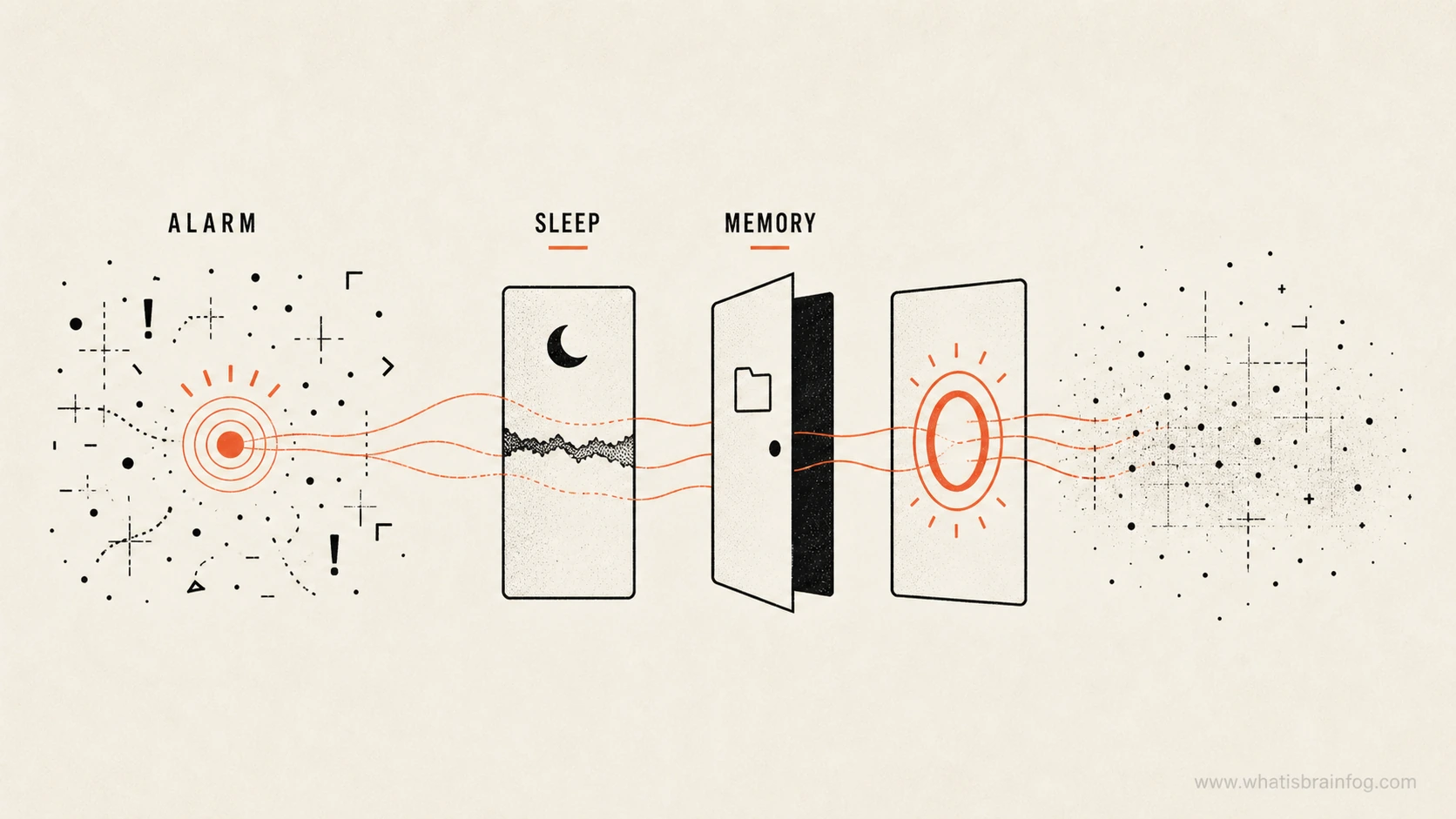
How it can happen
How trauma can interrupt thinking
Three possible factors, in any order. This isn't a test.
Threat load
Threat monitoring can take attention before you choose it
Your brain may treat sounds, expressions, movement, and changes in tone as possible danger. When attention keeps going there, less is left for working memory, language, and the task at hand.
Shutdown state
You can go blank or feel detached
During an overwhelming moment, some people lose their place in a conversation, can't find a familiar word, or feel cut off from what's happening around them.
Forgetfulness alone doesn't show dissociation. A clinician needs the full context to judge.
Recovery failure
The night can carry into the next day
Nightmares, insomnia, pain, and sleep-disordered breathing can all leave concentration and memory worse the next day.
Persistent unrefreshing sleep or snoring deserves a separate sleep assessment.
One bad episode is hard to interpret. If your thinking keeps changing with the same kind of reminder, conflict, nightmare, or shutdown, your clinician has something more specific to ask about.
When reminders or conflict make thinking harder
If your brain fog keeps flaring after reminders, conflict, nightmares, or feeling unsafe, tell your clinician what came just before. That timing helps an assessment but doesn't prove the cause.
Cognitive Impact by Domain
A meta-analysis of 60 studies (n=4,108) found average differences across several cognitive domains in people with PTSD. The largest average differences were in verbal learning and processing speed. This does not predict one person's cognitive profile.
Scott et al., Psychological Bulletin 2015. PMID 25365762
How trauma-related symptoms can affect thinking
Threat monitoring
your attention can keep turning to possible danger, leaving less for the task at hand.
Sleep disruption
nightmares, hyperarousal, insomnia, and sleep fragmentation can independently impair cognition.
Dissociation and shutdown
detachment or reduced access to memory and language can occur during overwhelming states.
Mood, pain, and medication overlap
depression, chronic pain, alcohol, sedating medicines, and other factors can maintain cognitive symptoms.
Evidence-based PTSD treatment can improve symptoms, but cognitive recovery varies and may require reassessment of other contributors.
When to seek more help
When to Seek Professional Help
Seek assessment when safety, severity, daily-life changes, or lasting symptoms call for it; no self-help deadline applies.
Immediate danger or crisis
Get emergency or crisis support now for suicidal thoughts, self-harm risk, being unable to stay safe, or danger from others.
New neurological signs
New weakness, facial droop, trouble speaking, seizure, sudden confusion, or a sudden severe headache needs urgent medical help.
Dissociation or flashbacks create risk
Losing time, becoming disoriented, or being unable to drive, work, parent, or stay safe warrants prompt professional review.
Function is declining
Persistent cognitive change affecting daily life deserves assessment even when the trauma link is uncertain.
Symptoms changed with medication or substances
Contact the prescriber or a suitable clinician. This page isn't a reason to stop psychiatric medication suddenly.
Preparing for an assessment
What to tell a clinician about your thinking
My brain fog seems to change alongside reminders, feeling on guard, or shutting down. I want to discuss whether trauma could explain part of it, and what else we should check.
Consultation sheet
Lead with triggers and timing, not the symptom alone.
Full conversation script
I am having cognitive symptoms alongside possible trauma-related symptoms. I would like an assessment that also considers sleep, head injury, pain, mood, medicines, substance use, and medical causes.Tests and assessment
What a Trauma Assessment May Include
Testing can look for sleep, neurological, medical, medication-related, or injury-related causes that may coexist with trauma symptoms.
How testing is chosen
Begin with history, daily function, safety, and examination. Add sleep, medical, neurological, or cognitive tests only if results would change what your clinician checks or treats.
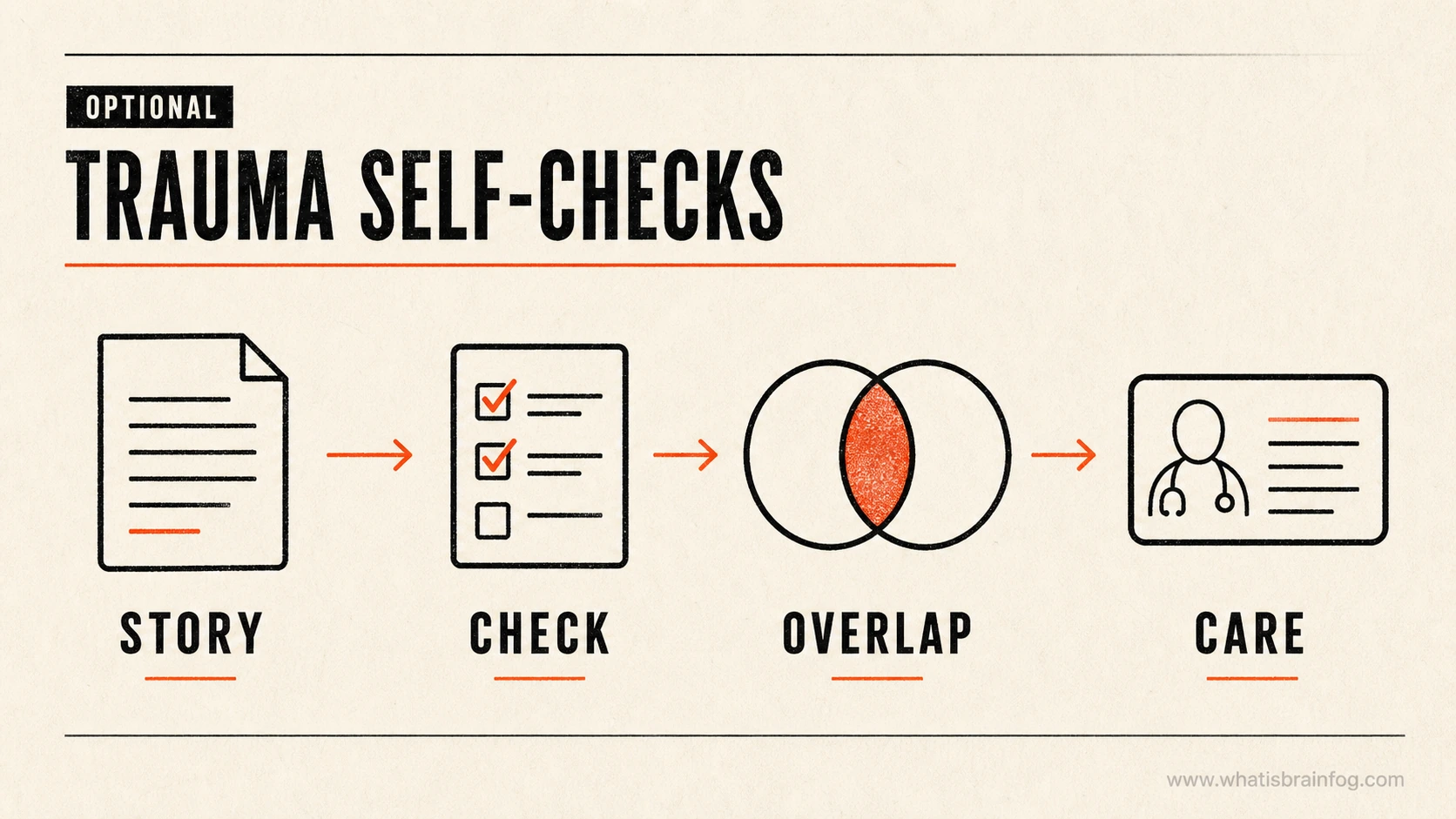
Trauma screening and structured history
Clinical history covering trauma symptoms, duration, impairment, immediate safety, sleep, head injury, pain, mood, medicines, and substance use
Validated PTSD or depression screeners when useful as conversation aids
Targeted physical examination, sleep evaluation, blood tests, or cognitive testing only when the symptoms or examination give a clear reason
Urgent neurological or emergency assessment for new focal deficits, acute confusion, severe headache, or immediate danger
There is no routine cortisol, imaging, blood, or questionnaire result that confirms trauma as the cause of brain fog. Order a test only when the history or examination identifies a specific problem it could confirm, exclude, or help manage.
Check other possible causes
A clinical review of sleep, pain, head injury, medications, mood, substance use, and other plausible contributors.
A sleep assessment when snoring, witnessed breathing pauses, nightmares, insomnia, or unrefreshing sleep are prominent.
Targeted blood tests only when history, examination, diet, bleeding risk, medicines, or other findings make them relevant.
Thinking and memory testing when a clinician needs to measure which abilities are affected or tell possible causes apart.
How to read the result
US, UK, and Australia
Finding trauma-informed care where you live
Choose your country to see the relevant guidelines, how people usually get care, and which services are available.
US Department of Veterans Affairs and Department of Defense Clinical Practice Guideline for PTSD and Acute Stress Disorder (2023)
- Use a clinical assessment; questionnaires support but do not establish diagnosis.
- Discuss recommended trauma-focused psychotherapies with a trained clinician when PTSD fits.
- Medication decisions require individualized prescriber review.
- Assess immediate safety and common medical, sleep, injury, mood, and substance-use overlap.
How trauma care usually starts in the United States. Availability and coverage vary.
-
01 Start with assessment and safety
Describe the cognitive symptoms, trauma-related symptoms, sleep, head injury, pain, medicines, alcohol or other substances, and functional change. Use urgent or crisis care for immediate danger.
-
02 Discuss evidence-based options
Ask how the clinician reached the diagnosis, which guideline-supported options fit, what alternatives exist, and how they'll check for benefit or harm.
-
03 Check training and access
Check relevant trauma-treatment training, license, fees, coverage, accessibility, and their plan for other conditions. A directory listing is not a quality guarantee.
-
04 Veterans can check Department of Veterans Affairs routes
Veterans and service members can ask about Department of Veterans Affairs or Vet Center eligibility and available evidence-based PTSD care.
What the numbers mean
ACE questionnaire
Counts categories of childhood adversity for context. It does not diagnose PTSD, determine the cause of brain fog, or predict an individual's outcome.
PTSD Checklist for DSM-5 (PCL-5)
A PTSD symptom checklist used for screening and monitoring. Interpretation depends on setting and must be combined with clinical assessment.
PHQ-9
A depression symptom screen. It is not a trauma test; any self-harm response needs prompt clinical follow-up regardless of the total score.
NICE NG116: Post-traumatic stress disorder
- Assessment should cover PTSD symptoms, risk, impairment, and coexisting conditions.
- NICE recommends trauma-focused CBT and EMDR in defined circumstances.
- Treatment format and duration depend on age, timing, complexity, preference, and clinical need.
- Verify current local referral and crisis routes because service access varies.
How trauma care usually starts in the United Kingdom. Local services and wait times vary.
-
01 In the UK, start with a GP or NHS self-referral
Ask for an assessment of trauma symptoms and thinking problems. Also mention sleep, injury, pain, medicines, mood, and substance use.
-
02 Check local talking-therapy access
Eligibility, referral routes, treatment availability, and waits differ by area. Confirm the current local pathway rather than relying on a fixed estimate.
-
03 Check whether the treatment is helping
Ask whether the proposed care follows NICE guidance for the diagnosis, how it handles complexity and dissociation, and what happens if progress stalls.
Phoenix Australia: Australian Guidelines for the Prevention and Treatment of Acute Stress Disorder, PTSD and Complex PTSD
- A clinician should assess you, not a biomarker or self-test.
- Discuss guideline-supported psychological treatment with a suitably trained clinician.
- Medicare, state, Department of Veterans' Affairs (DVA), and private routes have different eligibility and availability.
- MDMA remains an unapproved product with access restricted to specifically authorised psychiatrists.
How trauma care usually starts in Australia. Eligibility, rebates, and availability change.
-
01 Start with safety and assessment
Use emergency or crisis services for immediate danger. Otherwise, describe trauma symptoms, cognition, sleep, head injury, pain, medicines, mood, and substance use to a GP or qualified mental-health clinician.
-
02 Check current care and rebate routes
Ask the GP or service about current Medicare eligibility, fees, rebates, wait times, clinician training, and alternatives. Check the current session allowance. Older pages may list an outdated number.
-
03 Support for veterans and their families
Confirm current eligibility and services directly with the Department of Veterans' Affairs (DVA) or Open Arms.
Recovery
Can trauma brain fog improve?
Many people improve with appropriate care, but trauma symptoms and cognition do not follow one fixed sequence or session count.
Review progress by symptoms, functioning, safety, sleep, adverse effects, and goals. Reassess the diagnosis and overlapping causes when cognition does not improve as expected.
Whether ongoing danger or instability is still present
Whether the treatment helps, feels tolerable, is accessible, and suits the person's preferences
Sleep, pain, concussion, depression, medication, and substance-use overlap
Complexity, duration, dissociation, and other coexisting conditions
Practical supports and the person's own recovery goals
Recent research
What recent research has found about trauma and cognition
People describe blankness, scanning, memory lapses, poor sleep, or difficulty finding words.
The ACE questionnaire counts categories of childhood adversity. It describes population-level risk and life context; it does not diagnose PTSD, explain current brain fog, or predict an individual's future.
Felitti et al., Am J Prev Med 1998 · DOI
Brain fog in PTSD is not yet one standardized clinical construct. People can report real cognitive difficulty even when a brief test does not capture the whole experience, while dissociation and coexisting health conditions may add to the problem.
Sanger et al., Psychol Res Behav Manag 2025; PMID 40093756 · PubMed
A 2026 review found average verbal episodic-memory and working-memory differences between adults with PTSD and trauma-exposed adults without it. Variation between studies and possible publication bias mean the result cannot predict one person's memory or establish a diagnosis.
Sulejmani et al., Prilozi 2026; PMID 41863109 · PubMed
Hypervigilance, dissociation, avoidance, sleep disruption, and feeling on alert can consume cognitive resources. These guide an assessment. They aren't a self-test or proof trauma is the only cause.
DSM-5-TR; NICE NG116
Trauma-focused cognitive behavioral therapy, Cognitive Processing Therapy (CPT), Prolonged Exposure (PE), and Eye Movement Desensitization and Reprocessing (EMDR) are evidence-based PTSD treatments when a trained clinician provides one that suits you. Which one, and for how long, varies.
NICE NG116; US Department of Veterans Affairs and Department of Defense 2023 (Schnurr et al., Ann Intern Med 2024, PMID 38408360); Kip et al. 2025, PMID 40250015 · DOI · PubMed
Sleep may improve at a different pace from other PTSD symptoms. In one 2025 treatment study, participants reported better sleep while actigraphy did not show the same change, and many still reported clinically significant sleep difficulty after treatment.
Porten et al., Eur J Psychotraumatol 2025; PMID 40862670 · PubMed
Computerized working-memory training is still experimental for PTSD. A small 2025 trial found veterans could use the program, and those who finished it may have benefited. Larger studies haven't yet confirmed this or shown wider benefit.
Bomyea et al., J Psychiatr Res 2025; PMID 39642474 · PubMed
If thinking problems continue while trauma symptoms improve, recheck sleep, pain, concussion, medications, depression, ADHD, thyroid, anemia, substance use, and other possible causes.
Clinical reminder: persistent cognitive symptoms can have more than one cause.
Recovery is possible, but thinking and emotional symptoms don't follow one fixed order or timeline. New, worsening, or localized neurological symptoms need a separate medical assessment.
NICE NG116; US Department of Veterans Affairs and Department of Defense PTSD Clinical Practice Guideline 2023
What Biomarkers and Brain Scans Can Actually Tell You
What may keep thinking problems going
Trauma-related conditions can affect attention, memory, alertness, and sleep. These are real biological and psychological effects, but no single scan, cortisol result, or inflammation test can show what causes one person's brain fog.
These are three possible contributors. The same difficulties can also come from sleep loss, concussion, pain, medication, mood, substance use, or a medical condition.
What research can and cannot tell one person
Research can ask
How groups differ on average
Studies can compare stress hormones, sleep, cognition, or brain networks across groups and time.
This page cannot infer
What a scan or blood test can't explain about your symptoms
Results vary with timing, sleep, medicines, illness, age, sampling, and many other factors. Routine cortisol testing does not diagnose trauma-related brain fog.
Your clinician should weigh symptoms, function, safety, an exam and other possible causes, not a one-size-fits-all “trauma curve.”
Specific evidence findings
Cognition
Studies find average differences in attention, learning, memory, and processing speed in PTSD. Newer reviews support verbal episodic-memory and working-memory differences even against trauma-exposed comparison groups, while also reporting substantial variation between studies.
Scott et al. 2015, PMID 25365762; Sulejmani et al. 2026, PMID 41863109
Biomarkers
Cortisol, inflammation, genetics, and brain-imaging results are still research findings. None offers a routine clinical test showing trauma caused one person's brain fog.
Life-stage Read
Trauma, Cognition, and Life Stage
The same history can look different as school, work, relationships, hormones, health, and independence change. These help you ask better questions. They aren't rules about what trauma must do to a brain.
Children
A child may look inattentive, restless, withdrawn, forgetful, or suddenly worse at school. Trauma is one possibility. So are learning differences, ADHD, sleep problems, family stress, sensory needs, and medical causes. The child needs a child-focused assessment, not an adult label.
Teenagers
The first visible change may be falling grades, staying away from people, taking more risks, sleeping at the wrong times, or using alcohol or drugs. The cognitive problem can hide inside what adults first read as attitude or poor effort.
Young adults
Leaving home, starting work or university, or entering close relationships can make earlier experiences look different. Some people first realize that what felt normal while growing up was adversity. That realization can belong in the history without becoming the only explanation for new brain fog.
Adults
A person may appear to cope for years, then struggle when caregiving, illness, grief, pregnancy, relationship strain, or work pressure leaves less room to compensate. Old trauma can matter. The question is whether trauma explains the whole change, or whether sleep, pain, medicines, mood, injury, or illness is also present.
Perimenopause
By itself, perimenopause (the years before menopause) can affect sleep, mood, word memory, attention, and working memory. Research also suggests trauma and menopause symptoms can occur together in these years, but researchers can't yet say exactly why. If both apply to you, one doesn't rule out the other.
Older adults
Old trauma can remain relevant, but new cognitive change still needs its own review. Medicines, sleep, mood, hearing or vision loss, neurological disease, and other medical causes can look similar, so check each one even with a trauma history.
[Source 1][Source 2][Source 3][Source 4][Source 5][Source 6][Source 7]
1915-2026
Understanding Trauma and Cognition: A Timeline
The history of trauma care includes changing diagnostic definitions, evolving evidence for psychotherapy, and repeated corrections to claims that became stronger than the data.
Shell shock described during the First World War
Soldiers had thinking and psychological symptoms after combat. Doctors saw the same symptoms in soldiers with no direct blast exposure. That helped them see psychological trauma could affect thinking even without an obvious physical brain injury.
Source From shell shock and war neurosis to PTSD: a history of psychotraumatology ; Source 'Shell shock' revisited: an examination of the case records of the National Hospital in London (Linden and Jones, Med Hist 2014; PMID 25284893)
PTSD enters the third edition of the Diagnostic and Statistical Manual
Post-Traumatic Stress Disorder becomes an official diagnosis, driven by research on Vietnam veterans, Holocaust survivors, and sexual trauma survivors. The manual lists thinking symptoms, including trouble concentrating, as part of the condition.
EMDR Introduced
Francine Shapiro introduces Eye Movement Desensitization and Reprocessing, a therapy that processes trauma with side-to-side eye movements or taps. It later becomes a NICE-recommended first-line treatment.
Source Shapiro, J Behav Ther Exp Psychiatry 1989 (PMID 2576656) ; de Jongh et al., J Trauma Stress 2024 (PMID 38282286)
ACE Study Published
The ACE Study linked categories of childhood adversity with later health outcomes at the population level. ACE scores do not diagnose PTSD, explain current brain fog, or determine an individual's future.
The Body Keeps the Score
Van der Kolk's book helped popularize trauma-informed ideas. It's a summary for general readers, not a clinical guideline. Some claims need more careful checking.
Source van der Kolk, The Body Keeps the Score (Viking, 2014)
Neurocognitive Meta-Analysis
Scott et al. publish a full meta-analysis measuring thinking problems in PTSD. Verbal learning (d = -0.62), processing speed (d = -0.59), and attention/working memory (d = -0.50) are most affected.
Somatic Experiencing Validated
A randomized trial reported benefit for Somatic Experiencing in PTSD. One trial supports further study but does not establish it as equivalent to guideline-recommended trauma-focused therapies.
NICE NG116 Published
The UK's National Institute for Health and Care Excellence (NICE) recommends EMDR and trauma-focused CBT as first-line treatments for PTSD, backing therapy built for trauma over general approaches.
Source NICE NG116 PTSD (2018)
FDA does not approve the first MDMA-assisted therapy application
The FDA didn't approve Lykos's midomafetamine (MDMA) application, concluding it wasn't proven effective and safe. In Australia, MDMA is still unapproved, and only specifically authorized psychiatrists can prescribe it under a regulated pathway.
Researchers review brain fog in PTSD
A review of brain fog in PTSD calls it a self-reported thinking problem that may involve attention, memory, dissociation (feeling detached or unreal), sleep, and other physical or mental health conditions. It finds there's still no agreed definition or measure.
Source Sanger et al., Psychol Res Behav Manag 2025; PMID 40093756
A larger memory review separates trauma exposure from PTSD
A meta-analysis comparing adults with PTSD against trauma-exposed adults without PTSD found average differences in verbal episodic and working memory. Studies varied a lot, so this is only a group-level link. It isn't a memory test that diagnoses PTSD in one person.
Still foggy: I'm in treatment but still have brain fog
Was the Therapy Aimed at the Right Problem?
Feeling better in one area while your thinking stays unclear doesn't prove therapy failed. CPT, PE, EMDR, and broader trauma-focused CBT do different work. The first question is whether the therapy fits the diagnosis and the problem that is still getting in the way.
Compare the main trauma therapiesWhen therapy helps but brain fog stays
You're not failing
Emotional healing and cognitive clearing often happen on different timelines. If therapy helped your mood but left your thinking unclear, another condition may also be contributing.
Before you call therapy a failure
If distress improves but thinking does not, review whether the treatment is helping, its adverse effects, sleep, pain, concussion, ADHD, medicines, substance use, and relevant medical causes.
What may still be making thinking harder
Check
Tests that may be worth discussing
- A clinical review of sleep, pain, head injury, medications, mood, substance use, and other plausible contributors.
- A sleep assessment when snoring, witnessed breathing pauses, nightmares, insomnia, or unrefreshing sleep are prominent.
- Targeted blood tests only when history, examination, diet, bleeding risk, medicines, or other findings make them relevant.
- Thinking and memory testing when a clinician needs to measure which abilities are affected or tell possible causes apart.
Ask
Other causes worth asking about
- Whether the current therapy is evidence-based for the diagnosis and matched to your preferences, safety, and readiness.
- A medication review if your thinking changed after starting, stopping, or changing a medicine.
- Sleep, concussion, migraine, pain, ADHD, depression, alcohol, or other contributors that may need parallel care.
- Cognitive rehabilitation only when an assessment finds an everyday problem it's designed for.
Optional self-check
PTSD Checklist for DSM-5 (PCL-5)
Self-check instrument
The PTSD Checklist for DSM-5 (PCL-5) can help you describe current symptoms and see whether they change over time. My Fog saves totals, never your individual answers.
Optional log
Trigger check-in
Your notebook
Your history and free-text note stay in this browser. My Fog receives the date, brain fog level, broad state, and the categories you choose.
Grounding and Breathing Tools
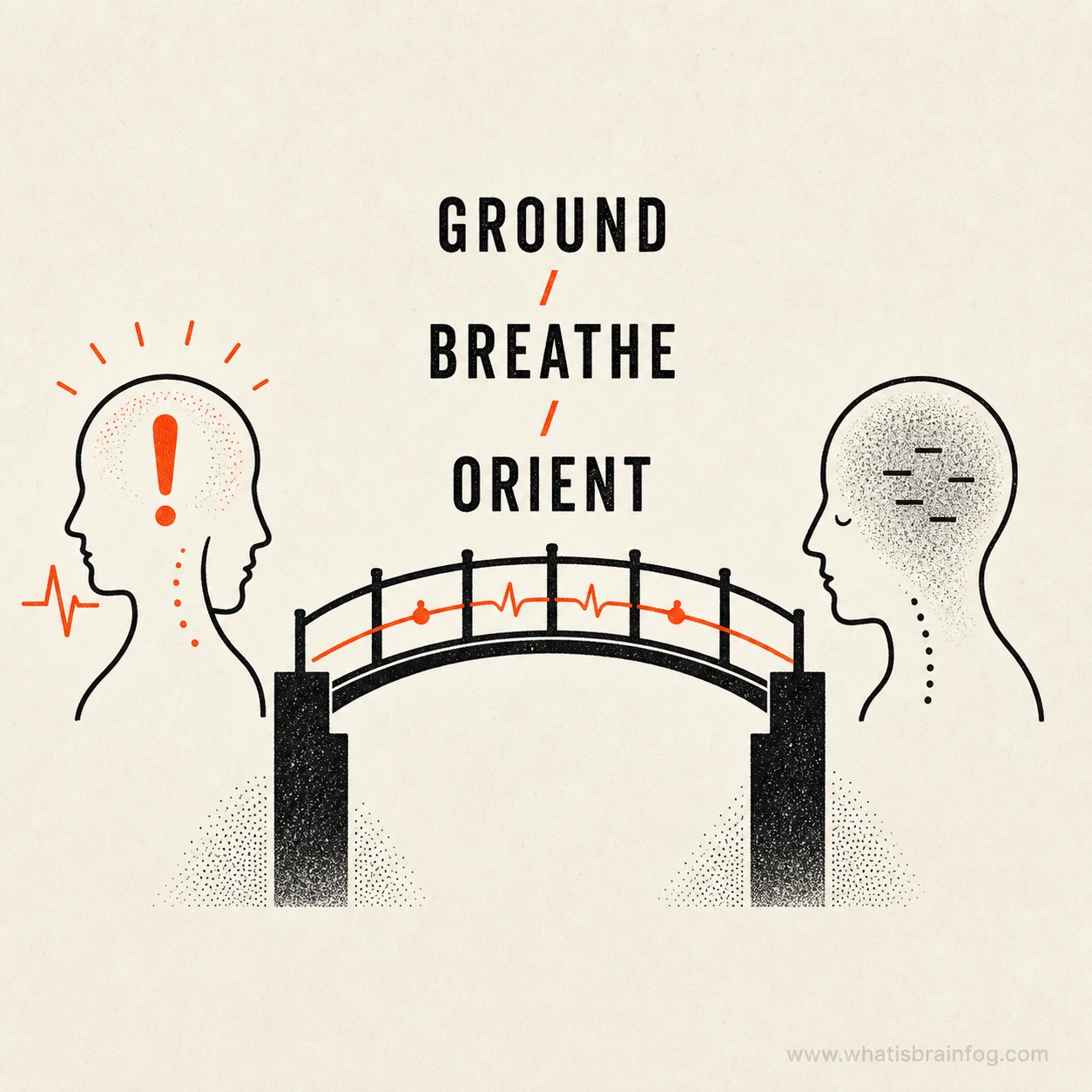
Regulation bench
Use these briefly when you feel too activated or too shut down to think clearly. Then decide what helps next.
What can remain
Why thinking problems can stay after therapy starts
Trauma symptoms and cognition can change at different rates
Improvement in distress does not guarantee that sleep, memory, attention, or executive function will improve on the same timeline.
Another contributor may still be active
Sleep disruption, concussion, pain, depression, medication effects, substance use, and medical conditions can coexist.
The diagnosis or treatment may need a second look
The treatment approach, pace, readiness, access, adverse effects, and the working diagnosis all deserve review when progress stalls.
Prepare for an appointment
Open the trauma appointment handout
If you want to bring the symptom history to an appointment, open the handout below. It does not require sign-in.
Support: I'm supporting someone who's been through trauma
Supporting someone with trauma-related brain fog
From the outside, trauma-related thinking problems can look inconsistent, because they get better and worse at different times. A reminder, a poor night's sleep, feeling on guard, or shutting down can change how clearly someone thinks from one hour to the next.
What support can do
Offer predictability, less pressure to explain in the moment, and one concrete option while respecting the person's choices and your own limits.
From the outside
What you may see
They may lose track of a conversation, need more time, or cancel when overloaded.
Responses can change with sleep, pain, reminders, conflict, medication, or perceived safety.
The same outward behavior can have more than one cause. Ask what's going on instead of guessing.
From their side
What the person may be dealing with
They may describe detachment, blankness, scanning, poor sleep, or difficulty accessing words.
They may also be dealing with concussion, migraine, pain, depression, medicines, or a sleep disorder.
Only the person and their clinicians can decide what fits, so leave the cause to them.
Phrases that can hurt
Just get over it
This dismisses distress and cognitive difficulty. Ask what practical support would reduce pressure now.
Have you tried not thinking about it?
Many people are already spending enormous effort avoiding reminders. This can sound like blame. Offer a pause, a change of subject, practical company, or help finding qualified care instead.
It happened years ago
Time alone does not tell you whether current symptoms meet a diagnosis or what other contributors are present.
Other people had it worse
Comparison does not assess safety, symptoms, impairment, or care needs.
Tell me everything
You're not their therapist. Let them decide, with a qualified professional, how much to share and how fast.
Practical support
How to Help Without Adding Pressure
Ask what helps and respect a request to pause, leave, or involve a qualified clinician.
Support sleep, appointments, transport, meals, or note-taking without treating those actions as therapy.
Use emergency or crisis services when there is immediate danger, and keep your own boundaries clear.
Related context
How trauma can affect thinking
What points toward trauma, what points elsewhere, and where to read next.
One thing
If trauma or PTSD may play a part, start with a qualified assessment. Compare sleep, concussion, pain, medication, and other contributors before narrowing it down.
NICE NG116 and VA/DoD PTSD guidance
Before you assume one cause
Check concussion, sleep disorders, ADHD, and medication effects before deciding trauma is the whole cause.
Nearby causes
ptsd
Formal diagnostic context for trauma-linked symptom clusters
anxiety
Shared worry, arousal, sleep, and concentration symptoms
depression
Overlapping low mood, withdrawal, slowing, and poor concentration
burnout
Sustained demand and poor recovery can overlap with trauma-related exhaustion
pcs
Head-injury timing changes the assessment and care pathway
migraine
Headache, sensory sensitivity, and cognitive symptoms can overlap
One thing
If trauma symptoms improve but cognition remains impaired, ask for reassessment of sleep, pain, concussion, mood, medicines, substance use, and relevant medical causes.
Use a timeframe appropriate to severity and clinical context
Before you call it stalled
Persistent fog may mean the treatment is not helping enough, only some symptoms improved, side effects are getting in the way, or another condition also needs assessment.
Nearby causes
sleep
Insomnia and fragmented sleep can independently impair cognition
burnout
Sustained demand and poor recovery can overlap with trauma-related exhaustion
adhd
Attention symptoms may predate trauma or coexist
pain
Pain and pain medicines can independently impair cognition
alcohol
Use can worsen sleep and cognition and may need separate care
sleep apnea
Snoring, breathing pauses, and unrefreshing sleep need their own assessment
One thing
Reduce surprise, offer one clear next step, and do not force disclosure or trauma processing.
Support without diagnosing
Before you read it as avoidance
Withdrawal, forgetfulness, and indecision can have many causes. Ask what support is wanted instead of assigning intent.
Nearby causes
ptsd
Formal diagnostic context for trauma-linked symptom clusters
depression
Overlapping low mood, withdrawal, slowing, and poor concentration
anxiety
Shared worry, arousal, sleep, and concentration symptoms
eating disorders
Nutrition, safety, and mental-health needs may require specialist care
Optional tools
ACE Calculator
Optional public-domain adversity self-check
PTSD symptom checklist
Optional PCL-5 self-check
Window of Tolerance Check-in
Compare how activated or shut down you feel with your fog level
Grounding and Breathing
Regulation bench for activated or shutdown states
Trigger check-in
Brief note for spotting trigger-linked fog
Related causes
PTSD
Compare the overlap
Anxiety
Compare the overlap
Depression
Compare the overlap
Sleep
Compare the overlap
Across the site
Appointment handout
A shorter summary you can save or show during an appointment
Related reading
Cortisol and Brain Fog: When Testing Helps
What to record before your appointment and when cortisol testing helps.
Review status
Published: 2025
Reviewed: 2026-07-15
By: Dr. Alexandru-Theodor Amarfei, M.D.
This information is educational, not medical advice. Trauma is a complex area that benefits from professional support. If you're in crisis, please seek immediate help.