ADHD and Brain Fog
Which description fits you?
Your starting point
Quick answer
Evidence and recovery context
ADHD and brain fog
Attention and executive function | Updated 2026-08-10
ADHD can make it hard to remember the next step while cooking. You may know a bill needs paying but struggle to make the payment. During a conversation, you may realise you missed part of what someone was saying.
Why ADHD may go unnoticed for years
Girls, quiet children and high achievers are often missed
Strong ability, strict routines or regular help from parents or teachers with remembering tasks, staying organised and finishing schoolwork can hide childhood difficulties. They may become more obvious when school structure disappears, adult responsibilities increase, or perimenopause makes existing ADHD symptoms harder to manage.
Assessment quality
A questionnaire and a quick prescription aren't a full ADHD assessment
A proper assessment covers your childhood history, problems in different parts of life and other possible explanations. It should also include a clear follow-up plan, especially when the clinician prescribes medicine.
In their own words
What people with ADHD say is difficult
I am so, so tired of misplacing things.
I’ll think something takes 10 minutes and it takes 3 hours.
For me, I suck at starting AND stopping things. Transitions are hard.
ADHD toolsScreening, appointment preparation and focus
Not diagnosed: I think I might have ADHD
See what ADHD can feel like, take the adult screener once, and check whether anything changed recently.
Why attention can change so much from one activity to another
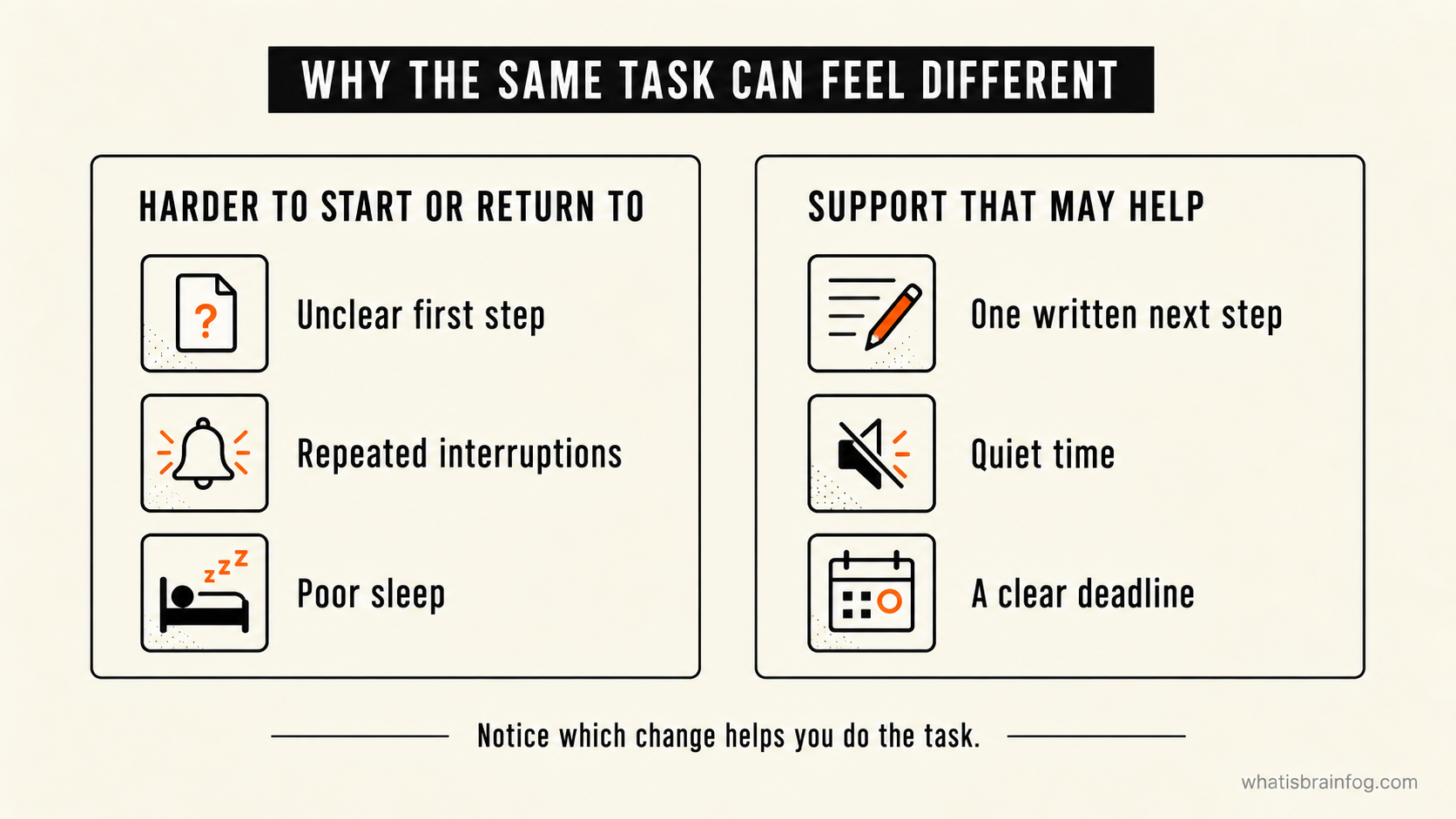
An absorbing interest, an urgent problem or a clear deadline can hold attention for hours. Routine work with no immediate reward may be much harder to begin or return to after an interruption. This is one reason the same person can appear highly capable in one situation and stuck in another.
One reason mornings may be harder A 2010 study of 40 adults with ADHD found a later evening rise in melatonin in those who also had trouble falling asleep. This supports checking sleep timing when mornings are difficult. It doesn't mean everyone with ADHD has a delayed body clock.
Van Veen et al., Biol Psychiatry 2010 (PMID 20163790). Read the ADHD evidence timeline
Daily life
How ADHD difficulties can affect an ordinary day
Examples include conversations, chores, work, study, sleep, and relationships.
Daily life
Examples you may recognize
For an assessment
Explain what actually happened
“I forgot the second part of a request before I could write it down” tells a clinician more than “my brain was foggy.”
ADHD-related difficulties usually have roots in childhood, even when adult demands make them harder to manage.
An absorbing interest can hold attention for hours while meals, messages, or the passing time go unnoticed.
A deadline may trigger a last-minute burst that finishes the work but leaves no time to check mistakes or recover afterward.
A written next step, a visible deadline or a reminder at the right time may help you start without having to remember the whole plan.
Timing can separate different problems
Check when the problem happens
| When | Possible explanation |
|---|---|
| Mornings | A difficult morning may reflect delayed sleep timing, poor sleep quality, or medicine that isn't active yet. |
| After meals | Repeated trouble thinking after meals happens with or without ADHD. Record when you ate, whether you'd skipped a meal, and any sleepiness, shakiness or other symptoms. Bring recurrent episodes to a medical appointment. |
| After activity | Exercise can help some planning and focus skills, but a big or delayed crash after activity needs a wider explanation than ADHD alone. |
Take the adult ADHD screener
The result can help you decide whether to discuss a full ADHD assessment. It can't diagnose ADHD.
Adult ADHD screener
Six-question adult ADHD screener
Answer all six questions about the past six months. Choose the response that best matches how often each difficulty happened.
Problems that can look similar
Other problems that can look like ADHD
A medicine side effect is more likely if drowsiness, agitation or trouble thinking starts after a new prescription or dose change, comes back after each dose and changes as the dose wears off. Check what time you took the dose and when the problem begins.
Anxiety interferes most when the person feels threatened or expects something to go wrong. They may avoid making a phone call, freeze before an appointment, repeatedly check a decision or be unable to settle while waiting for bad news. ADHD-related problems can remain on calm days, including losing track of time, forgetting an appointment or starting several household jobs without finishing them.
ADHD usually involves difficulties that go back to childhood. Sleep apnea more often causes unrefreshing sleep, daytime sleepiness, morning headaches, loud snoring, gasping or witnessed pauses in breathing.
Testing may be done at home or during an overnight sleep study, depending on the person's health history.
If you have a CPAP prescription but don't use it regularly, tell the sleep team which part gets in the way: the mask, equipment setup, cleaning or bedtime routine.
Kapur et al., Journal of Clinical Sleep Medicine 2017, PMID: 28162150; American Academy of Sleep Medicine diagnostic-testing guideline. (66).
Autistic overload is often connected to noise, crowded places, unfamiliar social situations, sudden changes or unclear expectations. ADHD is more likely to interfere when someone must plan several steps, judge how long something will take, change direction midway or remember what comes next. Both conditions can occur together.
Caffeine-related problems rise and fall with use. Too much can bring shakiness, restlessness, poor sleep or a racing heartbeat. Missing a usual amount can bring headache, tiredness and slower thinking. Someone with ADHD can have these caffeine effects too. An ADHD assessment looks for difficulties that began in childhood and occur across settings; it also considers how caffeine use or withdrawal changes concentration.
PMDD symptoms return at the same point in each menstrual cycle. Before a period, mood, patience and mental energy get much worse, and everyday demands get much harder to handle. They ease once the period starts. ADHD is still there the rest of the month, though it may be harder to manage before a period.
When ADHD and autism are both present
Some people use AuDHD to mean having both autism and ADHD. Starting and finishing tasks may still be hard. Autism may add sensory overload, social exhaustion, a strong need for predictability or trouble recovering after too much input.
One condition doesn't cancel out the other. ADHD assessment looks at attention, activity, organization and whether problems began in childhood. Autism assessment also looks at sensory experience, social communication, routines and the need for predictability. A full assessment should cover home, work, school and relationships, and what changes with structure, interest or less sensory input.
ADHD
Interest, urgency and outside structure can change performance sharply. A person may put off packing for a trip all day, then pack fast when the taxi is nearly outside. Another person nearby, a clear deadline or an immediate consequence may suddenly make it easier to act.
Cognitive disengagement syndrome
Researchers use the term cognitive disengagement syndrome for frequent daydreaming, mental confusion, slowed behavior and seeming mentally absent. The person may seem far away while eating, traveling, getting dressed or doing an activity that's neither boring nor stressful.
How to use this distinction: Does urgency or outside structure help you start and finish routine tasks? Or does thinking stay slow and dreamlike during enjoyable, urgent and structured activities? Neither experience can diagnose ADHD or cognitive disengagement syndrome by itself.
A 2025 self-report study of 106 adults found that cognitive disengagement symptoms had different links with sleep and evening preference than ADHD symptom dimensions. The sample was small and not recruited from a clinic.
Becker, American Psychologist, 2025. Read the overview. Knouse and Becker, Sleep Medicine, 2025. Read the 106-adult study.
Use the timeline first
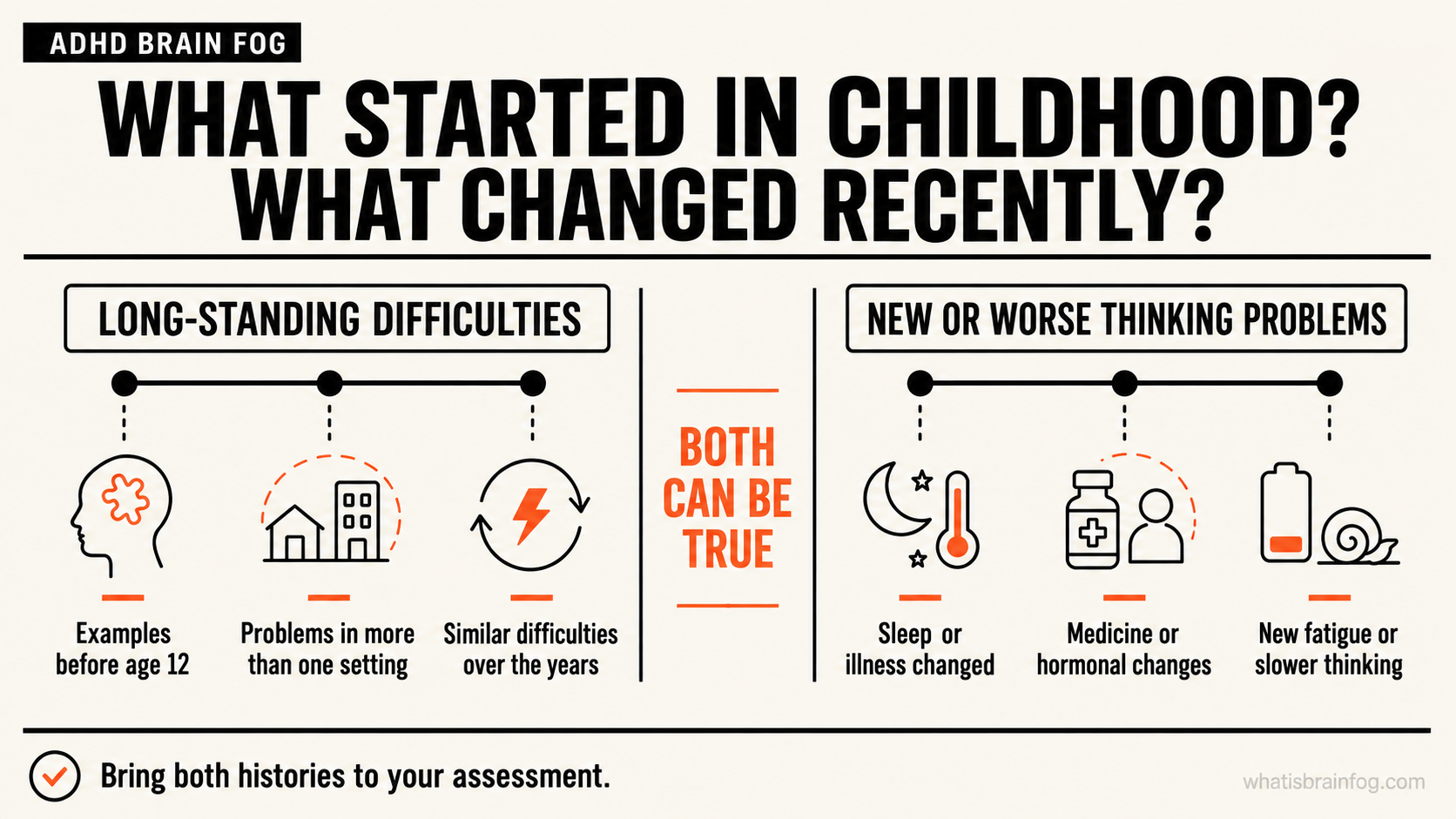
Could this be lifelong ADHD, or did your concentration change recently?
Was it lifelong, or did something change?Use this if you're unsure when the problems began.
When the problems began
Did similar problems with starting tasks, managing time, remembering things or staying organized begin in childhood?
When the thinking problems are new or worsening
Check what else changed when the new problem began
Open the cause library to check whether the new thinking problem started alongside a change in sleep, medicines, health, mood or hormones.
ADHD across life
Why ADHD may become more obvious at different ages
Some people learn they have ADHD only as adults. An assessment still looks for signs before age 12 in more than one setting. Problems may become more obvious when parents, school timetables or familiar routines no longer organize the day, or when work, parenting or illness add new demands.
| Time of life | Why the difficulties may become more noticeable | Questions for an assessment |
|---|---|---|
| Childhood | A child may repeatedly lose belongings, miss parts of instructions, need close prompting, interrupt others or struggle to settle when expected. | What to check: whether similar problems show up at home and school, how long they've lasted, and whether sleep, anxiety, learning difficulties, hearing, vision or another condition explains them better. |
| Teenage years | More subjects, changing classrooms, larger workloads, later sleep and greater social pressure can expose problems that were easier to manage in elementary school. | Check whether similar problems showed up earlier in childhood. Also check learning needs, current sleep and mood, substance use, and the effect on school, home and relationships. Teenagers need an assessment made for their age, not an adult screener. |
| Leaving school or home | Parents, teachers and fixed timetables may no longer organize the day. The person must manage travel, meals, money, appointments, study or a first job with less outside help. | Whether the difficulties existed before this transition or appeared only after poor sleep, stress, illness, depression, anxiety or a major change in circumstances. |
| Established adulthood | Parenting, caring for someone, running a household, taking on more responsibility or losing a familiar routine can overwhelm the methods that used to work. | Childhood history, present difficulties at home, work or in relationships, and other contributors such as sleep problems, medication, mood, pain or physical illness. |
| Hormonal transitions | Concentration, memory, sleep and mood may shift alongside menstrual changes, pregnancy, the postpartum period or perimenopause. Someone who already had ADHD may find old difficulties harder to work around. Someone with no similar difficulties before may need another explanation. | Separate your earlier ADHD problems from new ones with sleep, mood, memory or attention. Check whether the new ones follow your menstrual cycle or began during pregnancy, after childbirth, or in perimenopause. |
| Later adulthood | Lifelong problems with time, organization or forgetfulness can still matter. Get a new decline checked, even with ADHD. | Earlier history and newer changes in memory, language, orientation, movement, self-care or personality, alongside sleep, medicines, mood, hearing, vision and neurological causes. |
A diagnosis made later in life doesn't mean ADHD began late. The assessment should reconstruct the earlier history while taking any genuinely new cognitive or physical change seriously.
Only ten studies met the criteria for a 2025 systematic review of cognition in adults aged 50 and older with confirmed ADHD. Attention and episodic-memory findings differed across groups, while executive-function findings were mixed. The evidence is not yet strong enough to define one older-adult ADHD cognitive profile or to separate it reliably from age-related conditions. (43).
Children and teenagers
Children and teenagers need an age-appropriate assessment
The adult ASRS only covers people 18 and over. Younger people need an age-appropriate assessment. It should bring together what they experience, what happens at home and what teachers, coaches or other adults who know them well report.
A primary care clinician, pediatrician, adolescent psychiatrist, psychologist or another qualified local service may be involved, depending on where you live. The assessment should consider development and learning, sleep, emotional health, hearing, vision, medicines, substance use, and other health problems when relevant.
Bring teacher comments, older reports and examples from lessons, homework, getting dressed, meals, messages with friends, family routines, packing for trips and, when relevant, driving. Different adults may notice different problems.
Old reports help when they exist. The assessment should still go ahead without them.
Clinical care addresses ADHD symptoms and related health problems. Adjustments in education help a young person take part in learning. They may need one, the other or both.
Education support has different names and legal rules in each country, so ask the education provider or local education service what formal help is available.
The ADHD doctor handout includes a parent note and can help organize examples from home, education, friendships and routines before the appointment.
Why basic needs can be easy to miss
Someone who becomes absorbed in an activity may work for hours without stopping to eat, drink, rest or use the bathroom.
- Before the day gets busy, decide roughly when you'll eat.
- Keep water visible and within reach.
- Set one reminder for a specific problem that keeps happening.
- If appetite loss began after starting or changing medicine, or has led to weight loss or difficulty eating, discuss it with the prescriber.
A 2025 review found mixed results on whether people with ADHD notice body sensations differently. It didn't identify a single explanation or treatment. (67).
Daily life
Turn repeated problems into an appointment note
Make my noteNothing is saved automatically.
Appointment note
Describe what happened
Complete any section that matters. Leave the rest blank.
What went wrong at work?
What happened with a partner or family member?
What happened with friends or in a group?
What happened while trying to manage the house?
What happened while learning or studying?
What happened while driving or doing something where a mistake could matter?
Assessment
What should a proper ADHD assessment cover?
A full assessment asks whether you had similar difficulties before age 12, where they cause problems now and whether another condition is involved. It should cover childhood history, daily life in more than one setting, sleep, mood, medicines, substance use, learning difficulties and physical health.
DIVA-5 or another structured interview may help cover current difficulties and childhood history. Clinicians usually save cognitive testing for a separate question about learning, memory or another thinking skill.
“I've had problems with attention and organization for a long time, but my memory and ability to finish work got worse around [month or event]. I want to discuss whether ADHD explains the long-standing difficulties and whether sleep, mood, medicines, or a health problem explains the newer change.”
- Your ASRS result, including the date and version you completed.
- The daily-life note you completed, if you used it.
- Old school reports, written comments or examples from someone who knew you earlier, if available.
- Previous ADHD, learning, mental-health or cognitive-assessment reports.
- A list of medicines, supplements, caffeine, nicotine, alcohol, cannabis and other substances.
- The approximate date when anything became new or clearly worse.
- If you've already tried ADHD care, what improved, what didn't and which side effects you had.
- What will the full assessment check that the ASRS can't?
- Which parts of my history support ADHD, and which parts don't fit?
- Do recent changes in memory, mental speed or exhaustion need a separate assessment?
- Would cognitive testing answer a specific question about learning or memory?
- If you recommend care, what change in daily life should we look for?
- How and when will we review benefits and side effects?
Want one page to save or show at the appointment? The doctor handout lists what to explain, bring and ask.
Assessment routes
How to start an ADHD assessment where you live
Choose your country to see where people often start, who may do the assessment, what can cause delays and what usually happens after a referral.
Local rules, waiting times and prescribing requirements change.
Before paying for an online ADHD assessment
Ask who will do the assessment, how they'll look at childhood history, whether they use a structured interview and what follow-up the service includes.
Be cautious when the clinician spends little time with you, skips other possible explanations, or has no clear plan to review benefits and side effects.
In the United States, federal telemedicine flexibilities for controlled medicines currently run through December 31, 2026. State rules and clinic requirements can still differ. Check the DEA and your state regulator yourself. A provider's summary alone isn't enough.
Choose your country
What current ADHD guidance agrees on
Adult ADHD diagnosis uses DSM-5 criteria plus structured clinical assessment. Major evidence summaries include Faraone et al. 2021 and Cortese et al. 2025.
- •Symptoms must trace back to childhood, even if the person was diagnosed much later.
- •Diagnosis depends on impairment across settings and ruling out better explanations.
- •Stimulants remain first-line for many adults, and non-stimulants are real options. Either approach works best when care also covers sleep, structure, and behavioral supports.
- •Adult ADHD is often missed in women and in people who are mainly inattentive. It isn't rare.
Getting an ADHD assessment: United States
Where people usually start, what happens next, and common access barriers
Start by checking who can assess adult ADHD and what your insurance covers. Rules for prescribing controlled medicines are a separate part of care.
ADHD screening and tests for other causes
How each result may help, and the limits of each test
Clinicians diagnose ADHD from your history and how it affects daily life. No single lab result can diagnose it. These checks can find problems that resemble ADHD. They can also identify health issues that worsen thinking, memory, and attention:
Lab ranges vary by facility.
If your insurance denies coverage
Tools to appeal denials (US-specific)
A template you can adapt for an appeal
Tip:Fill in the blanks with your specific scores and symptoms. Customize as needed.
Rules that can affect repeat prescriptions
Schedule II prescriptions can't be refilled. Ask the prescriber and pharmacy when the next prescription can be issued and filled, how much the plan covers, and whether the pharmacy needs to order it. Federal rules, state rules and insurance limits aren't always the same.
Official links
Check your insurer's current policies. If the insurer doesn't reverse the denial, a patient advocate can take over the appeal. Many hospitals and disease-specific nonprofits have one on staff.
Driving and work safety
Driving
ADHD can affect attention and reaction time while driving. Medicine may improve driving performance for some people, but benefit and side effects vary. Disclosure rules differ by country and license type. Ask the licensing authority or your clinician what applies to you.
Work and occupational safety
ADHD can affect work that needs sustained attention, organization, or time management. Disability laws in your country may entitle you to reasonable adjustments. Medicine, therapy, or practical changes may help, but the effect varies by person and job.
Seven ADHD research findings
Missed diagnosis, caffeine, iron, exercise, treatment, therapy and late diagnosis.
Seven sourced findings
What research says about missed ADHD, caffeine, iron and treatment
Why ADHD is missed more often in girls and women
ADHD diagnoses are much more common in boys during childhood, but the male-to-female gap is much smaller in adult samples. ADHD in girls and women can go unnoticed when the main problem is quiet inattention. It can also go unnoticed when they keep up by working late, using constant reminders and spending far more effort than other people can see.
Faraone et al., Neurosci Biobehav Rev. 2021; Young et al., BMC Psychiatry. 2020 Source ↗
Why feeling calmer after caffeine doesn't diagnose ADHD
Caffeine can alter attention in people without ADHD too. So feeling calmer or more focused after coffee can't confirm an ADHD diagnosis. If caffeine changes how you function, include the amount, timing and effects in your assessment history.
Ioannidis et al., J Psychopharmacol. 2014; Kløve & Petersen, Psychopharmacology (Berl). 2025; NIMH, ADHD in adults Source ↗
What low ferritin can and can't tell you
Most studies linking low ferritin (iron stores) with ADHD involved children, and the results were mixed. A low ferritin result can still matter because iron deficiency may contribute to fatigue, restless legs, and concentration problems. Check the result and the dose with a clinician before you take iron.
Cortese et al., Expert Rev Neurother. 2012; Konofal et al., Arch Pediatr Adolesc Med. 2004
What adult exercise studies actually found
Fourteen studies involving 373 adults with ADHD were combined in a 2025 review. The clearest result came right after exercise: participants did better on computer tests of impulse control. They had to press a button when one symbol appeared and stop when another appeared.
Yang et al., J Glob Health. 2025; Xu et al., Psychol Sport Exerc. 2026 Source ↗
What a 2025 review found about adult ADHD care
At about 12 weeks, stimulants and atomoxetine reduced inattention, hyperactivity, and impulsivity on both self-rated and clinician-rated scales in a 2025 review. It didn't show reliable improvement in quality of life, and longer-term evidence was limited. A useful response should improve real life, such as paying bills, driving safely, following conversations, or finishing home routines. Symptom improvement alone can't confirm the diagnosis.
Ostinelli et al., Lancet Psychiatry. 2025 Source ↗
Exhaustion after treatment
Why can exhaustion remain when ADHD care helps?
Improved attention doesn't always restore sleep or undo months of overwork. Exhaustion that is present from waking suggests that sleep deserves attention. Exhaustion that builds after sustained demands and eases when demands fall is more consistent with overload. A 2024 workplace study linked trouble with planning and organizing to burnout. It didn't show that ADHD causes every case of exhaustion.
Turjeman-Levi et al., AIMS Public Health. 2024 Source 1 ↗
How the diagnosis changed
How ADHD became a medical diagnosis
How the evidence changed from 1798 to today
ADHD history
How ADHD became a medical diagnosis
Attention problems appear in early medical writing
In 1798, Alexander Crichton wrote about difficulty sustaining attention and mental restlessness. His account is often cited as one of the earliest descriptions of problems that resemble ADHD.
Childhood self-control becomes a medical question
Over a century later, George Still described 20 children with severe problems controlling their behavior and attention. He considered medical explanations, recorded family histories and reported roughly three boys for every girl.
An unexpected response to stimulant medicine
While treating 30 children, Charles Bradley found that Benzedrine improved school performance and behavior in about half. The result helped open a new line of treatment research.
Attention moves to the center
The third edition of the Diagnostic and Statistical Manual reframed the condition as Attention Deficit Disorder with or without hyperactivity, making it possible to recognize inattentive cases.
A large childhood ADHD trial compares treatments
The MTA study randomly assigned 579 children to four types of care for 14 months. Carefully managed medication, alone or with behavioral treatment, reduced ADHD symptoms more than intensive behavioral treatment alone or usual community care.
Researchers examine iron and ferritin
In a study of children, Konofal and colleagues found lower ferritin levels in those with ADHD than in the comparison group. Researchers then looked more closely at iron levels and symptom severity.
Adult screening becomes practical
The WHO ASRS-v1.1 gave adults and clinicians a quick screening tool that's still widely used today.
A review estimates ADHD rates across countries
A worldwide meta-analysis confirmed ADHD is global, not a label limited to Western culture. Across 102 studies, Polanczyk et al. estimated 5.29% of children and teens have it.
Studies link ADHD with later sleep timing
Van Veen et al. measured when melatonin began to rise under dim light in adults with ADHD and sleep-onset insomnia. This gave researchers a body-clock measure, so they weren't relying only on reported bedtimes.
Studies examine adult diagnosis and long-term health
In a Danish population study, Dalsgaard et al. found an adjusted death-rate ratio of 2.07 for people with ADHD and 4.25 for those diagnosed at age 18 or older. Accidents accounted for much of the excess. These group averages can't predict an individual’s lifespan. Researchers also debated how to distinguish ADHD recognized late from other problems that start in adulthood.
Large studies link DNA regions to ADHD
Large genetic studies (GWAS) found common DNA regions linked to ADHD. Reviews confirmed it's one of the more heritable psychiatric conditions. Twin-based heritability estimates center around 74%.
Demontis et al., Nat Genet. 2019 · PMID: 30478444. (68), reviewed the twin-study estimate.
International experts summarize the evidence
The World Federation of ADHD's consensus statement became a major summary of the evidence. 80 experts from 27 countries signed off on 208 evidence-based conclusions.
A study links adult ADHD with later dementia
Levine et al. reported a 2.77-fold association between adult ADHD and later dementia diagnoses in a cohort of 109,218 adults. This observational result doesn't show that ADHD causes dementia or that medicine prevents it.
A large review examines adult ADHD care
Ostinelli et al. examined medicines and psychological support for adults, while Cortese et al. published a broad review of adult ADHD evidence, uncertainties, and controversies.
Brain imaging finds more than one ADHD profile
Pan et al. used brain imaging across more than 1,000 children to propose three possible ADHD biotypes with different structural-network signatures. These are study groupings, not a clinical diagnostic test, and they don't yet tell a clinician which care will work for one person.
Need a definition?
ADHD terms
Definitions of assessment, sleep and attention terms
Glossary
ADHD terms
- Executive dysfunction
- Difficulty starting, organizing, changing or finishing an activity even when you understand what needs to be done. It can occur in ADHD and in other conditions.
- Working memory
- The ability to hold a small amount of information in mind while using it, such as remembering the next two steps while cooking or following a conversation.
- Time blindness
- An informal term for repeatedly misjudging how much time has passed, how long something will take or how close a deadline is.
- Ferritin
- A protein that stores iron. A ferritin blood test helps estimate your iron stores. Low stores may add to fatigue or restless legs.
- ASRS-v1.1
- Part A of the Adult ADHD Self-Report Scale. Its six questions cover difficulties in the past six months.
- DIVA-5
- A structured interview used in some adult ADHD assessments to examine current difficulties and whether related problems were present in childhood.
- WURS
- A questionnaire about childhood difficulties that may be linked to ADHD. It can support an assessment.
- DSM-5 and DSM-5-TR
- A diagnostic manual and its later text revision used in the United States and some other settings. They describe the symptoms, age-of-onset requirement and daily-life effects considered when assessing ADHD. Other health systems may also use ICD criteria.
- Melatonin and dim-light melatonin onset
- Melatonin is a hormone involved in sleep timing. Dim-light melatonin onset is the time in the evening when melatonin starts to rise in dim light. It's used mainly in sleep research and specialist assessments.
- Stimulant medication
- ADHD medicines like methylphenidate and amphetamine products. Many adults try them first. Who they suit, how they're monitored and what's approved vary by person and country.
- Non-stimulant medication
- ADHD medicines that aren't stimulants, including atomoxetine and, depending on age and country, guanfacine or clonidine.
- Cognitive behavioral therapy for ADHD
- A structured therapy where you practice planning, breaking work into smaller steps, cutting distractions and following through between sessions.
- Collateral history
- Information from someone who knew you earlier in life, or from school reports and other old records. It may help show whether you had the difficulties in childhood.
- Sleep-study terms: AHI, UARS and RERAs
- The apnoea-hypopnoea index counts apnoeas and hypopnoeas per hour of sleep. Upper airway resistance syndrome describes sleep disruption caused by increased breathing effort that may not meet the usual sleep-apnea threshold. Respiratory effort-related arousals are individual breathing events that briefly disturb sleep.
- Cognitive disengagement syndrome
- A research term for frequent daydreaming, mental confusion, slowed behavior and appearing mentally absent. Researchers study it separately from ADHD, although the two can overlap.
- Interoception
- The ability to notice sensations inside your body, such as hunger, thirst, fatigue, pain, heartbeat or bladder fullness.
Outlook
What improvement can look like in real life
Look for everyday improvements: fewer late fees, less frantic catching up and getting back to a task after an interruption. Eating before you lose track of time and miss a meal counts too, as does needing less panic to get started. You may still have ADHD symptoms, but daily life takes less effort and fewer problems need fixing.
Why progress can be uneven: Some medicines can affect attention on the day you take them. Therapy, sleep care and practical systems usually need longer. Better focus may also reveal that exhaustion, appetite loss, poor sleep or a recent memory change didn't improve. That tells you what needs separate attention. It doesn't prove that all ADHD care failed.
Signs that care is helping
- You’re still using one reliable calendar or visible list after the novelty wears off.
- The everyday task you chose to work on is becoming easier, even if a questionnaire score changes little.
- You and the other person agree how to handle missed commitments, with fewer arguments about what happened.
- You get separate help for persistent problems such as waking exhausted or feeling worse after a dose.
When to get urgent medical help
Get urgent medical help for thinking problems that start over hours or days, new weakness or numbness, vision or speech changes, seizures, fever with confusion, or a rapid decline. These can be a medical emergency.
Sources
References used on this page
Each link opens the paper, guideline, or official source.
Already diagnosed: I have ADHD and still have brain fog
ADHD treatment helped, but I still cannot think clearly
Review what improved, what didn't, and whether medicine, sleep or another health problem needs attention.
ADHD treatment can improve attention without fixing poor sleep, medication side effects or burnout.
What helps with ADHD brain fog?
Find practical ideas and treatments for the part of daily life you want to make easier.
What would you like to make easier?
Pick an idea for a task you keep putting off.
Three places to startMake the first step smallerReplace “do the paperwork” with one action you can start.Practical support
Try this
Write one action: “open the invoice” or “find the account number.” Put what you need in front of you. Do that step, then decide what comes next.
What to look for: Getting started with less time spent deciding where to begin.
Keep in mind: If the first step still feels unclear, name the exact document, item or action you need.
Work beside someoneTry quiet company for a task you keep putting off.Practical support
Try this
Ask a friend to work nearby or join a video call. You each pick a task and start. Quiet company may help you keep going.
What to look for: Starting or continuing a task that felt difficult alone.
Keep in mind: Choose someone who is happy to work quietly. Chatting may make it harder to concentrate.
Learn skills for planning and getting startedPractice planning, getting started and returning to a task after interruptions.Some evidenceSkills
Try this
Cognitive behavioral therapy (CBT) for ADHD teaches practical skills. Bring a task you keep avoiding. Practice breaking it down, choosing a start time and returning after interruptions, then try the plan between sessions.
What to look for: Fewer avoided tasks and a plan you can return to when the day goes wrong.
Keep in mind: Check that the course teaches ADHD skills. You need chances to practice them between sessions.
- Timing
- A course usually takes several weeks or months.
- Cost or effort
- Course or appointments
All ADHD options and evidenceSearch medicines, practical changes and newer treatments40 options
40 options available
Make the first step smallerReplace “do the paperwork” with one action you can start.Practical support
Try this
Write one action: “open the invoice” or “find the account number.” Put what you need in front of you. Do that step, then decide what comes next.
What to look for: Getting started with less time spent deciding where to begin.
Keep in mind: If the first step still feels unclear, name the exact document, item or action you need.
Read the evidence 2 sources
Adults with ADHD
NICE NG87: ADHD diagnosis and managementGuideline · Guideline, not a trial
- Who took part
- Children, young people and adults
- How long
- Ongoing care
What the source found: It recommends changes to your surroundings, medication when needed and structured ADHD-focused psychological support. Treatment reviews cover daily function, sleep, appetite and side effects.
Thinking and memory: Not directly tested.
Important limit: UK guidance. Licensing and access differ elsewhere.
(69)Cognitive behavioural therapy for adults with ADHD: meta-analysisSystematic review · 28 studies
- Who took part
- Adults with ADHD
- How long
- Varied courses and follow-up
What the source found: CBT-based care improved ADHD and emotional symptoms overall. Trials also reported benefits in self-esteem or quality of life, with differences between studies.
Thinking and memory: The treatments targeted planning and coping.
Important limit: Programs and comparison groups varied. People usually knew which treatment they received.
(70)Leave a note before switching tasksLeave yourself a note so you can pick up where you stopped.Practical support
Try this
Before you switch tasks, leave a note such as “next: check paragraph two.” Set a reminder for your next commitment with a clear name, such as “leave for dentist.”
What to look for: Returning to unfinished work without having to work out where you were.
Keep in mind: Too many alarms are easy to ignore. Keep the ones that remind you to do something specific.
Read the evidence 1 source
Adults with ADHD
Cognitive behavioural therapy for adults with ADHD: meta-analysisSystematic review · 28 studies
- Who took part
- Adults with ADHD
- How long
- Varied courses and follow-up
What the source found: CBT-based care improved ADHD and emotional symptoms overall. Trials also reported benefits in self-esteem or quality of life, with differences between studies.
Thinking and memory: The treatments targeted planning and coping.
Important limit: Programs and comparison groups varied. People usually knew which treatment they received.
(70)Work beside someoneTry quiet company for a task you keep putting off.Practical support
Try this
Ask a friend to work nearby or join a video call. You each pick a task and start. Quiet company may help you keep going.
What to look for: Starting or continuing a task that felt difficult alone.
Keep in mind: Choose someone who is happy to work quietly. Chatting may make it harder to concentrate.
Read the evidence 1 source
Adults with ADHD
Some adults report that quiet company helps them work. Controlled ADHD trials of body doubling remain limited.
Adult ADHD: evidence, uncertainties and controversiesClinical review · Broad evidence review
- Who took part
- Adults with ADHD
- How long
- Assessment and longer-term care
What the source found: It covers standard treatments and stresses checking for other sleep, psychiatric and medical problems.
Thinking and memory: Not directly tested.
Important limit: This is a broad review that gives background.
(71)Learn skills for planning and getting startedPractice planning, getting started and returning to a task after interruptions.Some evidenceSkills
Try this
Cognitive behavioral therapy (CBT) for ADHD teaches practical skills. Bring a task you keep avoiding. Practice breaking it down, choosing a start time and returning after interruptions, then try the plan between sessions.
What to look for: Fewer avoided tasks and a plan you can return to when the day goes wrong.
Keep in mind: Check that the course teaches ADHD skills. You need chances to practice them between sessions.
- Timing
- A course usually takes several weeks or months.
- Cost or effort
- Course or appointments
Read the evidence 3 sources
Adults with ADHD
Adult ADHD treatment: component network meta-analysisSystematic review · 113 trials; 14,887 adults
- Who took part
- Adults with diagnosed ADHD
- How long
- Main comparison near 12 weeks
What the source found: Stimulants and atomoxetine reduced core symptoms on both self-rated and clinician-rated measures. Most other interventions had less consistent findings across raters.
Thinking and memory: Core ADHD symptom ratings are the main result. This does not show self-rated thinking problems went away.
Important limit: Most trials were short. Confidence varied from very low to moderate. The review searched through September 2023, so newer trials need separate appraisal.
(72)Cognitive behavioural therapy for adults with ADHD: meta-analysisSystematic review · 28 studies
- Who took part
- Adults with ADHD
- How long
- Varied courses and follow-up
What the source found: CBT-based care improved ADHD and emotional symptoms overall. Trials also reported benefits in self-esteem or quality of life, with differences between studies.
Thinking and memory: The treatments targeted planning and coping.
Important limit: Programs and comparison groups varied. People usually knew which treatment they received.
(70)CBT plus medication versus medication alone in adult ADHDSystematic review · 6 randomized trials
- Who took part
- Adults with ADHD
- How long
- 3, 6 and 9 months
What the source found: Adding CBT improved symptoms more at three months. At six and nine months, the studies did not show a clear difference between the groups.
Thinking and memory: Not directly tested.
Important limit: This smaller review addresses add-on care. Later follow-up evidence was limited.
(73)Practice ADHD skills onlineOnline lessons offer another way to practice planning and handle procrastination.Some evidenceSkills
Try this
An online ADHD skills course uses lessons and exercises you complete at home. Choose one difficulty, such as putting off paperwork, and practice an exercise on that task.
What to look for: Putting things off less often or finding everyday tasks easier to manage.
Keep in mind: Online courses differ in quality. Check what help the course includes, what it costs and how the provider uses your information.
- Cost or effort
- Course fees and availability vary.
Read the evidence 1 source
Adults with ADHD
The 2026 attexis trial tested one self-guided CBT program in adults. People who used it reported that their symptoms and daily functioning improved. The comparison group got usual care.
attexis: a self-guided digital CBT trialRandomized trial · 337 randomized
- Who took part
- Adults with confirmed ADHD
- How long
- 3-month primary outcome; 6-month follow-up
What the source found: attexis plus usual care improved self-rated ADHD symptoms more than usual care alone. The adjusted difference at three months was 5.0 ASRS points. Functioning and quality-of-life scores also improved more.
Thinking and memory: The trial used ratings of everyday difficulties.
Important limit: Unblinded comparison with usual care, not an equally engaging control app. Developer involvement. Applies to this program, not to every ADHD or AI app.
(74)Keep one place for things to rememberPut appointments and tasks somewhere you already check.Practical support
Try this
Use one calendar for appointments and one short list for tasks. Add a request as soon as it arrives. Before finishing work, check tomorrow and choose the first task.
What to look for: Fewer forgotten appointments and lost requests.
Keep in mind: Use something you already check, such as your phone calendar or a notebook. Keep the setup simple.
Read the evidence 2 sources
Adults with ADHD
NICE NG87: ADHD diagnosis and managementGuideline · Guideline, not a trial
- Who took part
- Children, young people and adults
- How long
- Ongoing care
What the source found: It recommends changes to your surroundings, medication when needed and structured ADHD-focused psychological support. Treatment reviews cover daily function, sleep, appetite and side effects.
Thinking and memory: Not directly tested.
Important limit: UK guidance. Licensing and access differ elsewhere.
(69)Cognitive behavioural therapy for adults with ADHD: meta-analysisSystematic review · 28 studies
- Who took part
- Adults with ADHD
- How long
- Varied courses and follow-up
What the source found: CBT-based care improved ADHD and emotional symptoms overall. Trials also reported benefits in self-esteem or quality of life, with differences between studies.
Thinking and memory: The treatments targeted planning and coping.
Important limit: Programs and comparison groups varied. People usually knew which treatment they received.
(70)Allow time to get ready and leaveAdd preparation and travel to your calendar alongside the appointment.Practical support
Try this
Time one task you're often late for, including getting ready. Next time, allow the time it actually took. Set a reminder for when to start getting ready and when to leave.
What to look for: Less rushing and fewer late arrivals.
Keep in mind: Allow extra time for interruptions. An alarm helps only when it gives you enough time to act.
Read the evidence 2 sources
Adults with ADHD
NICE NG87: ADHD diagnosis and managementGuideline · Guideline, not a trial
- Who took part
- Children, young people and adults
- How long
- Ongoing care
What the source found: It recommends changes to your surroundings, medication when needed and structured ADHD-focused psychological support. Treatment reviews cover daily function, sleep, appetite and side effects.
Thinking and memory: Not directly tested.
Important limit: UK guidance. Licensing and access differ elsewhere.
(69)Cognitive behavioural therapy for adults with ADHD: meta-analysisSystematic review · 28 studies
- Who took part
- Adults with ADHD
- How long
- Varied courses and follow-up
What the source found: CBT-based care improved ADHD and emotional symptoms overall. Trials also reported benefits in self-esteem or quality of life, with differences between studies.
Thinking and memory: The treatments targeted planning and coping.
Important limit: Programs and comparison groups varied. People usually knew which treatment they received.
(70)Put essentials where you use themGive the items you lose a visible home.Practical support
Try this
Choose one item you often lose, such as keys. Put a tray or hook where you usually set it down. Keep everyday supplies close to where you use them.
What to look for: Less searching when you need to get out of the door.
Keep in mind: Keep medicines locked away from children, even if you leave other everyday items in view.
Read the evidence 1 source
Adults with ADHD
NICE NG87: ADHD diagnosis and managementGuideline · Guideline, not a trial
- Who took part
- Children, young people and adults
- How long
- Ongoing care
What the source found: It recommends changes to your surroundings, medication when needed and structured ADHD-focused psychological support. Treatment reviews cover daily function, sleep, appetite and side effects.
Thinking and memory: Not directly tested.
Important limit: UK guidance. Licensing and access differ elsewhere.
(69)Protect one task from interruptionsClose unrelated tabs and silence alerts while you work on one priority.Practical support
Try this
Choose one thing to finish. Close unrelated tabs, silence optional alerts and tell people when you will be available. Leave urgent contacts and safety alarms switched on.
What to look for: Fewer restarts and less time spent on unrelated tasks.
Keep in mind: Choose a length that fits your job or caring responsibilities. A short block can be easier to arrange.
Read the evidence 2 sources
Adults with ADHD
NICE NG87: ADHD diagnosis and managementGuideline · Guideline, not a trial
- Who took part
- Children, young people and adults
- How long
- Ongoing care
What the source found: It recommends changes to your surroundings, medication when needed and structured ADHD-focused psychological support. Treatment reviews cover daily function, sleep, appetite and side effects.
Thinking and memory: Not directly tested.
Important limit: UK guidance. Licensing and access differ elsewhere.
(69)Cognitive behavioural therapy for adults with ADHD: meta-analysisSystematic review · 28 studies
- Who took part
- Adults with ADHD
- How long
- Varied courses and follow-up
What the source found: CBT-based care improved ADHD and emotional symptoms overall. Trials also reported benefits in self-esteem or quality of life, with differences between studies.
Thinking and memory: The treatments targeted planning and coping.
Important limit: Programs and comparison groups varied. People usually knew which treatment they received.
(70)Ask for a specific change at workWritten requests, clearer priorities or quiet work time may make the day easier.Practical support
Try this
Describe one problem: “I lose track of verbal requests.” Ask for written follow-ups, one clear priority or fewer interruptions. You can request an ordinary change to how work is organized without explaining your full medical history. A formal accommodation may require documentation.
What to look for: Fewer missed tasks and less work spilling into the evening.
Keep in mind: Workplace rights vary by country, and in some places a formal adjustment does depend on disclosing. Weigh that before deciding how much to say. Too much work may require fewer tasks or a changed deadline.
Read about work and exhaustion
Read the evidence 2 sources
Adults with ADHD
NICE NG87: ADHD diagnosis and managementGuideline · Guideline, not a trial
- Who took part
- Children, young people and adults
- How long
- Ongoing care
What the source found: It recommends changes to your surroundings, medication when needed and structured ADHD-focused psychological support. Treatment reviews cover daily function, sleep, appetite and side effects.
Thinking and memory: Not directly tested.
Important limit: UK guidance. Licensing and access differ elsewhere.
(69)Adult ADHD: evidence, uncertainties and controversiesClinical review · Broad evidence review
- Who took part
- Adults with ADHD
- How long
- Assessment and longer-term care
What the source found: It covers standard treatments and stresses checking for other sleep, psychiatric and medical problems.
Thinking and memory: Not directly tested.
Important limit: This is a broad review that gives background.
(71)ADHD coaching: help using a plan you can stick withAn ADHD coach can help you work on a specific everyday difficulty.Limited evidenceSkills
Try this
Bring one problem, such as missed deadlines. Ask how the coach would help you plan and practice between meetings. Check their training and agree when to review progress.
What to look for: A simpler plan and someone to check in with while you try it.
Keep in mind: Coaching has less supporting evidence than ADHD-focused CBT. Skip guarantees and long courses paid upfront.
- Cost or effort
- Paid appointments.
Read the evidence 1 source
Adults with ADHD
Adult ADHD: evidence, uncertainties and controversiesClinical review · Broad evidence review
- Who took part
- Adults with ADHD
- How long
- Assessment and longer-term care
What the source found: It covers standard treatments and stresses checking for other sleep, psychiatric and medical problems.
Thinking and memory: Not directly tested.
Important limit: This is a broad review that gives background.
(71)MethylphenidateA prescription medicine that can help with attention and impulsive behavior.Stronger evidenceMedication
Try this
At the review, tell the prescriber which everyday things got easier, such as finishing routine work or following a conversation. Also tell them how the medicine affected your appetite and sleep. Both help them decide the dose.
What to look for: Better attention or fewer impulsive actions while the medicine is working.
Keep in mind: It can reduce appetite, disturb sleep or raise blood pressure and pulse. These need checking during treatment.
- Timing
- You may notice an effect on the day you take it. Finding the right treatment can take longer.
- Cost or effort
- Prescription and follow-up
Read the evidence 3 sources
Adults with ADHD
Adult ADHD treatment: component network meta-analysisSystematic review · 113 trials; 14,887 adults
- Who took part
- Adults with diagnosed ADHD
- How long
- Main comparison near 12 weeks
What the source found: Stimulants and atomoxetine reduced core symptoms on both self-rated and clinician-rated measures. Most other interventions had less consistent findings across raters.
Thinking and memory: Core ADHD symptom ratings are the main result. This does not show self-rated thinking problems went away.
Important limit: Most trials were short. Confidence varied from very low to moderate. The review searched through September 2023, so newer trials need separate appraisal.
(72)NICE NG87: ADHD diagnosis and managementGuideline · Guideline, not a trial
- Who took part
- Children, young people and adults
- How long
- Ongoing care
What the source found: It recommends changes to your surroundings, medication when needed and structured ADHD-focused psychological support. Treatment reviews cover daily function, sleep, appetite and side effects.
Thinking and memory: Not directly tested.
Important limit: UK guidance. Licensing and access differ elsewhere.
(69)ADHD medication and major real-world outcomes: target-trial emulationObservational study · 148,581 people
- Who took part
- Newly diagnosed people with ADHD; mixed ages
- How long
- 2-year outcomes
What the source found: The study linked starting medication with lower rates of several harms, including transport accidents and substance misuse.
Thinking and memory: The study didn't measure brain fog or recovery on thinking tests.
Important limit: Observational target-trial emulation, not random assignment. Age-specific denominators differ. These are not direct cognitive outcomes.
(75)Lisdexamfetamine and other amphetamine medicinesPrescription medicines that can help with attention, restlessness and impulsive behavior.Stronger evidenceMedication
Try this
Follow the agreed prescription. At the review, explain what became easier, how long the benefit lasted, and any changes in appetite, sleep or mood.
What to look for: Better attention or less restlessness and impulsive behavior.
Keep in mind: Sleep, appetite, blood pressure, pulse and mood need checking. Take only your prescribed medicine and do not share it.
- Timing
- You may notice an effect on the day you take it.
- Cost or effort
- Prescription and follow-up
Read the evidence 2 sources
Adults with ADHD
Adult ADHD treatment: component network meta-analysisSystematic review · 113 trials; 14,887 adults
- Who took part
- Adults with diagnosed ADHD
- How long
- Main comparison near 12 weeks
What the source found: Stimulants and atomoxetine reduced core symptoms on both self-rated and clinician-rated measures. Most other interventions had less consistent findings across raters.
Thinking and memory: Core ADHD symptom ratings are the main result. This does not show self-rated thinking problems went away.
Important limit: Most trials were short. Confidence varied from very low to moderate. The review searched through September 2023, so newer trials need separate appraisal.
(72)NICE NG87: ADHD diagnosis and managementGuideline · Guideline, not a trial
- Who took part
- Children, young people and adults
- How long
- Ongoing care
What the source found: It recommends changes to your surroundings, medication when needed and structured ADHD-focused psychological support. Treatment reviews cover daily function, sleep, appetite and side effects.
Thinking and memory: Not directly tested.
Important limit: UK guidance. Licensing and access differ elsewhere.
(69)AtomoxetineA non-stimulant option that builds its effect over time.Stronger evidenceMedication
Try this
Judge the benefit over weeks rather than a single day. Pick one task you find hard now and agree when you'll review whether it became easier.
What to look for: Easier concentration or fewer impulsive actions.
Keep in mind: Nausea, sleep changes, sexual side effects and a rise in blood pressure or pulse can occur. Report major mood changes promptly.
- Timing
- Usually assessed over several weeks.
- Cost or effort
- Prescription and follow-up
Read the evidence 2 sources
Adults with ADHD
Adult ADHD treatment: component network meta-analysisSystematic review · 113 trials; 14,887 adults
- Who took part
- Adults with diagnosed ADHD
- How long
- Main comparison near 12 weeks
What the source found: Stimulants and atomoxetine reduced core symptoms on both self-rated and clinician-rated measures. Most other interventions had less consistent findings across raters.
Thinking and memory: Core ADHD symptom ratings are the main result. This does not show self-rated thinking problems went away.
Important limit: Most trials were short. Confidence varied from very low to moderate. The review searched through September 2023, so newer trials need separate appraisal.
(72)NICE NG87: ADHD diagnosis and managementGuideline · Guideline, not a trial
- Who took part
- Children, young people and adults
- How long
- Ongoing care
What the source found: It recommends changes to your surroundings, medication when needed and structured ADHD-focused psychological support. Treatment reviews cover daily function, sleep, appetite and side effects.
Thinking and memory: Not directly tested.
Important limit: UK guidance. Licensing and access differ elsewhere.
(69)Viloxazine extended releaseA non-stimulant prescription option for adults in the United States.Some evidenceMedication
Try this
Availability differs by country. Before treatment, have the pharmacist check your other medicines, supplements and caffeine use for interactions.
What to look for: Less difficulty with attention, impulsive behavior or restlessness.
Keep in mind: It can cause tiredness, insomnia or nausea and raise blood pressure or pulse. Get prompt help for new suicidal thoughts or sudden mood changes.
- Cost or effort
- Prescription; availability varies
Read the evidence 2 sources
Adults with ADHD
Viloxazine extended release in adults with ADHDRandomized trial · 374 randomized
- Who took part
- Adults aged 18 to 65 with ADHD
- How long
- 6 weeks
What the source found: ADHD symptom ratings improved more than with placebo. The trial also rated executive difficulties on a scale.
Thinking and memory: The improvement was measured with a questionnaire about everyday difficulties.
Important limit: Short manufacturer-sponsored trial. Insomnia, fatigue and nausea can offset benefit.
(76)Qelbree: prescribing safety informationManufacturer safety information · US product information
- Who took part
- Adults and children aged 6 and over
- How long
- During treatment
What the source found: Qelbree's US label covers ADHD in adults and children aged six and over. Safety information warns about suicidal thoughts or actions and changes in blood pressure and pulse.
Thinking and memory: Not directly tested.
Important limit: This source supports safety and labelled use, not independent comparative efficacy. Check all medicines and supplements for interactions.
(77)Guanfacine extended releaseA prescription alternative that can cause sleepiness and lower blood pressure.Some evidenceMedication
Try this
Not every country offers it to adults. Before treatment, mention any fainting or daytime sleepiness. Blood pressure and pulse need checking during use.
What to look for: Less difficulty with attention, impulsive behavior or restlessness.
Keep in mind: Sleepiness, dizziness or low blood pressure may outweigh the benefit. Stopping suddenly can raise blood pressure. Agree how to cut down before stopping.
- Cost or effort
- Prescription; adult use varies
Read the evidence 3 sources
Adults with ADHD
NICE NG87: ADHD diagnosis and managementGuideline · Guideline, not a trial
- Who took part
- Children, young people and adults
- How long
- Ongoing care
What the source found: It recommends changes to your surroundings, medication when needed and structured ADHD-focused psychological support. Treatment reviews cover daily function, sleep, appetite and side effects.
Thinking and memory: Not directly tested.
Important limit: UK guidance. Licensing and access differ elsewhere.
(69)Guanfacine extended release: Japanese adult randomized trialRandomized trial · 201 randomized
- Who took part
- Japanese adults with ADHD
- How long
- 10-week primary outcome
What the source found: Symptom scores improved more than with placebo (effect size 0.52). Adverse-event discontinuation was 19.8% versus 3.0%.
Thinking and memory: The trial measured core symptom ratings. It did not show reliable relief from thinking or memory problems.
Important limit: Sleepiness, low blood pressure and dizziness on standing were important side effects. Adult licensing varies by country.
(78)Adult guanfacine: one-year post-marketing follow-upObservational study · 961 enrolled; 912 safety; 784 effectiveness analyses
- Who took part
- Adults starting guanfacine in Japanese routine care
- How long
- Up to 1 year
What the source found: The 12-month continuation rate was 45.2%. Sleepiness was the most often reported side effect. ADHD symptom ratings improved among patients remaining in follow-up.
Thinking and memory: No direct cognitive recovery result.
Important limit: The study had no control group and used only observed data. People who stopped can't be fairly compared with those who stayed. It studied safety and continuation.
(79)BupropionSometimes prescribed for adult ADHD, although it isn't licensed for ADHD.Limited evidenceMedication
Try this
This is a prescription option for selected adults. Before treatment, discuss seizures, eating disorders, alcohol use and other medicines because these can affect whether it's safe.
What to look for: Some adults find attention and other ADHD symptoms easier to manage.
Keep in mind: Evidence is less certain than for established ADHD medicines. It can cause agitation or poor sleep and increase seizure risk.
- Cost or effort
- Prescription and follow-up
Read the evidence 2 sources
Adults with ADHD
Bupropion for adult ADHD: Cochrane reviewSystematic review · 6 trials; 438 participants
- Who took part
- Adults with ADHD
- How long
- 6 to 10 weeks
What the source found: Bupropion may reduce adult ADHD symptoms, but the evidence was low quality.
Thinking and memory: Not directly tested.
Important limit: The trials were small and mostly short. Bupropion is usually off-label for ADHD.
(80)Bupropion: patient medicine informationMedicine information · Safety guidance
- Who took part
- People prescribed bupropion
- How long
- During treatment
What the source found: Bupropion may be unsuitable if you've had seizures, anorexia or bulimia, or are suddenly stopping alcohol or sedatives.
Thinking and memory: Not directly tested.
Important limit: Interactions and blood pressure also require review. This is safety information, not ADHD efficacy evidence.
(81)Centanafadine: a newer ADHD medicineFDA-approved as SIMTRIYO in July 2026 for ADHD in adults and in children aged 6 and over who weigh at least 20 kg. Pharmacies can't sell it until the DEA schedules it.Approved; availability pending DEA schedulingMedication
Try this
Before considering it, ask your prescriber whether SIMTRIYO is available where you live and what the prescribing information says. Continue your agreed treatment while you look into it.
What to look for: Potential help with attention, impulsive behavior and restlessness. The adult trials rated core ADHD symptoms, not clearer thinking.
Keep in mind: The manufacturer still reports that it isn't commercially available. The label lists appetite loss, headache and insomnia among common adult side effects, plus important cardiovascular and psychiatric warnings. It also has boxed warnings about abuse and addiction and suicidal thoughts or behavior in children.
- Cost or effort
- The price isn't confirmed. You'll need a prescription and follow-up.
Read the FDA prescribing information
Read the evidence 5 sources
Adults with ADHD
The FDA prescribing label for the extended-release capsule is now available. It should guide prescribing. Doses from the older sustained-release tablet trials aren't instructions for this product. The manufacturer’s site still reports pending DEA scheduling and no commercial availability as of October 8, 2026.
FDA novel drug approvals 2026: SIMTRIYO (centanafadine)Regulator record · Approval listing
- Who took part
- US approval record
- How long
- July 24, 2026
What the source found: The FDA lists SIMTRIYO (centanafadine) as approved on July 24, 2026 to treat ADHD.
Thinking and memory: Not addressed by the approval listing.
Important limit: This approval listing doesn't compare it with other ADHD medicines or show it's commercially available.
(82)Centanafadine: two adult phase 3 trialsRandomized trials · 446 and 430 randomized
- Who took part
- Adults aged 18 to 55 with ADHD
- How long
- 6 weeks
What the source found: Both trials favored centanafadine over placebo on clinician-rated ADHD symptoms. Reported standardized effects ranged from about 0.24 to 0.40.
Thinking and memory: Trials rated core symptoms and did not show clearer thinking.
Important limit: These trials used sustained-release tablets. Their dosing is not for the newer extended-release capsule. No proof it beats other ADHD medicines.
(83)SIMTRIYO approval and access announcementManufacturer announcement · Regulatory/access announcement
- Who took part
- US adults and eligible children
- How long
- July 24, 2026
What the source found: Otsuka announced FDA approval of centanafadine as SIMTRIYO. Its September 18 update said the drug still needed DEA scheduling before sale.
Thinking and memory: Not directly tested.
Important limit: The FDA's list of new drug approvals confirms the approval. What we know about DEA scheduling and when it'll be sold comes from the manufacturer.
(84)Centanafadine and coexisting anxiety: September updateConference/manufacturer report · Phase 3b report; no numerical treatment claim used
- Who took part
- Adults with ADHD and anxiety disorders
- How long
- September 18, 2026
What the source found: The sponsor reported results on ADHD, anxiety and rated executive/emotional difficulties at Psych Congress.
Thinking and memory: Rated executive difficulties are distinct from direct tests of working memory or processing speed.
Important limit: Conference and sponsor reporting. Await the complete peer-reviewed results and regulatory documents before publishing detailed effect claims.
(85)FDA prescribing information: SIMTRIYO extended-release capsulesRegulator prescribing label · Prescribing information and medication guide
- Who took part
- Adults and children aged 6 and older weighing at least 20 kg
- How long
- Label revised July 2026; accessed October 8, 2026
What the source found: Defines the approved population, capsule formulation, monitoring, contraindications and adverse reactions.
Thinking and memory: No separate brain-fog benefit established.
Important limit: A label isn't a head-to-head trial or proof that brain fog improves. The document notes pending controlled-substance scheduling.
(86)When medicine helps and when symptoms returnRecord when benefit begins, when it fades, and which parts of the day remain difficult.Recommended in guidancePractical
Try this
Bring approximate times and a concrete example, such as losing track of dinner preparations after work. The prescriber can review the dose, timing or formulation alongside sleep, side effects and other possible causes.
What to look for: A clearer account of when treatment helps and what still needs attention.
Keep in mind: Stay on the prescribed dose until the review. Chest pain or fainting needs urgent medical help.
Read the evidence 2 sources
Adults with ADHD
NICE NG87: ADHD diagnosis and managementGuideline · Guideline, not a trial
- Who took part
- Children, young people and adults
- How long
- Ongoing care
What the source found: It recommends changes to your surroundings, medication when needed and structured ADHD-focused psychological support. Treatment reviews cover daily function, sleep, appetite and side effects.
Thinking and memory: Not directly tested.
Important limit: UK guidance. Licensing and access differ elsewhere.
(69)Adult ADHD: evidence, uncertainties and controversiesClinical review · Broad evidence review
- Who took part
- Adults with ADHD
- How long
- Assessment and longer-term care
What the source found: It covers standard treatments and stresses checking for other sleep, psychiatric and medical problems.
Thinking and memory: Not directly tested.
Important limit: This is a broad review that gives background.
(71)Check the packaging when a refill feels differentSome long-acting products release medicine differently or have different food instructions.Safety guidancePractical
Try this
Compare the name, manufacturer and strength on the new box with your old one. Ask the pharmacist if it releases medicine differently or if you need food with it.
What to look for: Finding a possible reason why the medicine feels stronger, weaker or wears off sooner.
Keep in mind: This applies especially to long-acting methylphenidate. Check the instructions before you crush, split or change how you take tablets.
Review benefits and side effects
Read the evidence 2 sources
Adults with ADHD
MHRA: caution when switching long-acting methylphenidate productsRegulatory safety guidance · Safety communication
- Who took part
- People taking modified-release methylphenidate
- How long
- Applies when products change
What the source found: Products differ in release profile, timing and food requirements. Switching needs care even when the active ingredient is the same.
Thinking and memory: Not directly tested.
Important limit: This doesn't show that all generics are inferior. Verify the exact formulation and instructions.
(87)NHS SPS: prescribing and switching modified-release methylphenidateProfessional medicines guidance · Practical prescribing guidance
- Who took part
- Methylphenidate treatment
- How long
- During prescribing or substitution
What the source found: Release profiles and administration requirements differ. Products with the same milligram amount can still work differently.
Thinking and memory: Not directly tested.
Important limit: UK products and local availability change; a pharmacist should check the actual supplied product.
(88)Make refills and doses easier to rememberAttach the prescription routine to something you already do.Recommended in guidancePractical
Try this
Set one dose reminder and a separate reminder to request the next prescription. Mark a dose as taken when you take it. Ask the pharmacist what to do after a missed dose.
What to look for: Fewer missed doses and less uncertainty about what you took.
Keep in mind: Unsure whether you took a dose? Take no extra dose. Keep medicines secure and away from children.
Read the evidence 1 source
Adults with ADHD
NICE NG87: ADHD diagnosis and managementGuideline · Guideline, not a trial
- Who took part
- Children, young people and adults
- How long
- Ongoing care
What the source found: It recommends changes to your surroundings, medication when needed and structured ADHD-focused psychological support. Treatment reviews cover daily function, sleep, appetite and side effects.
Thinking and memory: Not directly tested.
Important limit: UK guidance. Licensing and access differ elsewhere.
(69)Make eating easier when appetite dropsChoose simple food you'll actually reach for.Recommended in guidancePractical
Try this
Have an easy meal or snack ready for the time of day you can actually eat. Follow the food instructions for your medicine. Tell the prescriber if appetite or weight keeps dropping.
What to look for: Fewer missed meals and less hunger or low energy during the day.
Keep in mind: If you’re already struggling to eat enough, avoid cutting more foods out of your diet. Get ongoing weight loss checked.
Read the evidence 2 sources
Adults with ADHD
NICE NG87: ADHD diagnosis and managementGuideline · Guideline, not a trial
- Who took part
- Children, young people and adults
- How long
- Ongoing care
What the source found: It recommends changes to your surroundings, medication when needed and structured ADHD-focused psychological support. Treatment reviews cover daily function, sleep, appetite and side effects.
Thinking and memory: Not directly tested.
Important limit: UK guidance. Licensing and access differ elsewhere.
(69)NHS SPS: prescribing and switching modified-release methylphenidateProfessional medicines guidance · Practical prescribing guidance
- Who took part
- Methylphenidate treatment
- How long
- During prescribing or substitution
What the source found: Release profiles and administration requirements differ. Products with the same milligram amount can still work differently.
Thinking and memory: Not directly tested.
Important limit: UK products and local availability change; a pharmacist should check the actual supplied product.
(88)Check whether you naturally sleep lateDo you sleep better when you can go to bed and wake up later?For a sleep problem
Try this
Record when you fall asleep and wake on workdays and days off. Sleeping late without an alarm can suggest a late body clock, or that you're catching up on missed sleep. Bring a consistently late sleep schedule to a sleep appointment. Get ordinary morning daylight when you can.
What to look for: Finding a sleep plan that makes mornings more manageable.
Keep in mind: Timing matters for melatonin and light boxes. Check they suit you first, especially with bipolar disorder, an eye condition or medicines that increase light sensitivity.
Read the evidence 2 sources
Adults with ADHD
Chronotherapy in adults with ADHD and delayed sleep phaseRandomized trial · 51 participants
- Who took part
- Adults with ADHD and delayed sleep phase
- How long
- 3 weeks of treatment
What the source found: The study tested individually timed melatonin, with or without morning light, against placebo with sleep education. Body-clock timing could be moved earlier.
Thinking and memory: The study measured body clock timing and symptom ratings. It didn't show broad recovery in thinking.
Important limit: Small, selected sample. Timing matters, and you can't apply the findings to every person with ADHD or insomnia.
(89)Adult ADHD: evidence, uncertainties and controversiesClinical review · Broad evidence review
- Who took part
- Adults with ADHD
- How long
- Assessment and longer-term care
What the source found: It covers standard treatments and stresses checking for other sleep, psychiatric and medical problems.
Thinking and memory: Not directly tested.
Important limit: This is a broad review that gives background.
(71)Try therapy for trouble sleepingA structured sleep course teaches ways to fall asleep and spend less of the night awake.Evidence for better sleep
Try this
Cognitive behavioral therapy for insomnia (CBT-I) uses a sleep diary, a regular schedule and changes to habits that keep you awake in bed. You can do it in appointments or an online course.
What to look for: Falling asleep more easily or spending less time awake at night.
Keep in mind: Parts of the treatment can initially make you sleepier. The schedule needs adjustment for epilepsy, bipolar disorder, severe sleepiness or work where drowsiness is dangerous.
- Timing
- Usually a course lasting several weeks.
- Cost or effort
- Appointment or course costs vary.
Read the evidence 1 source
Adults with ADHD
AASM: behavioral and psychological treatments for chronic insomniaGuideline · Evidence-based sleep guideline
- Who took part
- Adults with chronic insomnia, not specifically ADHD
- How long
- Usually a multi-session course
What the source found: It recommends multi-part CBT-I for chronic insomnia. Sleep hygiene advice alone isn't enough.
Thinking and memory: Better sleep is the treatment aim; direct ADHD brain-fog effects are uncertain.
Important limit: It's for diagnosed insomnia. The schedule may need changing for other health conditions.
(90)Check snoring and daytime sleepinessBreathing pauses or gasping at night are reasons to check for sleep apnea.For a sleep problem
Try this
Ask someone who shares your room whether you snore, gasp or stop breathing briefly. Tell your doctor about those observations and daytime sleepiness. They can arrange a test for sleep apnea.
What to look for: Finding and treating a sleep problem that leaves you tired during the day.
Keep in mind: Drive only when you are awake enough to stay alert.
Read the evidence 2 sources
Adults with ADHD
Adult ADHD: evidence, uncertainties and controversiesClinical review · Broad evidence review
- Who took part
- Adults with ADHD
- How long
- Assessment and longer-term care
What the source found: It covers standard treatments and stresses checking for other sleep, psychiatric and medical problems.
Thinking and memory: Not directly tested.
Important limit: This is a broad review that gives background.
(71)NHS: sleep apnoea symptoms and treatmentPatient guidance · Condition-specific guidance
- Who took part
- People with suspected or confirmed sleep apnea
- How long
- Assessment and ongoing care
What the source found: Breathing pauses, snoring and daytime sleepiness can justify sleep-apnea assessment. Treatment depends on the diagnosis and severity.
Thinking and memory: Not directly tested.
Important limit: General sleep-apnea advice. It does not show that sleep apnea causes all ADHD fatigue.
(91)Try a walk before a difficult taskChoose a comfortable activity you enjoy before sitting down to work.Some evidencePractical
Try this
Try a comfortable walk, cycle or another activity you enjoy before a demanding task. Notice whether starting or staying with the task feels easier afterward.
What to look for: Whether the next task feels easier to start or continue.
Keep in mind: Lasting ADHD benefits are uncertain. Shorten or drop activity that leaves you much worse afterward.
Read the evidence 1 source
Adults with ADHD
Adult exercise studies found short-term improvement on tests of stopping an automatic response. This doesn't show better all-day concentration or relief of brain fog. Longer-term results were mixed.
Exercise and executive function in adult ADHDSystematic review · 14 studies; 8 in quantitative synthesis
- Who took part
- Adults with ADHD
- How long
- Single sessions and longer programs
What the source found: A single exercise session improved inhibitory control on average (Hedges g 0.55). Longer-term program findings were mixed.
Thinking and memory: Inhibitory control was tested directly. Work performance and subjective brain fog are different outcomes.
Important limit: Protocols and tasks differed. A best workout, universal duration or all-day benefit is unproven.
(92)Try quiet or soft background soundCompare quiet with low-volume white or pink noise while doing the same kind of task.Limited evidencePractical
Try this
Try reading or working in quiet, then with soft background noise. Keep whichever makes the task easier. Leave important alarms audible; mute the sound if it bothers you.
What to look for: Fewer distractions during that task.
Keep in mind: Background sound can help some people and distract others. There's little direct evidence for brown noise or everyday benefit in adults.
Read the evidence 1 source
Adults with ADHD
The cited review studied white and pink noise, mainly in younger people. Adult day-to-day benefit remains uncertain.
White and pink noise during tasks in ADHDSystematic review · 13 studies; 335 participants
- Who took part
- Children and college-age participants with ADHD or high symptoms
- How long
- Brief task sessions
What the source found: White or pink noise produced a small average improvement on laboratory tasks (g 0.249).
Thinking and memory: The studies directly measured performance on lab tasks.
Important limit: Adult daily-life benefits and long-term effects remain uncertain.
(93)Reduce distracting sound or glareChange the light, noise or movement that keeps pulling your attention away.Practical support
Try this
Move away from a busy walkway, adjust screen glare or try noise-reducing headphones. Change one thing and notice whether the task feels easier.
What to look for: Less effort spent blocking out your surroundings.
Keep in mind: Keep traffic, work alarms and people in your care audible. Remove headphones if reduced awareness makes the situation unsafe.
Read the evidence 2 sources
Adults with ADHD
NICE NG87: ADHD diagnosis and managementGuideline · Guideline, not a trial
- Who took part
- Children, young people and adults
- How long
- Ongoing care
What the source found: It recommends changes to your surroundings, medication when needed and structured ADHD-focused psychological support. Treatment reviews cover daily function, sleep, appetite and side effects.
Thinking and memory: Not directly tested.
Important limit: UK guidance. Licensing and access differ elsewhere.
(69)Adult ADHD: evidence, uncertainties and controversiesClinical review · Broad evidence review
- Who took part
- Adults with ADHD
- How long
- Assessment and longer-term care
What the source found: It covers standard treatments and stresses checking for other sleep, psychiatric and medical problems.
Thinking and memory: Not directly tested.
Important limit: This is a broad review that gives background.
(71)Practice returning your attentionA short guided practice can make noticing distraction easier.Mixed evidenceSkills
Try this
Try a short guided exercise, or pay attention to the feeling of your feet while walking. When you notice your mind wandering, gently return your attention to what you were noticing.
What to look for: Finding it easier to pause and return to what you meant to do.
Keep in mind: Benefit varies. Keep the practice brief; end it if distress rises.
Read the evidence 1 source
Adults with ADHD
Adult ADHD treatment: component network meta-analysisSystematic review · 113 trials; 14,887 adults
- Who took part
- Adults with diagnosed ADHD
- How long
- Main comparison near 12 weeks
What the source found: Stimulants and atomoxetine reduced core symptoms on both self-rated and clinician-rated measures. Most other interventions had less consistent findings across raters.
Thinking and memory: Core ADHD symptom ratings are the main result. This does not show self-rated thinking problems went away.
Important limit: Most trials were short. Confidence varied from very low to moderate. The review searched through September 2023, so newer trials need separate appraisal.
(72)Make an exhausting day less demandingGood concentration can still leave you worn out by the end of the day.Practical support
Try this
Choose one demand you can reduce, such as late-night catch-up work or repeated interruptions. Also note short sleep, skipped meals, pain and when medicine benefits fade; each may need a different response.
What to look for: Finishing the day with more energy for life outside work.
Keep in mind: Get lasting tiredness checked for other causes. If effort leaves you much worse for days afterward, cut back and say so at an appointment.
Read about ADHD and exhaustion
Read the evidence 2 sources
Adults with ADHD
Adult ADHD: evidence, uncertainties and controversiesClinical review · Broad evidence review
- Who took part
- Adults with ADHD
- How long
- Assessment and longer-term care
What the source found: It covers standard treatments and stresses checking for other sleep, psychiatric and medical problems.
Thinking and memory: Not directly tested.
Important limit: This is a broad review that gives background.
(71)ADHD, cognitive disengagement and sleep in adultsObservational study · 106 participants
- Who took part
- Non-referred adults reporting symptoms
- How long
- Cross-sectional self-report
What the source found: ADHD and cognitive-disengagement symptoms had different associations with sleep and evening preference.
Thinking and memory: Self-rated problems; no proven treatment benefit or measured thinking improvement.
Important limit: The sample was not a clinical treatment trial. Associations cannot show which treatment will help a person.
(94)Attention and medicine response across the menstrual cycleSome people find attention, sleep and mood get harder in the days before a period.Limited evidencePractical
Try this
If attention worsens at the same point in repeated cycles, bring those dates to your treatment review. Include sleep, mood and any change in your periods. The prescriber can consider those changes before deciding whether ADHD treatment needs adjusting.
What to look for: Showing when symptoms change and which ones need more help.
Keep in mind: Stay on your prescribed dose during this review. Pregnancy and breastfeeding need a separate medicine review.
Read about ADHD and hormonal changes
Read the evidence 1 source
Adults with ADHD
Evidence for changing ADHD medication across the menstrual cycle is limited. It doesn't support one dose-change schedule for everyone. A cycle-linked change alone doesn't confirm PMDD.
ADHD and female hormonal changesClinical review · Review, not a dosing trial
- Who took part
- Women across reproductive life stages
- How long
- Cycle and life-stage changes
What the source found: Describes reports of ADHD changes across menstrual and reproductive transitions.
Thinking and memory: Not directly tested.
Important limit: A universal cycle-based dose adjustment or ADHD hormone treatment is not established.
(95)Games designed for ADHD attention practiceSome treatment games improve attention-test scores; everyday benefits are less clear.Mixed evidenceDevices
Try this
Check which game it is and what ages it's for. Choose one everyday goal, like following written instructions. After playing, check whether that got easier, as well as your score.
What to look for: Losing focus less during an everyday task.
Keep in mind: Costs and access vary. Some products warn about seizures triggered by flashing images. Check the warnings first.
- Cost or effort
- Paid product; local access varies
Read the evidence 2 sources
Adults with ADHD
Prismira improved a computer attention measure over a sham comparison in adults, with less consistent functional results. The FDA record's EndeavorOTC adult study had no comparison group.
FDA K243729: Prismira and the GAMES trialFDA device review · 560 enrolled; 456 in reported efficacy analysis
- Who took part
- Adults aged 22 to 55 with inattentive or combined ADHD
- How long
- 9 weeks
What the source found: Attention-test improvement favored the active game over sham: adjusted TOVA difference 0.78 (95% CI 0.15 to 1.41). Several symptom, executive-rating and functional comparisons were not significant.
Thinking and memory: TOVA attention was tested directly. Judge overall symptom relief and day-to-day functioning separately.
Important limit: The document labels a completer-based group as ITT. Clinician global improvement favored treatment, but everyday-function evidence is less consistent. Prescription indication ages 22 to 55.
(96)FDA K233496: EndeavorOTC adult evidenceFDA device review · 221 enrolled; 153 in primary efficacy analysis
- Who took part
- Adults with inattentive or combined ADHD and an attention deficit
- How long
- 6 weeks
What the source found: The adult study reported improvement in computer-tested attention after treatment.
Thinking and memory: The study tested attention with TOVA, a computer test.
Important limit: Single-arm adult study, without a randomized comparison. A 2024 clearance doesn't show the game is available now or beats medicine.
(97)Neurofeedback: check what you're paying forBrainwave-feedback sessions are expensive, and convincing ADHD benefits are lacking.Mixed evidenceDevices
Try this
Neurofeedback shows your brain activity on a screen while you practice responding to it. Before booking, ask what symptom it's meant to improve and what the full course costs.
What to look for: Trials haven't reliably shown clear improvement in ADHD symptoms.
Keep in mind: Repeated sessions take time and money. Skip promises of a permanent cure and long courses paid upfront.
- Cost or effort
- Usually costly repeated sessions
Read the evidence 1 source
Adults with ADHD
The 2025 review's main analysis used raters who probably didn't know who got neurofeedback. It found little evidence that neurofeedback alone helps ADHD. Results looked better when raters knew, and in some smaller groups, but that doesn't show it's sure to work.
Neurofeedback for ADHD: randomized-trial meta-analysisSystematic review · 38 trials; 2,472 participants
- Who took part
- Ages 5 to 40; mainly younger participants
- How long
- Varied treatment courses
What the source found: The main probably blinded symptom analysis did not show a convincing benefit. Some protocol-specific and processing-speed analyses were more favorable.
Thinking and memory: There's only limited evidence that neurofeedback speeds up thinking.
Important limit: The findings don't justify expensive neurofeedback as your only treatment.
(98)Check whether brain games help outside the gameGetting better at a memory game may leave everyday forgetfulness unchanged.Limited evidenceDevices
Try this
Choose one everyday difficulty, such as remembering the next step while cooking. After practicing with the game, check whether that difficulty is any easier.
What to look for: An everyday improvement that matters to you.
Keep in mind: There's limited evidence of benefit beyond the tasks you practice. A rising score alone may not justify the time or money.
- Cost or effort
- Some games are free; others charge a fee.
Read the evidence 1 source
Adults with ADHD
Computerized cognitive training in adults with ADHDSystematic review · Multiple controlled studies
- Who took part
- Adults with ADHD
- How long
- Varied training courses
What the source found: Across nine studies, the review found a small improvement in the combined cognitive-test score. It found no clear improvement in ADHD symptoms or in separate measures of executive function, processing speed or working memory.
Thinking and memory: Judge a better score on a practiced task separately from remembering appointments or finishing work.
Important limit: It's unclear if practicing one task helps everyday life. Products and exercises differ.
(99)Fish oil supplements for ADHDFish oil has no clear benefit for adult ADHD symptoms.No clear ADHD benefitFood
Try this
Before adding a supplement, check what you hope it will change and whether studies have shown that benefit in adults. Food such as oily fish can be part of an ordinary balanced diet.
What to look for: Studies haven't shown a reliable improvement in adult ADHD symptoms.
Keep in mind: Supplements cost money and can interact with medicines. Check with a pharmacist before taking high doses.
- Cost or effort
- Recurring supplement cost
Read the evidence 1 source
Adults with ADHD
The Cochrane childhood review found no effect on parent-rated total ADHD symptoms. The child studies do not show whether adults with ADHD or brain fog would benefit.
Cochrane: polyunsaturated fatty acids for childhood ADHDSystematic review · 37 trials; more than 2,374 participants
- Who took part
- The trials included only children and adolescents.
- How long
- Varied trial periods
What the source found: High-certainty evidence found no effect on parent-rated total ADHD symptoms versus placebo. Other response outcomes were less certain.
Thinking and memory: Not directly tested.
Important limit: This doesn't prove adult benefit or which supplement form is best.
(100)Check for low iron or other missing nutrientsHeavy periods or a very limited diet can be reasons to investigate tiredness.For a confirmed deficiencyFood
Try this
Mention heavy bleeding, foods you rarely eat, restless legs or ongoing fatigue at an appointment. Those details help decide which blood tests, if any, would be useful.
What to look for: Finding a deficiency that can be treated.
Keep in mind: Too much iron, zinc or some vitamins can be harmful. High-dose supplements need a reason.
Read the evidence 2 sources
Adults with ADHD
NICE NG87: ADHD diagnosis and managementGuideline · Guideline, not a trial
- Who took part
- Children, young people and adults
- How long
- Ongoing care
What the source found: It recommends changes to your surroundings, medication when needed and structured ADHD-focused psychological support. Treatment reviews cover daily function, sleep, appetite and side effects.
Thinking and memory: Not directly tested.
Important limit: UK guidance. Licensing and access differ elsewhere.
(69)Adult ADHD: evidence, uncertainties and controversiesClinical review · Broad evidence review
- Who took part
- Adults with ADHD
- How long
- Assessment and longer-term care
What the source found: It covers standard treatments and stresses checking for other sleep, psychiatric and medical problems.
Thinking and memory: Not directly tested.
Important limit: This is a broad review that gives background.
(71)Cut out foods only for a clear reasonStart by making regular meals easier, especially if medication reduces your appetite.Limited adult evidenceFood
Try this
Keep simple meals available. If one food repeatedly causes symptoms, raise that specific food with your clinician. Look at that one problem before cutting out several food groups.
What to look for: Eating more regularly or finding an explanation for food-related symptoms.
Keep in mind: Strict diets can leave you short of nutrients. Gut-test results can't tell you which ADHD treatment or probiotic to choose.
Read the evidence 2 sources
Adults with ADHD
Most research on elimination diets for ADHD is in children. Adult studies of gut bacteria mainly show links with ADHD.
NICE NG87: ADHD diagnosis and managementGuideline · Guideline, not a trial
- Who took part
- Children, young people and adults
- How long
- Ongoing care
What the source found: It recommends changes to your surroundings, medication when needed and structured ADHD-focused psychological support. Treatment reviews cover daily function, sleep, appetite and side effects.
Thinking and memory: Not directly tested.
Important limit: UK guidance. Licensing and access differ elsewhere.
(69)Gut microbiome findings in adult ADHDSystematic review · Microbiome studies
- Who took part
- Adults with ADHD
- How long
- Mostly observational
What the source found: Reviews differences in gut microbiome findings between groups.
Thinking and memory: Not directly tested.
Important limit: This analysis compared gut bacteria between groups. It didn't test whether a stool test could guide ADHD treatment.
(101)Electrical or magnetic brain stimulationThese treatments are still being studied for ADHD.Still being studiedDevices
Try this
These treatments use electrical currents or magnetic pulses near the head. Before booking, ask whether studies show that exact device and treatment help adults with ADHD.
What to look for: Reliable everyday ADHD benefits remain uncertain.
Keep in mind: Repeated sessions can be expensive. On a home device, skip treatment settings from a research paper.
- Cost or effort
- Research access or repeated paid sessions
Read the evidence 1 source
Adults with ADHD
Adult ADHD treatment: component network meta-analysisSystematic review · 113 trials; 14,887 adults
- Who took part
- Adults with diagnosed ADHD
- How long
- Main comparison near 12 weeks
What the source found: Stimulants and atomoxetine reduced core symptoms on both self-rated and clinician-rated measures. Most other interventions had less consistent findings across raters.
Thinking and memory: Core ADHD symptom ratings are the main result. This does not show self-rated thinking problems went away.
Important limit: Most trials were short. Confidence varied from very low to moderate. The review searched through September 2023, so newer trials need separate appraisal.
(72)Help a child at home and schoolAgree on clear instructions, useful reminders and support in the classroom.Guidance for children
Try this
With the child and school, pick one problem, such as missed homework instructions. Agree on a simple reminder or written instruction. Parent-training courses teach you how to use them at home.
What to look for: Fewer missed instructions and more consistent help around the child.
Keep in mind: Medicine, growth checks and treatment choices depend on the child’s age. Use an age-specific care plan.
Read the evidence 1 source
Children and adolescents; not an adult treatment recommendation
NICE NG87: ADHD diagnosis and managementGuideline · Guideline, not a trial
- Who took part
- Children, young people and adults
- How long
- Ongoing care
What the source found: It recommends changes to your surroundings, medication when needed and structured ADHD-focused psychological support. Treatment reviews cover daily function, sleep, appetite and side effects.
Thinking and memory: Not directly tested.
Important limit: UK guidance. Licensing and access differ elsewhere.
(69)Treatment when anxiety or depression is there tooADHD, anxiety and depression may each need treatment. A change in one can affect how you feel overall.Limited evidenceMedication
Try this
Tell the prescriber about anxiety, depression and any past mania before treatment starts. Ask which problem needs attention first, what the medicine is intended to improve, and what to do if mood or anxiety worsens.
What to look for: A treatment plan that accounts for both conditions and includes a clear follow-up.
Keep in mind: Stay on the prescribed dose until your review. If you have a personal or family history of bipolar disorder, say so before starting. It changes which medicines suit you and how closely your prescriber monitors you.
Prepare for a medication review
Read the evidence 3 sources
Adults with ADHD and another psychiatric diagnosis
NICE NG87: ADHD diagnosis and managementGuideline · Guideline, not a trial
- Who took part
- Children, young people and adults
- How long
- Ongoing care
What the source found: It recommends changes to your surroundings, medication when needed and structured ADHD-focused psychological support. Treatment reviews cover daily function, sleep, appetite and side effects.
Thinking and memory: Not directly tested.
Important limit: UK guidance. Licensing and access differ elsewhere.
(69)Adult ADHD: evidence, uncertainties and controversiesClinical review · Broad evidence review
- Who took part
- Adults with ADHD
- How long
- Assessment and longer-term care
What the source found: It covers standard treatments and stresses checking for other sleep, psychiatric and medical problems.
Thinking and memory: Not directly tested.
Important limit: This is a broad review that gives background.
(71)Real world analysis of treatment change and response in adults with ADHD alone and with concomitant psychiatric comorbiditiesElectronic health record cohort study · 3,387 adults: 1,261 ADHD only, 755 with major depression, 467 with an anxiety disorder, 164 with a mood disorder
- Who took part
- Adults with ADHD prescribed ADHD medication, with and without another psychiatric diagnosis
- How long
- 12 months from the first ADHD prescription
What the source found: 44.8% had a treatment change within 12 months. Switching and adding a second medicine were roughly twice as common in people with depression plus anxiety (18.9% and 20.5%) as in other groups (8.5-13.6% and 8.9-12.1%). People who started on both a stimulant and a non-stimulant were more likely to have a change (adjusted hazard ratio 1.64, 95% CI 1.13 to 2.38).
Thinking and memory: The study measured prescribing and healthcare use, not thinking or concentration.
Important limit: This study used routine health records. It wasn't a trial, so it only shows what happened.
(102)No matching options. Try a shorter search or choose “All difficulties”.
Questions people ask about ADHD treatmentWhen focus improves but everyday problems remain
Why do I focus on the wrong thing?
Choose the priority before starting and remove the competing task from view. For long sessions that overrun, leave yourself a stopping point and a reminder for the next commitment.
Protect one task from interruptions · Leave a note before switching tasks
Why am I still tired when medication helps?
Check sleep, missed meals, work demands and when the medicine wears off. Snoring, gasping or strong daytime sleepiness are reasons to look into a sleep problem.
Make an exhausting day less demanding · Check snoring and daytime sleepiness · When medicine helps and when symptoms return
Has my medicine stopped working?
Work out when the change started, then check the ordinary explanations: short nights, missed meals, missed doses, or a refill that came in a different box. Take that to a medication review before anyone changes the dose.
When medicine helps and when symptoms return · Check the packaging when a refill feels different
Can working beside someone help me get started?
Try sitting with a friend or working together on a quiet video call. Some people find this easier than working alone. Choose company that helps you work without distracting you.
Can I learn ADHD skills online?
Some online courses teach ways to plan, start tasks and manage distractions. Look for a course for adults with ADHD that explains the exercises and the support included.
Practice ADHD skills online · Games designed for ADHD attention practice
Will supplements fix ADHD brain fog?
No supplement reliably helps brain fog in adults with ADHD. Low iron or another diagnosed deficiency needs its own treatment.
Fish oil supplements for ADHD · Check for low iron or other missing nutrients
How do I ask for help at work?
Give one example, such as losing track of spoken requests. Ask for written follow-ups or one clear priority. Agree on a time to check if the change helped.
Is brown noise better than white noise?
There's much less evidence for brown noise. Try both low-volume sound and quiet on the same kind of task, then keep whichever feels easier.
What if every planner gets abandoned?
Use one calendar and a short task list somewhere you already check. Begin with one kind of reminder, such as appointments, before adding more.
Keep one place for things to remember · Learn skills for planning and getting started
Can treatment change around my period?
Some people find attention and side effects shift at the same point in every cycle. Mention this at a medication review. Until then, stay on the prescribed dose.
Why am I wide awake at night?
Two problems look alike. Your body clock may run late, which is common with ADHD, or you may have insomnia. Clinicians treat them differently. Snoring or heavy daytime sleepiness suggests a third problem.
Check whether you naturally sleep late · Try therapy for trouble sleeping · Check snoring and daytime sleepiness
Is neurofeedback worth paying for?
Ask what the clinic is selling and what result it promises. In trials that compared neurofeedback with a convincing fake version, it did little or no better. Check the cost of a full course before starting one.
Neurofeedback: check what you're paying for · Check whether brain games help outside the game · Games designed for ADHD attention practice
More ADHD treatment guidance
Choose one part of daily life that matters now: arriving on time, completing routine work, following conversations or managing responsibilities at home. A useful treatment should make that activity noticeably easier without creating side effects that outweigh the benefit.
Practical changes you can try yourself
Exercise and movement
Choose something you can do regularly, such as walking, cycling, swimming, strength training or a sport. Adult studies have found better inhibitory control after single exercise sessions, but results from longer programs were mixed.
Movement can change alertness, mood and the ability to stop an automatic response. The benefit varies, so judge it by whether the activity makes a specific part of your day easier.
The evidence is promising but limited. Yang et al. 2025 pooled 14 adult ADHD studies with 373 participants and found they got better at stopping an automatic response after exercise.
Use tools so you don't have to remember every step
Choose one place for appointments. Add a timer only where losing track of time keeps causing problems. A smaller system you return to is more useful than several apps that need constant upkeep.
A visible calendar or written next step stays there after your attention moves on.
Match your sleep plan to a late body clock
Keep the same wake time each day and get morning daylight if you can. Discuss a light box or melatonin before using either for a suspected sleep-phase disorder.
Breakfast when skipped meals worsen the day
If medicine reduces your appetite, choose a realistic time to eat before the day becomes busy. Raise ongoing appetite loss, weight change or trouble eating at your prescriber review. A dietitian can also help make meals easier to manage.
Eating before appetite falls can prevent a missed meal from adding hunger, headache or low energy to an already difficult day.
ADHD prescriptions: benefits and follow-up
Stimulant medication
Stimulants are established options for many adults. At follow-up, describe what changed in daily life and any problems with sleep, appetite, anxiety, blood pressure, heart rate, or a rebound as the dose wears off. The prescriber can use this when thinking about the dose, the timing or the form of the medicine.
NICE NG87 recommends stimulants as first-line options for many adults. A 2025 network meta-analysis also found short-term benefit for core adult ADHD symptoms. NICE NG87; Ostinelli et al., Lancet Psychiatry 2025.
Non-stimulant medication
Non-stimulants are established options if you cannot take or tolerate stimulants. Ask how long the chosen option usually takes to work, which side effects matter, and what health checks apply to you.
A 2025 network meta-analysis found short-term benefit from atomoxetine for core adult ADHD symptoms. Approved options differ by age and country. Ostinelli et al., Lancet Psychiatry 2025.
SupplementsSee what's been studied, where evidence is weak, and which risks matter.
Omega-3 supplements
Research has mainly involved children and teenagers. Older reviews reported small benefits, but a 2023 Cochrane review found no effect on parent-rated total ADHD symptoms. These studies don't show that omega-3 relieves adult brain fog.
Melatonin
Most useful when delayed sleep timing is clearly present alongside ADHD. Ask about timing first, then dose.
Magnesium
Evidence is too weak to recommend magnesium as an ADHD treatment. Poor sleep or restlessness alone doesn't show a deficiency. Ask whether your diet, health history or medicines give a reason to investigate low magnesium.
Zinc
Zinc studies are small and appear more relevant where deficiency is common. Not everyone with ADHD needs zinc.
Iron (when ferritin is low)
Most studies of ferritin and attention in ADHD have involved children (Konofal 2004 and follow-ups). Cortese et al. 2012 reviewed those studies. Findings in adults are less clear. Confirmed iron deficiency may need its own care. That doesn't make iron a guaranteed fix for attention, memory, or mental-energy problems, and excess iron is harmful.
Food, appetite, and gut-test claimsOpen this if missed meals, appetite loss, or supplement claims are part of your question.
Regular meals when appetite is unreliable
For days when medicine, nausea, exhaustion, or too many decisions make eating easy to postpone.
No study has shown that an ADHD-specific diet treats ADHD-related problems with thinking and memory. Regular meals may still matter if a clear drop in energy and attention follows appetite suppression, skipped food or a sugar-heavy meal. A meal with protein can be one practical option, but food doesn't replace diagnosis or established ADHD care. Caffeine can worsen anxiety or delay sleep, so its timing matters.
Researchers have found differences in gut bacteria between groups of adults with and without ADHD. Those comparisons didn't test a treatment or show how to choose a probiotic. A commercial gut-test result doesn't provide that missing evidence.
Skills and outside structure
Practical skills that medicine can't provide
Body doubling
Work alongside someone in person or on video. A study café works too.
Formal trials are limited, but some adults report that another person's quiet presence helps them begin or continue. It should feel like support without supervision.
Time outdoors
If you can get outside safely, try moving one ordinary activity outdoors, such as a short walk, a conversation, or part of a study session. Just check whether that activity gets easier.
Most direct evidence comes from children. Adult studies are too limited to show whether outdoor settings improve ADHD symptoms.
CBT for adult ADHD
Ask whether the therapist teaches adult ADHD skills like planning a realistic first step, estimating time, returning after interruptions, and reviewing why you dropped a system. CBT (cognitive behavioral therapy) for ADHD is more structured than general supportive talk.
Trials support structured CBT alongside usual adult ADHD care. The sessions teach planning, time management, reducing distractions and returning to interrupted work.
Check sleep, medicine side effects, workload and hormonal timing
Start with what treatment improved and what stayed the same.
If attention improved but you still wake exhausted, snore, gasp or remain very sleepy during the day, read the sleep-apnea guide. ADHD and obstructive sleep apnea can occur together.
Choose what hasn't improvedBuild a short list of questions for your next appointment.
What remains
Choose what hasn't improved, or what appeared recently
Select anything that still affects you. Each choice opens a relevant guide.
Medication
Review benefits and side effects together
Review the daily-life change you chose above alongside appetite, sleep, anxiety, headaches, heart rate, blood pressure, irritability and any later-day crash. If concentration or alertness drops at a similar time after each dose, check the dose time, when you ate and how you slept the night before. Tell the prescriber these details before changing the medicine.
Exhaustion
What a workplace study found about ADHD and burnout
In a 2024 study of 171 workers, time-management difficulties were linked with physical fatigue. Difficulty organizing work and solving problems had links with emotional exhaustion and mental tiredness.
If you keep working late to catch up, find what caused the backlog: unclear priorities, too many tasks open at once, constant interruptions, or work taking longer than planned. A planner may fix one of those. It can't make an unrealistic workload manageable. A more useful change may be fewer priorities at once, uninterrupted work time, written instructions, a changed deadline, or a workplace accommodation.
This was a one-time survey. Turjeman-Levi et al., AIMS Public Health 2024, PMID: 38617412.
Hormonal timing
Changes during the menstrual cycle or perimenopause
Some people report changes in attention, sleep, irritability or medication response during particular parts of the menstrual cycle or during perimenopause. If the same shift appears in more than one cycle, tell the prescriber which days it happens and what gets harder. Current evidence does not support one cycle-based medication plan for everyone, so leave any dose change to the prescriber.
Kooij et al. 2025 reviews the hormonal context; evidence for medication changes across the cycle remains limited. PMID: 40692967.
Tools for focus, timing and notes
Daily notesKeep concentration, sleep, medicine timing, meals, and movement together when you are investigating a specific timing question.
Daily notes
Fog notes
Record brain fog, sleep, meals, movement, and whether you took your medicine. Add dose times in Notes if useful. Compare entries to see what was different on harder days. You can save notes on this device. If you're signed in, the tool also tries to add them to My Fog. Check the save message to see where they were saved.
Focus timerChoose a 15, 25, or 45 minute work session.
Timed work session
Focus timer
Slow breathing guideFollow a visual rhythm. End the exercise if you feel dizzy, panicky, breathless or in pain.
Optional breathing guide
Slow breathing guide
Use the moving circle to slow your breathing before a work period or difficult conversation. Breathe comfortably, at normal depth. End the exercise if you feel dizzy, panicky, breathless or in pain.
White, pink, or brown noiseOptional background sound. Start at a low volume. The sound doesn't help everyone.
Optional background sound
White, pink, or brown noise
Background noise can cover conversations, traffic or other uneven sounds. It helps some people and distracts others. Try it only if room noise is interrupting what you are doing.
Start at a low volume, especially with headphones. Turn it off if it is uncomfortable, painful, or leaves ringing or muffled hearing.
Screens and interruptionsReduce work interruptions and put the phone away before bed.
Turn off non-essential alerts while working. If scrolling delays sleep, set a stopping time and leave the phone out of reach.
A narrative review published online in 2025 linked high unstructured screen time with worse ADHD symptoms across 14 studies of children and adolescents. This doesn't prove the same effect in adults. (103).
Prepare for a treatment review
"ADHD treatment has made [specific change] easier. I still struggle with [remaining problem], usually at [time or situation]. Could we review whether medicine timing, sleep or another health problem could explain it?"
- Which daily-life change should we use to judge whether the current treatment is working?
- Did the problem begin after a dose, during poor sleep or alongside another health change?
- What should we change, test or review next, and when?
US insurance
When US insurance doesn't cover ADHD care
- Generic not tried first (step therapy requirement)
- Quantity exceeds the plan’s supply limit
- Brand requested without documented generic failure
- Diagnosis not documented with appropriate criteria
- Telehealth prescription without meeting current DEA requirements
I was diagnosed with ADHD using DSM-5 criteria by [provider]. I tried generic [methylphenidate/amphetamine] and had [specific side effects or inadequate improvement]. My prescriber recommends [specific medicine] because the first option was ineffective or not tolerated. Please review coverage based on this documented clinical need.
Controlled-substance rules, refill timing, and pharmacy supply can change by location, insurer, and prescription. Ask the prescriber and pharmacy what applies before you run out.
Sources
References used on this page
Each link opens the paper, guideline, or official source.
Helping someone: I'm helping someone with ADHD
For partners, parents, and friends
Supporting someone with ADHD
Understand what daily life may look like and how to help without taking over.
Talk about the problem, not the person's character
Say what happened and how it affected you: “The bill wasn't paid and we got a late fee,” or “The appointment was missed and I waited an hour.” Leave out words like lazy, careless or selfish.
Ask before stepping in
Find out what they need. Ask: “Would it help if I sat with you while you start, or would you rather have some space?” If the problem is choosing what comes first, offer to sort that out together.
Help with leaving on time
Work backwards from the time they must leave. Include getting dressed, finding belongings, travel and the delays that usually happen. Use what actually happened when planning the next trip.
Different needs
Seeking an assessment
Share what you remember, if they want you to
You may remember difficulties the person can't easily recall. Describe what you saw, where it caused problems and whether anything changed recently. If they want you at the appointment, agree beforehand on what they want you to contribute. Keep the visit from becoming a list of complaints about them.
After a late diagnosis
A late diagnosis can bring relief, anger or sadness
A late diagnosis may change how someone understands years of difficulty at school, work or home. They may feel relieved to have an explanation, angry about missed support, sad about lost opportunities, or several of these at once. Let them decide what the diagnosis means to them.
When some problems remain
Tell the clinician what improved and what didn't
“They're getting more work done, but they've fallen asleep before dinner four times this week.”
If snoring, gasping, breathing pauses or severe daytime sleepiness are present, read the sleep-apnea guide. If they want help, offer to book an appointment or tell the clinician what you noticed about their sleep and daytime alertness.
ADHD and autism
More reminders may not help during sensory overload
Someone with both ADHD and autism may struggle with organization while also becoming overwhelmed by noise, light, social demands or unexpected changes. Reduce unnecessary noise, choices and interruptions before adding more instructions. Give advance notice when plans change and allow recovery time after demanding situations.
For parents
Parenting a teen with ADHD
What was hard when you were a teenager may not be what is hard now. School, social pressure, constant messages and expectations have changed. Understanding the world your teenager is growing up in can help you listen without comparing them with yourself at the same age.
Include your teenager in decisions about care and school support. Parents and teachers may see important problems, but your teenager also needs a chance to explain how school, friendships, home and daily routines feel to them.
If homework is repeatedly missing, ask what happened to the last assignment. Was it understood, remembered, started, finished or submitted? The 2019 American Academy of Pediatrics guideline explains assessment and care from age 4 up to the 18th birthday (Wolraich et al., PMID 31570648).
United States
Ask the public school who handles evaluations under Section 504 and the Individuals with Disabilities Education Act (IDEA). Section 504 can provide changes such as extra test time. An individualized education program (IEP) is for a child who qualifies for special education. It lists the child's goals, services and how the school measures progress. A public school doesn't need a medical diagnosis before deciding whether a child qualifies under Section 504.
United Kingdom
The route depends on where the child goes to school.
- England: speak to the teacher or special educational needs coordinator (SENCO) about SEN support. If the child needs more help than the school provides, ask the local authority for an education, health and care (EHC) needs assessment.
- Wales: speak to the teacher or additional learning needs coordinator (ALNCo). If the child has additional learning needs, their support goes into an individual development plan (IDP).
- Scotland: ask the school about additional support for learning. A co-ordinated support plan (CSP) is for some children whose complex or multiple needs will likely last more than a year. Those needs also require significant support from education and another service.
- Northern Ireland: ask the school about SEN support. The Education Authority handles statutory assessments and Statements of Special Educational Needs for children needing more formal support.
England · Wales · Scotland · Northern Ireland
Australia
Ask the school to meet with the student and their parent or caregiver about reasonable adjustments. Australian education providers must consult and make reasonable adjustments so students with disability can take part in education on the same basis as other students. Ask the school to put the agreed adjustments in writing, with a review date.
Take hopelessness, severe anxiety, disordered eating or talk of self-harm seriously, even in a young person with ADHD. Tell the young person's clinician what you heard or saw. The urgent-help section lists immediate options.
For partners
Supporting a partner with perimenopause and ADHD
Perimenopause can affect sleep, memory, attention and mood. Notice when these changes began and whether they vary with sleep, the menstrual cycle or a medicine change.
- Take over one agreed responsibility during a difficult period.
- Reduce unnecessary demands when sleep or symptoms are worse.
- Help prepare a short account for an appointment if your partner wants that help.
Say what you can help with and what you can't
If you're managing another adult's appointments, bills, housework or medicines, list what you're actually doing. Decide together what they'll handle, what you'll share and what needs outside help. Say when the extra work is affecting your sleep, health, job or money.
Immediate safety
Get urgent help if someone may harm themselves or cannot stay safe
Get immediate help if the person says they may kill or seriously harm themselves, has taken an overdose, has seriously injured themselves, or can't keep themselves or someone else safe. If they can't stay awake, keep them from driving.
- Call or text 988 for the Suicide & Crisis Lifeline.
- Call 911 if someone is in immediate danger.
- In England, Scotland and Wales, call 111 and select the mental health option. In Northern Ireland, call Lifeline: 0808 808 8000.
- Call 999 or go to A&E if someone cannot stay safe or their life is at risk.
- Call 13 11 14 for Lifeline crisis support.
- Call 000 if someone is in immediate danger.
Sources
References used on this page
Each link opens the paper, guideline, or official source.
References
- Sibley MH et al., American Journal of Psychiatry. 2022. Variable patterns of remission from ADHD in the MTA cohort. Open source ↗
- Ostinelli EG et al., Lancet Psychiatry. 2025. Comparative efficacy and acceptability of treatments for adult ADHD. Open source ↗
- van der Ham M et al., Journal of Attention Disorders. 2026. Effects of sleep treatment on ADHD symptoms, sleep quality and fatigue in adults. Open source ↗
- Van Veen MM et al., Biological Psychiatry. 2010. Delayed circadian rhythm in adults with ADHD and sleep-onset insomnia. Open source ↗
- Kessler RC et al., Psychological Medicine. 2005. Validation of the six-question ASRS-v1.1 screener. Open source ↗
- Faraone SV et al., Neuroscience and Biobehavioral Reviews. 2021. World Federation of ADHD international consensus statement. Open source ↗
- Ioannidis K, Chamberlain SR, Müller U. Journal of Psychopharmacology. 2014. Ostracising caffeine from the pharmacological arsenal for ADHD: was this a correct decision? Open source ↗
- Cortese S et al., Expert Review of Neurotherapeutics. 2012. Iron and ADHD: a systematic review. Open source ↗
- Konofal E et al., Archives of Pediatrics and Adolescent Medicine. 2004. Iron deficiency in children with ADHD. Open source ↗
- Yang Y et al., Journal of Global Health. 2025. Physical activity and inhibitory control in adults with ADHD. Open source ↗
- Safren SA et al., JAMA. 2010. Cognitive behavioural therapy for adults with persistent ADHD symptoms. Open source ↗
- Young S et al., Journal of Attention Disorders. 2008. The experience of receiving an ADHD diagnosis and treatment in adulthood. Open source ↗
- Antshel KM, Russo N. Current Psychiatry Reports. 2019. Autism spectrum disorders and ADHD: overlap, diagnosis and treatment considerations. Open source ↗
- US Drug Enforcement Administration. Fourth temporary extension of telemedicine flexibilities through 31 December 2026. Open source ↗
- Lange KW et al., Attention Deficit and Hyperactivity Disorders. 2010. The history of attention deficit hyperactivity disorder. Open source ↗
- Strohl MP, Yale Journal of Biology and Medicine. 2011. Bradley and the discovery of stimulant effects in children. Open source ↗
- MTA Cooperative Group, Archives of General Psychiatry. 1999. Fourteen-month randomised clinical trial of ADHD treatment strategies. Open source ↗
- Polanczyk G et al., American Journal of Psychiatry. 2007. Worldwide prevalence of ADHD in children and adolescents. Open source ↗
- Dalsgaard S et al., Lancet. 2015. Mortality in children, adolescents and adults with ADHD. Open source ↗
- Demontis D et al., Nature Genetics. 2019. Genome-wide analyses identify ADHD risk loci. Open source ↗
- Levine SZ et al., JAMA Network Open. 2023. Adult ADHD and later dementia diagnoses. Open source ↗
- Cortese S et al., World Psychiatry. 2025. Adult ADHD evidence, uncertainties and controversies. Open source ↗
- Pan N et al., JAMA Psychiatry. 2026. Mapping ADHD heterogeneity and biotypes by topological deviations in morphometric similarity networks. Open source ↗
- Becker SP, American Psychologist. 2025. Cognitive disengagement syndrome. Open source ↗
- Bruton AM et al., Psychophysiology. 2025. Interoceptive accuracy in ADHD: a systematic review. Open source ↗
- Nigg JT et al., Journal of the American Academy of Child and Adolescent Psychiatry. 2024. Systematic review and meta-analysis of white or pink noise and task performance in youth with ADHD or elevated attention problems. Open source ↗
- Goodman DW et al., European Neuropsychopharmacology. 2026. American Society of Clinical Psychopharmacology task force consensus statement on deprescribing stimulant medications in adults with ADHD. Open source ↗
- Turjeman-Levi Y et al., AIMS Public Health. 2024. Executive-function difficulties and job burnout in adults with ADHD. Open source ↗
- Kooij JJS et al., Frontiers in Global Women's Health. 2025. Research advances and future directions in female ADHD: hormonal fluctuations, mood and cognition across the lifespan. Open source ↗
- Ustun B et al., JAMA Psychiatry. 2017;74(5):520-527. WHO Adult ADHD Self-Report Screening Scale for DSM-5 Open source ↗
- Mehren A et al., Borderline Personal Disord Emot Dysregul. 2020;7:1. Physical exercise in ADHD Open source ↗
- Chang JP-C et al., Neuropsychopharmacology. 2018;43(3):534-545. Omega-3 meta-analysis in youth with ADHD Open source ↗
- Liu TH et al., J Clin Psychiatry. 2023;84(5):22r14772. Omega-3 RCT meta-analysis Open source ↗
- Fernstrom JD, Fernstrom MH. J Nutr. 2007;137(6 Suppl 1):1539S-1547S. Tyrosine and catecholamine synthesis Open source ↗
- NICE NG87. Attention deficit hyperactivity disorder: diagnosis and management Open source ↗
- American Psychiatric Association. Diagnostic and Statistical Manual of Mental Disorders, 5th Edition (DSM-5). Arlington, VA: APA; 2013. Open source ↗
- Wolraich ML et al., Pediatrics. 2019;144(4):e20192528. Clinical practice guideline for ADHD in children and adolescents Open source ↗
- Centers for Disease Control and Prevention. Diagnosing ADHD. Updated June 1, 2026. Open source ↗
- Australian ADHD Professionals Association. Australian Evidence-Based Clinical Practice Guideline for ADHD. Open source ↗
- Nigg JT, Holton K. Restriction and elimination diets in ADHD treatment. Child Adolesc Psychiatr Clin N Am. 2014;23(4):937-953. Open source ↗
- Ghanizadeh A. Sensory processing problems in children with ADHD, a systematic review. Psychiatry Investig. 2011;8(2):89-94. Open source ↗
- Knouse LE, Becker SP. ADHD and cognitive disengagement syndrome symptoms have different associations with sleep and evening preference in a self-report study of 106 adults. Sleep Medicine. 2025;131:106531. PMID: 40273549. Open source ↗
- Pardo-Palenzuela N, Onandia-Hinchado I, Diaz-Orueta U. Systematic review of cognition in adults aged 50 and older with confirmed ADHD. Journal of Attention Disorders. Epub 2025, print 2026. PMID: 41146423. Open source ↗
- Antshel and Russo, Current Psychiatry Reports. 2019.
- DEA telemedicine guidance; US Department of Justice enforcement cases; NICE NG87; Cortese et al. 2025.
- Lange et al., Atten Defic Hyperact Disord. 2010 · PMID: 21258430
- Strohl MP, Yale J Biol Med. 2011 · PMID: 21451781
- MTA Cooperative Group, Arch Gen Psychiatry. 1999 · PMID: 10591283
- Konofal et al., Arch Pediatr Adolesc Med. 2004 · PMID: 15583094
- Kessler et al., Psychol Med. 2005 · PMID: 15841682
- Polanczyk et al., Am J Psychiatry. 2007 · PMID: 17541055
- Van Veen et al., Biol Psychiatry. 2010 · PMID: 20163790
- Dalsgaard et al., Lancet. 2015 · PMID: 25726514
- Faraone et al., Neurosci Biobehav Rev. 2021 · PMID: 33549739
- Levine et al., JAMA Netw Open. 2023 · PMID: 37847497
- Cortese et al., World Psychiatry. 2025 · PMID: 40948064
- Pan N et al., JAMA Psychiatry. 2026 · PMID: 41739459
- Long-term follow-up found that ADHD symptoms often improved and returned rather than disappearing once and for all. Short-term adult trials support medicine for core symptoms, but they didn't show reliable improvement in quality of life. Sibley et al., American Journal of Psychiatry. 2022, PMID: 34384227; Ostinelli et al., Lancet Psychiatry. 2025, PMID: 39701638.
- Chang et al. 2018; Liu et al. 2023; Gillies, Leach and Perez Algorta, Cochrane Database Syst Rev. 2023. DOI: 10.1002/14651858.CD007986.pub3.
- Van der Heijden et al., J Am Acad Child Adolesc Psychiatry. 2007;46(2):233-241
- Mousain-Bosc et al., Magnes Res. 2006;19(1):46-52
- Bilici et al., Prog Neuropsychopharmacol Biol Psychiatry. 2004;28(1):181-190
- Cortese S et al. Iron and attention deficit/hyperactivity disorder: what is the empirical evidence so far? A systematic review. Expert Rev Neurother. 2012;12(10):1227-1240. PMID: 23082739; Konofal et al. Pediatr Neurol. 2008;38(1):20-26
- Ostinelli et al., Lancet Psychiatry 2025, PMID: 39701638; Goodman et al., European Neuropsychopharmacology 2026, PMID: 42160906.
- Read how adults with ADHD described exhaustion that remained after concentration improved.
- Community discussion about ADHD and sleep apnea
- Bruton et al., Psychophysiology, 2025
- Faraone & Larsson, Mol Psychiatry. 2018 (online); 24(4):562-575 · PMID: 29892054
- Read Guideline (2019): NICE NG87: ADHD diagnosis and management
- Read Liu et al. (2023): Cognitive behavioural therapy for adults with ADHD: meta-analysis
- Read Cortese et al. (2025): Adult ADHD: evidence, uncertainties and controversies
- Read Ostinelli et al. (2025): Adult ADHD treatment: component network meta-analysis
- Read Li et al. (2024): CBT plus medication versus medication alone in adult ADHD
- Read D'Amelio et al. (2026): attexis: a self-guided digital CBT trial
- Read Observational study (2025): ADHD medication and major real-world outcomes: target-trial emulation
- Read Nasser et al. (2022): Viloxazine extended release in adults with ADHD
- Read Manufacturer safety information (2026): Qelbree: prescribing safety information
- Read Iwanami et al. (2020): Guanfacine extended release: Japanese adult randomized trial
- Read Iwanami et al. (2026): Adult guanfacine: one-year post-marketing follow-up
- Read Systematic review (2017): Bupropion for adult ADHD: Cochrane review
- Read Medicine information (2026): Bupropion: patient medicine information
- Read Regulator record (2026): FDA novel drug approvals 2026: SIMTRIYO (centanafadine)
- Read Randomized trials (2022): Centanafadine: two adult phase 3 trials
- Read Manufacturer announcement (2026): SIMTRIYO approval and access announcement
- Read Conference/manufacturer report (2026): Centanafadine and coexisting anxiety: September update
- Read Regulator prescribing label (2026): FDA prescribing information: SIMTRIYO extended-release capsules
- Read Regulatory safety guidance (2022): MHRA: caution when switching long-acting methylphenidate products
- Read Professional medicines guidance (2026): NHS SPS: prescribing and switching modified-release methylphenidate
- Read van Andel et al. (2021): Chronotherapy in adults with ADHD and delayed sleep phase
- Read Guideline (2021): AASM: behavioral and psychological treatments for chronic insomnia
- Read Patient guidance (2026): NHS: sleep apnoea symptoms and treatment
- Read Xu et al. (2026): Exercise and executive function in adult ADHD
- Read Nigg et al. (2024): White and pink noise during tasks in ADHD
- Read Knouse et al. (2025): ADHD, cognitive disengagement and sleep in adults
- Read Kooij et al. (2025): ADHD and female hormonal changes
- Read FDA device review (2025): FDA K243729: Prismira and the GAMES trial
- Read FDA device review (2024): FDA K233496: EndeavorOTC adult evidence
- Read Systematic review (2025): Neurofeedback for ADHD: randomized-trial meta-analysis
- Read Elbe et al. (2023): Computerized cognitive training in adults with ADHD
- Read Systematic review (2023): Cochrane: polyunsaturated fatty acids for childhood ADHD
- Read Jakobi et al. (2024): Gut microbiome findings in adult ADHD
- Read Liman et al. (2024): Real world analysis of treatment change and response in adults with ADHD alone and with concomitant psychiatric comorbidities
- Winter and O’Neill, PMID 41237171
Tips and related causes
Could this be ADHD?
Start with the childhood-history questions if you're not diagnosed. Choose Already diagnosed if ADHD care helped but memory problems, exhaustion, or slow thinking remain.
Remember
Save your ASRS score with one recent example of where the same difficulty caused a problem in daily life.
Remember
If ADHD care helps but thinking, memory or mental energy problems remain, check what else needs attention: medicine wearing off, side effects, mood, sensory overload, pain or another condition.
Medicine safety
Ask your prescriber before you start, stop or change medicine.
Remember
Help with the next concrete step without deciding the diagnosis or taking over the person's choices.
Supporter's role
Organize observations and reduce friction without turning support into surveillance.
Related causes
Sleep
Delayed sleep timing and insomnia are common among people with ADHD. Check sleep timing and quality before assigning every difficult morning to ADHD.
Depression
Depression and ADHD can coexist. Mood timing and lifelong attention history need separate assessment; medicine response does not establish which came first.
Digital Overload
Algorithmic feeds can intensify distraction and sleep loss. Check when screen use happens without treating phone use as a moral failure or a diagnosis.
Autism
Autism and ADHD can co-occur. Sensory load, social demands, masking, and executive difficulties need to be considered without treating one as proof of the other.
Review status
Reviewed: 2026-08-11