Kidney Disease and Brain Fog
Where are you starting?
Which situation describes you?
Quick answer
Evidence consensus
High - cognitive effects of kidney disease well-established
KDIGO 2024 CKD guideline; NICE NG203 CKD guideline; ADA Standards of Care 2024
Quick win
$ (basic blood and urine tests) - Variable. Cognitive symptoms can have several contributors and should be reviewed alongside the kidney diagnosis, results, symptoms, and treatment plan.
Evidence and recovery context
Kidney disease and cognitive symptoms
This guide separates what kidney disease can explain from other problems people with it often have.
Updated July 22, 2026
The short answer
Could kidney disease explain brain fog?
Kidney disease can slow your thinking, especially if you also have reduced kidney function, urine protein, anemia, blood-pressure problems, swelling, poor appetite, broken sleep, or take medicines your kidneys clear more slowly. One creatinine result isn't enough. Check how your eGFR (how well your kidneys filter) and urine albumin or protein change over time.
What makes it more likely
Brain fog worsening as kidney function declines, or appearing alongside urine protein, anemia, swelling, appetite loss, blood-pressure problems, or a growing medicine burden.
What may explain more
Sleep apnea, diabetes, anemia, depression, infection, medicine effects, and blood-vessel disease can cause the same daily problems, even in someone who already has chronic kidney disease (CKD).
The useful distinction
Kidney disease may contribute without being the whole explanation. Treating one abnormal result won't necessarily clear the brain fog if another cause is still active.
Investigating: Could kidney disease explain my fog?
I am wondering whether my kidneys are involved
Start with the kidney tests, stage, and other conditions that can look similar.
Six things that make kidney involvement more or less likely
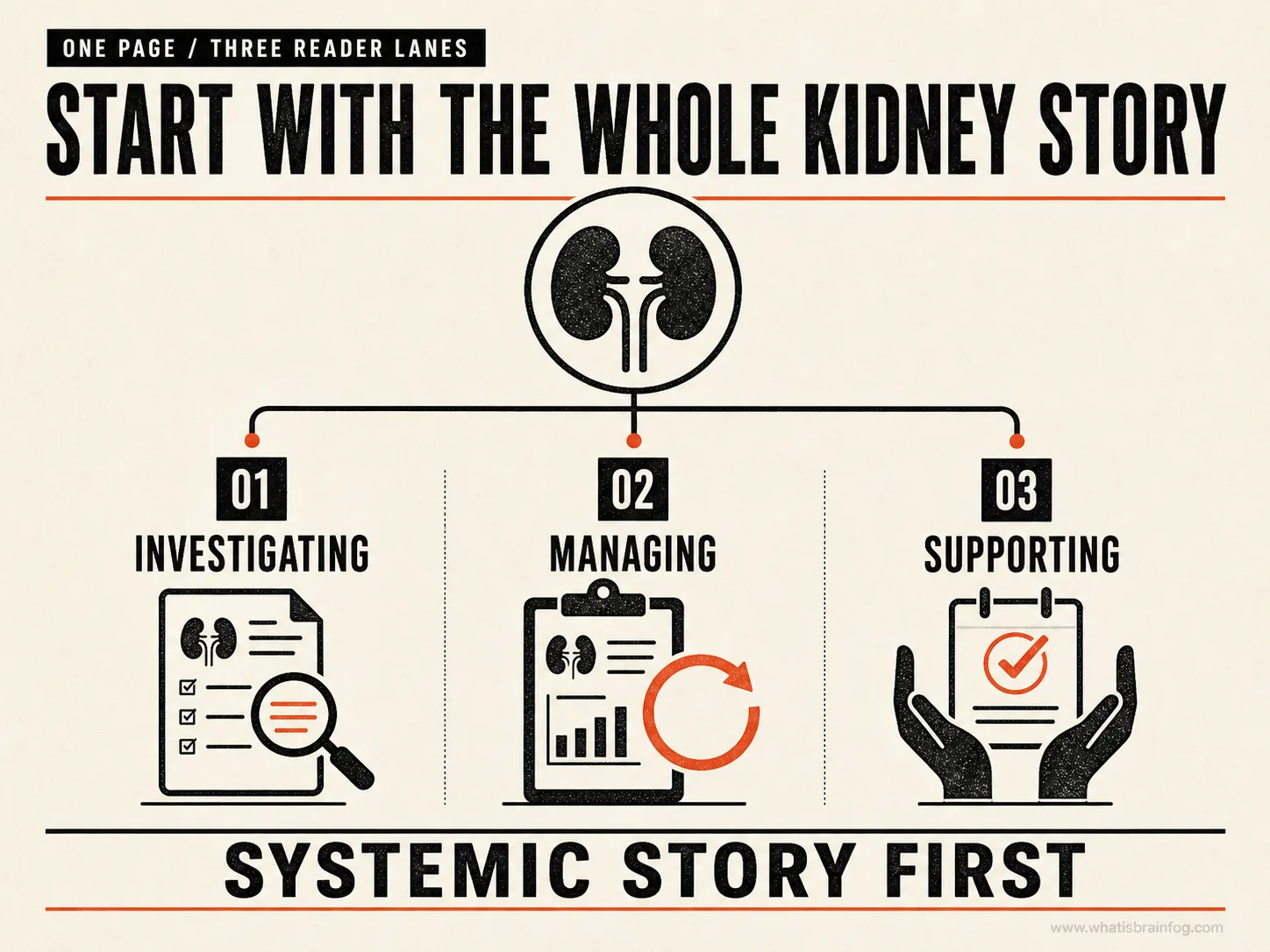
- Kidney-related brain fog usually appears alongside other CKD problems: swelling, hypertension, diabetes, urine protein, anemia, or worsening fatigue.
- The most useful first tests are creatinine with eGFR, UACR, CBC, ferritin and TSAT, electrolytes, bicarbonate, and often HbA1c.
- Thinking problems often become more obvious around CKD stage 3, but the trend in kidney function matters more than one lab result.
- Dialysis and transplant can greatly improve thinking when waste buildup is the main cause, but anemia and medicines still need separate attention.
- ACE inhibitors or ARBs, SGLT2 inhibitors, anemia treatment, and blood-pressure control help more than generic supplement combinations.
- If you already have diabetes or high blood pressure, blood and urine tests can check whether kidney disease is adding to brain fog.
Where to start
If you have known kidney disease and brain fog: discuss cognitive symptoms with your nephrologist. If you have unexplained thinking problems and risk factors (diabetes, high BP, family history), request kidney tests (creatinine, eGFR, urinalysis).
Timing: Variable. Cognitive symptoms can have several contributors and should be reviewed alongside the kidney diagnosis, results, symptoms, and treatment plan.
Daily life
What kidney-related brain fog can feel like
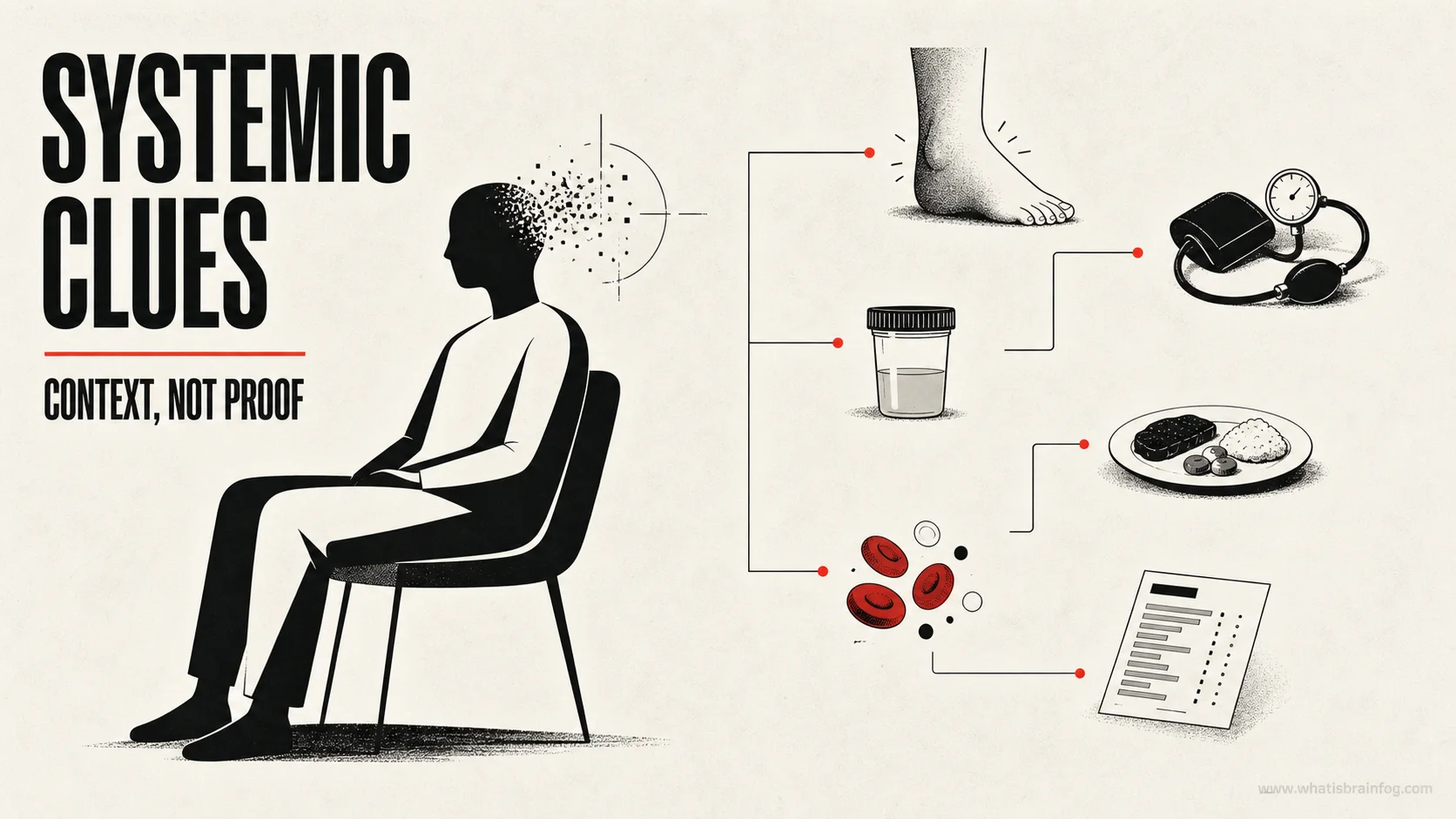
You may lose the steps halfway through a familiar task. You may read a medicine label twice because the numbers won't stay in your head. Instructions you understood yesterday may no longer make sense today. The kidney clue is not the lapse by itself. It is that thinking becomes less reliable as the rest of the illness becomes harder.
What this can tell you: The timing can make kidney involvement more plausible. It cannot show which part of CKD is responsible or rule out sleep, diabetes, anemia, depression, infection, vascular disease, or medicine effects.
The problem may reach beyond concentration: decisions take longer, and familiar tasks need more supervision than they used to.
Commonly reported
Light effort can use up the rest of the day's mental capacity when anemia, retained waste products, or fluid problems are active.
Commonly reported
Mornings after poor sleep or a restless night
Kidney-related brain fog is often worse on mornings after poor sleep, restless nights, night-time urination, or fluid changes, especially if you have abnormal kidney results or complications.
Worse after a meal
When brain fog gets worse after eating, the cause is usually another problem common in CKD: diabetes, blood-pressure shifts, or tiredness after larger meals.
Worse after physical effort
Physical effort can trigger kidney-related brain fog when anemia, waste buildup, or low stamina already limit recovery.
These often overlap because diabetes is the leading cause of CKD, but the presentations aren't identical.
Weaker kidneys can affect thinking through waste buildup, fluid balance, blood pressure and anemia. So kidney-related brain fog overlaps with hypertension, diabetes, anemia, electrolyte problems, poor sleep and many medicines.
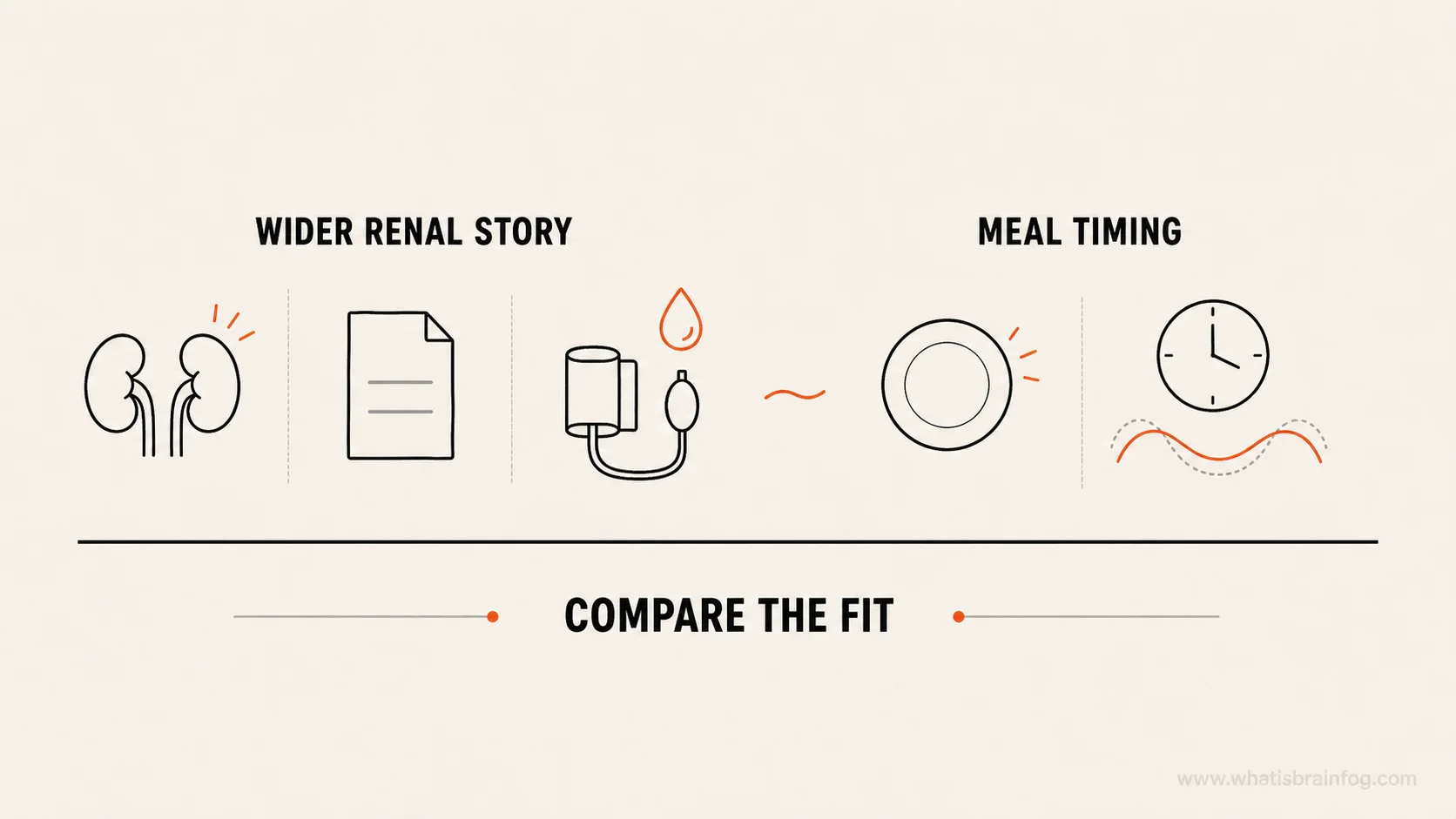
Kidney-related fog
Kidney-related brain fog is more likely when you also have swelling, foamy urine, high blood pressure, poor appetite, anemia, a falling eGFR, or a sense that your body chemistry is off.
Question to ask: Does brain fog happen with evidence of kidney disease, or only around meals and missed meals?
Sugar-related fog
More likely to cluster after meals, during missed-meal crashes, or with shakiness, sweating, cravings, and a rapid change after food.
Question to ask: Does your brain fog closely follow meal timing and glucose swings?
Anxiety
Both kidney disease and anxiety produce fatigue and difficulty concentrating. The difference usually shows up in whether physical kidney signs are present.
Does brain fog appear with physical kidney signs (swelling, anemia, lab changes) or with racing thoughts and stress triggers?
Medications
People with CKD often take several medicines that can affect thinking too. Look closely at timing to tell medicines from kidney disease.
Did brain fog start before the current medicines, or does it clearly worsen when medicines change but not when kidney function declines?
Sleep Apnea
Sleep apnea, common in CKD, independently causes morning brain fog, fatigue, and poor concentration. Both can be present at once.
Does brain fog change with sleep quality and snoring, or with kidney findings like eGFR, swelling, and anemia?
Standing-related heart-rate changes
Chronic kidney disease (CKD) and postural orthostatic tachycardia syndrome (POTS) can both affect fluid balance, blood pressure, and thinking. Kidney blood and urine results help separate them.
Does brain fog start after standing, or alongside abnormal kidney results, swelling, and anemia?
Kidney tests
What the kidney results can and cannot tell you
A kidney explanation needs more than one abnormal result. Current guidelines use both filtration and urine albumin to assess CKD. Older results matter because a stable number and a falling number do not mean the same thing.
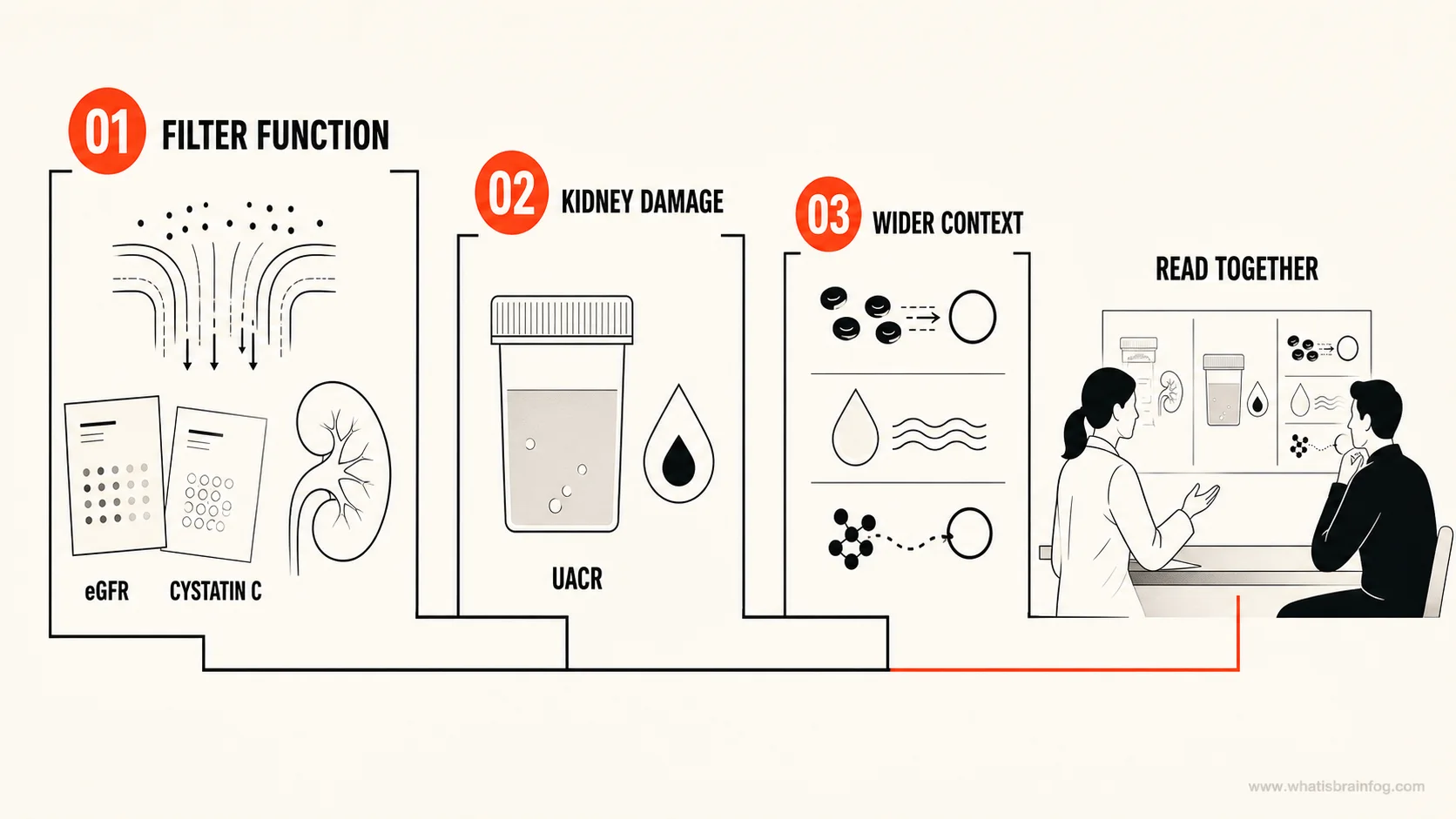
What must be true before kidney disease becomes a likely cause
The kidney findings are real and persistent
Kidney involvement is more likely when filtration or urine albumin stays abnormal over time and brain fog appears with kidney complications. These include anemia, swelling, hard-to-control blood pressure, electrolyte or acid-base changes, poor appetite, or advanced CKD.
The timing agrees with the kidney problems
Thinking may worsen as kidney function, anemia, fluid balance, blood pressure, sleep, or dialysis-day symptoms worsen. The same timing can still have more than one cause.
What makes kidney involvement more likely
Kidney disease is already plausible
You have diabetes, high blood pressure, abnormal kidney results, or swelling, or you take medicines that can affect your kidneys.
Several kidney findings occur together
Abnormal kidney results appear with more than one relevant complication. Fatigue or brain fog isn't the only finding.
Thinking changes when a kidney problem changes
The brain fog changes when a documented kidney complication changes, although that response doesn't prove the kidneys were the only cause.
What makes it less likely
Another cause explains more
Meal timing, measured glucose changes, or another condition explains the episodes better than the kidney findings do.
If another condition better explains when brain fog happens and what the tests show, investigate that condition first.
Expected kidney findings are missing
The expected kidney findings, complications, or timing are absent.
Another condition may then explain the brain fog better.
Kidney Disease: Improving Global Outcomes (KDIGO) says doctors should check kidney disease with both a filtering test and urine albumin (a protein). They should repeat one abnormal result before calling the disease chronic. A 2026 Chronic Renal Insufficiency Cohort study found that people with lower kidney filtering (eGFR) and more urine protein were more likely to develop new thinking problems. KDIGO 2024 · Huang et al. 2026
Clinical differentiation questions
| Compare | Question | Favors kidney | Favors the other cause |
|---|---|---|---|
| Blood sugar | Does brain fog change more with swelling, blood-pressure shifts, and kidney labs than with meal timing and glucose swings? | Swelling, blood-pressure problems, waste buildup, and anemia make kidney disease a more likely cause than day-to-day blood sugar changes. | Brain fog follows meal timing and blood sugar changes more than it follows kidney results. |
| Anxiety | Does brain fog appear with kidney signs (swelling, anemia, abnormal labs) or with racing thoughts, feeling on edge, or stress triggers? | Physical signs of CKD are driving the cognitive symptoms more than psychological stress. | Brain fog follows anxiety triggers and mood changes more than it follows kidney function results. |
| Medications | Did brain fog start before the current medicines? Does it clearly worsen as kidney disease worsens, or when medicines change? | The thinking problems follow the kidney function trend, not medication timing. | Brain fog matches medication changes, doses, or known cognitive side effects more closely. |
Kidney Function Testing
- Serum creatinine and eGFR (estimated glomerular filtration rate)
- Cystatin C, which the KDIGO 2024 kidney guideline recommends when eGFR needs confirming
- Blood urea nitrogen (BUN)
- Urinalysis (protein, blood)
- Urine albumin-to-creatinine ratio (UACR)
- Electrolytes (sodium, potassium, bicarbonate, phosphorus)
- HbA1c when diabetes is present or plausible
- Complete blood count (CBC), because anemia is common in chronic kidney disease and can worsen fatigue and thinking
- Ferritin and transferrin saturation (TSAT), which help assess iron status in anemia of chronic kidney disease
- Parathyroid hormone (PTH) and vitamin D when kidney-related mineral and bone problems are relevant
- Serum albumin (nutritional status and inflammation marker)
An eGFR of 60 or higher does not rule out CKD when another marker of kidney damage persists. Cystatin C can improve filtration estimates when creatinine may be misleading.
Cost context: $
Creatinine, eGFR, urine albumin, anemia, and electrolyte results organized in one place.
Estimated kidney filtration (eGFR)
What the estimate can show, why the trend matters, and where its limits begin.
Urine albumin-to-creatinine ratio (UACR)
Why urine albumin can reveal kidney damage that a creatinine result may miss.
When a second filtration test may make the estimate more reliable.
Kidney disease stage
The same eGFR can mean something different when urine albumin changes
Chronic kidney disease (CKD) staging uses two measurements: the G stage for filtration and the A stage for urine albumin. One creatinine or eGFR result cannot describe both kidney function and kidney damage.
Early kidney disease: filtration may still look normal (G1-G2)
Persistent albumin in the urine, or another sign of kidney damage, may show early chronic kidney disease even when estimated kidney filtration stays 60 or higher. At this stage, another condition may explain more of the brain fog than kidney disease does.
Moderate kidney disease: complications matter more (G3)
An estimated kidney filtration result below 60 makes kidney disease more relevant. But anemia, blood pressure, diabetes, sleep, and medicine effects may still explain more of the day-to-day change than the filtration number itself.
Advanced kidney disease: several problems may combine (G4-G5)
As kidney function falls, retained waste, anemia, acid-base or electrolyte problems, poor sleep, appetite loss, and medicine buildup can happen together. Several kidney-linked causes may affect your thinking at once.
Urine protein changes the risk, even at the same filtration level
The laboratory labels A1, A2, and A3 describe increasing albumin in the urine. Two people with the same estimated filtration rate can therefore fall into different kidney-risk categories.
These categories describe kidney disease and risk. They don't prove that a particular day of brain fog came from the kidneys.
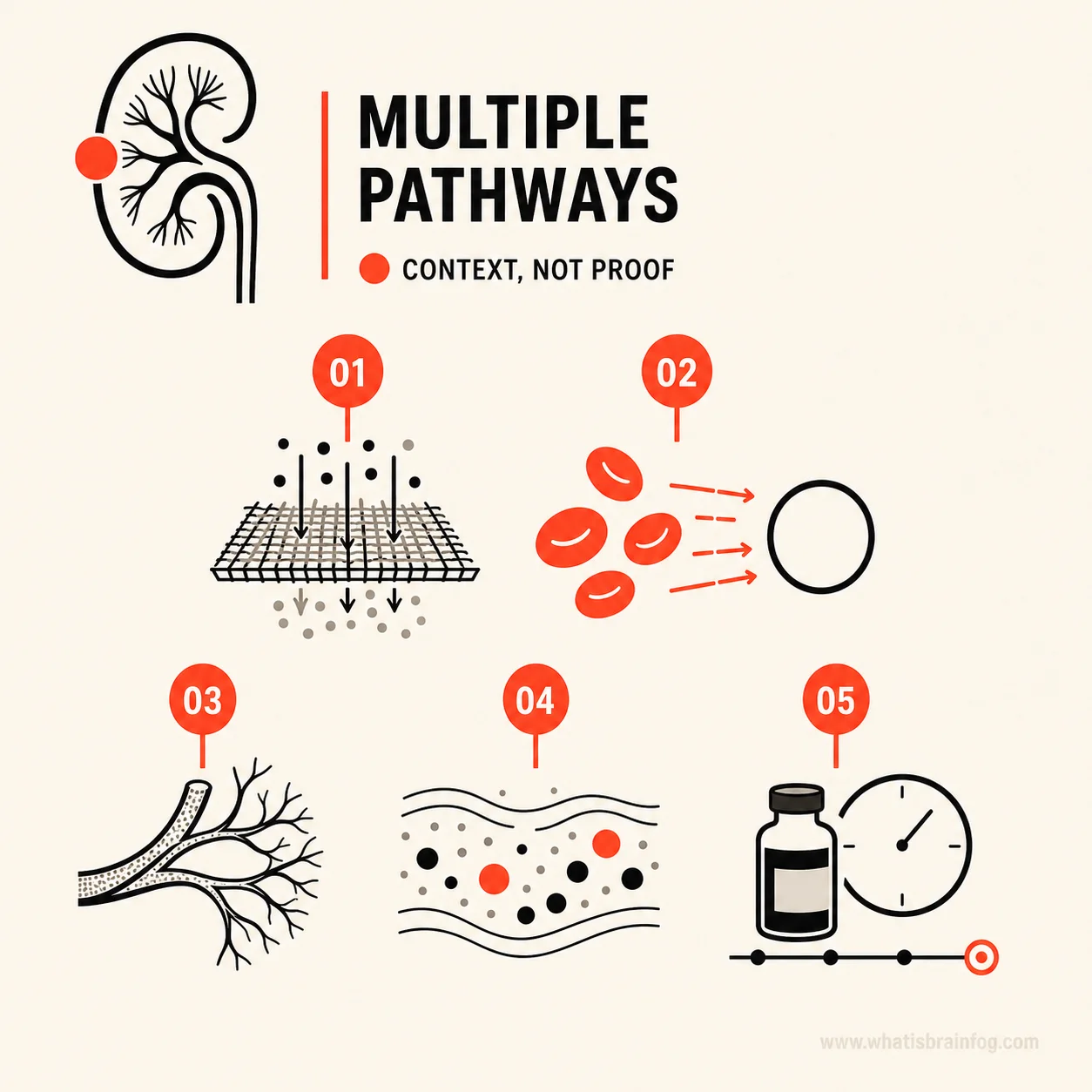
Kidney disease affects thinking through several paths at once, not one toxin or deficiency alone.
Waste clearance
When kidneys can't clear waste products like indoxyl sulfate and p-cresyl sulfate, these protein-bound toxins cross into the brain and trigger inflammation, oxidative stress, and direct nerve-cell damage.
Anemia and oxygen
Damaged kidneys produce less erythropoietin (EPO), leading to fewer red blood cells and less oxygen reaching the brain. This alone can cause persistent mental fatigue and slowed processing.
Vascular load
CKD accelerates small-vessel disease in the brain through hypertension, vascular calcification, and endothelial dysfunction. This produces white-matter lesions and microbleeds that impair executive function.
Electrolytes and fluid
Low bicarbonate, high potassium, phosphorus-calcium imbalance, and fluid shifts all affect nerve signaling, and each can worsen thinking.
Medication burden
Many CKD patients take medications that can independently cloud thinking: blood-pressure medicines, diuretics, phosphate binders, and opioids for pain. The cognitive load of polypharmacy adds up.
Prevalence
Cognitive impairment is common across CKD and rises further in dialysis populations
Zhang et al., PloS one 2024 (PMID 38829896); Murray, Advances in chronic kidney disease 2008 (PMID 18334236)
Uremic Toxins
Uremic toxins accumulate in CKD, causing cognitive impairment and brain fog
Drew et al., Am J Kidney Dis. 2019
Kidney disease overlaps with metabolic brain fog because chronic kidney disease (CKD) can affect glucose handling, blood pressure, acid-base balance, and electrolytes. Blood and urine tests are still needed before deciding kidney disease explains brain fog.
- Brain fog worsening on days with more swelling, blood-pressure instability, poor sleep, or dialysis-related fatigue.
- Slower thinking that occurs with anemia, poor appetite, or the sense that the whole body is metabolically off.
- Overlap with diabetes, medication burden, sleep disruption, and vascular disease that needs sorting out, not guessing.
Kidney-related brain fog usually goes unnoticed because it isn't a neat, isolated cognitive complaint. It appears alongside swelling, blood-pressure changes, anemia, appetite changes, abnormal labs, or the sense that your whole body chemistry is off. That systemic feel matters.
Kidney risk factors include diabetes, high blood pressure, a family history of kidney disease, obesity, and previous kidney infections or stones. Regular use of anti-inflammatory painkillers (NSAIDs) like ibuprofen or naproxen is another. One risk factor doesn't prove that the kidneys explain the brain fog.
KDIGO 2024 CKD guideline
Healthy kidneys continually remove waste from the blood. In advanced CKD, retained waste is one possible contributor to slower thinking, but no single toxin result can prove why one person has brain fog.
Andrews et al. 2025; Drew et al. 2019
Kidney involvement becomes more plausible when brain fog occurs with ankle swelling, persistent fatigue, appetite loss, itching, cramps, or urine changes. None of these symptoms is specific to chronic kidney disease, and early disease can have no obvious symptoms.
KDIGO 2024 CKD guideline; NICE NG203
eGFR estimates filtration, but it is not the whole kidney result. A value of 60 or higher can still sit alongside kidney damage shown by urine albumin. A value below 60 needs confirmation over time, unless the illness is acute (sudden).
Huang et al. 2026; KDIGO 2024 CKD guideline
At an appointment, ask whether your existing results include both an eGFR trend and urine albumin or protein. Ask whether anemia, electrolytes, medicines, diabetes, sleep, or blood pressure explain more of the change in thinking.
KDIGO 2024 CKD guideline
Diabetes is a common cause of CKD because long-term high glucose can damage the kidney's filtering units. When diabetes and brain fog coexist, kidney results add context. Glucose swings, medicines, sleep, vascular disease, and other causes may still explain the day-to-day problem.
KDIGO 2024 CKD guideline; ADA Standards of Care 2024
Blood pressure can matter in kidney disease, but a personal target depends on the diagnosis, medicines, symptoms, and clinician guidance. Bring home readings if you already monitor them.
KDIGO blood pressure guideline 2021; KDIGO 2024 CKD guideline
Anemia can occur in CKD and may add to fatigue or cognitive symptoms. The cause and treatment need to be assessed with the kidney results and wider medical history.
KDIGO 2024 CKD Guideline; Drew et al. 2019
CKD can remain unnoticed because earlier stages often cause no clear symptoms. Brain fog alone is too general to call an early kidney sign. But an unexpected eGFR trend or urine albumin result can reveal a problem before the body feels obviously unwell.
Zhang et al. 2024; Berger et al. 2016
Persistent foam can occur with protein in the urine, but appearance alone can't diagnose it. A urine albumin-to-creatinine ratio or another measured urine-protein test can show whether protein is present.
KDIGO 2024 CKD guideline
Dialysis treats kidney failure. Ordinary brain fog is no reason to start it. Your thinking may change around dialysis, but the timing and severity vary. Review this with your dialysis team.
Drew et al. 2019; Murray 2008
Fluid changes can matter: thirst, swelling, vomiting, diarrhoea, hot weather, dialysis, and diuretics can all change fluid balance. More fluid is not automatically safer in CKD, so the important detail is what changed and what fluid advice applies to your stage and treatment.
Andrews et al. 2025; KDIGO 2024 CKD guideline
Kidney care aims to identify the cause, monitor changes, and choose treatment through an individual plan. Early assessment is useful when kidney symptoms, risk factors, or abnormal results are present.
KDIGO 2024 CKD guideline; Drew et al. 2019
Dialysis and cognition
Why thinking can change across a dialysis week
Some people feel clearer after dialysis. Others are exhausted, slow, dizzy, or unable to think properly on treatment days. Both experiences can occur because dialysis does more than remove waste.
The difficult day may follow the treatment
Blood pressure shifts, fast fluid removal, cramps, poor sleep, travel, and the physical strain of the session can make thinking worse. That can happen even when dialysis is working well.
Feeling better doesn't prove one toxin caused the brain fog
Waste removal may help, but anemia, vascular disease, inflammation, medicines, depression, and sleep problems can remain. Improvement after dialysis is useful but doesn't fully explain the cause.
When in the week thinking is worst
Tell the kidney team when thinking is worst: before treatment, during it, later that day, or on the long gap between sessions. That gives them something specific to check.
After transplant
A new kidney can improve cognition without returning every part of thinking to normal
Studies show several areas of thinking improve on average after a kidney transplant. Blood vessel damage, sleep, mood, anemia, other illness, and anti-rejection medicines can keep affecting daily thinking.
Improvement can be real and incomplete
Someone may gain speed, attention, or mental stamina and still have problems that need their own explanation. The useful question becomes what changed after transplant and what did not.
New brain fog after transplant deserves medicine and infection checks
Anti-rejection treatment, drug interactions, kidney function, infection, sleep, and metabolic problems can change thinking. Have these checked before blaming new confusion on the old kidney disease.
How the evidence changed
How research connected kidney disease and cognition
The modern kidney-brain conversation didn't appear overnight. It grew gradually from long-term studies of aging, dialysis, and CKD.
2004
Kurella links CKD and cognitive impairment in older adults
One of the earlier high-impact studies showing chronic kidney disease is linked to measurable cognitive impairment.
2008
Murray frames the cognitive burden in CKD and dialysis populations
This review helped move kidney-related cognitive dysfunction from an afterthought to a recognized clinical problem.
2010
A long-term kidney cohort strengthens the kidney-cognition link
Yaffe et al. showed that both lower eGFR and higher albuminuria were independently associated with worse cognitive performance across multiple domains in 825 older adults with CKD.
2016
Berger et al. meta-analysis quantifies cognitive decline across CKD stages
A systematic review and meta-analysis of 44 studies (51,575 participants) confirmed people with CKD scored significantly worse on overall thinking, planning (executive function), memory, and language. Scores dropped as CKD worsened.
2019
Drew, Weiner, and Sarnak map the main kidney-brain pathways
The field crystallizes around uremic toxins, anemia, cerebrovascular disease, and inflammation as parallel drivers of cognitive decline.
2024
International kidney guidelines update how chronic kidney disease is assessed
The guideline refresh strengthens staging, albuminuria interpretation, cystatin C use, and medication strategy.
2026
A long-term kidney study shows that cognitive risk changes with disease stage
A large cohort analysis supports a graded relationship between lower eGFR and higher cognitive-impairment risk.
If kidney testing is in progress, you don't need to wait passively. These steps are safe and useful regardless of what the results show.
Read the kidney results together
If you also have kidney symptoms or abnormal results, ask whether the kidney check should include creatinine with eGFR, UACR, CBC, iron studies, electrolytes, and a medication review.
The fastest way to reduce guesswork is to get the right panel and look at the trend instead of one number.
Compare brain fog with blood pressure, swelling, and weight
Check your blood pressure at home each morning and evening for a week. If swelling, fluid shifts or unstable blood pressure are also present, consider weighing yourself daily that week too. High or unstable blood pressure is both a cause and an effect of kidney disease. Knowing your usual readings can help your clinician understand your lab results.
Match food advice to CKD stage and blood results
Find out what fluid advice applies to you
Ask whether your fluid intake should be increased, kept steady, or restricted. In CKD, 'drink more water' can be helpful or harmful depending on disease stage, swelling, blood pressure, urine output, and other signs of fluid balance.
Review medicines, contrast, and supplements
Make appointments easier to remember
Bring a support person or written note to nephrology if brain fog makes appointments hard to remember. Kidney care gets more usable when someone else hears the plan too.
Compare lab changes with harder thinking days
Notice salty foods
You don't need to count milligrams. Notice how much processed, restaurant, or packaged food you eat. Ask the kidney team if cutting back fits your stage and results.
Notice your worst days
Notice when brain fog is worst, whether it varies with swelling, sleep quality, fatigue, or appetite changes. Looking over a week tells you more than a single bad day.
One lab result isn't enough to explain all the brain fog
Kidney function varies day to day. One borderline creatinine doesn't mean kidney failure.
If brain fog is bad today
Body
Rest when needed. Energy is often limited in CKD.
Food
Follow dietary guidance from your renal team. Restrictions depend on your specific situation.
Water
Advanced CKD may mean watching how much fluid you drink.
Environment
Work with your healthcare team on managing fatigue and symptoms.
Connection
Kidney disease support communities can provide practical advice.
Ask
Ask for your eGFR trend. Direction is the finding; one reading hides it.
Avoid
Taking supplements your nephrologist hasn't checked, or ignoring symptoms.
Care options
What treatment can change, and what may remain
Ask about a nephrologist. Work with a renal dietitian. Consider CKD support groups.
Lifestyle
Blood-pressure checks and medicines
Blood-pressure goals and medicines depend on the kidney diagnosis, other conditions, symptoms, and clinician guidance.
Why it matters: High blood pressure damages kidney blood vessels and accelerates decline.
Diabetes care when relevant
Diabetes and kidney disease need managing together through an individual care plan.
Why it matters: High blood sugar damages kidney filtering units over time.
Diet by kidney stage and blood results
Food, fluid, sodium, potassium, and phosphorus advice needs to match the kidney diagnosis, results, medicines, and dialysis status.
Why it matters: Kidney disease can change how the body handles fluid and minerals, but the correct plan differs between people.
Medical
Kidney care plan
CKD, acute kidney injury, uremia, dialysis, and transplant need different decisions. A kidney clinician uses your diagnosis, result trends, symptoms, complications, and guidelines to decide testing, referral, medicines, dialysis, or transplant evaluation.
Brain fog alone doesn't decide a kidney treatment.
Supplements
Kidney function changes what's safe to take. Check any supplement with the kidney team before taking it.
Supporting care
Blood-pressure checks and medicines
Use the monitoring and medicine plan agreed with the care team.
Anemia assessment
The kidney team decides which tests and treatments are appropriate.
Can kidney-related brain fog improve?
Sometimes partly, sometimes substantially. Treating blood pressure, diabetes, anemia, and urine albumin aggressively enough can improve earlier CKD-related brain fog. If uremic toxins are the main driver, dialysis can improve cognition directly. Transplant often improves cognition more than dialysis because it restores more normal kidney function. Long-standing vascular injury may only improve partly, which is why early detection and earlier treatment matter.
- Earlier-stage CKD: improvement often depends on how well diabetes, blood pressure, and albuminuria are controlled over months.
- CKD with anemia: cognition can improve once hemoglobin and iron status are treated appropriately.
- Dialysis-stage CKD: many report clearer thinking once dialysis starts removing waste, though dialysis days can still be tiring.
- Transplant: often produces the biggest cognitive improvement, but not every deficit resets completely.
Reversibility isn't all-or-nothing. The practical question is whether the kidney disease and its complications are still active enough to keep hurting the brain.
Medicine review
A medicine that was once tolerable can become too much as kidney function falls
The kidneys help clear many medicines and their breakdown products. When clearance falls, the same prescription can last longer or produce stronger effects. Drowsiness, slowed thinking, imbalance, tremor, and confusion may then look like the kidney disease itself.
Bring the full list, not kidney medicines alone
Pain medicines, sleep medicines, antihistamines, gabapentin or pregabalin, opioids, diabetes medicines, and supplements may all matter. Their dose and timing may need review when kidney function changes.
Look for a change, even with a familiar medicine
A new prescription, a dose increase, an acute illness, dehydration, or a fall in eGFR can turn a long-standing medicine into a new problem. Note when brain fog changed in relation to those events.
Keep taking essential treatment until your prescriber reviews it
A pharmacist, prescriber, or renal team can check renal dosing, interactions, and safer alternatives. The point is to find an avoidable cognitive burden without destabilizing another condition.
Food and CKD
There is no single kidney diet for every stage or every blood result
Sodium, protein, potassium, phosphorus, fluid, and carbohydrate advice can change with kidney stage, urine protein, dialysis, diabetes, appetite, and the actual lab results. A restriction that is necessary for one person may be pointless or harmful for another.
Check your own results before you cut potassium
Potassium restriction is usually tied to a high blood result, medicines, or advanced kidney disease. Many people with earlier CKD do not need to avoid every fruit, vegetable, bean, or whole grain.
Protein advice changes with dialysis
Some people with non-dialysis CKD may get advice to moderate protein. Dialysis can increase protein needs. The stage and treatment determine which direction is relevant.
Poor appetite can become the bigger risk
Nausea, altered taste, fatigue, and complicated restrictions can reduce intake. A renal dietitian can protect nutrition while fitting sodium, potassium, phosphorus, protein, or fluid to the person, not to a generic menu.
A generic low-potassium menu can wrongly restrict someone whose potassium is normal. Your blood result, kidney stage, medicines, dialysis status, appetite, and overall nutrition decide whether potassium needs attention.
Diet by kidney stage and blood results
Dietary restrictions vary by CKD stage. Work with a renal dietitian. For many non-dialysis CKD patients, sodium matters before aggressive potassium restriction does.
Lower-sodium food when it fits the kidney plan
For people whose kidney problems include difficult blood pressure, swelling, and fatigue, not one sudden change in a lab result.
Food support when iron deficiency and kidney-related anemia are confirmed
For confirmed iron deficiency or mixed CKD-anemia presentations. It's meant to help the blood carry oxygen, not to be a high-protein diet plan.
Thinking problems alone are no reason to start iron or change protein intake. The kidney team should read the blood results and choose any treatment.
If you have kidney disease and cognitive symptoms, bring the symptom timeline, kidney results, medicines, and treatment details to the kidney care team. More than one contributor may be involved.
What people said helped
- A kidney review helped clarify which symptoms and results needed attention.
- Recording symptoms beside treatment days and blood-pressure changes helped with appointments.
What people said did not help
- Ignoring early kidney disease - it progresses
- Not controlling blood pressure and blood sugar
- Taking supplements without asking their nephrologist
What caught people off guard
- Cognitive impairment is common in kidney disease, and it's real
- Kidney treatment decisions and cognitive symptoms do not always move together.
- Anemia and other contributors can be assessed alongside kidney results.
Where people lost time
- Not getting kidney function checked if at risk (diabetes, hypertension)
- Taking supplements without asking their nephrologist
- Not controlling the conditions that cause kidney disease
Community reports can help someone spot useful details, but they don't diagnose anything or predict one person's response.
-
Brain fog appears alongside swelling, blood pressure issues, or feeling generally unwell.
-
This doesn't feel like an isolated brain problem. It feels like my whole body chemistry is off.
-
When the kidney side is worse, the cognition is worse too.
Finding care
Kidney care in the US, UK, and Australia
Coverage, referral rules, and wait times differ by country. These notes explain how kidney care usually starts in the United States, United Kingdom, and Australia. Confirm the current local rule with the clinic or insurer involved.
KDIGO chronic kidney disease guidelines; American Kidney Fund resources
- eGFR and urine albumin are interpreted with their trend and the clinical context
- Referral depends on cause, severity, rate of change, complications, and kidney-failure risk
- Blood pressure and diabetes care should follow an individual kidney plan
- Dialysis and transplant decisions are not based on cognitive symptoms alone
Local terms
Primary Care
primary care clinician
Specialist
nephrologist
Insurance
health insurance (Medicare covers dialysis at any age)
How care usually proceeds
US care for kidney disease and brain fog from waste buildup:
Screening (if risk factors)
If diabetes, hypertension, family history, or other risk factors: request kidney function testing (serum creatinine with eGFR, urinalysis, UACR).
Kidney screening typically covered for high-risk individuals.
PCP Management (early CKD)
A primary-care clinician may monitor early CKD and coordinate an individual plan for blood pressure, diabetes, medicines, and kidney-risk factors.
Standard PCP visits and medications covered.
When a kidney specialist may be needed
Referral depends on the diagnosis, eGFR and urine-albumin trend, acute changes, complications, and kidney-failure risk.
Nephrology typically covered. More frequent visits as CKD progresses.
Dialysis/Transplant (if kidney failure)
Dialysis and transplant are options for kidney failure. The kidney team explains when they are appropriate and what to expect.
Medicare provides coverage for ESRD patients regardless of age. Transplant evaluation covered.
Insurance and approvals
Common reasons coverage is denied
- Nephrologist visit 'not necessary' at early stages
- Frequency of labs exceeds plan limits
I have chronic kidney disease with eGFR of [X] and am experiencing cognitive symptoms consistent with uremic encephalopathy. Per KDIGO guidelines, nephrology management is indicated for patients with advanced CKD or rapidly progressing disease. I request coverage for nephrology evaluation and ongoing management.
What the results mean
eGFR (estimated Glomerular Filtration Rate)
>90 mL/min/1.73m²
Key measure of kidney function. 60-89 = mild reduction. 30-59 = moderate. 15-29 = severe. <15 = kidney failure.
Serum Creatinine
0.6-1.2 mg/dL
Waste product filtered by kidneys. Elevated = reduced kidney function. Used to calculate eGFR.
BUN (Blood Urea Nitrogen)
7-20 mg/dL
Another waste product. Elevated in kidney dysfunction. High BUN with normal creatinine can indicate dehydration.
UACR (Urine Albumin-to-Creatinine Ratio)
<30 mg/g
Measures protein in urine. >30 = albuminuria (kidney damage). >300 = severely increased.
NICE CG182 Chronic Kidney Disease
- eGFR staging same as international standards
- NHS Kidney Care provides patient resources
- Referral depends on the diagnosis, trends, complications, and kidney-failure risk
- Dialysis and transplant available through NHS
Local terms
Primary Care
GP
Specialist
consultant nephrologist
Insurance
NHS
How care usually proceeds
Managing kidney disease through the NHS:
Screening
Routine bloods often include kidney function. GP can order eGFR, creatinine, urinalysis if symptoms or risk factors.
Blood tests: days
GP Management (early CKD)
A GP can monitor early CKD and coordinate an individual plan for blood pressure, diabetes, medicines, and risk factors.
Ongoing GP care
When a kidney specialist may be needed
Referral to nephrology for advanced CKD or rapidly declining function.
Nephrology: 6-12 weeks typical
Dialysis/Transplant
NHS provides dialysis and transplant services for kidney failure.
Planning begins well before need. Transplant wait depends on organ availability.
CARI (Caring for Australians and New Zealanders with Kidney Impairment) guidelines; Kidney Health Australia
- Kidney Health Australia (kidney.org.au) provides free CKD management plans
- eGFR and UACR are the two key CKD monitoring tests. Medicare covers both.
- Dialysis covered by Medicare through public hospitals
- Australia's Pharmaceutical Benefits Scheme (PBS) subsidises SGLT2 inhibitors (empagliflozin, dapagliflozin) for eligible people with CKD
Local terms
Primary Care
GP
Specialist
nephrologist
Insurance
Medicare / PBS
How care usually proceeds
In Australia, Medicare and the CARI clinical guidelines support kidney care.
GP Annual Screening
eGFR, UACR, and blood pressure. Annual screening for patients with diabetes, hypertension, or family history. All Medicare-covered.
Results in 1-3 days
RACGP/CARI Management Plan
Early CKD care can include an agreed blood-pressure target and avoiding medicines or exposures that can harm the kidneys. It can also include an SGLT2 inhibitor when it's medically suitable and PBS-subsidised.
Ongoing GP care
When a kidney specialist may be needed
Referral depends on the diagnosis, trends, complications, and kidney-failure risk. Access and wait times vary by location and service.
Public: 3-12 months. Private: 2-6 weeks
Questions for an appointment
What to bring up when kidney disease and brain fog overlap
My brain fog seems to worsen alongside kidney symptoms, swelling or fluid changes, or abnormal blood and urine results. Could we review my kidney function, anemia tests, and medicines together instead of treating the thinking problems on their own?
I have brain fog. I also have a kidney diagnosis, an unusual kidney result, or symptoms like swelling, tiredness, nausea, itching, changed urination, or shortness of breath. I can't tell if my kidneys are involved. Or the cause could be anemia, blood pressure, diabetes, poor sleep, a medicine, infection, dehydration, or another condition. Could we review my blood and urine results over time and decide what to check next?
Tests to discuss
- eGFR
- UACR
- Cystatin C
- CBC + CMP Blood Test Bundle
- Ferritin
- Serum Sodium
- Serum Potassium
- HbA1c
- Medication Review
What would make kidney disease less likely
- Repeat eGFR and urine tests do not show lasting kidney damage, and kidney symptoms are absent.
- The brain fog was present before the kidney problem and has not changed as kidney results or treatment changed.
- Anemia, low glucose, poor sleep, sleep apnea, infection, a medicine, depression, anxiety, migraine, or another condition explains the timing better.
- Kidney disease may still be present without causing the brain fog. Early chronic kidney disease often has no symptoms.
- Sudden confusion, trouble speaking, one-sided weakness, a seizure, fainting, or a sudden severe headache needs urgent assessment for another cause, even with chronic kidney disease.
Details that change how likely kidney involvement is
- One creatinine or eGFR result does not show whether kidney damage is lasting. Chronic kidney disease usually requires an eGFR below 60 or another sign of kidney damage that lasts at least three months.
- An eGFR of 60 to 89 is not chronic kidney disease by itself. Urine albumin, blood or structural changes, repeat results, age, muscle mass, medicines, and the clinical history matter.
- Advanced kidney disease can affect your thinking. So can anemia, blood pressure, diabetes, sleep, medicines, infection, and blood-vessel disease.
- The National Kidney Foundation and American Society of Nephrology recommend the 2021 creatinine equation without a race variable for US adults. KDIGO says race should not be used in eGFR calculations.
What to bring
- Bring every creatinine and eGFR result you can find, with the date, laboratory range, and equation name when the report shows it. A result list is more useful than one recent value.
- Bring urine albumin-to-creatinine ratio, urinalysis, urine protein, scan, biopsy, and kidney clinic results. Check whether a urine result was repeated in a first-morning sample.
- Write when the brain fog starts, how long it lasts, and whether it changes with swelling, urine, nausea, appetite, itching, breathlessness, sleep, blood pressure, meals, illness, or dialysis.
- Bring seven days of home blood pressure readings if you have them. Include the time, symptoms, and whether the reading was before or after medicine or dialysis.
- Bring every prescription, pain medicine, cold medicine, antacid, supplement, herbal product, protein or creatine product, and salt substitute. Include the dose, timing, and recent changes.
- Bring recent CBC, ferritin, iron, sodium, potassium, bicarbonate, glucose, HbA1c, calcium, phosphate, albumin, and parathyroid hormone results when available.
- If you're on dialysis, bring the treatment schedule, missed or shortened treatments, access problems, blood pressure changes, dry-weight changes, and when your thinking is best or worst.
- For pregnancy, bring the obstetric and kidney plans. Creatinine-based eGFR equations are not reliable during pregnancy.
Useful screening tools
- eGFR estimates kidney filtration from creatinine, age, and sex in the equation used by the laboratory. The US 2021 CKD-EPI equation does not include race. One eGFR can change with acute illness, hydration, medicines, meat or creatine intake, and muscle mass.
- UACR compares urine albumin with urine creatinine. In US units, less than 30 mg/g is A1, 30 to 299 mg/g is A2, and at least 300 mg/g is A3. In UK and Australian units, the matching boundaries are below 3, 3 to 30, and above 30 mg/mmol.
- A high UACR may need confirmation. Heavy exercise, fever, a urinary infection, blood in the urine, menstruation, high glucose, and high blood pressure can change a urine albumin result.
- Cystatin C is another blood test used to estimate filtration. A combined creatinine and cystatin C equation can help when muscle mass, diet, amputation, frailty, or a decision near a cutoff makes creatinine less reliable.
- A CBC can show anemia. A CMP can show creatinine, glucose, sodium, potassium, bicarbonate, kidney and liver results. The doctor may add iron studies, calcium, phosphate, or parathyroid hormone when the kidney stage, symptoms, or blood results give a reason.
- Ferritin helps estimate stored iron, but inflammation can raise it. The doctor may need transferrin saturation, the CBC, bleeding history, nutrition, and kidney stage before deciding whether iron is low.
- Sodium and potassium can change with kidney function, vomiting, diarrhea, fluid intake, medicines, supplements, and dialysis. Ask your care team before you change salt, potassium, or fluids because of one result.
- HbA1c estimates average glucose over about two to three months. It may be less reliable with anemia, recent blood loss, transfusion, dialysis, or medicines that change red-cell production.
- Medication reviews check whether doses suit your kidneys and which medicines can affect thinking, blood pressure, fluid, potassium, or kidney function. Ask your doctor before stopping ACE inhibitors, ARBs, SGLT2 inhibitors, diuretics, or other prescriptions.
Warning signs
- Get urgent help for suddenly making much less urine, rapidly increasing swelling, repeated vomiting, severe weakness, new confusion, or trouble breathing. These can occur with acute kidney injury or dangerous fluid build-up.
- A very high blood pressure reading with chest pain, breathlessness, severe headache, new confusion, weakness, or vision change needs emergency care. Follow the personal emergency limit from the care team.
- A dangerous potassium change may cause severe weakness, palpitations, fainting, or an abnormal heartbeat. The symptoms don't show whether potassium is high or low, so get tested urgently.
- A dialysis patient should contact the dialysis team urgently for new confusion, severe breathlessness, chest pain, a seizure, fever, or an access problem. A missed treatment followed by worsening symptoms also needs urgent advice or emergency care.
Questions for a kidney appointment
- Do my repeat eGFR and urine albumin results meet the three-month definition of chronic kidney disease?
- Which eGFR equation did the laboratory use, and was race excluded? Would cystatin C or measured GFR help because of my muscle mass, diet, amputation, or a decision near a cutoff?
- If I'm pregnant, how should you check my kidney function when standard eGFR equations aren't reliable in pregnancy?
- Could anemia, iron status, sodium, potassium, bicarbonate, glucose, blood pressure, poor sleep, infection, or a medicine be contributing to the brain fog?
- What caused the kidney disease, and is there blood, protein, infection, blockage, inflammation, diabetes, or high blood pressure that needs separate care?
- Which doses depend on my kidneys? Which pain medicines, supplements, salt substitutes or contrast-dye scans should I ask before using?
- Do my eGFR, UACR, rate of change, blood pressure, or kidney-failure risk score mean I should see a nephrologist now?
- Would a brief thinking test help because the brain fog is affecting medicines, driving, work, school, dialysis choices, or daily safety?
- If the kidney results do not explain the brain fog, which sleep, neurological, hormonal, metabolic, infection, or mental health cause should we check next?
What to do day to day
- For seven days, rate the brain fog at the same time each day. Note sleep, swelling, urine, nausea, appetite, itching, breathlessness, meals, fluids, blood pressure, and medicine timing.
- Choose one ordinary thinking task, such as reading a page, following a meeting, preparing medicines, cooking from steps, or doing schoolwork. Notice what becomes hard and how long the problem lasts.
- Notice thinking before, during and after dialysis, and cramps, low blood pressure and recovery time.
- Take medicines exactly as prescribed while the review is underway. Ask the clinician or pharmacist before using ibuprofen, naproxen, a decongestant, an herbal product, creatine, or a salt substitute.
- Ask your care team before starting a high-water, low-salt, low-potassium, low-phosphate, or high-protein plan. Kidney diets and fluid limits depend on your diagnosis, blood results, medicines, and dialysis.
- Keep the blood and urine results with dates in My Fog, so the clinician can see change over time. The latest number alone isn't enough.
Age Context
- Children and teenagers need a pediatric kidney equation and age-specific blood pressure, growth, nutrition, bone, school, and medicine review. Adult eGFR equations do not apply.
- Creatinine comes from muscle. Low muscle mass, frailty, amputation, paralysis, or severe illness can make creatinine-based eGFR look better than the true filtration level. High muscle mass, meat, creatine, or hard exercise can move it the other way.
- Average eGFR tends to fall with age, but age alone does not make persistent urine albumin, blood in urine, a fast decline, or severe symptoms normal.
- Adult creatinine equations use age and sex because creatinine production differs on average. There is no separate kidney brain-fog cutoff based only on sex.
- Menstruation can add blood to a urine sample. Ask whether to repeat an abnormal urine result after bleeding stops.
- Pregnancy changes kidney blood flow and makes standard eGFR equations unreliable. New high blood pressure, headache, vision change, upper abdominal pain, swelling, or protein in urine needs prompt maternity assessment.
- Older adults need extra attention to falls, dehydration, frailty, medicines, hearing or vision, sleep, infection, stroke risk, and whether thinking changes make taking medicines unsafe.
Evidence Limits
- A 2024 review combined 50 studies of 25,289 adults with chronic kidney disease. It found thinking problems in 40% overall, 53% on hemodialysis, 39% on peritoneal dialysis, 32% without dialysis, and 26% after transplant.
- The 2024 percentages are group estimates, not a personal forecast. The studies used different thinking tests, cutoffs, ages, countries, kidney stages, and study designs.
- A 2026 US study followed 5,607 adults with chronic kidney disease. Some had an eGFR below 60 and a urine protein-to-creatinine ratio of at least 150 mg/g. Their later risk of overall thinking problems was 38% above the comparison group's.
- That 2026 result shows a link. It doesn't prove kidney disease caused each thinking change. The study measured urine protein-to-creatinine ratio, a different test from UACR. The 150 mg/g level isn't a personal treatment target.
- A 2025 review found a Montreal Cognitive Assessment cutoff of 24 caught problems in kidney patients, with more false alarms. Studies varied widely, so one score can screen for a problem but can't diagnose its cause.
- A 2025 review lists several things that may add to thinking problems in kidney disease, including built-up waste products, blood-vessel injury, anemia, inflammation, sleep problems, diabetes, and dialysis changes.
- A 2026 review of 26 observational dialysis studies found thinking results differed between hemodialysis and peritoneal dialysis, and dementia results varied widely. Thinking results alone shouldn't decide your dialysis method.
I think kidney disease may add to my brain fog because the timing and symptoms keep lining up. I want to check other likely causes and measurements before guessing.
- Has my kidney function been trending down over the past 1-2 years? Can you pull up prior results for comparison?
- Should I be seeing a nephrologist based on my current labs, or is primary care management still appropriate?
- What specific test results or findings would confirm or rule this out?
- I'd like to start with testing, not trial-and-error treatment.
- Could we check for overlapping contributors before assuming it's just one thing?
Urgent care
Get urgent medical care for much less urine than usual, blood in the urine, severe swelling, chest pain, severe shortness of breath, or new confusion in someone with known kidney disease.
Driving
Advanced chronic kidney disease, uremic encephalopathy, or dialysis-day exhaustion can impair driving. This is a safety issue, as well as a convenience one. Rules vary by location. In the United Kingdom, this may involve Driver and Vehicle Licensing Agency (DVLA) guidance. In the United States, clinician guidance and state motor-vehicle rules usually cover it when thinking is clearly impaired.
Work
Chronic kidney disease, especially on dialysis, may justify changes at work (accommodations) like flexible hours, water and bathroom access, less heat, or time for treatment visits. In the US, the Americans with Disabilities Act (ADA) may protect you when kidney disease substantially limits daily life.
Pregnancy
CKD complicates pregnancy, so plan it with nephrology and high-risk pregnancy care before conception. Blood pressure targets, medications, and proteinuria all matter.
Bring up kidney-related brain fog early, because the tests are simple and the long-term consequences of delay aren't trivial.
- Ask about kidney testing when the fog persists: If it lasts more than a couple of weeks and you already have diabetes, high blood pressure, swelling, or kidney risk factors, ask whether blood and urine tests should check kidney function.
- Seek review when kidney results or symptoms are getting worse: Have a clinician review a falling estimated kidney filtration rate (eGFR), protein in the urine, persistent foamy urine, swelling, hard-to-control blood pressure, or worsening fatigue.
- When kidney symptoms need urgent care: Confusion with advanced CKD, passing much less urine, severe shortness of breath, chest pain, or swelling that worsens fast.
A few situations make kidney-related brain fog more likely even before the labs come back.
Older adults
People often blame aging alone when older adults' thinking changes. But CKD, anemia, and multiple medicines often contribute, and they're treatable.
Diabetes or hypertension
If either is already present, the threshold for ordering kidney tests should be low. These are the two biggest CKD drivers in routine practice.
Frequent use of anti-inflammatory painkillers
Regular use of ibuprofen, naproxen, or other kidney-harming medicines should raise suspicion, especially without recent lab checks.
2026
Kidney function and urine protein were stronger together
In 5,607 adults with CKD, lower eGFR and higher urine protein were associated with later cognitive impairment. So one result can't show whether kidney disease is affecting thinking. Filtration and urine protein describe different parts of kidney health and need to be read together.
2026
Dialysis cognition still resists one simple explanation
A study following hemodialysis patients found that as leftover kidney function fell, thinking-test scores didn't neatly follow. Fluid and heart context changed some associations. A hard dialysis day may be real without proving one universal mechanism.
2025
Cognitive problems can make kidney care harder
In non-dialysis CKD, cognitive impairment was associated with poorer health outcomes, a systematic review found. The studies didn't prove cause and effect, but they support taking memory, attention, and decision problems seriously, not treating them as an aside.
2025
Kidney care must distinguish brain fog, delirium, depression, and dementia
A nephrology review explains why these are not interchangeable. A sudden confused state, a longer decline, low mood, and ordinary brain fog can look similar from the outside but lead to different questions and different care.
Liu et al., American Journal of Kidney Diseases; Chan et al., Health Psychology Review (Chan FHF et al. Subjective cognitive complaints in end-stage renal disease: a systematic review and meta-analysis. Health Psychol Rev. 2023;17(4):614-640, PMID 36200562)
2025
Most treatment research still comes from dialysis
A scoping review found 71 studies of treatments meant to improve thinking in CKD. Two-thirds studied people on long-term hemodialysis. Most tested anemia treatment, dialysis changes, or exercise. That leaves little evidence on cognitive rehabilitation (thinking-skills training) or for people with earlier CKD.
Questions people ask
Kidney disease and brain fog FAQ
Cognitive problems become more common as kidney function falls, so stage 3 makes kidney involvement more relevant. Urine albumin, anemia, difficult blood pressure, swelling, poor appetite, or sleep problems may make it more relevant still. Earlier CKD can still matter, but another cause is more likely to be contributing at that stage.
Huang et al., JAMA Network Open 2026; KDIGO 2024
Yes. Research in CKD describes problems with attention, processing speed, memory, and executive function. In daily life, that can mean forgetting a word, but also losing instructions, making slower decisions, or struggling to keep several steps in mind.
Drew et al., American Journal of Kidney Diseases 2019; Berger et al., BMC Medicine 2016; Berger et al., BMC Medicine 2016
It can, particularly when retained waste products are an important contributor. The result is not uniform. Treatment days can also bring fatigue, cramps, low blood pressure, poor sleep, and a long recovery, while anemia, vascular disease, medicines, or depression may still affect thinking.
Drew et al. 2019; O'Lone et al. 2016; Malik et al. 2026; Rosenberg et al. 2026; Hussein et al. 2017; Bossola et al. 2026; Dunlop et al. 2019; Morfin et al. 2016 (Morfin JA et al. Intensive Hemodialysis and Treatment Complications and Tolerability. Am J Kidney Dis. 2016;68(5S1):S43-S50, PMID 27772642)
Creatinine with eGFR and urine albumin or protein are the kidney starting point. CBC and iron studies can find anemia. Electrolytes and bicarbonate can reveal metabolic problems. HbA1c matters when diabetes is possible, and cystatin C can help when creatinine may give a misleading estimate. Older results show whether the change is stable or getting worse.
KDIGO 2024
A blood sugar crash is often tied closely to meals or missed meals and may include shakiness, sweating, cravings, or a quick change after eating. Kidney involvement becomes more plausible when urine protein, falling eGFR, swelling, anemia, appetite loss, or difficult blood pressure are also present. Diabetes can cause CKD, so both can be active at once.
KDIGO 2024; WBF kidney comparison
Sometimes. It depends on what's causing it. Anemia, metabolic problems, sleep, medicines, dialysis effects, blood vessel disease and the kidney disease itself don't all improve the same way. Even partial improvement helps, because it can show which causes you've fixed and which still need checking.
Liu et al., American Journal of Kidney Diseases 2025
Raise it when the change persists or worsens, especially if kidney function is falling, urine albumin is present, medicines have changed, or dialysis days are harder. The same goes when ordinary tasks like managing tablets, cooking, driving, or following treatment instructions become less reliable. Bring the medicine list and older kidney results to compare the change over time.
KDIGO 2024; Liu et al. 2025; Drew et al. 2019 (Drew DA et al. Cognitive Impairment in CKD: Pathophysiology, Management, and Prevention. Am J Kidney Dis. 2019;74(6):782-790, PMID 31378643)
Medical sources
Research and guidelines used for this guide
Prepared by the What Is Brain Fog editorial desk. Medical reviewer: Dr. Alexandru-Theodor Amarfei, M.D.
This guide is about chronic kidney disease or kidney failure severe enough to harm thinking through waste buildup (uremic toxins), anemia, blood-pressure swings, electrolyte imbalance, or fluid shifts. Thinking problems rarely occur alone and usually appear with other CKD signs.
CKD
Chronic kidney disease: long-term loss of kidney function. Toxin buildup, anemia, unstable blood pressure, and metabolic stress can then affect thinking.
eGFR
Estimated glomerular filtration rate: a calculated measure of how well the kidneys are filtering blood. The trend is usually more useful than a single result.
Uremic toxins
Waste products like indoxyl sulfate and p-cresyl sulfate. They build up as kidneys weaken and can add to brain inflammation and thinking problems.
Albuminuria / proteinuria
Protein leaking into the urine. This is a key marker of kidney damage and often shows up before severe symptoms do.
UACR
Urine albumin-to-creatinine ratio: the standard screening test for albuminuria.
Creatinine
A waste product filtered by the kidneys and used to calculate eGFR. It's useful, but not enough on its own.
BUN
Blood urea nitrogen: another waste product that rises with dehydration and kidney dysfunction.
Dialysis
A treatment that removes waste products and excess fluid from the blood when the kidneys can no longer do so adequately.
Nephrologist
A physician who specializes in kidney disease, electrolyte problems, and dialysis-related care.
SGLT2 inhibitor
A newer drug class that slows CKD and lowers heart and blood-vessel risk, even in many people without diabetes.
An article for people trying to tell CKD-related brain fog from meal-linked glucose crashes.
Neuroinflammation and Brain Fog
Explains one of the main kidney-to-brain pathways in more detail.
Cognitive impairment is found in roughly 40% of people with CKD and closer to 70% on hemodialysis
Kidney-related brain fog usually comes from wider CKD problems, including uremic toxins, anemia, blood-pressure swings, and blood vessel damage. A 2024 meta-analysis found thinking problems are common in people with CKD. Older dialysis reviews show an even higher rate on hemodialysis.
Zhang et al., PloS one 2024 (PMID 38829896); Murray, Advances in chronic kidney disease 2008 (PMID 18334236)
Editorially updated: July 22, 2026
Managing: I have chronic kidney disease and still have brain fog
I have chronic kidney disease and still have brain fog
Look beyond estimated filtration rate to anemia, sleep, blood pressure, dialysis effects, and medicines that may build up.
Six things that make kidney involvement more or less likely
- Kidney-related brain fog usually appears alongside other CKD problems: swelling, hypertension, diabetes, urine protein, anemia, or worsening fatigue.
- The most useful first tests are creatinine with eGFR, UACR, CBC, ferritin and TSAT, electrolytes, bicarbonate, and often HbA1c.
- Thinking problems often become more obvious around CKD stage 3, but the trend in kidney function matters more than one lab result.
- Dialysis and transplant can greatly improve thinking when waste buildup is the main cause, but anemia and medicines still need separate attention.
- ACE inhibitors or ARBs, SGLT2 inhibitors, anemia treatment, and blood-pressure control help more than generic supplement combinations.
- If you already have diabetes or high blood pressure, blood and urine tests can check whether kidney disease is adding to brain fog.
Where to start
If you have known kidney disease and brain fog: discuss cognitive symptoms with your nephrologist. If you have unexplained thinking problems and risk factors (diabetes, high BP, family history), request kidney tests (creatinine, eGFR, urinalysis).
Timing: Variable. Cognitive symptoms can have several contributors and should be reviewed alongside the kidney diagnosis, results, symptoms, and treatment plan.
Daily life
What kidney-related brain fog can feel like
You may lose the steps halfway through a familiar task. You may read a medicine label twice because the numbers won't stay in your head. Instructions you understood yesterday may no longer make sense today. The kidney clue is not the lapse by itself. It is that thinking becomes less reliable as the rest of the illness becomes harder.
What this can tell you: The timing can make kidney involvement more plausible. It cannot show which part of CKD is responsible or rule out sleep, diabetes, anemia, depression, infection, vascular disease, or medicine effects.
The problem may reach beyond concentration: decisions take longer, and familiar tasks need more supervision than they used to.
Commonly reported
Light effort can use up the rest of the day's mental capacity when anemia, retained waste products, or fluid problems are active.
Commonly reported
Mornings after poor sleep or a restless night
Kidney-related brain fog is often worse on mornings after poor sleep, restless nights, night-time urination, or fluid changes, especially if you have abnormal kidney results or complications.
Worse after a meal
When brain fog gets worse after eating, the cause is usually another problem common in CKD: diabetes, blood-pressure shifts, or tiredness after larger meals.
Worse after physical effort
Physical effort can trigger kidney-related brain fog when anemia, waste buildup, or low stamina already limit recovery.
These often overlap because diabetes is the leading cause of CKD, but the presentations aren't identical.
Weaker kidneys can affect thinking through waste buildup, fluid balance, blood pressure and anemia. So kidney-related brain fog overlaps with hypertension, diabetes, anemia, electrolyte problems, poor sleep and many medicines.
Kidney-related fog
Kidney-related brain fog is more likely when you also have swelling, foamy urine, high blood pressure, poor appetite, anemia, a falling eGFR, or a sense that your body chemistry is off.
Question to ask: Does brain fog happen with evidence of kidney disease, or only around meals and missed meals?
Sugar-related fog
More likely to cluster after meals, during missed-meal crashes, or with shakiness, sweating, cravings, and a rapid change after food.
Question to ask: Does your brain fog closely follow meal timing and glucose swings?
Anxiety
Both kidney disease and anxiety produce fatigue and difficulty concentrating. The difference usually shows up in whether physical kidney signs are present.
Does brain fog appear with physical kidney signs (swelling, anemia, lab changes) or with racing thoughts and stress triggers?
Medications
People with CKD often take several medicines that can affect thinking too. Look closely at timing to tell medicines from kidney disease.
Did brain fog start before the current medicines, or does it clearly worsen when medicines change but not when kidney function declines?
Sleep Apnea
Sleep apnea, common in CKD, independently causes morning brain fog, fatigue, and poor concentration. Both can be present at once.
Does brain fog change with sleep quality and snoring, or with kidney findings like eGFR, swelling, and anemia?
Standing-related heart-rate changes
Chronic kidney disease (CKD) and postural orthostatic tachycardia syndrome (POTS) can both affect fluid balance, blood pressure, and thinking. Kidney blood and urine results help separate them.
Does brain fog start after standing, or alongside abnormal kidney results, swelling, and anemia?
Kidney tests
What the kidney results can and cannot tell you
A kidney explanation needs more than one abnormal result. Current guidelines use both filtration and urine albumin to assess CKD. Older results matter because a stable number and a falling number do not mean the same thing.
What must be true before kidney disease becomes a likely cause
The kidney findings are real and persistent
Kidney involvement is more likely when filtration or urine albumin stays abnormal over time and brain fog appears with kidney complications. These include anemia, swelling, hard-to-control blood pressure, electrolyte or acid-base changes, poor appetite, or advanced CKD.
The timing agrees with the kidney problems
Thinking may worsen as kidney function, anemia, fluid balance, blood pressure, sleep, or dialysis-day symptoms worsen. The same timing can still have more than one cause.
What makes kidney involvement more likely
Kidney disease is already plausible
You have diabetes, high blood pressure, abnormal kidney results, or swelling, or you take medicines that can affect your kidneys.
Several kidney findings occur together
Abnormal kidney results appear with more than one relevant complication. Fatigue or brain fog isn't the only finding.
Thinking changes when a kidney problem changes
The brain fog changes when a documented kidney complication changes, although that response doesn't prove the kidneys were the only cause.
What makes it less likely
Another cause explains more
Meal timing, measured glucose changes, or another condition explains the episodes better than the kidney findings do.
If another condition better explains when brain fog happens and what the tests show, investigate that condition first.
Expected kidney findings are missing
The expected kidney findings, complications, or timing are absent.
Another condition may then explain the brain fog better.
Kidney Disease: Improving Global Outcomes (KDIGO) says doctors should check kidney disease with both a filtering test and urine albumin (a protein). They should repeat one abnormal result before calling the disease chronic. A 2026 Chronic Renal Insufficiency Cohort study found that people with lower kidney filtering (eGFR) and more urine protein were more likely to develop new thinking problems. KDIGO 2024 · Huang et al. 2026
Clinical differentiation questions
| Compare | Question | Favors kidney | Favors the other cause |
|---|---|---|---|
| Blood sugar | Does brain fog change more with swelling, blood-pressure shifts, and kidney labs than with meal timing and glucose swings? | Swelling, blood-pressure problems, waste buildup, and anemia make kidney disease a more likely cause than day-to-day blood sugar changes. | Brain fog follows meal timing and blood sugar changes more than it follows kidney results. |
| Anxiety | Does brain fog appear with kidney signs (swelling, anemia, abnormal labs) or with racing thoughts, feeling on edge, or stress triggers? | Physical signs of CKD are driving the cognitive symptoms more than psychological stress. | Brain fog follows anxiety triggers and mood changes more than it follows kidney function results. |
| Medications | Did brain fog start before the current medicines? Does it clearly worsen as kidney disease worsens, or when medicines change? | The thinking problems follow the kidney function trend, not medication timing. | Brain fog matches medication changes, doses, or known cognitive side effects more closely. |
Kidney Function Testing
- Serum creatinine and eGFR (estimated glomerular filtration rate)
- Cystatin C, which the KDIGO 2024 kidney guideline recommends when eGFR needs confirming
- Blood urea nitrogen (BUN)
- Urinalysis (protein, blood)
- Urine albumin-to-creatinine ratio (UACR)
- Electrolytes (sodium, potassium, bicarbonate, phosphorus)
- HbA1c when diabetes is present or plausible
- Complete blood count (CBC), because anemia is common in chronic kidney disease and can worsen fatigue and thinking
- Ferritin and transferrin saturation (TSAT), which help assess iron status in anemia of chronic kidney disease
- Parathyroid hormone (PTH) and vitamin D when kidney-related mineral and bone problems are relevant
- Serum albumin (nutritional status and inflammation marker)
An eGFR of 60 or higher does not rule out CKD when another marker of kidney damage persists. Cystatin C can improve filtration estimates when creatinine may be misleading.
Cost context: $
Creatinine, eGFR, urine albumin, anemia, and electrolyte results organized in one place.
Estimated kidney filtration (eGFR)
What the estimate can show, why the trend matters, and where its limits begin.
Urine albumin-to-creatinine ratio (UACR)
Why urine albumin can reveal kidney damage that a creatinine result may miss.
When a second filtration test may make the estimate more reliable.
Kidney disease stage
The same eGFR can mean something different when urine albumin changes
Chronic kidney disease (CKD) staging uses two measurements: the G stage for filtration and the A stage for urine albumin. One creatinine or eGFR result cannot describe both kidney function and kidney damage.
Early kidney disease: filtration may still look normal (G1-G2)
Persistent albumin in the urine, or another sign of kidney damage, may show early chronic kidney disease even when estimated kidney filtration stays 60 or higher. At this stage, another condition may explain more of the brain fog than kidney disease does.
Moderate kidney disease: complications matter more (G3)
An estimated kidney filtration result below 60 makes kidney disease more relevant. But anemia, blood pressure, diabetes, sleep, and medicine effects may still explain more of the day-to-day change than the filtration number itself.
Advanced kidney disease: several problems may combine (G4-G5)
As kidney function falls, retained waste, anemia, acid-base or electrolyte problems, poor sleep, appetite loss, and medicine buildup can happen together. Several kidney-linked causes may affect your thinking at once.
Urine protein changes the risk, even at the same filtration level
The laboratory labels A1, A2, and A3 describe increasing albumin in the urine. Two people with the same estimated filtration rate can therefore fall into different kidney-risk categories.
These categories describe kidney disease and risk. They don't prove that a particular day of brain fog came from the kidneys.
Kidney disease affects thinking through several paths at once, not one toxin or deficiency alone.
Waste clearance
When kidneys can't clear waste products like indoxyl sulfate and p-cresyl sulfate, these protein-bound toxins cross into the brain and trigger inflammation, oxidative stress, and direct nerve-cell damage.
Anemia and oxygen
Damaged kidneys produce less erythropoietin (EPO), leading to fewer red blood cells and less oxygen reaching the brain. This alone can cause persistent mental fatigue and slowed processing.
Vascular load
CKD accelerates small-vessel disease in the brain through hypertension, vascular calcification, and endothelial dysfunction. This produces white-matter lesions and microbleeds that impair executive function.
Electrolytes and fluid
Low bicarbonate, high potassium, phosphorus-calcium imbalance, and fluid shifts all affect nerve signaling, and each can worsen thinking.
Medication burden
Many CKD patients take medications that can independently cloud thinking: blood-pressure medicines, diuretics, phosphate binders, and opioids for pain. The cognitive load of polypharmacy adds up.
Prevalence
Cognitive impairment is common across CKD and rises further in dialysis populations
Zhang et al., PloS one 2024 (PMID 38829896); Murray, Advances in chronic kidney disease 2008 (PMID 18334236)
Uremic Toxins
Uremic toxins accumulate in CKD, causing cognitive impairment and brain fog
Drew et al., Am J Kidney Dis. 2019
Kidney disease overlaps with metabolic brain fog because chronic kidney disease (CKD) can affect glucose handling, blood pressure, acid-base balance, and electrolytes. Blood and urine tests are still needed before deciding kidney disease explains brain fog.
- Brain fog worsening on days with more swelling, blood-pressure instability, poor sleep, or dialysis-related fatigue.
- Slower thinking that occurs with anemia, poor appetite, or the sense that the whole body is metabolically off.
- Overlap with diabetes, medication burden, sleep disruption, and vascular disease that needs sorting out, not guessing.
Kidney-related brain fog usually goes unnoticed because it isn't a neat, isolated cognitive complaint. It appears alongside swelling, blood-pressure changes, anemia, appetite changes, abnormal labs, or the sense that your whole body chemistry is off. That systemic feel matters.
Kidney risk factors include diabetes, high blood pressure, a family history of kidney disease, obesity, and previous kidney infections or stones. Regular use of anti-inflammatory painkillers (NSAIDs) like ibuprofen or naproxen is another. One risk factor doesn't prove that the kidneys explain the brain fog.
KDIGO 2024 CKD guideline
Healthy kidneys continually remove waste from the blood. In advanced CKD, retained waste is one possible contributor to slower thinking, but no single toxin result can prove why one person has brain fog.
Andrews et al. 2025; Drew et al. 2019
Kidney involvement becomes more plausible when brain fog occurs with ankle swelling, persistent fatigue, appetite loss, itching, cramps, or urine changes. None of these symptoms is specific to chronic kidney disease, and early disease can have no obvious symptoms.
KDIGO 2024 CKD guideline; NICE NG203
eGFR estimates filtration, but it is not the whole kidney result. A value of 60 or higher can still sit alongside kidney damage shown by urine albumin. A value below 60 needs confirmation over time, unless the illness is acute (sudden).
Huang et al. 2026; KDIGO 2024 CKD guideline
At an appointment, ask whether your existing results include both an eGFR trend and urine albumin or protein. Ask whether anemia, electrolytes, medicines, diabetes, sleep, or blood pressure explain more of the change in thinking.
KDIGO 2024 CKD guideline
Diabetes is a common cause of CKD because long-term high glucose can damage the kidney's filtering units. When diabetes and brain fog coexist, kidney results add context. Glucose swings, medicines, sleep, vascular disease, and other causes may still explain the day-to-day problem.
KDIGO 2024 CKD guideline; ADA Standards of Care 2024
Blood pressure can matter in kidney disease, but a personal target depends on the diagnosis, medicines, symptoms, and clinician guidance. Bring home readings if you already monitor them.
KDIGO blood pressure guideline 2021; KDIGO 2024 CKD guideline
Anemia can occur in CKD and may add to fatigue or cognitive symptoms. The cause and treatment need to be assessed with the kidney results and wider medical history.
KDIGO 2024 CKD Guideline; Drew et al. 2019
CKD can remain unnoticed because earlier stages often cause no clear symptoms. Brain fog alone is too general to call an early kidney sign. But an unexpected eGFR trend or urine albumin result can reveal a problem before the body feels obviously unwell.
Zhang et al. 2024; Berger et al. 2016
Persistent foam can occur with protein in the urine, but appearance alone can't diagnose it. A urine albumin-to-creatinine ratio or another measured urine-protein test can show whether protein is present.
KDIGO 2024 CKD guideline
Dialysis treats kidney failure. Ordinary brain fog is no reason to start it. Your thinking may change around dialysis, but the timing and severity vary. Review this with your dialysis team.
Drew et al. 2019; Murray 2008
Fluid changes can matter: thirst, swelling, vomiting, diarrhoea, hot weather, dialysis, and diuretics can all change fluid balance. More fluid is not automatically safer in CKD, so the important detail is what changed and what fluid advice applies to your stage and treatment.
Andrews et al. 2025; KDIGO 2024 CKD guideline
Kidney care aims to identify the cause, monitor changes, and choose treatment through an individual plan. Early assessment is useful when kidney symptoms, risk factors, or abnormal results are present.
KDIGO 2024 CKD guideline; Drew et al. 2019
Dialysis and cognition
Why thinking can change across a dialysis week
Some people feel clearer after dialysis. Others are exhausted, slow, dizzy, or unable to think properly on treatment days. Both experiences can occur because dialysis does more than remove waste.
The difficult day may follow the treatment
Blood pressure shifts, fast fluid removal, cramps, poor sleep, travel, and the physical strain of the session can make thinking worse. That can happen even when dialysis is working well.
Feeling better doesn't prove one toxin caused the brain fog
Waste removal may help, but anemia, vascular disease, inflammation, medicines, depression, and sleep problems can remain. Improvement after dialysis is useful but doesn't fully explain the cause.
When in the week thinking is worst
Tell the kidney team when thinking is worst: before treatment, during it, later that day, or on the long gap between sessions. That gives them something specific to check.
After transplant
A new kidney can improve cognition without returning every part of thinking to normal
Studies show several areas of thinking improve on average after a kidney transplant. Blood vessel damage, sleep, mood, anemia, other illness, and anti-rejection medicines can keep affecting daily thinking.
Improvement can be real and incomplete
Someone may gain speed, attention, or mental stamina and still have problems that need their own explanation. The useful question becomes what changed after transplant and what did not.
New brain fog after transplant deserves medicine and infection checks
Anti-rejection treatment, drug interactions, kidney function, infection, sleep, and metabolic problems can change thinking. Have these checked before blaming new confusion on the old kidney disease.
How the evidence changed
How research connected kidney disease and cognition
The modern kidney-brain conversation didn't appear overnight. It grew gradually from long-term studies of aging, dialysis, and CKD.
2004
Kurella links CKD and cognitive impairment in older adults
One of the earlier high-impact studies showing chronic kidney disease is linked to measurable cognitive impairment.
2008
Murray frames the cognitive burden in CKD and dialysis populations
This review helped move kidney-related cognitive dysfunction from an afterthought to a recognized clinical problem.
2010
A long-term kidney cohort strengthens the kidney-cognition link
Yaffe et al. showed that both lower eGFR and higher albuminuria were independently associated with worse cognitive performance across multiple domains in 825 older adults with CKD.
2016
Berger et al. meta-analysis quantifies cognitive decline across CKD stages
A systematic review and meta-analysis of 44 studies (51,575 participants) confirmed people with CKD scored significantly worse on overall thinking, planning (executive function), memory, and language. Scores dropped as CKD worsened.
2019
Drew, Weiner, and Sarnak map the main kidney-brain pathways
The field crystallizes around uremic toxins, anemia, cerebrovascular disease, and inflammation as parallel drivers of cognitive decline.
2024
International kidney guidelines update how chronic kidney disease is assessed
The guideline refresh strengthens staging, albuminuria interpretation, cystatin C use, and medication strategy.
2026
A long-term kidney study shows that cognitive risk changes with disease stage
A large cohort analysis supports a graded relationship between lower eGFR and higher cognitive-impairment risk.
If kidney testing is in progress, you don't need to wait passively. These steps are safe and useful regardless of what the results show.
Read the kidney results together
If you also have kidney symptoms or abnormal results, ask whether the kidney check should include creatinine with eGFR, UACR, CBC, iron studies, electrolytes, and a medication review.
The fastest way to reduce guesswork is to get the right panel and look at the trend instead of one number.
Compare brain fog with blood pressure, swelling, and weight
Check your blood pressure at home each morning and evening for a week. If swelling, fluid shifts or unstable blood pressure are also present, consider weighing yourself daily that week too. High or unstable blood pressure is both a cause and an effect of kidney disease. Knowing your usual readings can help your clinician understand your lab results.
Match food advice to CKD stage and blood results
Find out what fluid advice applies to you
Ask whether your fluid intake should be increased, kept steady, or restricted. In CKD, 'drink more water' can be helpful or harmful depending on disease stage, swelling, blood pressure, urine output, and other signs of fluid balance.
Review medicines, contrast, and supplements
Make appointments easier to remember
Bring a support person or written note to nephrology if brain fog makes appointments hard to remember. Kidney care gets more usable when someone else hears the plan too.
Compare lab changes with harder thinking days
Notice salty foods
You don't need to count milligrams. Notice how much processed, restaurant, or packaged food you eat. Ask the kidney team if cutting back fits your stage and results.
Notice your worst days
Notice when brain fog is worst, whether it varies with swelling, sleep quality, fatigue, or appetite changes. Looking over a week tells you more than a single bad day.
One lab result isn't enough to explain all the brain fog
Kidney function varies day to day. One borderline creatinine doesn't mean kidney failure.
If brain fog is bad today
Body
Rest when needed. Energy is often limited in CKD.
Food
Follow dietary guidance from your renal team. Restrictions depend on your specific situation.
Water
Advanced CKD may mean watching how much fluid you drink.
Environment
Work with your healthcare team on managing fatigue and symptoms.
Connection
Kidney disease support communities can provide practical advice.
Ask
Ask for your eGFR trend. Direction is the finding; one reading hides it.
Avoid
Taking supplements your nephrologist hasn't checked, or ignoring symptoms.
Care options
What treatment can change, and what may remain
Ask about a nephrologist. Work with a renal dietitian. Consider CKD support groups.
Lifestyle
Blood-pressure checks and medicines
Blood-pressure goals and medicines depend on the kidney diagnosis, other conditions, symptoms, and clinician guidance.
Why it matters: High blood pressure damages kidney blood vessels and accelerates decline.
Diabetes care when relevant
Diabetes and kidney disease need managing together through an individual care plan.
Why it matters: High blood sugar damages kidney filtering units over time.
Diet by kidney stage and blood results
Food, fluid, sodium, potassium, and phosphorus advice needs to match the kidney diagnosis, results, medicines, and dialysis status.
Why it matters: Kidney disease can change how the body handles fluid and minerals, but the correct plan differs between people.
Medical
Kidney care plan
CKD, acute kidney injury, uremia, dialysis, and transplant need different decisions. A kidney clinician uses your diagnosis, result trends, symptoms, complications, and guidelines to decide testing, referral, medicines, dialysis, or transplant evaluation.
Brain fog alone doesn't decide a kidney treatment.
Supplements
Kidney function changes what's safe to take. Check any supplement with the kidney team before taking it.
Supporting care
Blood-pressure checks and medicines
Use the monitoring and medicine plan agreed with the care team.
Anemia assessment
The kidney team decides which tests and treatments are appropriate.
Can kidney-related brain fog improve?
Sometimes partly, sometimes substantially. Treating blood pressure, diabetes, anemia, and urine albumin aggressively enough can improve earlier CKD-related brain fog. If uremic toxins are the main driver, dialysis can improve cognition directly. Transplant often improves cognition more than dialysis because it restores more normal kidney function. Long-standing vascular injury may only improve partly, which is why early detection and earlier treatment matter.
- Earlier-stage CKD: improvement often depends on how well diabetes, blood pressure, and albuminuria are controlled over months.
- CKD with anemia: cognition can improve once hemoglobin and iron status are treated appropriately.
- Dialysis-stage CKD: many report clearer thinking once dialysis starts removing waste, though dialysis days can still be tiring.
- Transplant: often produces the biggest cognitive improvement, but not every deficit resets completely.
Reversibility isn't all-or-nothing. The practical question is whether the kidney disease and its complications are still active enough to keep hurting the brain.
Medicine review
A medicine that was once tolerable can become too much as kidney function falls
The kidneys help clear many medicines and their breakdown products. When clearance falls, the same prescription can last longer or produce stronger effects. Drowsiness, slowed thinking, imbalance, tremor, and confusion may then look like the kidney disease itself.
Bring the full list, not kidney medicines alone
Pain medicines, sleep medicines, antihistamines, gabapentin or pregabalin, opioids, diabetes medicines, and supplements may all matter. Their dose and timing may need review when kidney function changes.
Look for a change, even with a familiar medicine
A new prescription, a dose increase, an acute illness, dehydration, or a fall in eGFR can turn a long-standing medicine into a new problem. Note when brain fog changed in relation to those events.
Keep taking essential treatment until your prescriber reviews it
A pharmacist, prescriber, or renal team can check renal dosing, interactions, and safer alternatives. The point is to find an avoidable cognitive burden without destabilizing another condition.
Food and CKD
There is no single kidney diet for every stage or every blood result
Sodium, protein, potassium, phosphorus, fluid, and carbohydrate advice can change with kidney stage, urine protein, dialysis, diabetes, appetite, and the actual lab results. A restriction that is necessary for one person may be pointless or harmful for another.
Check your own results before you cut potassium
Potassium restriction is usually tied to a high blood result, medicines, or advanced kidney disease. Many people with earlier CKD do not need to avoid every fruit, vegetable, bean, or whole grain.
Protein advice changes with dialysis
Some people with non-dialysis CKD may get advice to moderate protein. Dialysis can increase protein needs. The stage and treatment determine which direction is relevant.
Poor appetite can become the bigger risk
Nausea, altered taste, fatigue, and complicated restrictions can reduce intake. A renal dietitian can protect nutrition while fitting sodium, potassium, phosphorus, protein, or fluid to the person, not to a generic menu.
A generic low-potassium menu can wrongly restrict someone whose potassium is normal. Your blood result, kidney stage, medicines, dialysis status, appetite, and overall nutrition decide whether potassium needs attention.
Diet by kidney stage and blood results
Dietary restrictions vary by CKD stage. Work with a renal dietitian. For many non-dialysis CKD patients, sodium matters before aggressive potassium restriction does.
Lower-sodium food when it fits the kidney plan
For people whose kidney problems include difficult blood pressure, swelling, and fatigue, not one sudden change in a lab result.
Food support when iron deficiency and kidney-related anemia are confirmed
For confirmed iron deficiency or mixed CKD-anemia presentations. It's meant to help the blood carry oxygen, not to be a high-protein diet plan.
Thinking problems alone are no reason to start iron or change protein intake. The kidney team should read the blood results and choose any treatment.
If you have kidney disease and cognitive symptoms, bring the symptom timeline, kidney results, medicines, and treatment details to the kidney care team. More than one contributor may be involved.
What people said helped
- A kidney review helped clarify which symptoms and results needed attention.
- Recording symptoms beside treatment days and blood-pressure changes helped with appointments.
What people said did not help
- Ignoring early kidney disease - it progresses
- Not controlling blood pressure and blood sugar
- Taking supplements without asking their nephrologist
What caught people off guard
- Cognitive impairment is common in kidney disease, and it's real
- Kidney treatment decisions and cognitive symptoms do not always move together.
- Anemia and other contributors can be assessed alongside kidney results.
Where people lost time
- Not getting kidney function checked if at risk (diabetes, hypertension)
- Taking supplements without asking their nephrologist
- Not controlling the conditions that cause kidney disease
Community reports can help someone spot useful details, but they don't diagnose anything or predict one person's response.
-
Brain fog appears alongside swelling, blood pressure issues, or feeling generally unwell.
-
This doesn't feel like an isolated brain problem. It feels like my whole body chemistry is off.
-
When the kidney side is worse, the cognition is worse too.
Finding care
Kidney care in the US, UK, and Australia
Coverage, referral rules, and wait times differ by country. These notes explain how kidney care usually starts in the United States, United Kingdom, and Australia. Confirm the current local rule with the clinic or insurer involved.
KDIGO chronic kidney disease guidelines; American Kidney Fund resources
- eGFR and urine albumin are interpreted with their trend and the clinical context
- Referral depends on cause, severity, rate of change, complications, and kidney-failure risk
- Blood pressure and diabetes care should follow an individual kidney plan
- Dialysis and transplant decisions are not based on cognitive symptoms alone
Local terms
Primary Care
primary care clinician
Specialist
nephrologist
Insurance
health insurance (Medicare covers dialysis at any age)
How care usually proceeds
US care for kidney disease and brain fog from waste buildup:
Screening (if risk factors)
If diabetes, hypertension, family history, or other risk factors: request kidney function testing (serum creatinine with eGFR, urinalysis, UACR).
Kidney screening typically covered for high-risk individuals.
PCP Management (early CKD)
A primary-care clinician may monitor early CKD and coordinate an individual plan for blood pressure, diabetes, medicines, and kidney-risk factors.
Standard PCP visits and medications covered.
When a kidney specialist may be needed
Referral depends on the diagnosis, eGFR and urine-albumin trend, acute changes, complications, and kidney-failure risk.
Nephrology typically covered. More frequent visits as CKD progresses.
Dialysis/Transplant (if kidney failure)
Dialysis and transplant are options for kidney failure. The kidney team explains when they are appropriate and what to expect.
Medicare provides coverage for ESRD patients regardless of age. Transplant evaluation covered.
Insurance and approvals
Common reasons coverage is denied
- Nephrologist visit 'not necessary' at early stages
- Frequency of labs exceeds plan limits
I have chronic kidney disease with eGFR of [X] and am experiencing cognitive symptoms consistent with uremic encephalopathy. Per KDIGO guidelines, nephrology management is indicated for patients with advanced CKD or rapidly progressing disease. I request coverage for nephrology evaluation and ongoing management.
What the results mean
eGFR (estimated Glomerular Filtration Rate)
>90 mL/min/1.73m²
Key measure of kidney function. 60-89 = mild reduction. 30-59 = moderate. 15-29 = severe. <15 = kidney failure.
Serum Creatinine
0.6-1.2 mg/dL
Waste product filtered by kidneys. Elevated = reduced kidney function. Used to calculate eGFR.
BUN (Blood Urea Nitrogen)
7-20 mg/dL
Another waste product. Elevated in kidney dysfunction. High BUN with normal creatinine can indicate dehydration.
UACR (Urine Albumin-to-Creatinine Ratio)
<30 mg/g
Measures protein in urine. >30 = albuminuria (kidney damage). >300 = severely increased.
NICE CG182 Chronic Kidney Disease
- eGFR staging same as international standards
- NHS Kidney Care provides patient resources
- Referral depends on the diagnosis, trends, complications, and kidney-failure risk
- Dialysis and transplant available through NHS
Local terms
Primary Care
GP
Specialist
consultant nephrologist
Insurance
NHS
How care usually proceeds
Managing kidney disease through the NHS:
Screening
Routine bloods often include kidney function. GP can order eGFR, creatinine, urinalysis if symptoms or risk factors.
Blood tests: days
GP Management (early CKD)
A GP can monitor early CKD and coordinate an individual plan for blood pressure, diabetes, medicines, and risk factors.
Ongoing GP care
When a kidney specialist may be needed
Referral to nephrology for advanced CKD or rapidly declining function.
Nephrology: 6-12 weeks typical
Dialysis/Transplant
NHS provides dialysis and transplant services for kidney failure.
Planning begins well before need. Transplant wait depends on organ availability.
CARI (Caring for Australians and New Zealanders with Kidney Impairment) guidelines; Kidney Health Australia
- Kidney Health Australia (kidney.org.au) provides free CKD management plans
- eGFR and UACR are the two key CKD monitoring tests. Medicare covers both.
- Dialysis covered by Medicare through public hospitals
- Australia's Pharmaceutical Benefits Scheme (PBS) subsidises SGLT2 inhibitors (empagliflozin, dapagliflozin) for eligible people with CKD
Local terms
Primary Care
GP
Specialist
nephrologist
Insurance
Medicare / PBS
How care usually proceeds
In Australia, Medicare and the CARI clinical guidelines support kidney care.
GP Annual Screening
eGFR, UACR, and blood pressure. Annual screening for patients with diabetes, hypertension, or family history. All Medicare-covered.
Results in 1-3 days
RACGP/CARI Management Plan
Early CKD care can include an agreed blood-pressure target and avoiding medicines or exposures that can harm the kidneys. It can also include an SGLT2 inhibitor when it's medically suitable and PBS-subsidised.
Ongoing GP care
When a kidney specialist may be needed
Referral depends on the diagnosis, trends, complications, and kidney-failure risk. Access and wait times vary by location and service.
Public: 3-12 months. Private: 2-6 weeks
Questions for an appointment
What to bring up when kidney disease and brain fog overlap
My brain fog seems to worsen alongside kidney symptoms, swelling or fluid changes, or abnormal blood and urine results. Could we review my kidney function, anemia tests, and medicines together instead of treating the thinking problems on their own?
I have brain fog. I also have a kidney diagnosis, an unusual kidney result, or symptoms like swelling, tiredness, nausea, itching, changed urination, or shortness of breath. I can't tell if my kidneys are involved. Or the cause could be anemia, blood pressure, diabetes, poor sleep, a medicine, infection, dehydration, or another condition. Could we review my blood and urine results over time and decide what to check next?
Tests to discuss
- eGFR
- UACR
- Cystatin C
- CBC + CMP Blood Test Bundle
- Ferritin
- Serum Sodium
- Serum Potassium
- HbA1c
- Medication Review
What would make kidney disease less likely
- Repeat eGFR and urine tests do not show lasting kidney damage, and kidney symptoms are absent.
- The brain fog was present before the kidney problem and has not changed as kidney results or treatment changed.
- Anemia, low glucose, poor sleep, sleep apnea, infection, a medicine, depression, anxiety, migraine, or another condition explains the timing better.
- Kidney disease may still be present without causing the brain fog. Early chronic kidney disease often has no symptoms.
- Sudden confusion, trouble speaking, one-sided weakness, a seizure, fainting, or a sudden severe headache needs urgent assessment for another cause, even with chronic kidney disease.
Details that change how likely kidney involvement is
- One creatinine or eGFR result does not show whether kidney damage is lasting. Chronic kidney disease usually requires an eGFR below 60 or another sign of kidney damage that lasts at least three months.
- An eGFR of 60 to 89 is not chronic kidney disease by itself. Urine albumin, blood or structural changes, repeat results, age, muscle mass, medicines, and the clinical history matter.
- Advanced kidney disease can affect your thinking. So can anemia, blood pressure, diabetes, sleep, medicines, infection, and blood-vessel disease.
- The National Kidney Foundation and American Society of Nephrology recommend the 2021 creatinine equation without a race variable for US adults. KDIGO says race should not be used in eGFR calculations.
What to bring
- Bring every creatinine and eGFR result you can find, with the date, laboratory range, and equation name when the report shows it. A result list is more useful than one recent value.
- Bring urine albumin-to-creatinine ratio, urinalysis, urine protein, scan, biopsy, and kidney clinic results. Check whether a urine result was repeated in a first-morning sample.
- Write when the brain fog starts, how long it lasts, and whether it changes with swelling, urine, nausea, appetite, itching, breathlessness, sleep, blood pressure, meals, illness, or dialysis.
- Bring seven days of home blood pressure readings if you have them. Include the time, symptoms, and whether the reading was before or after medicine or dialysis.
- Bring every prescription, pain medicine, cold medicine, antacid, supplement, herbal product, protein or creatine product, and salt substitute. Include the dose, timing, and recent changes.
- Bring recent CBC, ferritin, iron, sodium, potassium, bicarbonate, glucose, HbA1c, calcium, phosphate, albumin, and parathyroid hormone results when available.
- If you're on dialysis, bring the treatment schedule, missed or shortened treatments, access problems, blood pressure changes, dry-weight changes, and when your thinking is best or worst.
- For pregnancy, bring the obstetric and kidney plans. Creatinine-based eGFR equations are not reliable during pregnancy.
Useful screening tools
- eGFR estimates kidney filtration from creatinine, age, and sex in the equation used by the laboratory. The US 2021 CKD-EPI equation does not include race. One eGFR can change with acute illness, hydration, medicines, meat or creatine intake, and muscle mass.
- UACR compares urine albumin with urine creatinine. In US units, less than 30 mg/g is A1, 30 to 299 mg/g is A2, and at least 300 mg/g is A3. In UK and Australian units, the matching boundaries are below 3, 3 to 30, and above 30 mg/mmol.
- A high UACR may need confirmation. Heavy exercise, fever, a urinary infection, blood in the urine, menstruation, high glucose, and high blood pressure can change a urine albumin result.
- Cystatin C is another blood test used to estimate filtration. A combined creatinine and cystatin C equation can help when muscle mass, diet, amputation, frailty, or a decision near a cutoff makes creatinine less reliable.
- A CBC can show anemia. A CMP can show creatinine, glucose, sodium, potassium, bicarbonate, kidney and liver results. The doctor may add iron studies, calcium, phosphate, or parathyroid hormone when the kidney stage, symptoms, or blood results give a reason.
- Ferritin helps estimate stored iron, but inflammation can raise it. The doctor may need transferrin saturation, the CBC, bleeding history, nutrition, and kidney stage before deciding whether iron is low.
- Sodium and potassium can change with kidney function, vomiting, diarrhea, fluid intake, medicines, supplements, and dialysis. Ask your care team before you change salt, potassium, or fluids because of one result.
- HbA1c estimates average glucose over about two to three months. It may be less reliable with anemia, recent blood loss, transfusion, dialysis, or medicines that change red-cell production.
- Medication reviews check whether doses suit your kidneys and which medicines can affect thinking, blood pressure, fluid, potassium, or kidney function. Ask your doctor before stopping ACE inhibitors, ARBs, SGLT2 inhibitors, diuretics, or other prescriptions.
Warning signs
- Get urgent help for suddenly making much less urine, rapidly increasing swelling, repeated vomiting, severe weakness, new confusion, or trouble breathing. These can occur with acute kidney injury or dangerous fluid build-up.
- A very high blood pressure reading with chest pain, breathlessness, severe headache, new confusion, weakness, or vision change needs emergency care. Follow the personal emergency limit from the care team.
- A dangerous potassium change may cause severe weakness, palpitations, fainting, or an abnormal heartbeat. The symptoms don't show whether potassium is high or low, so get tested urgently.
- A dialysis patient should contact the dialysis team urgently for new confusion, severe breathlessness, chest pain, a seizure, fever, or an access problem. A missed treatment followed by worsening symptoms also needs urgent advice or emergency care.
Questions for a kidney appointment
- Do my repeat eGFR and urine albumin results meet the three-month definition of chronic kidney disease?
- Which eGFR equation did the laboratory use, and was race excluded? Would cystatin C or measured GFR help because of my muscle mass, diet, amputation, or a decision near a cutoff?
- If I'm pregnant, how should you check my kidney function when standard eGFR equations aren't reliable in pregnancy?
- Could anemia, iron status, sodium, potassium, bicarbonate, glucose, blood pressure, poor sleep, infection, or a medicine be contributing to the brain fog?
- What caused the kidney disease, and is there blood, protein, infection, blockage, inflammation, diabetes, or high blood pressure that needs separate care?
- Which doses depend on my kidneys? Which pain medicines, supplements, salt substitutes or contrast-dye scans should I ask before using?
- Do my eGFR, UACR, rate of change, blood pressure, or kidney-failure risk score mean I should see a nephrologist now?
- Would a brief thinking test help because the brain fog is affecting medicines, driving, work, school, dialysis choices, or daily safety?
- If the kidney results do not explain the brain fog, which sleep, neurological, hormonal, metabolic, infection, or mental health cause should we check next?
What to do day to day
- For seven days, rate the brain fog at the same time each day. Note sleep, swelling, urine, nausea, appetite, itching, breathlessness, meals, fluids, blood pressure, and medicine timing.
- Choose one ordinary thinking task, such as reading a page, following a meeting, preparing medicines, cooking from steps, or doing schoolwork. Notice what becomes hard and how long the problem lasts.
- Notice thinking before, during and after dialysis, and cramps, low blood pressure and recovery time.
- Take medicines exactly as prescribed while the review is underway. Ask the clinician or pharmacist before using ibuprofen, naproxen, a decongestant, an herbal product, creatine, or a salt substitute.
- Ask your care team before starting a high-water, low-salt, low-potassium, low-phosphate, or high-protein plan. Kidney diets and fluid limits depend on your diagnosis, blood results, medicines, and dialysis.
- Keep the blood and urine results with dates in My Fog, so the clinician can see change over time. The latest number alone isn't enough.
Age Context
- Children and teenagers need a pediatric kidney equation and age-specific blood pressure, growth, nutrition, bone, school, and medicine review. Adult eGFR equations do not apply.
- Creatinine comes from muscle. Low muscle mass, frailty, amputation, paralysis, or severe illness can make creatinine-based eGFR look better than the true filtration level. High muscle mass, meat, creatine, or hard exercise can move it the other way.
- Average eGFR tends to fall with age, but age alone does not make persistent urine albumin, blood in urine, a fast decline, or severe symptoms normal.
- Adult creatinine equations use age and sex because creatinine production differs on average. There is no separate kidney brain-fog cutoff based only on sex.
- Menstruation can add blood to a urine sample. Ask whether to repeat an abnormal urine result after bleeding stops.
- Pregnancy changes kidney blood flow and makes standard eGFR equations unreliable. New high blood pressure, headache, vision change, upper abdominal pain, swelling, or protein in urine needs prompt maternity assessment.
- Older adults need extra attention to falls, dehydration, frailty, medicines, hearing or vision, sleep, infection, stroke risk, and whether thinking changes make taking medicines unsafe.
Evidence Limits
- A 2024 review combined 50 studies of 25,289 adults with chronic kidney disease. It found thinking problems in 40% overall, 53% on hemodialysis, 39% on peritoneal dialysis, 32% without dialysis, and 26% after transplant.
- The 2024 percentages are group estimates, not a personal forecast. The studies used different thinking tests, cutoffs, ages, countries, kidney stages, and study designs.
- A 2026 US study followed 5,607 adults with chronic kidney disease. Some had an eGFR below 60 and a urine protein-to-creatinine ratio of at least 150 mg/g. Their later risk of overall thinking problems was 38% above the comparison group's.
- That 2026 result shows a link. It doesn't prove kidney disease caused each thinking change. The study measured urine protein-to-creatinine ratio, a different test from UACR. The 150 mg/g level isn't a personal treatment target.
- A 2025 review found a Montreal Cognitive Assessment cutoff of 24 caught problems in kidney patients, with more false alarms. Studies varied widely, so one score can screen for a problem but can't diagnose its cause.
- A 2025 review lists several things that may add to thinking problems in kidney disease, including built-up waste products, blood-vessel injury, anemia, inflammation, sleep problems, diabetes, and dialysis changes.
- A 2026 review of 26 observational dialysis studies found thinking results differed between hemodialysis and peritoneal dialysis, and dementia results varied widely. Thinking results alone shouldn't decide your dialysis method.
I think kidney disease may add to my brain fog because the timing and symptoms keep lining up. I want to check other likely causes and measurements before guessing.
- Has my kidney function been trending down over the past 1-2 years? Can you pull up prior results for comparison?
- Should I be seeing a nephrologist based on my current labs, or is primary care management still appropriate?
- What specific test results or findings would confirm or rule this out?
- I'd like to start with testing, not trial-and-error treatment.
- Could we check for overlapping contributors before assuming it's just one thing?
Urgent care
Get urgent medical care for much less urine than usual, blood in the urine, severe swelling, chest pain, severe shortness of breath, or new confusion in someone with known kidney disease.
Driving
Advanced chronic kidney disease, uremic encephalopathy, or dialysis-day exhaustion can impair driving. This is a safety issue, as well as a convenience one. Rules vary by location. In the United Kingdom, this may involve Driver and Vehicle Licensing Agency (DVLA) guidance. In the United States, clinician guidance and state motor-vehicle rules usually cover it when thinking is clearly impaired.
Work
Chronic kidney disease, especially on dialysis, may justify changes at work (accommodations) like flexible hours, water and bathroom access, less heat, or time for treatment visits. In the US, the Americans with Disabilities Act (ADA) may protect you when kidney disease substantially limits daily life.
Pregnancy
CKD complicates pregnancy, so plan it with nephrology and high-risk pregnancy care before conception. Blood pressure targets, medications, and proteinuria all matter.
Bring up kidney-related brain fog early, because the tests are simple and the long-term consequences of delay aren't trivial.
- Ask about kidney testing when the fog persists: If it lasts more than a couple of weeks and you already have diabetes, high blood pressure, swelling, or kidney risk factors, ask whether blood and urine tests should check kidney function.
- Seek review when kidney results or symptoms are getting worse: Have a clinician review a falling estimated kidney filtration rate (eGFR), protein in the urine, persistent foamy urine, swelling, hard-to-control blood pressure, or worsening fatigue.
- When kidney symptoms need urgent care: Confusion with advanced CKD, passing much less urine, severe shortness of breath, chest pain, or swelling that worsens fast.
A few situations make kidney-related brain fog more likely even before the labs come back.
Older adults
People often blame aging alone when older adults' thinking changes. But CKD, anemia, and multiple medicines often contribute, and they're treatable.
Diabetes or hypertension
If either is already present, the threshold for ordering kidney tests should be low. These are the two biggest CKD drivers in routine practice.
Frequent use of anti-inflammatory painkillers
Regular use of ibuprofen, naproxen, or other kidney-harming medicines should raise suspicion, especially without recent lab checks.
2026
Kidney function and urine protein were stronger together
In 5,607 adults with CKD, lower eGFR and higher urine protein were associated with later cognitive impairment. So one result can't show whether kidney disease is affecting thinking. Filtration and urine protein describe different parts of kidney health and need to be read together.
2026
Dialysis cognition still resists one simple explanation
A study following hemodialysis patients found that as leftover kidney function fell, thinking-test scores didn't neatly follow. Fluid and heart context changed some associations. A hard dialysis day may be real without proving one universal mechanism.
2025
Cognitive problems can make kidney care harder
In non-dialysis CKD, cognitive impairment was associated with poorer health outcomes, a systematic review found. The studies didn't prove cause and effect, but they support taking memory, attention, and decision problems seriously, not treating them as an aside.
2025
Kidney care must distinguish brain fog, delirium, depression, and dementia
A nephrology review explains why these are not interchangeable. A sudden confused state, a longer decline, low mood, and ordinary brain fog can look similar from the outside but lead to different questions and different care.
Liu et al., American Journal of Kidney Diseases; Chan et al., Health Psychology Review (Chan FHF et al. Subjective cognitive complaints in end-stage renal disease: a systematic review and meta-analysis. Health Psychol Rev. 2023;17(4):614-640, PMID 36200562)
2025
Most treatment research still comes from dialysis
A scoping review found 71 studies of treatments meant to improve thinking in CKD. Two-thirds studied people on long-term hemodialysis. Most tested anemia treatment, dialysis changes, or exercise. That leaves little evidence on cognitive rehabilitation (thinking-skills training) or for people with earlier CKD.
Questions people ask
Kidney disease and brain fog FAQ
Cognitive problems become more common as kidney function falls, so stage 3 makes kidney involvement more relevant. Urine albumin, anemia, difficult blood pressure, swelling, poor appetite, or sleep problems may make it more relevant still. Earlier CKD can still matter, but another cause is more likely to be contributing at that stage.
Huang et al., JAMA Network Open 2026; KDIGO 2024
Yes. Research in CKD describes problems with attention, processing speed, memory, and executive function. In daily life, that can mean forgetting a word, but also losing instructions, making slower decisions, or struggling to keep several steps in mind.
Drew et al., American Journal of Kidney Diseases 2019; Berger et al., BMC Medicine 2016; Berger et al., BMC Medicine 2016
It can, particularly when retained waste products are an important contributor. The result is not uniform. Treatment days can also bring fatigue, cramps, low blood pressure, poor sleep, and a long recovery, while anemia, vascular disease, medicines, or depression may still affect thinking.
Drew et al. 2019; O'Lone et al. 2016; Malik et al. 2026; Rosenberg et al. 2026; Hussein et al. 2017; Bossola et al. 2026; Dunlop et al. 2019; Morfin et al. 2016 (Morfin JA et al. Intensive Hemodialysis and Treatment Complications and Tolerability. Am J Kidney Dis. 2016;68(5S1):S43-S50, PMID 27772642)
Creatinine with eGFR and urine albumin or protein are the kidney starting point. CBC and iron studies can find anemia. Electrolytes and bicarbonate can reveal metabolic problems. HbA1c matters when diabetes is possible, and cystatin C can help when creatinine may give a misleading estimate. Older results show whether the change is stable or getting worse.
KDIGO 2024
A blood sugar crash is often tied closely to meals or missed meals and may include shakiness, sweating, cravings, or a quick change after eating. Kidney involvement becomes more plausible when urine protein, falling eGFR, swelling, anemia, appetite loss, or difficult blood pressure are also present. Diabetes can cause CKD, so both can be active at once.
KDIGO 2024; WBF kidney comparison
Sometimes. It depends on what's causing it. Anemia, metabolic problems, sleep, medicines, dialysis effects, blood vessel disease and the kidney disease itself don't all improve the same way. Even partial improvement helps, because it can show which causes you've fixed and which still need checking.
Liu et al., American Journal of Kidney Diseases 2025
Raise it when the change persists or worsens, especially if kidney function is falling, urine albumin is present, medicines have changed, or dialysis days are harder. The same goes when ordinary tasks like managing tablets, cooking, driving, or following treatment instructions become less reliable. Bring the medicine list and older kidney results to compare the change over time.
KDIGO 2024; Liu et al. 2025; Drew et al. 2019 (Drew DA et al. Cognitive Impairment in CKD: Pathophysiology, Management, and Prevention. Am J Kidney Dis. 2019;74(6):782-790, PMID 31378643)
Medical sources
Research and guidelines used for this guide
Prepared by the What Is Brain Fog editorial desk. Medical reviewer: Dr. Alexandru-Theodor Amarfei, M.D.
This guide is about chronic kidney disease or kidney failure severe enough to harm thinking through waste buildup (uremic toxins), anemia, blood-pressure swings, electrolyte imbalance, or fluid shifts. Thinking problems rarely occur alone and usually appear with other CKD signs.
CKD
Chronic kidney disease: long-term loss of kidney function. Toxin buildup, anemia, unstable blood pressure, and metabolic stress can then affect thinking.
eGFR
Estimated glomerular filtration rate: a calculated measure of how well the kidneys are filtering blood. The trend is usually more useful than a single result.
Uremic toxins
Waste products like indoxyl sulfate and p-cresyl sulfate. They build up as kidneys weaken and can add to brain inflammation and thinking problems.
Albuminuria / proteinuria
Protein leaking into the urine. This is a key marker of kidney damage and often shows up before severe symptoms do.
UACR
Urine albumin-to-creatinine ratio: the standard screening test for albuminuria.
Creatinine
A waste product filtered by the kidneys and used to calculate eGFR. It's useful, but not enough on its own.
BUN
Blood urea nitrogen: another waste product that rises with dehydration and kidney dysfunction.
Dialysis
A treatment that removes waste products and excess fluid from the blood when the kidneys can no longer do so adequately.
Nephrologist
A physician who specializes in kidney disease, electrolyte problems, and dialysis-related care.
SGLT2 inhibitor
A newer drug class that slows CKD and lowers heart and blood-vessel risk, even in many people without diabetes.
An article for people trying to tell CKD-related brain fog from meal-linked glucose crashes.
Neuroinflammation and Brain Fog
Explains one of the main kidney-to-brain pathways in more detail.
Cognitive impairment is found in roughly 40% of people with CKD and closer to 70% on hemodialysis
Kidney-related brain fog usually comes from wider CKD problems, including uremic toxins, anemia, blood-pressure swings, and blood vessel damage. A 2024 meta-analysis found thinking problems are common in people with CKD. Older dialysis reviews show an even higher rate on hemodialysis.
Zhang et al., PloS one 2024 (PMID 38829896); Murray, Advances in chronic kidney disease 2008 (PMID 18334236)
Editorially updated: July 22, 2026
Supporting: I'm helping someone with kidney disease
I am helping someone with kidney disease
Notice missed medicines, lost instructions, sudden confusion, and whether difficult days cluster around treatment.
Six things that make kidney involvement more or less likely
- Kidney-related brain fog usually appears alongside other CKD problems: swelling, hypertension, diabetes, urine protein, anemia, or worsening fatigue.
- The most useful first tests are creatinine with eGFR, UACR, CBC, ferritin and TSAT, electrolytes, bicarbonate, and often HbA1c.
- Thinking problems often become more obvious around CKD stage 3, but the trend in kidney function matters more than one lab result.
- Dialysis and transplant can greatly improve thinking when waste buildup is the main cause, but anemia and medicines still need separate attention.
- ACE inhibitors or ARBs, SGLT2 inhibitors, anemia treatment, and blood-pressure control help more than generic supplement combinations.
- If you already have diabetes or high blood pressure, blood and urine tests can check whether kidney disease is adding to brain fog.
Where to start
If you have known kidney disease and brain fog: discuss cognitive symptoms with your nephrologist. If you have unexplained thinking problems and risk factors (diabetes, high BP, family history), request kidney tests (creatinine, eGFR, urinalysis).
Timing: Variable. Cognitive symptoms can have several contributors and should be reviewed alongside the kidney diagnosis, results, symptoms, and treatment plan.
Daily life
What kidney-related brain fog can feel like
You may lose the steps halfway through a familiar task. You may read a medicine label twice because the numbers won't stay in your head. Instructions you understood yesterday may no longer make sense today. The kidney clue is not the lapse by itself. It is that thinking becomes less reliable as the rest of the illness becomes harder.
What this can tell you: The timing can make kidney involvement more plausible. It cannot show which part of CKD is responsible or rule out sleep, diabetes, anemia, depression, infection, vascular disease, or medicine effects.
The problem may reach beyond concentration: decisions take longer, and familiar tasks need more supervision than they used to.
Commonly reported
Light effort can use up the rest of the day's mental capacity when anemia, retained waste products, or fluid problems are active.
Commonly reported
Mornings after poor sleep or a restless night
Kidney-related brain fog is often worse on mornings after poor sleep, restless nights, night-time urination, or fluid changes, especially if you have abnormal kidney results or complications.
Worse after a meal
When brain fog gets worse after eating, the cause is usually another problem common in CKD: diabetes, blood-pressure shifts, or tiredness after larger meals.
Worse after physical effort
Physical effort can trigger kidney-related brain fog when anemia, waste buildup, or low stamina already limit recovery.
These often overlap because diabetes is the leading cause of CKD, but the presentations aren't identical.
Weaker kidneys can affect thinking through waste buildup, fluid balance, blood pressure and anemia. So kidney-related brain fog overlaps with hypertension, diabetes, anemia, electrolyte problems, poor sleep and many medicines.
Kidney-related fog
Kidney-related brain fog is more likely when you also have swelling, foamy urine, high blood pressure, poor appetite, anemia, a falling eGFR, or a sense that your body chemistry is off.
Question to ask: Does brain fog happen with evidence of kidney disease, or only around meals and missed meals?
Sugar-related fog
More likely to cluster after meals, during missed-meal crashes, or with shakiness, sweating, cravings, and a rapid change after food.
Question to ask: Does your brain fog closely follow meal timing and glucose swings?
Anxiety
Both kidney disease and anxiety produce fatigue and difficulty concentrating. The difference usually shows up in whether physical kidney signs are present.
Does brain fog appear with physical kidney signs (swelling, anemia, lab changes) or with racing thoughts and stress triggers?
Medications
People with CKD often take several medicines that can affect thinking too. Look closely at timing to tell medicines from kidney disease.
Did brain fog start before the current medicines, or does it clearly worsen when medicines change but not when kidney function declines?
Sleep Apnea
Sleep apnea, common in CKD, independently causes morning brain fog, fatigue, and poor concentration. Both can be present at once.
Does brain fog change with sleep quality and snoring, or with kidney findings like eGFR, swelling, and anemia?
Standing-related heart-rate changes
Chronic kidney disease (CKD) and postural orthostatic tachycardia syndrome (POTS) can both affect fluid balance, blood pressure, and thinking. Kidney blood and urine results help separate them.
Does brain fog start after standing, or alongside abnormal kidney results, swelling, and anemia?
Kidney tests
What the kidney results can and cannot tell you
A kidney explanation needs more than one abnormal result. Current guidelines use both filtration and urine albumin to assess CKD. Older results matter because a stable number and a falling number do not mean the same thing.
What must be true before kidney disease becomes a likely cause
The kidney findings are real and persistent
Kidney involvement is more likely when filtration or urine albumin stays abnormal over time and brain fog appears with kidney complications. These include anemia, swelling, hard-to-control blood pressure, electrolyte or acid-base changes, poor appetite, or advanced CKD.
The timing agrees with the kidney problems
Thinking may worsen as kidney function, anemia, fluid balance, blood pressure, sleep, or dialysis-day symptoms worsen. The same timing can still have more than one cause.
What makes kidney involvement more likely
Kidney disease is already plausible
You have diabetes, high blood pressure, abnormal kidney results, or swelling, or you take medicines that can affect your kidneys.
Several kidney findings occur together
Abnormal kidney results appear with more than one relevant complication. Fatigue or brain fog isn't the only finding.
Thinking changes when a kidney problem changes
The brain fog changes when a documented kidney complication changes, although that response doesn't prove the kidneys were the only cause.
What makes it less likely
Another cause explains more
Meal timing, measured glucose changes, or another condition explains the episodes better than the kidney findings do.
If another condition better explains when brain fog happens and what the tests show, investigate that condition first.
Expected kidney findings are missing
The expected kidney findings, complications, or timing are absent.
Another condition may then explain the brain fog better.
Kidney Disease: Improving Global Outcomes (KDIGO) says doctors should check kidney disease with both a filtering test and urine albumin (a protein). They should repeat one abnormal result before calling the disease chronic. A 2026 Chronic Renal Insufficiency Cohort study found that people with lower kidney filtering (eGFR) and more urine protein were more likely to develop new thinking problems. KDIGO 2024 · Huang et al. 2026
Clinical differentiation questions
| Compare | Question | Favors kidney | Favors the other cause |
|---|---|---|---|
| Blood sugar | Does brain fog change more with swelling, blood-pressure shifts, and kidney labs than with meal timing and glucose swings? | Swelling, blood-pressure problems, waste buildup, and anemia make kidney disease a more likely cause than day-to-day blood sugar changes. | Brain fog follows meal timing and blood sugar changes more than it follows kidney results. |
| Anxiety | Does brain fog appear with kidney signs (swelling, anemia, abnormal labs) or with racing thoughts, feeling on edge, or stress triggers? | Physical signs of CKD are driving the cognitive symptoms more than psychological stress. | Brain fog follows anxiety triggers and mood changes more than it follows kidney function results. |
| Medications | Did brain fog start before the current medicines? Does it clearly worsen as kidney disease worsens, or when medicines change? | The thinking problems follow the kidney function trend, not medication timing. | Brain fog matches medication changes, doses, or known cognitive side effects more closely. |
Kidney Function Testing
- Serum creatinine and eGFR (estimated glomerular filtration rate)
- Cystatin C, which the KDIGO 2024 kidney guideline recommends when eGFR needs confirming
- Blood urea nitrogen (BUN)
- Urinalysis (protein, blood)
- Urine albumin-to-creatinine ratio (UACR)
- Electrolytes (sodium, potassium, bicarbonate, phosphorus)
- HbA1c when diabetes is present or plausible
- Complete blood count (CBC), because anemia is common in chronic kidney disease and can worsen fatigue and thinking
- Ferritin and transferrin saturation (TSAT), which help assess iron status in anemia of chronic kidney disease
- Parathyroid hormone (PTH) and vitamin D when kidney-related mineral and bone problems are relevant
- Serum albumin (nutritional status and inflammation marker)
An eGFR of 60 or higher does not rule out CKD when another marker of kidney damage persists. Cystatin C can improve filtration estimates when creatinine may be misleading.
Cost context: $
Creatinine, eGFR, urine albumin, anemia, and electrolyte results organized in one place.
Estimated kidney filtration (eGFR)
What the estimate can show, why the trend matters, and where its limits begin.
Urine albumin-to-creatinine ratio (UACR)
Why urine albumin can reveal kidney damage that a creatinine result may miss.
When a second filtration test may make the estimate more reliable.
Kidney disease stage
The same eGFR can mean something different when urine albumin changes
Chronic kidney disease (CKD) staging uses two measurements: the G stage for filtration and the A stage for urine albumin. One creatinine or eGFR result cannot describe both kidney function and kidney damage.
Early kidney disease: filtration may still look normal (G1-G2)
Persistent albumin in the urine, or another sign of kidney damage, may show early chronic kidney disease even when estimated kidney filtration stays 60 or higher. At this stage, another condition may explain more of the brain fog than kidney disease does.
Moderate kidney disease: complications matter more (G3)
An estimated kidney filtration result below 60 makes kidney disease more relevant. But anemia, blood pressure, diabetes, sleep, and medicine effects may still explain more of the day-to-day change than the filtration number itself.
Advanced kidney disease: several problems may combine (G4-G5)
As kidney function falls, retained waste, anemia, acid-base or electrolyte problems, poor sleep, appetite loss, and medicine buildup can happen together. Several kidney-linked causes may affect your thinking at once.
Urine protein changes the risk, even at the same filtration level
The laboratory labels A1, A2, and A3 describe increasing albumin in the urine. Two people with the same estimated filtration rate can therefore fall into different kidney-risk categories.
These categories describe kidney disease and risk. They don't prove that a particular day of brain fog came from the kidneys.
Kidney disease affects thinking through several paths at once, not one toxin or deficiency alone.
Waste clearance
When kidneys can't clear waste products like indoxyl sulfate and p-cresyl sulfate, these protein-bound toxins cross into the brain and trigger inflammation, oxidative stress, and direct nerve-cell damage.
Anemia and oxygen
Damaged kidneys produce less erythropoietin (EPO), leading to fewer red blood cells and less oxygen reaching the brain. This alone can cause persistent mental fatigue and slowed processing.
Vascular load
CKD accelerates small-vessel disease in the brain through hypertension, vascular calcification, and endothelial dysfunction. This produces white-matter lesions and microbleeds that impair executive function.
Electrolytes and fluid
Low bicarbonate, high potassium, phosphorus-calcium imbalance, and fluid shifts all affect nerve signaling, and each can worsen thinking.
Medication burden
Many CKD patients take medications that can independently cloud thinking: blood-pressure medicines, diuretics, phosphate binders, and opioids for pain. The cognitive load of polypharmacy adds up.
Prevalence
Cognitive impairment is common across CKD and rises further in dialysis populations
Zhang et al., PloS one 2024 (PMID 38829896); Murray, Advances in chronic kidney disease 2008 (PMID 18334236)
Uremic Toxins
Uremic toxins accumulate in CKD, causing cognitive impairment and brain fog
Drew et al., Am J Kidney Dis. 2019
Kidney disease overlaps with metabolic brain fog because chronic kidney disease (CKD) can affect glucose handling, blood pressure, acid-base balance, and electrolytes. Blood and urine tests are still needed before deciding kidney disease explains brain fog.
- Brain fog worsening on days with more swelling, blood-pressure instability, poor sleep, or dialysis-related fatigue.
- Slower thinking that occurs with anemia, poor appetite, or the sense that the whole body is metabolically off.
- Overlap with diabetes, medication burden, sleep disruption, and vascular disease that needs sorting out, not guessing.
Kidney-related brain fog usually goes unnoticed because it isn't a neat, isolated cognitive complaint. It appears alongside swelling, blood-pressure changes, anemia, appetite changes, abnormal labs, or the sense that your whole body chemistry is off. That systemic feel matters.
Kidney risk factors include diabetes, high blood pressure, a family history of kidney disease, obesity, and previous kidney infections or stones. Regular use of anti-inflammatory painkillers (NSAIDs) like ibuprofen or naproxen is another. One risk factor doesn't prove that the kidneys explain the brain fog.
KDIGO 2024 CKD guideline
Healthy kidneys continually remove waste from the blood. In advanced CKD, retained waste is one possible contributor to slower thinking, but no single toxin result can prove why one person has brain fog.
Andrews et al. 2025; Drew et al. 2019
Kidney involvement becomes more plausible when brain fog occurs with ankle swelling, persistent fatigue, appetite loss, itching, cramps, or urine changes. None of these symptoms is specific to chronic kidney disease, and early disease can have no obvious symptoms.
KDIGO 2024 CKD guideline; NICE NG203
eGFR estimates filtration, but it is not the whole kidney result. A value of 60 or higher can still sit alongside kidney damage shown by urine albumin. A value below 60 needs confirmation over time, unless the illness is acute (sudden).
Huang et al. 2026; KDIGO 2024 CKD guideline
At an appointment, ask whether your existing results include both an eGFR trend and urine albumin or protein. Ask whether anemia, electrolytes, medicines, diabetes, sleep, or blood pressure explain more of the change in thinking.
KDIGO 2024 CKD guideline
Diabetes is a common cause of CKD because long-term high glucose can damage the kidney's filtering units. When diabetes and brain fog coexist, kidney results add context. Glucose swings, medicines, sleep, vascular disease, and other causes may still explain the day-to-day problem.
KDIGO 2024 CKD guideline; ADA Standards of Care 2024
Blood pressure can matter in kidney disease, but a personal target depends on the diagnosis, medicines, symptoms, and clinician guidance. Bring home readings if you already monitor them.
KDIGO blood pressure guideline 2021; KDIGO 2024 CKD guideline
Anemia can occur in CKD and may add to fatigue or cognitive symptoms. The cause and treatment need to be assessed with the kidney results and wider medical history.
KDIGO 2024 CKD Guideline; Drew et al. 2019
CKD can remain unnoticed because earlier stages often cause no clear symptoms. Brain fog alone is too general to call an early kidney sign. But an unexpected eGFR trend or urine albumin result can reveal a problem before the body feels obviously unwell.
Zhang et al. 2024; Berger et al. 2016
Persistent foam can occur with protein in the urine, but appearance alone can't diagnose it. A urine albumin-to-creatinine ratio or another measured urine-protein test can show whether protein is present.
KDIGO 2024 CKD guideline
Dialysis treats kidney failure. Ordinary brain fog is no reason to start it. Your thinking may change around dialysis, but the timing and severity vary. Review this with your dialysis team.
Drew et al. 2019; Murray 2008
Fluid changes can matter: thirst, swelling, vomiting, diarrhoea, hot weather, dialysis, and diuretics can all change fluid balance. More fluid is not automatically safer in CKD, so the important detail is what changed and what fluid advice applies to your stage and treatment.
Andrews et al. 2025; KDIGO 2024 CKD guideline
Kidney care aims to identify the cause, monitor changes, and choose treatment through an individual plan. Early assessment is useful when kidney symptoms, risk factors, or abnormal results are present.
KDIGO 2024 CKD guideline; Drew et al. 2019
Dialysis and cognition
Why thinking can change across a dialysis week
Some people feel clearer after dialysis. Others are exhausted, slow, dizzy, or unable to think properly on treatment days. Both experiences can occur because dialysis does more than remove waste.
The difficult day may follow the treatment
Blood pressure shifts, fast fluid removal, cramps, poor sleep, travel, and the physical strain of the session can make thinking worse. That can happen even when dialysis is working well.
Feeling better doesn't prove one toxin caused the brain fog
Waste removal may help, but anemia, vascular disease, inflammation, medicines, depression, and sleep problems can remain. Improvement after dialysis is useful but doesn't fully explain the cause.
When in the week thinking is worst
Tell the kidney team when thinking is worst: before treatment, during it, later that day, or on the long gap between sessions. That gives them something specific to check.
After transplant
A new kidney can improve cognition without returning every part of thinking to normal
Studies show several areas of thinking improve on average after a kidney transplant. Blood vessel damage, sleep, mood, anemia, other illness, and anti-rejection medicines can keep affecting daily thinking.
Improvement can be real and incomplete
Someone may gain speed, attention, or mental stamina and still have problems that need their own explanation. The useful question becomes what changed after transplant and what did not.
New brain fog after transplant deserves medicine and infection checks
Anti-rejection treatment, drug interactions, kidney function, infection, sleep, and metabolic problems can change thinking. Have these checked before blaming new confusion on the old kidney disease.
How the evidence changed
How research connected kidney disease and cognition
The modern kidney-brain conversation didn't appear overnight. It grew gradually from long-term studies of aging, dialysis, and CKD.
2004
Kurella links CKD and cognitive impairment in older adults
One of the earlier high-impact studies showing chronic kidney disease is linked to measurable cognitive impairment.
2008
Murray frames the cognitive burden in CKD and dialysis populations
This review helped move kidney-related cognitive dysfunction from an afterthought to a recognized clinical problem.
2010
A long-term kidney cohort strengthens the kidney-cognition link
Yaffe et al. showed that both lower eGFR and higher albuminuria were independently associated with worse cognitive performance across multiple domains in 825 older adults with CKD.
2016
Berger et al. meta-analysis quantifies cognitive decline across CKD stages
A systematic review and meta-analysis of 44 studies (51,575 participants) confirmed people with CKD scored significantly worse on overall thinking, planning (executive function), memory, and language. Scores dropped as CKD worsened.
2019
Drew, Weiner, and Sarnak map the main kidney-brain pathways
The field crystallizes around uremic toxins, anemia, cerebrovascular disease, and inflammation as parallel drivers of cognitive decline.
2024
International kidney guidelines update how chronic kidney disease is assessed
The guideline refresh strengthens staging, albuminuria interpretation, cystatin C use, and medication strategy.
2026
A long-term kidney study shows that cognitive risk changes with disease stage
A large cohort analysis supports a graded relationship between lower eGFR and higher cognitive-impairment risk.
If kidney testing is in progress, you don't need to wait passively. These steps are safe and useful regardless of what the results show.
Read the kidney results together
If you also have kidney symptoms or abnormal results, ask whether the kidney check should include creatinine with eGFR, UACR, CBC, iron studies, electrolytes, and a medication review.
The fastest way to reduce guesswork is to get the right panel and look at the trend instead of one number.
Compare brain fog with blood pressure, swelling, and weight
Check your blood pressure at home each morning and evening for a week. If swelling, fluid shifts or unstable blood pressure are also present, consider weighing yourself daily that week too. High or unstable blood pressure is both a cause and an effect of kidney disease. Knowing your usual readings can help your clinician understand your lab results.
Match food advice to CKD stage and blood results
Find out what fluid advice applies to you
Ask whether your fluid intake should be increased, kept steady, or restricted. In CKD, 'drink more water' can be helpful or harmful depending on disease stage, swelling, blood pressure, urine output, and other signs of fluid balance.
Review medicines, contrast, and supplements
Make appointments easier to remember
Bring a support person or written note to nephrology if brain fog makes appointments hard to remember. Kidney care gets more usable when someone else hears the plan too.
Compare lab changes with harder thinking days
Notice salty foods
You don't need to count milligrams. Notice how much processed, restaurant, or packaged food you eat. Ask the kidney team if cutting back fits your stage and results.
Notice your worst days
Notice when brain fog is worst, whether it varies with swelling, sleep quality, fatigue, or appetite changes. Looking over a week tells you more than a single bad day.
One lab result isn't enough to explain all the brain fog
Kidney function varies day to day. One borderline creatinine doesn't mean kidney failure.
If brain fog is bad today
Body
Rest when needed. Energy is often limited in CKD.
Food
Follow dietary guidance from your renal team. Restrictions depend on your specific situation.
Water
Advanced CKD may mean watching how much fluid you drink.
Environment
Work with your healthcare team on managing fatigue and symptoms.
Connection
Kidney disease support communities can provide practical advice.
Ask
Ask for your eGFR trend. Direction is the finding; one reading hides it.
Avoid
Taking supplements your nephrologist hasn't checked, or ignoring symptoms.
Care options
What treatment can change, and what may remain
Ask about a nephrologist. Work with a renal dietitian. Consider CKD support groups.
Lifestyle
Blood-pressure checks and medicines
Blood-pressure goals and medicines depend on the kidney diagnosis, other conditions, symptoms, and clinician guidance.
Why it matters: High blood pressure damages kidney blood vessels and accelerates decline.
Diabetes care when relevant
Diabetes and kidney disease need managing together through an individual care plan.
Why it matters: High blood sugar damages kidney filtering units over time.
Diet by kidney stage and blood results
Food, fluid, sodium, potassium, and phosphorus advice needs to match the kidney diagnosis, results, medicines, and dialysis status.
Why it matters: Kidney disease can change how the body handles fluid and minerals, but the correct plan differs between people.
Medical
Kidney care plan
CKD, acute kidney injury, uremia, dialysis, and transplant need different decisions. A kidney clinician uses your diagnosis, result trends, symptoms, complications, and guidelines to decide testing, referral, medicines, dialysis, or transplant evaluation.
Brain fog alone doesn't decide a kidney treatment.
Supplements
Kidney function changes what's safe to take. Check any supplement with the kidney team before taking it.
Supporting care
Blood-pressure checks and medicines
Use the monitoring and medicine plan agreed with the care team.
Anemia assessment
The kidney team decides which tests and treatments are appropriate.
Can kidney-related brain fog improve?
Sometimes partly, sometimes substantially. Treating blood pressure, diabetes, anemia, and urine albumin aggressively enough can improve earlier CKD-related brain fog. If uremic toxins are the main driver, dialysis can improve cognition directly. Transplant often improves cognition more than dialysis because it restores more normal kidney function. Long-standing vascular injury may only improve partly, which is why early detection and earlier treatment matter.
- Earlier-stage CKD: improvement often depends on how well diabetes, blood pressure, and albuminuria are controlled over months.
- CKD with anemia: cognition can improve once hemoglobin and iron status are treated appropriately.
- Dialysis-stage CKD: many report clearer thinking once dialysis starts removing waste, though dialysis days can still be tiring.
- Transplant: often produces the biggest cognitive improvement, but not every deficit resets completely.
Reversibility isn't all-or-nothing. The practical question is whether the kidney disease and its complications are still active enough to keep hurting the brain.
Medicine review
A medicine that was once tolerable can become too much as kidney function falls
The kidneys help clear many medicines and their breakdown products. When clearance falls, the same prescription can last longer or produce stronger effects. Drowsiness, slowed thinking, imbalance, tremor, and confusion may then look like the kidney disease itself.
Bring the full list, not kidney medicines alone
Pain medicines, sleep medicines, antihistamines, gabapentin or pregabalin, opioids, diabetes medicines, and supplements may all matter. Their dose and timing may need review when kidney function changes.
Look for a change, even with a familiar medicine
A new prescription, a dose increase, an acute illness, dehydration, or a fall in eGFR can turn a long-standing medicine into a new problem. Note when brain fog changed in relation to those events.
Keep taking essential treatment until your prescriber reviews it
A pharmacist, prescriber, or renal team can check renal dosing, interactions, and safer alternatives. The point is to find an avoidable cognitive burden without destabilizing another condition.
Food and CKD
There is no single kidney diet for every stage or every blood result
Sodium, protein, potassium, phosphorus, fluid, and carbohydrate advice can change with kidney stage, urine protein, dialysis, diabetes, appetite, and the actual lab results. A restriction that is necessary for one person may be pointless or harmful for another.
Check your own results before you cut potassium
Potassium restriction is usually tied to a high blood result, medicines, or advanced kidney disease. Many people with earlier CKD do not need to avoid every fruit, vegetable, bean, or whole grain.
Protein advice changes with dialysis
Some people with non-dialysis CKD may get advice to moderate protein. Dialysis can increase protein needs. The stage and treatment determine which direction is relevant.
Poor appetite can become the bigger risk
Nausea, altered taste, fatigue, and complicated restrictions can reduce intake. A renal dietitian can protect nutrition while fitting sodium, potassium, phosphorus, protein, or fluid to the person, not to a generic menu.
A generic low-potassium menu can wrongly restrict someone whose potassium is normal. Your blood result, kidney stage, medicines, dialysis status, appetite, and overall nutrition decide whether potassium needs attention.
Diet by kidney stage and blood results
Dietary restrictions vary by CKD stage. Work with a renal dietitian. For many non-dialysis CKD patients, sodium matters before aggressive potassium restriction does.
Lower-sodium food when it fits the kidney plan
For people whose kidney problems include difficult blood pressure, swelling, and fatigue, not one sudden change in a lab result.
Food support when iron deficiency and kidney-related anemia are confirmed
For confirmed iron deficiency or mixed CKD-anemia presentations. It's meant to help the blood carry oxygen, not to be a high-protein diet plan.
Thinking problems alone are no reason to start iron or change protein intake. The kidney team should read the blood results and choose any treatment.
If you have kidney disease and cognitive symptoms, bring the symptom timeline, kidney results, medicines, and treatment details to the kidney care team. More than one contributor may be involved.
What people said helped
- A kidney review helped clarify which symptoms and results needed attention.
- Recording symptoms beside treatment days and blood-pressure changes helped with appointments.
What people said did not help
- Ignoring early kidney disease - it progresses
- Not controlling blood pressure and blood sugar
- Taking supplements without asking their nephrologist
What caught people off guard
- Cognitive impairment is common in kidney disease, and it's real
- Kidney treatment decisions and cognitive symptoms do not always move together.
- Anemia and other contributors can be assessed alongside kidney results.
Where people lost time
- Not getting kidney function checked if at risk (diabetes, hypertension)
- Taking supplements without asking their nephrologist
- Not controlling the conditions that cause kidney disease
Community reports can help someone spot useful details, but they don't diagnose anything or predict one person's response.
-
Brain fog appears alongside swelling, blood pressure issues, or feeling generally unwell.
-
This doesn't feel like an isolated brain problem. It feels like my whole body chemistry is off.
-
When the kidney side is worse, the cognition is worse too.
Finding care
Kidney care in the US, UK, and Australia
Coverage, referral rules, and wait times differ by country. These notes explain how kidney care usually starts in the United States, United Kingdom, and Australia. Confirm the current local rule with the clinic or insurer involved.
KDIGO chronic kidney disease guidelines; American Kidney Fund resources
- eGFR and urine albumin are interpreted with their trend and the clinical context
- Referral depends on cause, severity, rate of change, complications, and kidney-failure risk
- Blood pressure and diabetes care should follow an individual kidney plan
- Dialysis and transplant decisions are not based on cognitive symptoms alone
Local terms
Primary Care
primary care clinician
Specialist
nephrologist
Insurance
health insurance (Medicare covers dialysis at any age)
How care usually proceeds
US care for kidney disease and brain fog from waste buildup:
Screening (if risk factors)
If diabetes, hypertension, family history, or other risk factors: request kidney function testing (serum creatinine with eGFR, urinalysis, UACR).
Kidney screening typically covered for high-risk individuals.
PCP Management (early CKD)
A primary-care clinician may monitor early CKD and coordinate an individual plan for blood pressure, diabetes, medicines, and kidney-risk factors.
Standard PCP visits and medications covered.
When a kidney specialist may be needed
Referral depends on the diagnosis, eGFR and urine-albumin trend, acute changes, complications, and kidney-failure risk.
Nephrology typically covered. More frequent visits as CKD progresses.
Dialysis/Transplant (if kidney failure)
Dialysis and transplant are options for kidney failure. The kidney team explains when they are appropriate and what to expect.
Medicare provides coverage for ESRD patients regardless of age. Transplant evaluation covered.
Insurance and approvals
Common reasons coverage is denied
- Nephrologist visit 'not necessary' at early stages
- Frequency of labs exceeds plan limits
I have chronic kidney disease with eGFR of [X] and am experiencing cognitive symptoms consistent with uremic encephalopathy. Per KDIGO guidelines, nephrology management is indicated for patients with advanced CKD or rapidly progressing disease. I request coverage for nephrology evaluation and ongoing management.
What the results mean
eGFR (estimated Glomerular Filtration Rate)
>90 mL/min/1.73m²
Key measure of kidney function. 60-89 = mild reduction. 30-59 = moderate. 15-29 = severe. <15 = kidney failure.
Serum Creatinine
0.6-1.2 mg/dL
Waste product filtered by kidneys. Elevated = reduced kidney function. Used to calculate eGFR.
BUN (Blood Urea Nitrogen)
7-20 mg/dL
Another waste product. Elevated in kidney dysfunction. High BUN with normal creatinine can indicate dehydration.
UACR (Urine Albumin-to-Creatinine Ratio)
<30 mg/g
Measures protein in urine. >30 = albuminuria (kidney damage). >300 = severely increased.
NICE CG182 Chronic Kidney Disease
- eGFR staging same as international standards
- NHS Kidney Care provides patient resources
- Referral depends on the diagnosis, trends, complications, and kidney-failure risk
- Dialysis and transplant available through NHS
Local terms
Primary Care
GP
Specialist
consultant nephrologist
Insurance
NHS
How care usually proceeds
Managing kidney disease through the NHS:
Screening
Routine bloods often include kidney function. GP can order eGFR, creatinine, urinalysis if symptoms or risk factors.
Blood tests: days
GP Management (early CKD)
A GP can monitor early CKD and coordinate an individual plan for blood pressure, diabetes, medicines, and risk factors.
Ongoing GP care
When a kidney specialist may be needed
Referral to nephrology for advanced CKD or rapidly declining function.
Nephrology: 6-12 weeks typical
Dialysis/Transplant
NHS provides dialysis and transplant services for kidney failure.
Planning begins well before need. Transplant wait depends on organ availability.
CARI (Caring for Australians and New Zealanders with Kidney Impairment) guidelines; Kidney Health Australia
- Kidney Health Australia (kidney.org.au) provides free CKD management plans
- eGFR and UACR are the two key CKD monitoring tests. Medicare covers both.
- Dialysis covered by Medicare through public hospitals
- Australia's Pharmaceutical Benefits Scheme (PBS) subsidises SGLT2 inhibitors (empagliflozin, dapagliflozin) for eligible people with CKD
Local terms
Primary Care
GP
Specialist
nephrologist
Insurance
Medicare / PBS
How care usually proceeds
In Australia, Medicare and the CARI clinical guidelines support kidney care.
GP Annual Screening
eGFR, UACR, and blood pressure. Annual screening for patients with diabetes, hypertension, or family history. All Medicare-covered.
Results in 1-3 days
RACGP/CARI Management Plan
Early CKD care can include an agreed blood-pressure target and avoiding medicines or exposures that can harm the kidneys. It can also include an SGLT2 inhibitor when it's medically suitable and PBS-subsidised.
Ongoing GP care
When a kidney specialist may be needed
Referral depends on the diagnosis, trends, complications, and kidney-failure risk. Access and wait times vary by location and service.
Public: 3-12 months. Private: 2-6 weeks
Questions for an appointment
What to bring up when kidney disease and brain fog overlap
My brain fog seems to worsen alongside kidney symptoms, swelling or fluid changes, or abnormal blood and urine results. Could we review my kidney function, anemia tests, and medicines together instead of treating the thinking problems on their own?
I have brain fog. I also have a kidney diagnosis, an unusual kidney result, or symptoms like swelling, tiredness, nausea, itching, changed urination, or shortness of breath. I can't tell if my kidneys are involved. Or the cause could be anemia, blood pressure, diabetes, poor sleep, a medicine, infection, dehydration, or another condition. Could we review my blood and urine results over time and decide what to check next?
Tests to discuss
- eGFR
- UACR
- Cystatin C
- CBC + CMP Blood Test Bundle
- Ferritin
- Serum Sodium
- Serum Potassium
- HbA1c
- Medication Review
What would make kidney disease less likely
- Repeat eGFR and urine tests do not show lasting kidney damage, and kidney symptoms are absent.
- The brain fog was present before the kidney problem and has not changed as kidney results or treatment changed.
- Anemia, low glucose, poor sleep, sleep apnea, infection, a medicine, depression, anxiety, migraine, or another condition explains the timing better.
- Kidney disease may still be present without causing the brain fog. Early chronic kidney disease often has no symptoms.
- Sudden confusion, trouble speaking, one-sided weakness, a seizure, fainting, or a sudden severe headache needs urgent assessment for another cause, even with chronic kidney disease.
Details that change how likely kidney involvement is
- One creatinine or eGFR result does not show whether kidney damage is lasting. Chronic kidney disease usually requires an eGFR below 60 or another sign of kidney damage that lasts at least three months.
- An eGFR of 60 to 89 is not chronic kidney disease by itself. Urine albumin, blood or structural changes, repeat results, age, muscle mass, medicines, and the clinical history matter.
- Advanced kidney disease can affect your thinking. So can anemia, blood pressure, diabetes, sleep, medicines, infection, and blood-vessel disease.
- The National Kidney Foundation and American Society of Nephrology recommend the 2021 creatinine equation without a race variable for US adults. KDIGO says race should not be used in eGFR calculations.
What to bring
- Bring every creatinine and eGFR result you can find, with the date, laboratory range, and equation name when the report shows it. A result list is more useful than one recent value.
- Bring urine albumin-to-creatinine ratio, urinalysis, urine protein, scan, biopsy, and kidney clinic results. Check whether a urine result was repeated in a first-morning sample.
- Write when the brain fog starts, how long it lasts, and whether it changes with swelling, urine, nausea, appetite, itching, breathlessness, sleep, blood pressure, meals, illness, or dialysis.
- Bring seven days of home blood pressure readings if you have them. Include the time, symptoms, and whether the reading was before or after medicine or dialysis.
- Bring every prescription, pain medicine, cold medicine, antacid, supplement, herbal product, protein or creatine product, and salt substitute. Include the dose, timing, and recent changes.
- Bring recent CBC, ferritin, iron, sodium, potassium, bicarbonate, glucose, HbA1c, calcium, phosphate, albumin, and parathyroid hormone results when available.
- If you're on dialysis, bring the treatment schedule, missed or shortened treatments, access problems, blood pressure changes, dry-weight changes, and when your thinking is best or worst.
- For pregnancy, bring the obstetric and kidney plans. Creatinine-based eGFR equations are not reliable during pregnancy.
Useful screening tools
- eGFR estimates kidney filtration from creatinine, age, and sex in the equation used by the laboratory. The US 2021 CKD-EPI equation does not include race. One eGFR can change with acute illness, hydration, medicines, meat or creatine intake, and muscle mass.
- UACR compares urine albumin with urine creatinine. In US units, less than 30 mg/g is A1, 30 to 299 mg/g is A2, and at least 300 mg/g is A3. In UK and Australian units, the matching boundaries are below 3, 3 to 30, and above 30 mg/mmol.
- A high UACR may need confirmation. Heavy exercise, fever, a urinary infection, blood in the urine, menstruation, high glucose, and high blood pressure can change a urine albumin result.
- Cystatin C is another blood test used to estimate filtration. A combined creatinine and cystatin C equation can help when muscle mass, diet, amputation, frailty, or a decision near a cutoff makes creatinine less reliable.
- A CBC can show anemia. A CMP can show creatinine, glucose, sodium, potassium, bicarbonate, kidney and liver results. The doctor may add iron studies, calcium, phosphate, or parathyroid hormone when the kidney stage, symptoms, or blood results give a reason.
- Ferritin helps estimate stored iron, but inflammation can raise it. The doctor may need transferrin saturation, the CBC, bleeding history, nutrition, and kidney stage before deciding whether iron is low.
- Sodium and potassium can change with kidney function, vomiting, diarrhea, fluid intake, medicines, supplements, and dialysis. Ask your care team before you change salt, potassium, or fluids because of one result.
- HbA1c estimates average glucose over about two to three months. It may be less reliable with anemia, recent blood loss, transfusion, dialysis, or medicines that change red-cell production.
- Medication reviews check whether doses suit your kidneys and which medicines can affect thinking, blood pressure, fluid, potassium, or kidney function. Ask your doctor before stopping ACE inhibitors, ARBs, SGLT2 inhibitors, diuretics, or other prescriptions.
Warning signs
- Get urgent help for suddenly making much less urine, rapidly increasing swelling, repeated vomiting, severe weakness, new confusion, or trouble breathing. These can occur with acute kidney injury or dangerous fluid build-up.
- A very high blood pressure reading with chest pain, breathlessness, severe headache, new confusion, weakness, or vision change needs emergency care. Follow the personal emergency limit from the care team.
- A dangerous potassium change may cause severe weakness, palpitations, fainting, or an abnormal heartbeat. The symptoms don't show whether potassium is high or low, so get tested urgently.
- A dialysis patient should contact the dialysis team urgently for new confusion, severe breathlessness, chest pain, a seizure, fever, or an access problem. A missed treatment followed by worsening symptoms also needs urgent advice or emergency care.
Questions for a kidney appointment
- Do my repeat eGFR and urine albumin results meet the three-month definition of chronic kidney disease?
- Which eGFR equation did the laboratory use, and was race excluded? Would cystatin C or measured GFR help because of my muscle mass, diet, amputation, or a decision near a cutoff?
- If I'm pregnant, how should you check my kidney function when standard eGFR equations aren't reliable in pregnancy?
- Could anemia, iron status, sodium, potassium, bicarbonate, glucose, blood pressure, poor sleep, infection, or a medicine be contributing to the brain fog?
- What caused the kidney disease, and is there blood, protein, infection, blockage, inflammation, diabetes, or high blood pressure that needs separate care?
- Which doses depend on my kidneys? Which pain medicines, supplements, salt substitutes or contrast-dye scans should I ask before using?
- Do my eGFR, UACR, rate of change, blood pressure, or kidney-failure risk score mean I should see a nephrologist now?
- Would a brief thinking test help because the brain fog is affecting medicines, driving, work, school, dialysis choices, or daily safety?
- If the kidney results do not explain the brain fog, which sleep, neurological, hormonal, metabolic, infection, or mental health cause should we check next?
What to do day to day
- For seven days, rate the brain fog at the same time each day. Note sleep, swelling, urine, nausea, appetite, itching, breathlessness, meals, fluids, blood pressure, and medicine timing.
- Choose one ordinary thinking task, such as reading a page, following a meeting, preparing medicines, cooking from steps, or doing schoolwork. Notice what becomes hard and how long the problem lasts.
- Notice thinking before, during and after dialysis, and cramps, low blood pressure and recovery time.
- Take medicines exactly as prescribed while the review is underway. Ask the clinician or pharmacist before using ibuprofen, naproxen, a decongestant, an herbal product, creatine, or a salt substitute.
- Ask your care team before starting a high-water, low-salt, low-potassium, low-phosphate, or high-protein plan. Kidney diets and fluid limits depend on your diagnosis, blood results, medicines, and dialysis.
- Keep the blood and urine results with dates in My Fog, so the clinician can see change over time. The latest number alone isn't enough.
Age Context
- Children and teenagers need a pediatric kidney equation and age-specific blood pressure, growth, nutrition, bone, school, and medicine review. Adult eGFR equations do not apply.
- Creatinine comes from muscle. Low muscle mass, frailty, amputation, paralysis, or severe illness can make creatinine-based eGFR look better than the true filtration level. High muscle mass, meat, creatine, or hard exercise can move it the other way.
- Average eGFR tends to fall with age, but age alone does not make persistent urine albumin, blood in urine, a fast decline, or severe symptoms normal.
- Adult creatinine equations use age and sex because creatinine production differs on average. There is no separate kidney brain-fog cutoff based only on sex.
- Menstruation can add blood to a urine sample. Ask whether to repeat an abnormal urine result after bleeding stops.
- Pregnancy changes kidney blood flow and makes standard eGFR equations unreliable. New high blood pressure, headache, vision change, upper abdominal pain, swelling, or protein in urine needs prompt maternity assessment.
- Older adults need extra attention to falls, dehydration, frailty, medicines, hearing or vision, sleep, infection, stroke risk, and whether thinking changes make taking medicines unsafe.
Evidence Limits
- A 2024 review combined 50 studies of 25,289 adults with chronic kidney disease. It found thinking problems in 40% overall, 53% on hemodialysis, 39% on peritoneal dialysis, 32% without dialysis, and 26% after transplant.
- The 2024 percentages are group estimates, not a personal forecast. The studies used different thinking tests, cutoffs, ages, countries, kidney stages, and study designs.
- A 2026 US study followed 5,607 adults with chronic kidney disease. Some had an eGFR below 60 and a urine protein-to-creatinine ratio of at least 150 mg/g. Their later risk of overall thinking problems was 38% above the comparison group's.
- That 2026 result shows a link. It doesn't prove kidney disease caused each thinking change. The study measured urine protein-to-creatinine ratio, a different test from UACR. The 150 mg/g level isn't a personal treatment target.
- A 2025 review found a Montreal Cognitive Assessment cutoff of 24 caught problems in kidney patients, with more false alarms. Studies varied widely, so one score can screen for a problem but can't diagnose its cause.
- A 2025 review lists several things that may add to thinking problems in kidney disease, including built-up waste products, blood-vessel injury, anemia, inflammation, sleep problems, diabetes, and dialysis changes.
- A 2026 review of 26 observational dialysis studies found thinking results differed between hemodialysis and peritoneal dialysis, and dementia results varied widely. Thinking results alone shouldn't decide your dialysis method.
I think kidney disease may add to my brain fog because the timing and symptoms keep lining up. I want to check other likely causes and measurements before guessing.
- Has my kidney function been trending down over the past 1-2 years? Can you pull up prior results for comparison?
- Should I be seeing a nephrologist based on my current labs, or is primary care management still appropriate?
- What specific test results or findings would confirm or rule this out?
- I'd like to start with testing, not trial-and-error treatment.
- Could we check for overlapping contributors before assuming it's just one thing?
Urgent care
Get urgent medical care for much less urine than usual, blood in the urine, severe swelling, chest pain, severe shortness of breath, or new confusion in someone with known kidney disease.
Driving
Advanced chronic kidney disease, uremic encephalopathy, or dialysis-day exhaustion can impair driving. This is a safety issue, as well as a convenience one. Rules vary by location. In the United Kingdom, this may involve Driver and Vehicle Licensing Agency (DVLA) guidance. In the United States, clinician guidance and state motor-vehicle rules usually cover it when thinking is clearly impaired.
Work
Chronic kidney disease, especially on dialysis, may justify changes at work (accommodations) like flexible hours, water and bathroom access, less heat, or time for treatment visits. In the US, the Americans with Disabilities Act (ADA) may protect you when kidney disease substantially limits daily life.
Pregnancy
CKD complicates pregnancy, so plan it with nephrology and high-risk pregnancy care before conception. Blood pressure targets, medications, and proteinuria all matter.
Bring up kidney-related brain fog early, because the tests are simple and the long-term consequences of delay aren't trivial.
- Ask about kidney testing when the fog persists: If it lasts more than a couple of weeks and you already have diabetes, high blood pressure, swelling, or kidney risk factors, ask whether blood and urine tests should check kidney function.
- Seek review when kidney results or symptoms are getting worse: Have a clinician review a falling estimated kidney filtration rate (eGFR), protein in the urine, persistent foamy urine, swelling, hard-to-control blood pressure, or worsening fatigue.
- When kidney symptoms need urgent care: Confusion with advanced CKD, passing much less urine, severe shortness of breath, chest pain, or swelling that worsens fast.
A few situations make kidney-related brain fog more likely even before the labs come back.
Older adults
People often blame aging alone when older adults' thinking changes. But CKD, anemia, and multiple medicines often contribute, and they're treatable.
Diabetes or hypertension
If either is already present, the threshold for ordering kidney tests should be low. These are the two biggest CKD drivers in routine practice.
Frequent use of anti-inflammatory painkillers
Regular use of ibuprofen, naproxen, or other kidney-harming medicines should raise suspicion, especially without recent lab checks.
2026
Kidney function and urine protein were stronger together
In 5,607 adults with CKD, lower eGFR and higher urine protein were associated with later cognitive impairment. So one result can't show whether kidney disease is affecting thinking. Filtration and urine protein describe different parts of kidney health and need to be read together.
2026
Dialysis cognition still resists one simple explanation
A study following hemodialysis patients found that as leftover kidney function fell, thinking-test scores didn't neatly follow. Fluid and heart context changed some associations. A hard dialysis day may be real without proving one universal mechanism.
2025
Cognitive problems can make kidney care harder
In non-dialysis CKD, cognitive impairment was associated with poorer health outcomes, a systematic review found. The studies didn't prove cause and effect, but they support taking memory, attention, and decision problems seriously, not treating them as an aside.
2025
Kidney care must distinguish brain fog, delirium, depression, and dementia
A nephrology review explains why these are not interchangeable. A sudden confused state, a longer decline, low mood, and ordinary brain fog can look similar from the outside but lead to different questions and different care.
Liu et al., American Journal of Kidney Diseases; Chan et al., Health Psychology Review (Chan FHF et al. Subjective cognitive complaints in end-stage renal disease: a systematic review and meta-analysis. Health Psychol Rev. 2023;17(4):614-640, PMID 36200562)
2025
Most treatment research still comes from dialysis
A scoping review found 71 studies of treatments meant to improve thinking in CKD. Two-thirds studied people on long-term hemodialysis. Most tested anemia treatment, dialysis changes, or exercise. That leaves little evidence on cognitive rehabilitation (thinking-skills training) or for people with earlier CKD.
Questions people ask
Kidney disease and brain fog FAQ
Cognitive problems become more common as kidney function falls, so stage 3 makes kidney involvement more relevant. Urine albumin, anemia, difficult blood pressure, swelling, poor appetite, or sleep problems may make it more relevant still. Earlier CKD can still matter, but another cause is more likely to be contributing at that stage.
Huang et al., JAMA Network Open 2026; KDIGO 2024
Yes. Research in CKD describes problems with attention, processing speed, memory, and executive function. In daily life, that can mean forgetting a word, but also losing instructions, making slower decisions, or struggling to keep several steps in mind.
Drew et al., American Journal of Kidney Diseases 2019; Berger et al., BMC Medicine 2016; Berger et al., BMC Medicine 2016
It can, particularly when retained waste products are an important contributor. The result is not uniform. Treatment days can also bring fatigue, cramps, low blood pressure, poor sleep, and a long recovery, while anemia, vascular disease, medicines, or depression may still affect thinking.
Drew et al. 2019; O'Lone et al. 2016; Malik et al. 2026; Rosenberg et al. 2026; Hussein et al. 2017; Bossola et al. 2026; Dunlop et al. 2019; Morfin et al. 2016 (Morfin JA et al. Intensive Hemodialysis and Treatment Complications and Tolerability. Am J Kidney Dis. 2016;68(5S1):S43-S50, PMID 27772642)
Creatinine with eGFR and urine albumin or protein are the kidney starting point. CBC and iron studies can find anemia. Electrolytes and bicarbonate can reveal metabolic problems. HbA1c matters when diabetes is possible, and cystatin C can help when creatinine may give a misleading estimate. Older results show whether the change is stable or getting worse.
KDIGO 2024
A blood sugar crash is often tied closely to meals or missed meals and may include shakiness, sweating, cravings, or a quick change after eating. Kidney involvement becomes more plausible when urine protein, falling eGFR, swelling, anemia, appetite loss, or difficult blood pressure are also present. Diabetes can cause CKD, so both can be active at once.
KDIGO 2024; WBF kidney comparison
Sometimes. It depends on what's causing it. Anemia, metabolic problems, sleep, medicines, dialysis effects, blood vessel disease and the kidney disease itself don't all improve the same way. Even partial improvement helps, because it can show which causes you've fixed and which still need checking.
Liu et al., American Journal of Kidney Diseases 2025
Raise it when the change persists or worsens, especially if kidney function is falling, urine albumin is present, medicines have changed, or dialysis days are harder. The same goes when ordinary tasks like managing tablets, cooking, driving, or following treatment instructions become less reliable. Bring the medicine list and older kidney results to compare the change over time.
KDIGO 2024; Liu et al. 2025; Drew et al. 2019 (Drew DA et al. Cognitive Impairment in CKD: Pathophysiology, Management, and Prevention. Am J Kidney Dis. 2019;74(6):782-790, PMID 31378643)
Medical sources
Research and guidelines used for this guide
Prepared by the What Is Brain Fog editorial desk. Medical reviewer: Dr. Alexandru-Theodor Amarfei, M.D.
This guide is about chronic kidney disease or kidney failure severe enough to harm thinking through waste buildup (uremic toxins), anemia, blood-pressure swings, electrolyte imbalance, or fluid shifts. Thinking problems rarely occur alone and usually appear with other CKD signs.
CKD
Chronic kidney disease: long-term loss of kidney function. Toxin buildup, anemia, unstable blood pressure, and metabolic stress can then affect thinking.
eGFR
Estimated glomerular filtration rate: a calculated measure of how well the kidneys are filtering blood. The trend is usually more useful than a single result.
Uremic toxins
Waste products like indoxyl sulfate and p-cresyl sulfate. They build up as kidneys weaken and can add to brain inflammation and thinking problems.
Albuminuria / proteinuria
Protein leaking into the urine. This is a key marker of kidney damage and often shows up before severe symptoms do.
UACR
Urine albumin-to-creatinine ratio: the standard screening test for albuminuria.
Creatinine
A waste product filtered by the kidneys and used to calculate eGFR. It's useful, but not enough on its own.
BUN
Blood urea nitrogen: another waste product that rises with dehydration and kidney dysfunction.
Dialysis
A treatment that removes waste products and excess fluid from the blood when the kidneys can no longer do so adequately.
Nephrologist
A physician who specializes in kidney disease, electrolyte problems, and dialysis-related care.
SGLT2 inhibitor
A newer drug class that slows CKD and lowers heart and blood-vessel risk, even in many people without diabetes.
An article for people trying to tell CKD-related brain fog from meal-linked glucose crashes.
Neuroinflammation and Brain Fog
Explains one of the main kidney-to-brain pathways in more detail.
Cognitive impairment is found in roughly 40% of people with CKD and closer to 70% on hemodialysis
Kidney-related brain fog usually comes from wider CKD problems, including uremic toxins, anemia, blood-pressure swings, and blood vessel damage. A 2024 meta-analysis found thinking problems are common in people with CKD. Older dialysis reviews show an even higher rate on hemodialysis.
Zhang et al., PloS one 2024 (PMID 38829896); Murray, Advances in chronic kidney disease 2008 (PMID 18334236)
Editorially updated: July 22, 2026
References
- KDIGO 2024 CKD Guideline - Kidney Int 2024 PMID 38490803 Open source
- Kurella M et al., J Am Geriatr Soc - Cognitive impairment in chronic kidney disease PMID 15507063 · DOI 10.1111/j.1532-5415.2004.52508.x Open source
- Murray AM, Adv Chronic Kidney Dis - Cognitive impairment in the aging dialysis and CKD populations PMID 18334236 · DOI 10.1053/j.ackd.2008.01.010 Open source
- Drew DA et al., Am J Kidney Dis - Cognitive Impairment in CKD: Pathophysiology, Management, and Prevention PMID 31378643 · DOI 10.1053/j.ajkd.2019.05.017 Open source
- Zhang Y et al., 2024 - Prevalence of cognitive impairment in CKD: a systematic review and meta-analysis PMID 38829896 Open source
- DAPA-CKD Trial - Dapagliflozin in CKD, NEJM 2020 PMID 32970396 · DOI 10.1056/NEJMoa2024816 Open source
- EMPA-KIDNEY Trial - Empagliflozin in CKD, NEJM 2023 PMID 36331190 · DOI 10.1056/NEJMoa2204233 Open source
- Etgen T, et al., Am J Nephrol - Chronic kidney disease and cognitive impairment: a systematic review and meta-analysis PMID 22555151 · DOI 10.1159/000338135 Open source
- Yaffe K et al., J Am Geriatr Soc - Chronic Renal Insufficiency Cohort (CRIC) cognitive study: CKD and cognitive function in older adults PMID 20374407 · DOI 10.1111/j.1532-5415.2009.02670.x Open source
- Berger I et al., BMC Med - Cognition in chronic kidney disease: a systematic review and meta-analysis PMID 27964726 · DOI 10.1186/s12916-016-0745-9 Open source
- Baker M, Perazella MA, Am J Kidney Dis - NSAIDs in CKD: Are They Safe? PMID 32479922 · DOI 10.1053/j.ajkd.2020.03.023 Open source
- Malik A, et al., Clin Exp Nephrol - Dialysis modality and cognitive outcomes in chronic kidney disease: a systematic review and meta-analysis DOI 10.1007/s10157-025-02798-2 Open source
- Perkovic V et al., NEJM - FLOW trial: Semaglutide in CKD with T2D PMID 38785209 · DOI 10.1056/NEJMoa2403347 Open source
- McMahon EJ et al., J Am Soc Nephrol - A randomized trial of dietary sodium restriction in CKD PMID 24204003 · DOI 10.1681/ASN.2013030285 Open source
Related context
Kidney guide
Start with the kidney results, symptoms, and situation that apply to you.
Review status
By: Dr. Alexandru-Theodor Amarfei, M.D.
This information is educational and isn't medical advice. Kidney disease needs a doctor's care. Talk to your nephrologist before changing diet, supplements, or medications.
Public tools
Kidney appointment notes
Questions and results in one place
Kidney function workup
Creatinine, eGFR, urine albumin, anemia, and electrolyte results organized in one place.
Estimated kidney filtration (eGFR)
What the estimate can show, why the trend matters, and where its limits begin.
Urine albumin-to-creatinine ratio (UACR)
Why urine albumin can reveal kidney damage that a creatinine result may miss.
Cystatin C
When a second filtration test may make the estimate more reliable.
Related causes
Diabetes
Compare the overlap
Metabolic Vascular
Compare the overlap
Anemia
Compare the overlap
Electrolytes
Compare the overlap