Endometriosis and Brain Fog
Choose your guide
Quick answer
Could endometriosis explain brain fog?
Context
Start here
What helps with endometriosis?
Choose the problem making daily life hardest, then open practical options and the evidence behind them.
Main sorter
Follow the whole cycle
If endometriosis causes your brain fog, it usually happens during the same part of your cycle as pain, heavy bleeding, inflammation and disrupted sleep. If the timing matches pre-period mood crashes better than pain flares, PMDD is more likely.
Do not skip
Know the urgent signs
Get urgent care for sudden severe belly pain, heavy bleeding soaking a pad an hour, fever or signs of infection. These may point to an urgent complication.
Investigating: I think endometriosis is causing my fog
What makes thinking harder with endometriosis
Brain fog with endometriosis is real and under-researched. It often follows the cycle, though not always. Pain, broken sleep, hormone shifts and medicine side effects can each make it worse, and they usually add up together.
Quick Answer
Is it endometriosis or PMDD?
If brain fog comes from endometriosis, it should usually show up in the part of the cycle that drives pain, bleeding, inflammation and poor sleep. If the timing is cleaner for luteal mood collapse than for pain flares, PMDD should rise.
Urgent Help
When to seek urgent medical attention
Get urgent care for sudden severe belly pain, heavy bleeding soaking a pad an hour, fever or signs of infection. These may point to an urgent complication.
Quick Win
Check if symptoms change with your cycle. If brain fog worsens predictably around your period and you also have pelvic pain, discuss endometriosis evaluation with your gynecologist. Check iron/ferritin if you bleed heavily. Anemia is common and treatable.
NICE NG73 Endometriosis (2017, updated 2024); Becker CM et al. ESHRE guideline. 2022. PMID: 35350465; Mansour D et al. Review of guidelines on iron deficiency in heavy menstrual bleeding. 2020. PMID: 33247314
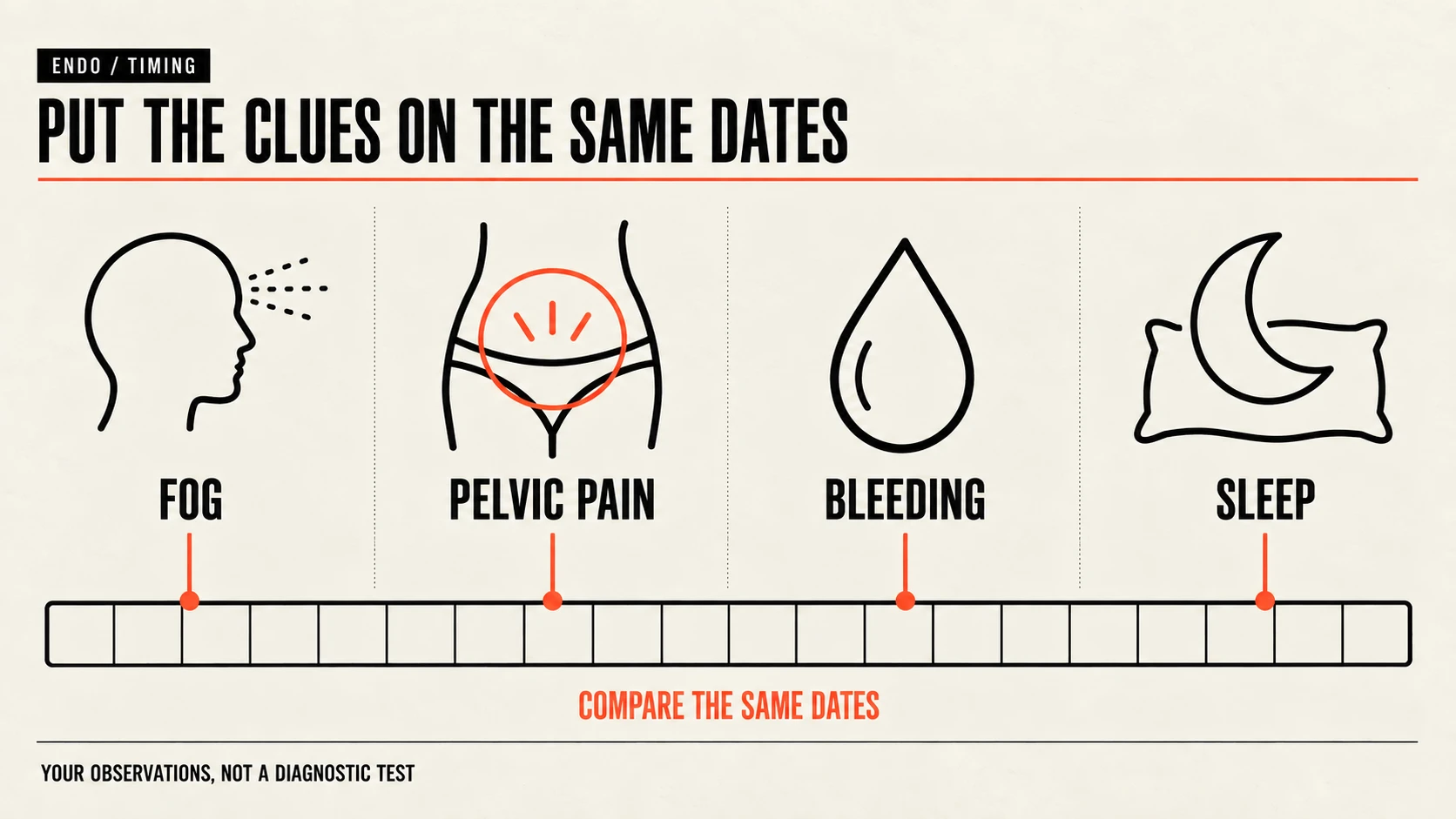
Record brain fog, pelvic pain, bleeding and sleep on the same days, side by side. Compare your observations on the same dates. This is not a diagnostic test.
View full-size illustration (opens in a new tab)How this cause is evaluated
Direct evidence needed
- Symptoms repeat with a trigger or timing that fits how endometriosis works.
Supporting signs
- Your history, exposures or other conditions make endometriosis a cause to check first.
- Several relevant signs occur together.
- Your response to relevant treatments fits endometriosis better than chronic pain.
What lowers confidence
- The reported symptoms may fit Pain more closely.
- The expected history, timing or triggers are missing.
Differential
How it differs from similar causes
Endometriosis or pain: which fits the whole picture?
If yes: Endometriosis brain fog follows your cycle and tends to worsen around your period, even on days when pain is manageable. That link to the cycle suggests inflammation and hormone changes from endometriosis itself.
If no: If your brain fog follows your pain level, not your cycle, and it's worse on high-pain days at any point in the cycle, chronic pain is likely the bigger cause.
Compare with Pain
Endometriosis or medicine side effects: which fits better?
If yes: If you had brain fog before starting endo medicines and it follows your menstrual cycle, the disease's inflammation alone is likely the cause.
If no: GnRH agonists, hormonal birth control, and pain medications used for endo all have cognitive side effects. If your brain fog started or worsened on treatment, the meds deserve a closer look.
Compare with Meds
Endometriosis or migraine: which fits better?
If yes: Endo and migraines share estrogen sensitivity, but endo brain fog persists between headaches and worsens with pelvic symptoms. If your thinking problems are there even when you're headache-free, it's more likely body-wide inflammation from endo.
If no: Migraine brain fog (postdrome) typically follows headaches and clears between attacks. If your thinking problems cluster around headaches, not your menstrual cycle, migraine's the stronger explanation.
Compare with Migraine
Recognition
What it often feels like
Endometriosis-related brain fog usually follows the cycle, shaped by pain, inflammation, bleeding and poor recovery.
Does brain fog reliably worsen with pelvic pain, bleeding, bloating or the inflammatory part of the cycle?
Endometriosis may be central, but anemia, PMDD, histamine reactions, poor sleep or thyroid problems can overlap heavily.
Timing
My brain fog rises with my cycle and pain, not on its own.
Symptom
Heavy bleeding, exhaustion or low-iron symptoms happen with the brain fog.
Symptom
Bloating, pelvic inflammation, bowel symptoms, or flare days make my head worse too.
Timing
Pain days cost me cognitively even after the worst pain settles down.
Timing
When brain fog tends to show up
Worse in the morning
After-meal worsening
Worse after exertion
Signs
What people usually notice first
People often call endometriosis brain fog a repeated slow-down, not occasional distraction.
Thinking worsens with the cycle, alongside pain, bleeding and inflammatory flares.
Many users say clear thinking comes and goes during the day.
Common Confusions
Causes that look similar
Pain
People can confuse endometriosis and chronic pain because both can leave them tired and struggling to think. The surrounding details usually tell them apart.
Key question: If you line up the timing, triggers, and the symptoms that happen with brain fog, does this look more like Endometriosis or Pain?
Meds
People can confuse endometriosis with medicine side effects because both can leave them tired and struggling to think. The surrounding details usually tell them apart.
Key question: Endometriosis or medicine side effects: which fits better?
Migraine
Endometriosis and Migraine can sound alike in a short symptom list. You can usually tell them apart once you look closely at timing, triggers and your other symptoms.
Key question: If you look at the whole picture, not just the brain fog, does endometriosis or migraine fit better?
What people often miss
'Endo fog' is real. It's not in your head. The inflammation from endometriosis affects your entire body, including your brain. Add chronic pain consuming cognitive resources, anemia from heavy bleeding, and hormonal chaos.
THE CYCLE TRACKING TEST: For your next 2 cycles, rate your brain fog daily (1-10) alongside your cycle day. Is it predictably worse: around your period? Mid-cycle? Before your period? If fog follows your cycle, hormones or inflammation from endo may be driving it.
NICE NG73 Endometriosis: Diagnosis and Management, Section 1.2 (2017, updated 2024)
Endometriosis affects up to 1 in 10 women of reproductive age, about 190 million worldwide, according to the WHO. It's not rare. But a ten-country study of 1,418 women found an average diagnostic delay of nearly 7 years, partly because women are dismissed. 'Periods are supposed to hurt' is a lie that delays treatment.
Nnoaham KE et al. Impact of endometriosis on quality of life and work productivity: a multicenter study across ten countries. Fertil Steril. 2011;96(2):366-373. PMID: 21718982; Ballard K et al. What's the delay? A qualitative study of women's experiences of reaching a diagnosis of endometriosis. Fertil Steril. 2006;86(5):1296-1301. PMID: 17070183; WHO Endometriosis Fact Sheet, March 2023
THE PAIN LOCATION MAP: Where is your pain? Pelvic? Lower back? Pain with sex? Painful bowel movements during your period? Painful urination? Pain radiating to legs? Map your pain. Endo can grow on several organs, and not always where it hurts.
Hsu AL et al. Relating pelvic pain location to surgical findings of endometriosis. Obstet Gynecol. 2011;118(2 Pt 1):223-230. PMID: 21775836; Zondervan KT et al. Endometriosis. Nat Rev Dis Primers. 2018;4(1):9. PMID: 30026507; NICE NG73 Section 1.1
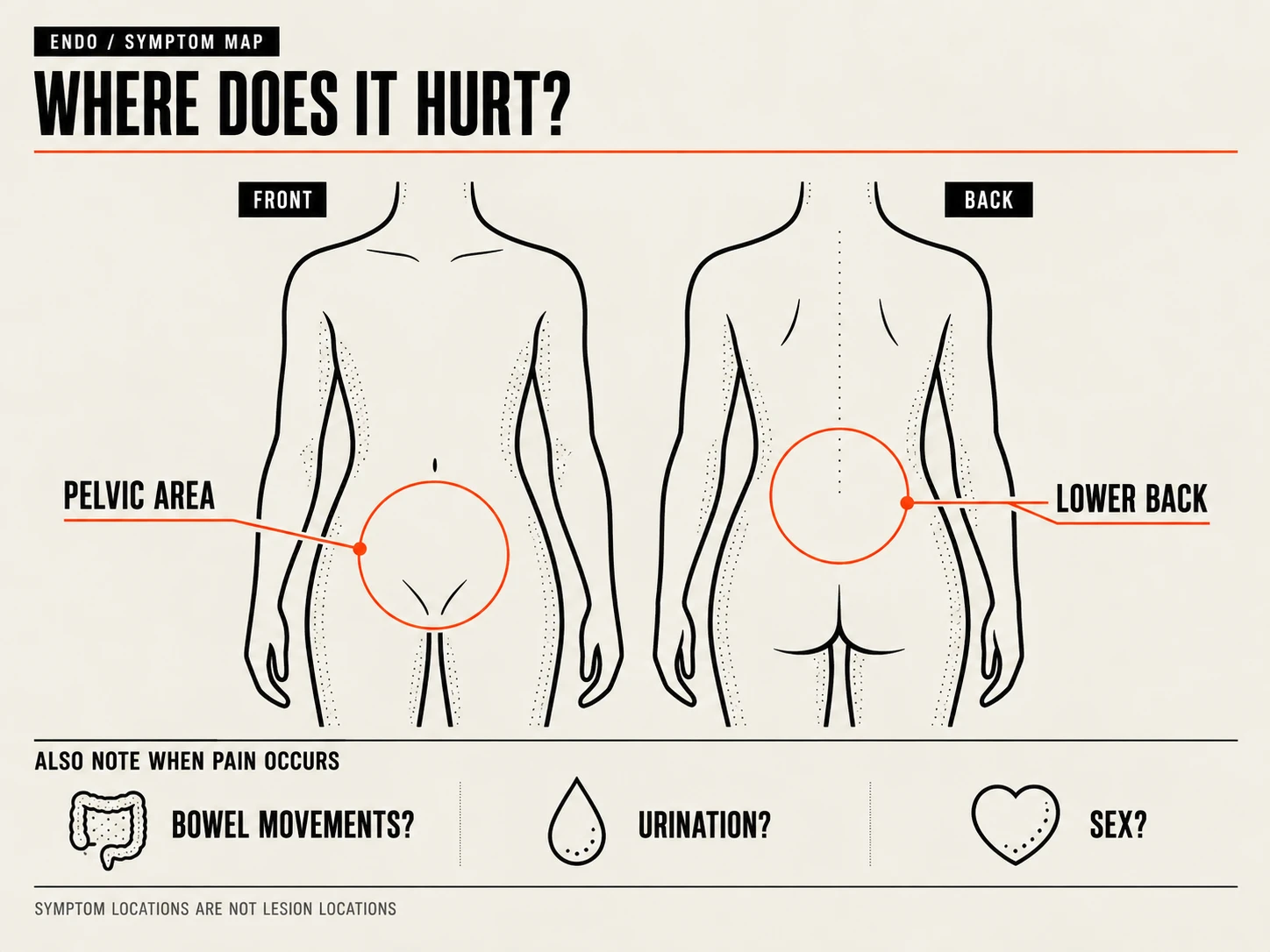
Describe where symptoms occur: pelvic area, lower back, and pain with bowel movements, urination or sex. Symptom locations are not lesion locations.
View full-size illustration (opens in a new tab)'Normal' scans don't rule out endometriosis. Ultrasound and MRI can miss it, especially small spots on the pelvic lining. Laparoscopy, keyhole surgery to look for and sample the lesions, can confirm it. Guidelines suggest it when scans are normal, symptoms fit, and treatment hasn't helped or isn't suitable. Ask your gynecologist whether it's right for you.
Saunders PTK, Horne AW. Endometriosis: new insights and opportunities for relief of symptoms. Biol Reprod. 2025;113(5):1029-1043. PMID: 40704733; Becker CM et al. ESHRE guideline: endometriosis. Hum Reprod Open. 2022. PMID: 35350465; NICE NG73
THE ANEMIA CHECK: Heavy periods often cause anemia, which causes brain fog of its own. Signs of low iron include pale pink inner eyelids instead of red, pale nail beds, getting short of breath on stairs and craving ice. Ask for a ferritin test, which measures your iron stores.
WHO Guideline on Daily Iron Supplementation. WHO, 2016; Munro MG et al. Am J Obstet Gynecol. 2023;229(1):1-9. PMID: 36706856; Auerbach M et al. JAMA. 2025;333(20):1813-1823. PMID: 40159291; Murray-Kolb LE et al. Am J Clin Nutr. 2007;85(3):778-787. PMID: 17344500
Chronic pain takes up capacity that thinking would otherwise use. Your brain is processing pain signals constantly, which leaves less for everything else. Treating the pain may free some of that back, though how much varies.
Berryman A, Machado L. Cognitive Functioning in Females with Endometriosis-Associated Chronic Pelvic Pain: A Literature Review. Arch Clin Neuropsychol. 2025;40(5):1066-1080. PMID: 39826909; Berryman C et al. Evidence for working memory deficits in chronic pain: a systematic review and meta-analysis. Pain. 2013;154(8):1181-96. PMID: 23707355; Akhurst J et al. A Systematic Review and Meta-Analysis of Cognitive Performance among People with Chronic Use of Opioids for Chronic Non-Cancer Pain. Pain Med. 2021;22(4):979-993. PMID: 33502504
If surgery is on the table, ask what type and location of endometriosis is suspected, and why excision or ablation is being recommended for that lesion. Complex or deep disease may benefit from specialist endometriosis assessment. Comparative evidence between the two techniques is limited.
Becker CM et al. ESHRE guideline: endometriosis. Hum Reprod Open. 2022;2022(2):hoac009. PMID: 35350465; Duffy JM et al. Laparoscopic surgery for endometriosis. Cochrane Database Syst Rev. 2014;(4):CD011031. PMID: 24696265
THE FAMILY HISTORY CHECK: Does your mother, sister, or aunt have: diagnosed endo, severe period pain, infertility, or similar symptoms? Endometriosis has a genetic component. A study found first-degree relatives face roughly a 7-fold increased risk (OR 7.2).
Moen MH, Magnus P. The familial risk of endometriosis. Acta Obstet Gynecol Scand. 1993;72(7):560-4. PMID: 8213105
Hormone treatment eases symptoms but doesn't remove the lesions. Birth control, progestins and GnRH agonists can reduce pain while you take them. Surgery can remove lesions, but symptoms return for some people. Ask which option fits your goals, including whether you want to get pregnant.
NICE NG73 Endometriosis Section 1.3 (Hormonal Treatment); Becker CM et al. ESHRE guideline: endometriosis. Hum Reprod Open. 2022. PMID: 35350465; Becker CM et al. Reevaluating response and failure of medical treatment of endometriosis: a systematic review. Fertil Steril. 2017;108(1):125-136. PMID: 28668150; Saunders PTK, Horne AW. Endometriosis: new insights and opportunities for relief of symptoms. Biol Reprod. 2025;113(5):1029-1043. PMID: 40704733
Doctors often miss endometriosis in teenagers. If you've had severe period pain since your teens and people called it 'normal', that's what early-onset endometriosis looks like. Pain that severe was never normal.
Greene R et al. Diagnostic experience among 4,334 women reporting surgically diagnosed endometriosis. Fertil Steril. 91(1):32-9 (PubMed date 2008). PMID: 18367178; Janssen EB et al. Prevalence of endometriosis diagnosed by laparoscopy in adolescents with dysmenorrhea or chronic pelvic pain: a systematic review. Hum Reprod Update. 2013;19(5):570-82. PMID: 23727940; NICE NG73 Section 1.1
THE BOWEL/BLADDER TIMING: Do your bowel or bladder symptoms worsen around your period? Painful bowel movements during menstruation? Painful urination? Blood in stool or urine during your period? This suggests endo affecting bowel or bladder.
Becker CM et al. ESHRE guideline: endometriosis. Hum Reprod Open. 2022. PMID: 35350465; Fauconnier A, Chapron C. Endometriosis and pelvic pain: epidemiological evidence of the relationship and implications. Hum Reprod Update. 2005;11(6):595-606. PMID: 16172113; NICE NG73 Section 1.1 (bowel/bladder symptoms)
Treatment can change daily life. Pain control, iron correction, hormonal management and, for some people, surgery each address a different part of the burden. Changes in thinking after surgery aren't predictable, so check your thinking on its own over the following months. An operation may not clear your brain fog.
Becker CM et al. ESHRE guideline: endometriosis. Hum Reprod Open. 2022. PMID: 35350465; Boersen Z et al. BMC Womens Health. 2026;26(1). PMID: 41821023; Berryman A et al. Arch Clin Neuropsychol. 2025;40(5):1066-1080. PMID: 39826909; Bafort C et al. Laparoscopic surgery for endometriosis. Cochrane Database Syst Rev. 2020;10(10):CD011031. PMID: 33095458
Researchers keep publishing new findings on endometriosis, so check newer papers before you treat an older summary as final.
Cuffaro et al., International journal of molecular sciences 2024 (PMID 38928175); Dydyk et al., StatPearls 2025 (PMID 32119472)
Clinical Evidence
The research at a glance
Neuropsychiatric
Finding: Endometriosis associated with neuropsychiatric manifestations including cognitive dysfunction
Acad Mental Health Well-Being 2025; Curr Obstet Gynecol Rep 2025
Endometriosis Brain
Finding: The "endometriosis brain" - cognitive symptoms independent of pelvic pain
Endometriosis brain review 2025
Doctor Prep
How to bring this to a clinician
Opening script
My brain fog tracks with my endometriosis symptoms, pain flares, or heavy bleeding. I want to look at endo-related inflammation, sleep disruption, and iron loss instead of treating the cognition as unrelated.
Tests to discuss
- Menstrual Cycle and Symptom Diary
- CBC + CMP Blood Test Bundle
- Ferritin
- Medication Review
- Pelvic ultrasound for suspected endometriosis
- Specialist pelvic MRI for suspected deep endometriosis
- Laparoscopy discussion when diagnosis or treatment remains uncertain
- Pregnancy test when pregnancy is possible
Signs to mention
- Pelvic pain, very painful periods, pain during or after sex, bowel or bladder pain, trouble becoming pregnant, or heavy bleeding occurs with brain fog.
- Your thinking is worse after a poor night of sleep, severe pain, heavy bleeding, or a medicine dose.
- Pelvic symptoms affect work, school, exercise, sleep, sex, eating, bowel movements, urination, or caring for other people.
- A close relative has endometriosis, or earlier surgery, ultrasound, or MRI found endometriosis, an ovarian endometrioma, or adenomyosis.
- Symptoms improve when pain, bleeding, sleep or another measured problem is treated, even if brain fog doesn't go away completely.
What to bring
- Bring any notes you already have about pelvic pain, bleeding, bowel or bladder symptoms, sex, sleep, energy, headaches, and brain fog. You do not need to wait for two or three full cycles before asking for help.
- Mark the first day of each period and note whether symptoms also happen between periods.
- Bring two real examples of what pain, bleeding, or fatigue stopped you from doing. This may include school, work, sleep, sex, exercise, or tasks at home.
- Bring the full reports from earlier pelvic ultrasound, MRI, laparoscopy, biopsy, or surgery. Include the operation note and pathology report when available.
- List every hormone treatment, pain medicine, antidepressant, sleep medicine, supplement, and non-prescription medicine. Write what helped, what did not, and any side effects.
- Bring earlier CBC, ferritin, iron, TSH, thyroid hormone, B12, and pregnancy-test reports if they were done.
- Say whether pregnancy is wanted now, later, never, or uncertain. This can change which treatments fit.
- Write any family history of endometriosis and any history of anemia, migraine, bowel disease, bladder problems, pelvic infection, fibroids, adenomyosis, or ovarian cysts.
Screening tools
- A short symptom diary can show when pain, bleeding, sleep, medicines, and thinking change. Start now and bring what you have. Keep your appointment even if the diary isn't perfect.
- A CBC can show anemia. Ferritin and other iron tests may be useful when periods are heavy, bleeding is frequent, or tiredness and reduced exercise tolerance are present.
- A pregnancy test is important when pregnancy is possible and there is new pelvic pain or bleeding. Endometriosis does not protect against an ectopic pregnancy.
- A pelvic exam may find tenderness, a mass, or reduced movement. A normal exam doesn't rule out endometriosis.
- NICE recommends an internal (transvaginal) ultrasound for suspected endometriosis, even with a normal exam. If you decline it or it isn't suitable, a belly (transabdominal) ultrasound is an option.
- Specialist ultrasound or pelvic MRI can help map deep endometriosis before treatment. Someone trained in gynecological imaging should plan and read the scan.
- A normal ultrasound or MRI does not rule out all endometriosis. Laparoscopy may be discussed when symptoms remain important, imaging is negative, and treatment has not worked or is not suitable.
- CA125, hormone panels, hs-CRP, saliva tests, and home inflammation tests do not diagnose endometriosis. Do not use one of these results to confirm or dismiss it.
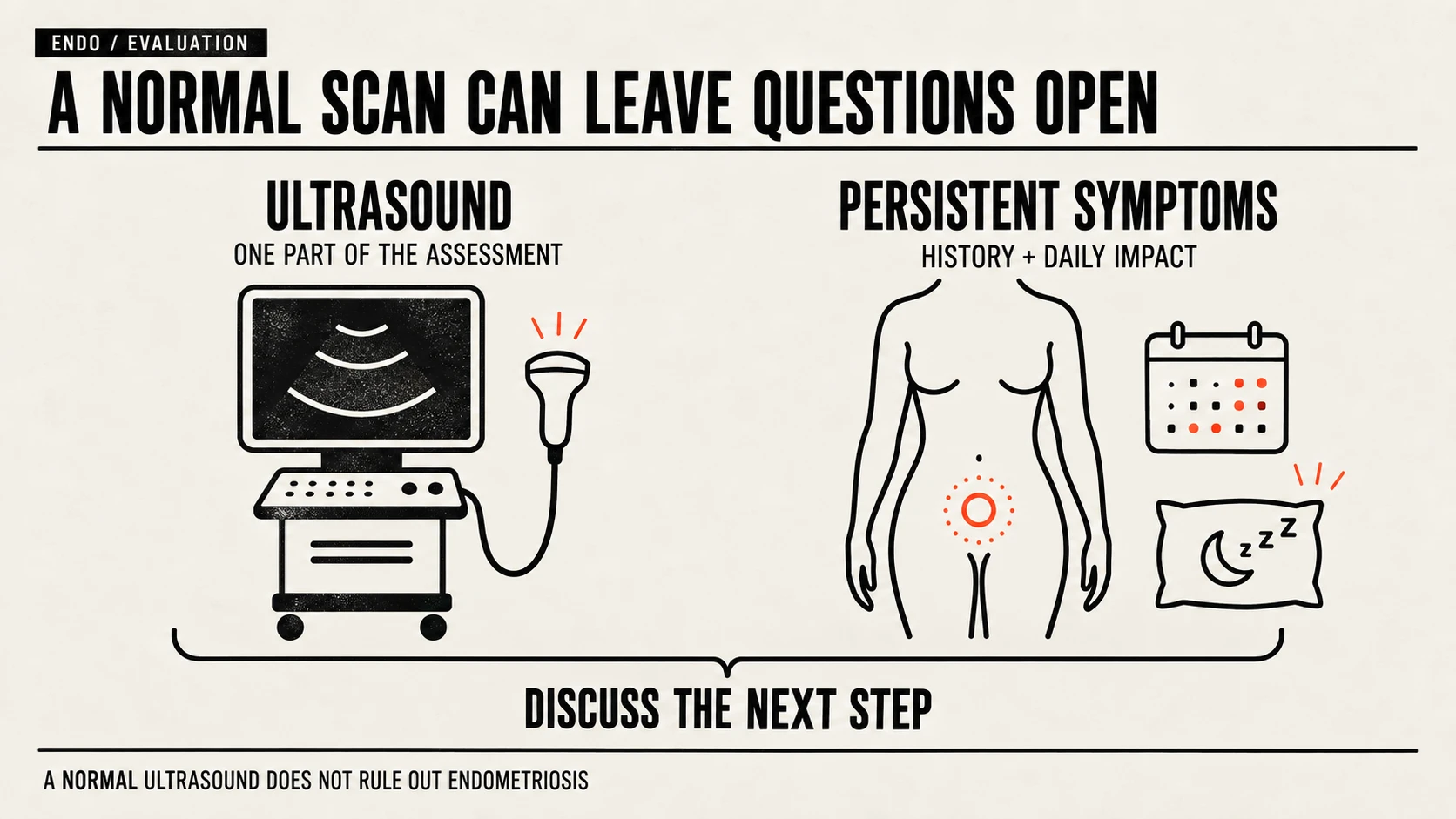
A normal ultrasound does not rule out endometriosis. Bring earlier imaging reports alongside your symptom history and examples of daily impact.
View full-size illustration (opens in a new tab)Doctor Scripts
How to handle the next clinical conversation
Initial Visit
I think Endometriosis may be part of my brain fog because the timing and symptoms keep lining up. I want to check the strongest rule-outs and measurements before guessing.
- What specific test results or findings would confirm or rule this out?
- What tests make sense, and what can we treat now?
- If the first round of tests is unclear, what else should we check?
- Endometriosis Evaluation: Ultrasound and MRI are part of the work-up, but normal imaging doesn't rule out superficial endometriosis, and scans can look normal even with significant disease. ESHRE says laparoscopy may be considered when imaging is negative, or when treatment based on symptoms hasn't worked or isn't appropriate.
- Assess Comorbidities: Anemia from heavy bleeding is common and contributes to fatigue and fog. Treating anemia helps.
FAQ
Questions that actually matter here
My periods are awful and my brain goes with them - is this endo or could it be PMDD?
Endometriosis may be more likely when brain fog rises with pelvic pain, heavy bleeding, bloating, bowel flares or the inflammatory part of the cycle. PMDD is more likely when mood crashes, irritability and worse thinking come before your period and lift soon after bleeding starts. Ferritin, sleep loss and medicine effects can blur both, so note your symptoms across two full cycles before deciding which fits. You can ask for help sooner.
NICE NG73; Becker CM et al. Hum Reprod Open. 2022. PMID: 35350465; Reilly TJ et al. J Affect Disord. 2024. PMID: 38199397; Yen JY et al. Compr Psychiatry. 2012. PMID: 21821238
How quickly can I tell whether treatment is helping?
Treating iron deficiency: thinking may improve within weeks as ferritin rises. Hormonal management (OCP, dienogest, GnRH agonists): usually 4-12 weeks before you can judge it. Surgery varies widely, and current evidence does not establish a predictable cognitive response to it. If nothing has moved after an adequate trial, re-check competing causes and consider clinician-level testing.
NICE NG73; Becker CM et al. ESHRE guideline. Hum Reprod Open. 2022. PMID: 35350465; Bruner AB et al. Randomised study of cognitive effects of iron supplementation in non-anaemic iron-deficient adolescent girls. Lancet. 1996;348(9033):992-6. PMID: 8855856; Falkingham M et al. The effects of oral iron supplementation on cognition in older children and adults: a systematic review and meta-analysis. Nutr J. 2010;9:4. PMID: 20100340; Strowitzki T et al. Dienogest in the treatment of endometriosis-associated pelvic pain: a 12-week, randomized, double-blind, placebo-controlled study. Eur J Obstet Gynecol Reprod Biol. 2010;151(2):193-8. PMID: 20444534; Harada T et al. Low-dose oral contraceptive pill for dysmenorrhea associated with endometriosis: a placebo-controlled, double-blind, randomized trial. Fertil Steril. 90(5):1583-8 (PubMed date 2007). PMID: 18164001; Berryman A, Machado L. Cognitive Functioning in Females with Endometriosis-Associated Chronic Pelvic Pain: A Literature Review. Arch Clin Neuropsychol. 2025;40(5):1066-1080. PMID: 39826909
My gynecologist says endo does not cause brain fog - who should I see instead?
You do not need someone who agrees with every internet claim. You need a clinician who will take cycle-linked pain and cognitive symptoms seriously and help sort endometriosis from PMDD, anemia, thyroid disease, medication burden, and sleep disruption. If your gynecologist dismisses the link outright, see a gynecologist or pelvic-pain specialist who focuses on endometriosis. Ask for basic ferritin, blood count and thyroid tests, rather than being passed from one general referral to the next.
NICE NG73; Becker CM et al. Hum Reprod Open. 2022. PMID: 35350465; Reilly TJ et al. J Affect Disord. 2024. PMID: 38199397; Yen JY et al. Compr Psychiatry. 2012. PMID: 21821238
Does endometriosis show up on MRI or ultrasound?
Sometimes, but often not. Transvaginal ultrasound can identify ovarian endometriomas (chocolate cysts), and MRI is better at detecting deep infiltrating endometriosis. But many lesions - especially superficial peritoneal implants - are invisible on imaging. A 2025 review confirmed that no reliable non-invasive biomarker exists for endometriosis. Normal imaging doesn't rule out endometriosis. If your symptoms fit but scans are clear, push for referral to an endometriosis specialist. Laparoscopy remains the gold standard for definitive diagnosis.
Saunders PTK, Horne AW. Biol Reprod. 2025;113(5):1029-1043. PMID: 40704733; Nisenblat V et al. Cochrane Database Syst Rev. 2016;2(2):CD009591. PMID: 26919512; Becker CM et al. ESHRE guideline: endometriosis. Hum Reprod Open. 2022. PMID: 35350465; NICE NG73
Can endometriosis come back after surgery?
Yes. One hospital study found reoperation in roughly 20% of people within two years. The extent and location of disease, the type of operation and the surgeon's experience all play a part. Excision and ablation are both used, and evidence comparing them for symptom outcomes is mixed, so the operation is chosen with a gynaecology team rather than by a single rule. Ongoing hormonal management after surgery (such as continuous OCP or dienogest) can reduce recurrence risk. For complex or deep disease, ask whether a specialist endometriosis centre is appropriate.
Becker CM et al. ESHRE guideline: endometriosis. Hum Reprod Open. 2022. PMID: 35350465; Shakiba K et al. Obstet Gynecol. 2008. PMID: 18515510; Zakhari A et al. Hum Reprod Update. 2021. PMID: 33020832; Bafort C et al. Cochrane Database Syst Rev. 2020. PMID: 33095458; Burks C et al. J Minim Invasive Gynecol. 2020. PMID: 33310168; Pundir J et al. J Minim Invasive Gynecol. 2017. PMID: 28456617
Can endometriosis cause brain fog even without severe pain?
Yes, though it's less common. Endometriosis keeps inflammation going through your whole body. Studies in women link endometriosis to a more sensitive brain and spinal cord, mostly in those with pelvic pain. That can affect thinking however bad the pain feels. Iron deficiency from heavy bleeding can also cause brain fog without severe pain. If your thinking follows your cycle but your pain is manageable, endometriosis is still worth checking.
As-Sanie S et al. J Pain. 2015. PMID: 26456676; Gomez-Llerena A et al. J Minim Invasive Gynecol. 2025. PMID: 40721059; Zondervan KT et al. Nat Rev Dis Primers. 2018. PMID: 30026507; Agic A et al. Gynecol Obstet Invest. 2006. PMID: 16679772; Taylor HS et al. Lancet. 2021. PMID: 33640070
How long does it take to get diagnosed with endometriosis?
The average diagnostic delay is nearly 7 years. Community reports consistently mention being told 'periods are supposed to hurt', which delayed diagnosis for years. If you have cyclical pelvic pain, heavy periods, and brain fog that follows your cycle, push back if you're dismissed. Ask for a referral to a gynaecologist with an interest in endometriosis, or to a specialist endometriosis centre if complex or deep disease is suspected.
NICE NG73; community reports; ESHRE guideline 2022
Is there newer 2024-2026 research on endometriosis and brain fog?
Yes. Recent papers continue to update the endometriosis picture, but they still need claim-level review before they should change how you interpret your own symptoms.
Cuffaro et al., International journal of molecular sciences 2024 (PMID 38928175); Dydyk et al., StatPearls 2025 (PMID 32119472)
Can endometriosis cause brain fog?
Yes. Endometriosis drives chronic inflammation that can reach the brain and spinal cord. A 2026 study found that this inflammation, repeating each cycle, inflames the brain and spinal cord and makes them more sensitive. Add iron deficiency from heavy bleeding and chronic pain using up mental energy, and several causes add up to brain fog.
What does endometriosis brain fog usually feel like?
Cyclical and tied to your body's rhythms. The fog often gets heavier around your period, alongside pelvic pain, fatigue, and that bone-deep exhaustion that comes from years of chronic inflammation. Some people describe it as a monthly cognitive crash, like your brain joins the rest of your body in shutting down for a few days. Word-finding drops, concentration breaks apart, and processing speed slows. Pain days cost you cognitively even after the worst pain settles.
What should I try first if I think endometriosis is involved?
Note your cycle day, pain, bleeding and how clear your thinking is, and bring the notes to your gynecologist without waiting two full cycles. If your thinking problems reliably worsen around your period or with pelvic pain, ask for an endometriosis evaluation. If your periods are heavy, ask for a ferritin test. Iron deficiency from bleeding is common and treatable, and itself causes brain fog.
What tests should I discuss for endometriosis brain fog?
Start with ferritin and CBC (heavy bleeding depletes iron - ferritin < 30 mcg/L suggests deficiency even without frank anemia). Full iron studies (serum iron, TIBC, transferrin saturation) are more informative than ferritin alone because ferritin can be falsely normal during inflammation. Also request CRP (inflammation marker), thyroid panel, and vitamin D. For endometriosis itself, imaging (transvaginal ultrasound, MRI) can identify some lesions, but normal scans don't rule out endo. Laparoscopy is the gold standard.
When should I bring endometriosis brain fog to a clinician?
STOP - Seek urgent care if: sudden severe abdominal pain, heavy bleeding soaking a pad per hour, fever, or signs of infection. Outside emergencies, see a clinician if you have cyclical pain plus thinking problems and haven't yet had endometriosis evaluation. The average diagnostic delay is nearly 7 years. Don't wait for self-tracking to 'prove' it first if symptoms are affecting your daily function.
How is endometriosis brain fog different from pain-related brain fog?
With endometriosis, brain fog tends to follow the menstrual cycle, worsening around periods with pelvic pain, bloating and heavy bleeding. With other chronic pain, it's more constant and less tied to hormone changes. A systematic review found chronic pain conditions are linked to declines in thinking, but endometriosis adds cyclical inflammation, iron loss from bleeding and hormone disruption. If your thinking problems reliably follow your cycle, endometriosis fits better than pain alone.
Can endometriosis affect fertility?
Yes. Of women with infertility, 25-50% have endometriosis. The ESHRE guideline addresses fertility specifically: excision surgery can improve natural conception rates in some cases, and IVF outcomes may be affected by endometriosis stage. Fertility anxiety itself compounds the cognitive and emotional burden. If fertility is a concern, ask your specialist about the Endometriosis Fertility Index and discuss treatment timing.
Immediate support actions
Body
Light movement as tolerated. Rest during flares. Heat packs for pain.
Food
Anti-inflammatory eating. Iron-rich foods if heavy bleeding. Regular meals for blood sugar stability.
Water
Stay hydrated. Helps with both pain and cognitive function.
Environment
Keep a heating pad or TENS unit handy.
Connection
Endo support communities are active and helpful. Endometriosis is common, affecting up to 1 in 10 women of reproductive age.
Ask
Ask whether the worst thinking lands on the same part of the cycle as the worst pain and bleeding.
Avoid
Don't accept 'normal' scans as dismissal. Don't see non-specialists for surgery. Don't ignore anemia.
Patient Language
How people describe it
Their brain and their pelvis go down at the same time. On the worst pain days, thinking slows, memory drops, and brain fog follows the cycle so closely that they can predict their bad brain days by their bad body days.
- When the pain and inflammation are bad, my thinking is worse too.
- Brain fog tends to show up around the same part of the cycle as the rest of the endo flare.
- This feels tied to pain, bleeding, and poor recovery, not just mood.
Mechanism
How endometriosis affects your brain
Endometriosis is a chronic inflammatory condition where tissue similar to uterine lining grows outside the uterus, affecting approximately 1 in 10 women of reproductive age. The resulting pain, inflammation, and hormonal disruption can impair concentration, memory, and processing speed - a pattern often called 'endo fog.'
- Cyclical pelvic inflammation drives systemic inflammatory cytokines that cross the blood-brain barrier, affecting neural function
- A 2026 study demonstrated that repeated endometriosis-related inflammation drives central nervous system sensitization through neuroinflammatory pathways
- Chronic pain uses up mental energy. A systematic review linked chronic pain conditions to faster decline in thinking
- Heavy menstrual bleeding depletes iron stores, causing iron-deficiency anemia that independently impairs oxygen delivery to the brain
- Sleep disruption from nighttime pain compounds the cognitive burden, reducing restorative sleep quality
- Hormone changes over the menstrual cycle alter brain chemistry. Brain fog often follows estrogen and progesterone shifts
Compare
Endometriosis vs similar causes of brain fog
Several conditions cause brain fog like endometriosis does. Brain fog that reliably follows the menstrual cycle usually points to endometriosis or PMDD.
PMDD (Premenstrual Dysphoric Disorder)
Both cause thinking problems that follow your cycle. PMDD brain fog comes after ovulation (luteal phase) and clears within days of your period. With endometriosis, symptoms can be present in every phase of the cycle.
Key question: Does your brain fog clear within a few days of your period starting, or last through your period?
NICE NG73; Zondervan KT et al. Nat Rev Dis Primers. 2018. PMID: 30026507
Iron-Deficiency Anemia
Anemia brain fog is steadier and not strongly cycle-linked. But endometriosis often causes anemia through heavy bleeding, so both can be present simultaneously. If treating iron deficiency helps but doesn't clear the brain fog, endometriosis may explain the rest.
Key question: Is your brain fog constant all month, or does it clearly follow your cycle and pain?
WHO Iron Supplementation Guidelines; Zondervan 2018
Fibromyalgia
In fibromyalgia, central sensitization drives brain fog, which appears with widespread pain, unrefreshing sleep and sensory overload. Endometriosis fog is more localized to pelvic pain and cycle-linked. However, central sensitization from chronic endometriosis pain can mimic fibromyalgia. About 6% of endometriosis patients also have a fibromyalgia diagnosis.
Key question: Is your pain mainly pelvic and cycle-linked, or widespread throughout your body?
Greenbaum H et al. Am J Reprod Immunol. 2019. PMID: 30682223; Sinaii N et al. Hum Reprod. 2002. PMID: 12351553
History
A brief history of Endometriosis recognition
Endometriosis has been documented for centuries, but recognition of its cognitive effects is very recent. Understanding the diagnostic delay helps explain why so many patients struggle for years without answers.
Earliest descriptions
The Ebers Papyrus describes symptoms that fit endometriosis. That makes it one of the oldest recorded gynecological conditions.
First pathological description
Karl von Rokitansky first described endometriosis as a distinct pathological entity, identifying endometrial-like tissue outside the uterus.
Retrograde menstruation theory
John Sampson proposed that menstrual blood flows backward through the fallopian tubes, depositing endometrial cells in the pelvis. This theory remains influential though incomplete.
Familial risk established
Moen and Magnus showed a genetic link: close (first-degree) relatives of women with endometriosis have about 7 times the risk.
Diagnostic delay quantified
A landmark ten-country study of 1,418 women found diagnosis took nearly 7 years on average, and their quality of life and work productivity suffered significantly.
NICE NG73 guideline published
NICE published full guidelines for endometriosis diagnosis and management, emphasizing that normal imaging doesn't rule out endometriosis.
ESHRE guideline updated
The European Society for Human Reproduction and Embryology updated its endometriosis guideline. It often allows diagnosis from symptoms, an exam and imaging without laparoscopy, and tailors surgery and medicines to each person.
WHO global action plan
The WHO added endometriosis to its global women's health action plan, citing about 190 million affected worldwide and calling for better research and care.
Neuroinflammation pathway demonstrated
Harvey et al. found repeated backward menstrual flow makes the brain and spinal cord more sensitive through nervous-system inflammation, showing how endometriosis can affect thinking.
Visit prep
Open the Endometriosis doctor handout
Open the public handout now to prepare focused questions for your visit.
This opens in your browser. We don't ask for email or add you to lists.
Managing: I have endometriosis and still have brain fog
I've been diagnosed and the fog won't lift
Use the guide below to choose your next step.
What helps with endometriosis?
Choose what is making daily life hardest. Open an option for practical steps and treatment details.
What do you need help with?
Choose relief you can use now or compare longer-term pain treatment.
Three places to startMake pain relief work for your dayReview what you use, when you use it and whether it actually reduces pain.Guidelines; limited direct trialsTreatment
What this involves
Use pain medicine according to its label or prescription. A pharmacist can check whether paracetamol or an anti-inflammatory fits your other medicines and health conditions.
What to look for: Enough relief to sleep, travel or finish an ordinary task.
Keep in mind: Do not combine anti-inflammatory medicines such as ibuprofen and naproxen. Stomach ulcers, kidney disease, blood thinners and possible pregnancy can change the choice.
Reduce painful periods with the combined pillA prescribed pill can reduce period pain and may let you have fewer bleeds.Guideline-supportedTreatment
What this involves
Compare a monthly-bleed schedule with continuous use with the prescriber. Say whether pain, bleeding or both are the main problem.
What to look for: Fewer painful days and less disruption from periods.
Keep in mind: Estrogen-containing contraception may be unsuitable with migraine aura or a clot history. It prevents pregnancy while used.
- Timing
- Review relief over the first few cycles. Troublesome side effects deserve an earlier review.
Ease a flare with gentle heatTry a covered heat pad or warm bath when cramps make it hard to settle.Comfort measurePractical help
Start here
Put a cloth between your skin and a warm heat pad, or try a comfortably warm bath. Choose a position that reduces pressure on your pelvis.
What to look for: Cramps ease enough to rest or move more comfortably.
Keep in mind: Heat can burn. Use it only where skin sensation is normal, check your skin and remove it before sleeping.
- Cost or effort
- Usually low cost.
All options and evidenceTreatments, practical help and study details38 options
38 options available
Ease a flare with gentle heatTry a covered heat pad or warm bath when cramps make it hard to settle.Comfort measurePractical help
Start here
Put a cloth between your skin and a warm heat pad, or try a comfortably warm bath. Choose a position that reduces pressure on your pelvis.
What to look for: Cramps ease enough to rest or move more comfortably.
Keep in mind: Heat can burn. Use it only where skin sensation is normal, check your skin and remove it before sleeping.
- Cost or effort
- Usually low cost.
Read the evidence 2 sources
Adults with endometriosis
General period-pain guidance supports this practical option. It is not a lesion treatment.
Period pain: practical reliefNHS patient guidance · Practical guidance
- Who took part
- People with period pain, including pain needing investigation
- How long
- During painful periods
Compared with: No study comparison.
What the source found: Suggests covered heat, a warm bath, gentle movement and suitable pain medicines.
Thinking and memory: No direct improvement in thinking or memory was established.
Important limit: General period-pain guidance. It does not establish treatment of endometriosis lesions.
Read NHS patient guidance: Period pain: practical reliefHeat and ice: safe applicationNHS physiotherapy instructions · Practical guidance
- Who took part
- People using local heat for pain
- How long
- During application
Compared with: No study comparison.
What the source found: Advises a cloth barrier, normal skin sensation and avoiding heat while asleep.
Thinking and memory: No direct improvement in thinking or memory was established.
Important limit: General heat-use instructions, not an endometriosis trial.
Read NHS physiotherapy instructions: Heat and ice: safe applicationMake pain relief work for your dayReview what you use, when you use it and whether it actually reduces pain.Guidelines; limited direct trialsTreatment
What this involves
Use pain medicine according to its label or prescription. A pharmacist can check whether paracetamol or an anti-inflammatory fits your other medicines and health conditions.
What to look for: Enough relief to sleep, travel or finish an ordinary task.
Keep in mind: Do not combine anti-inflammatory medicines such as ibuprofen and naproxen. Stomach ulcers, kidney disease, blood thinners and possible pregnancy can change the choice.
Read the evidence 3 sources
Adults with endometriosis
Clinical guidance supports these medicines for cramps. For endometriosis itself, no large trial backs them, so the evidence is uncertain.
Nonsteroidal anti-inflammatory drugs for pain in women with endometriosisCochrane review · One analyzable placebo comparison: 24 women
- Who took part
- Women with endometriosis-associated pain
- How long
- 2017 review of short-term analgesia
Compared with: Naproxen versus placebo
What the source found: For naproxen versus placebo, the pain-relief odds ratio was 3.27 (95% CI 0.61 to 17.69). The estimate was too imprecise to establish benefit.
Thinking and memory: Thinking, daily functioning and quality of life were not reported.
Important limit: The endometriosis-specific evidence is very low certainty. Common use for cramps isn't strong proof from endometriosis trials.
Read Brown et al. (2017): Nonsteroidal anti-inflammatory drugs for pain in women with endometriosisEndometriosis: diagnosis and management, NICE NG73Clinical guideline · Guideline, not one trial
- Who took part
- People with suspected, confirmed or recurrent endometriosis
- How long
- Treatment and follow-up depend on the intervention
Compared with: Evidence-informed clinical recommendations.
What the source found: Recommends symptom-led care, hormonal options and selected surgery. Normal imaging can miss superficial disease. Fertility plans change the choices.
Thinking and memory: No direct improvement in thinking or memory was established.
Important limit: Recommendations vary in evidence certainty. This is not a direct trial of brain fog.
Read Clinical guideline (2025): Endometriosis: diagnosis and management, NICE NG73Period pain: practical reliefNHS patient guidance · Practical guidance
- Who took part
- People with period pain, including pain needing investigation
- How long
- During painful periods
Compared with: No study comparison.
What the source found: Suggests covered heat, a warm bath, gentle movement and suitable pain medicines.
Thinking and memory: No direct improvement in thinking or memory was established.
Important limit: General period-pain guidance. It does not establish treatment of endometriosis lesions.
Read NHS patient guidance: Period pain: practical reliefReduce painful periods with the combined pillA prescribed pill can reduce period pain and may let you have fewer bleeds.Guideline-supportedTreatment
What this involves
Compare a monthly-bleed schedule with continuous use with the prescriber. Say whether pain, bleeding or both are the main problem.
What to look for: Fewer painful days and less disruption from periods.
Keep in mind: Estrogen-containing contraception may be unsuitable with migraine aura or a clot history. It prevents pregnancy while used.
- Timing
- Review relief over the first few cycles. Troublesome side effects deserve an earlier review.
Read the evidence 3 sources
Adults with endometriosis
ESHRE guideline: endometriosisClinical guideline · Guideline, not one trial
- Who took part
- Adolescents and adults with endometriosis, including fertility and menopause contexts
- How long
- Depends on the question
Compared with: Evidence synthesis and expert recommendations.
What the source found: Supports choosing treatment around pain, preferences and fertility. It includes postoperative suppression and the limits of hysterectomy and complementary treatments.
Thinking and memory: No direct improvement in thinking or memory was established.
Important limit: The 2022 guideline predates newer drug approvals and several newer supportive-care trials.
Read Becker et al. (2022): ESHRE guideline: endometriosisLow-dose oral contraceptive pill for dysmenorrhea associated with endometriosis: a placebo-controlled, double-blind, randomized trialRandomized placebo-controlled trial · 100 participants
- Who took part
- 100 patients with endometriosis-associated period pain; most had imaging rather than surgical confirmation
- How long
- Four treatment cycles
Compared with: Combined oral contraceptive versus placebo
What the source found: The combined pill improved period-pain outcomes more than placebo.
Thinking and memory: Cognition and brain fog were not reported treatment outcomes.
Important limit: The trial tested one version of the pill and was fairly short.
Read Harada et al. (2008): Low-dose oral contraceptive pill for dysmenorrhea associated with endometriosis: a placebo-controlled, double-blind, randomized trialPharmacologic Interventions for Endometriosis-Related Pain: A Systematic Review and Meta-analysisNetwork meta-analysis · 31 trials; 8,665 participants
- Who took part
- Participants in randomized endometriosis medication trials
- How long
- Varied across trials
Compared with: Placebo and active medicines across a trial network.
What the source found: Several hormonal treatments reduced pelvic pain compared with placebo. Results differed by pain type and treatment.
Symptoms: Pelvic pain, period pain, pain during sex and pain outside periods.
Thinking and memory: No direct improvement in thinking or memory was established.
Important limit: Indirect rankings depend on unlike trials. They cannot identify the best treatment for one person. Supplement rankings conflict with other reviews.
Read Kou et al. (2025): Pharmacologic Interventions for Endometriosis-Related Pain: A Systematic Review and Meta-analysisConsider a progestogen-only treatmentTablets such as dienogest can reduce pain without using a combined contraceptive pill.Guideline-supportedTreatment
What this involves
Compare an oral progestogen with other hormone options, including how it may affect bleeding, mood and your plans for pregnancy.
What to look for: Less pelvic pain and fewer painful bleeds.
Keep in mind: Irregular bleeding and mood changes can occur. Check whether the prescribed product also provides contraception.
- Timing
- Review pain and side effects over about two to three months.
Read the evidence 3 sources
Adults with endometriosis
ESHRE guideline: endometriosisClinical guideline · Guideline, not one trial
- Who took part
- Adolescents and adults with endometriosis, including fertility and menopause contexts
- How long
- Depends on the question
Compared with: Evidence synthesis and expert recommendations.
What the source found: Supports choosing treatment around pain, preferences and fertility. It includes postoperative suppression and the limits of hysterectomy and complementary treatments.
Thinking and memory: No direct improvement in thinking or memory was established.
Important limit: The 2022 guideline predates newer drug approvals and several newer supportive-care trials.
Read Becker et al. (2022): ESHRE guideline: endometriosisDienogest in the treatment of endometriosis-associated pelvic pain: a 12-week, randomized, double-blind, placebo-controlled studyRandomized placebo-controlled trial · 198 participants
- Who took part
- Women aged 18 to 45 with laparoscopically confirmed endometriosis and pelvic pain
- How long
- 12 weeks
Compared with: Dienogest versus placebo
What the source found: On a pain scale measured in mm, average scores fell 27.4 with dienogest and 15.1 with placebo, a 12.3-mm difference.
Thinking and memory: Cognition and brain fog were not reported treatment outcomes.
Important limit: A placebo comparison, not proof that dienogest is better than every other progestogen.
Read Strowitzki et al. (2010): Dienogest in the treatment of endometriosis-associated pelvic pain: a 12-week, randomized, double-blind, placebo-controlled studyPharmacologic Interventions for Endometriosis-Related Pain: A Systematic Review and Meta-analysisNetwork meta-analysis · 31 trials; 8,665 participants
- Who took part
- Participants in randomized endometriosis medication trials
- How long
- Varied across trials
Compared with: Placebo and active medicines across a trial network.
What the source found: Several hormonal treatments reduced pelvic pain compared with placebo. Results differed by pain type and treatment.
Symptoms: Pelvic pain, period pain, pain during sex and pain outside periods.
Thinking and memory: No direct improvement in thinking or memory was established.
Important limit: Indirect rankings depend on unlike trials. They cannot identify the best treatment for one person. Supplement rankings conflict with other reviews.
Read Kou et al. (2025): Pharmacologic Interventions for Endometriosis-Related Pain: A Systematic Review and Meta-analysisConsider a hormonal coilA levonorgestrel coil can help painful or heavy periods and avoids remembering a daily pill.Guideline-supportedTreatment
What this involves
Ask about fitting, pain relief during fitting and the expected settling period. Compare the coil with the pill when choosing treatment after surgery.
What to look for: Lighter periods and less period-related pain.
Keep in mind: Spotting and cramping are common at first. Persistent severe pain after fitting needs a review.
Read the evidence 3 sources
Especially people needing contraception or treatment after conservative surgery.
The small postoperative trial compared a coil with no additional hormonal treatment. PRE-EMPT was larger and compared two active strategies. They answer different questions.
Postoperative levonorgestrel-releasing intrauterine system for pelvic endometriosis-related pain: a randomized controlled trialRandomized postoperative trial · 55 randomized: 28 coil and 27 expectant management
- Who took part
- Patients with endometriosis and moderate-to-severe period pain after conservative laparoscopy
- How long
- 12 months after surgery
Compared with: Levonorgestrel intrauterine system versus expectant management
What the source found: Recurrent period pain was reported in 7.4% with the coil versus 39.1% with expectant management. Period pain and noncyclic pelvic pain improved more with the coil; pain with sex did not differ significantly.
Recurrence: Recurrent period pain within 12 months: 7.4% versus 39.1%.
Thinking and memory: Cognition and brain fog were not reported treatment outcomes.
Important limit: Small postoperative trial. The recurrence percentages concern period pain in the analyzed groups, not all disease returning in all 55 randomized patients.
Read Tanmahasamut et al. (2012): Postoperative levonorgestrel-releasing intrauterine system for pelvic endometriosis-related pain: a randomized controlled trialPRE-EMPT: long-acting progestogens versus the combined pill after surgeryRandomized pragmatic trial · 405 participants
- Who took part
- Patients having conservative endometriosis surgery at 34 UK hospitals
- How long
- 3 years
Compared with: Hormonal coil or progestogen injection versus combined oral contraceptive.
What the source found: Pain improved similarly in both groups. Three-year pain scores did not differ meaningfully; long-acting treatment was associated with fewer further procedures or second-line treatments.
Symptoms: Pain and quality-of-life measures.
Recurrence: Further surgery or second-line treatment was less frequent with long-acting progestogens.
Thinking and memory: No direct improvement in thinking or memory was established.
Important limit: Everyone in the study took one of the two medicines, and they knew which one.
Read Cooper et al. (2024): PRE-EMPT: long-acting progestogens versus the combined pill after surgeryHeavy menstrual bleeding: NICE NG88Clinical guideline · Guideline, not one trial
- Who took part
- People with heavy menstrual bleeding
- How long
- Investigation and ongoing treatment
Compared with: Clinical guidance.
What the source found: Recommends a blood count and treatment matched to the cause and fertility plans, including hormonal and nonhormonal options.
Thinking and memory: No direct improvement in thinking or memory was established.
Important limit: NICE doesn't recommend a ferritin test for everyone with heavy bleeding. Iron tests are for suspected iron deficiency.
Read Clinical guideline (2021): Heavy menstrual bleeding: NICE NG88Compare medicines that suppress ovarian hormonesGnRH medicines offer another pain option when earlier treatments have not helped enough.Larger trialsTreatment
What this involves
These medicines lower the hormones your ovaries make. Options include injections, elagolix tablets, or relugolix combined with add-back hormones. Compare bone checks, side effects, treatment limits and contraception before choosing.
What to look for: Less period pain and pain between periods.
Keep in mind: Hot flushes, bone loss and mood changes can occur. Add-back hormones reduce some low-estrogen effects; estrogen-containing combinations also need a clot-risk check. These drugs are unsuitable during pregnancy.
- Timing
- Review pain relief and side effects over the first few months, using the plan for your prescribed medicine.
Read the evidence 3 sources
Adults with endometriosis
The large elagolix and relugolix programs measured defined pain responses, not whether brain fog cleared. Their separate placebo comparisons do not show which medicine is best.
Treatment of Endometriosis-Associated Pain with Elagolix, an Oral GnRH AntagonistTwo phase III randomized trials · 872 in EM-I; 817 in EM-II
- Who took part
- Women with surgically diagnosed endometriosis and moderate-to-severe pain
- How long
- Six months; primary pain response at month 3
Compared with: A placebo. The trial tested two elagolix dose schedules against it.
What the source found: Period-pain responders in EM-I: 46.4% lower-dose and 75.8% higher-dose elagolix versus 19.6% placebo. In EM-II: 43.4% and 72.4% versus 22.7%. Pain between periods also improved. Response required less pain with stable or reduced rescue medicine use.
Thinking and memory: Cognition and brain fog were not reported treatment outcomes.
Important limit: Funded by AbbVie. Completion was 74.9% and 77.4%; six months cannot settle long-term benefit. Hot flushes, lipid increases and bone-density loss were more common with treatment.
Read Taylor et al. (2017): Treatment of Endometriosis-Associated Pain with Elagolix, an Oral GnRH AntagonistRelugolix combination therapy: SPIRIT 1 and 2Two phase 3 randomized trials · 638 and 623 randomized participants
- Who took part
- Adults aged 18 to 50 with confirmed endometriosis and moderate or severe pain
- How long
- 24 weeks
Compared with: Placebo; another arm initially received relugolix without add-back hormones.
What the source found: About 75% met the period-pain response criteria with combination therapy, compared with 27% and 30% on placebo.
Symptoms: Period pain and non-menstrual pelvic pain improved.
Thinking and memory: No direct improvement in thinking or memory was established.
Important limit: Response meant reduced pain with controlled pain-medicine use, not cure. Trials were industry-funded; 15% and 18% stopped early.
Read Giudice et al. (2022): Relugolix combination therapy: SPIRIT 1 and 2ESHRE guideline: endometriosisClinical guideline · Guideline, not one trial
- Who took part
- Adolescents and adults with endometriosis, including fertility and menopause contexts
- How long
- Depends on the question
Compared with: Evidence synthesis and expert recommendations.
What the source found: Supports choosing treatment around pain, preferences and fertility. It includes postoperative suppression and the limits of hysterectomy and complementary treatments.
Thinking and memory: No direct improvement in thinking or memory was established.
Important limit: The 2022 guideline predates newer drug approvals and several newer supportive-care trials.
Read Becker et al. (2022): ESHRE guideline: endometriosisDecide what surgery would addressUse the location of disease, pain and fertility plans to judge the possible benefit.Guidelines; results varyTreatment
What this involves
Ask which areas the surgeon plans to treat, what may remain, whether you'll need bowel or bladder specialists, and what recovery involves.
What to look for: A realistic chance of improving the symptom or fertility problem that matters to you.
Keep in mind: Surgery has recovery time and risks. Comparative evidence does not establish one surgical technique as best for every type of disease.
- Cost or effort
- An operation and recovery time.
Compare surgery for an ovarian endometrioma
Read the evidence 3 sources
Adults with endometriosis
Diagnostic laparoscopy, fertility-sparing surgery and ovarian-cyst surgery have different goals.
Laparoscopic surgery for endometriosisCochrane systematic review · 14 trials; 1,563 participants
- Who took part
- Patients in endometriosis surgery trials
- How long
- Varied; search current to April 2020
Compared with: Diagnostic laparoscopy or other surgical methods.
What the source found: Evidence for overall pain relief and excision versus ablation was uncertain. Surgery probably improved viable intrauterine pregnancy compared with diagnostic laparoscopy.
Symptoms: Pain outcomes remained uncertain in the included comparisons.
Disease or other outcome: Selected fertility outcomes improved; universal removal or cure was not demonstrated.
Thinking and memory: No direct improvement in thinking or memory was established.
Important limit: Much evidence was low or very low certainty. No live-birth data were available for the key comparisons.
Read Bafort et al. (2020): Laparoscopic surgery for endometriosisESHRE guideline: endometriosisClinical guideline · Guideline, not one trial
- Who took part
- Adolescents and adults with endometriosis, including fertility and menopause contexts
- How long
- Depends on the question
Compared with: Evidence synthesis and expert recommendations.
What the source found: Supports choosing treatment around pain, preferences and fertility. It includes postoperative suppression and the limits of hysterectomy and complementary treatments.
Thinking and memory: No direct improvement in thinking or memory was established.
Important limit: The 2022 guideline predates newer drug approvals and several newer supportive-care trials.
Read Becker et al. (2022): ESHRE guideline: endometriosisExcisional surgery versus ablative surgery for ovarian endometriomaCochrane review of randomized trials · Nine trials; 578 women overall
- Who took part
- Reproductive-aged women with ovarian endometriomas at least 3 cm and pain, infertility or both
- How long
- Recurrence outcomes at one to two years
Compared with: Cyst excision versus drainage and ablation
What the source found: Excision may reduce returning period pain, painful sex, ovarian cyst recurrence and repeat cyst surgery compared with drainage and ablation. Subsequent spontaneous pregnancy showed no clear difference.
Recurrence: Cyst recurrence and further cyst surgery: one year. Period-pain and painful-sex recurrence: up to two years.
Thinking and memory: Cognition and brain fog were not reported treatment outcomes.
Important limit: Most key outcomes were low certainty, and safety data were limited. You can't apply these ovarian-cyst results to all superficial implants.
Read Kalra et al. (2024): Excisional surgery versus ablative surgery for ovarian endometriomaKeep the benefit of surgery for longerHormonal treatment after surgery can reduce the chance of symptoms or disease returning.Larger evidence reviewsTreatment
What this involves
If pregnancy isn't your goal right now, compare a pill, progestogen or hormonal coil as ongoing treatment after recovery.
What to look for: Fewer returning symptoms and less need for another treatment.
Keep in mind: The choice must fit side effects and fertility plans. Symptoms can still return.
Read the evidence 4 sources
After conservative endometriosis surgery, when not trying to conceive immediately.
Returning period pain, a cyst seen again on imaging and another operation are different recurrence outcomes. Each source below names what it measured and when.
Endometriosis recurrence following postoperative hormonal suppressionSystematic review and meta-analysis · 17 studies; 2,137 participants. Main recurrence analysis: 14 studies, 1,766 participants.
- Who took part
- Premenopausal patients following conservative endometriosis surgery
- How long
- Study follow-up 12 to 36 months
Compared with: Expectant management or placebo.
What the source found: Postoperative hormonal suppression reduced recurrence compared with no suppression or placebo; pooled relative risk 0.41.
Symptoms: Pain also improved on average.
Recurrence: Reduced imaging-defined or symptom-defined recurrence while suppression was used.
Thinking and memory: No direct improvement in thinking or memory was established.
Important limit: Mixed medicines, study designs and recurrence definitions. It does not provide a guaranteed personal recurrence rate.
Read Zakhari et al. (2021): Endometriosis recurrence following postoperative hormonal suppressionPostoperative levonorgestrel-releasing intrauterine system for pelvic endometriosis-related pain: a randomized controlled trialRandomized postoperative trial · 55 randomized: 28 coil and 27 expectant management
- Who took part
- Patients with endometriosis and moderate-to-severe period pain after conservative laparoscopy
- How long
- 12 months after surgery
Compared with: Levonorgestrel intrauterine system versus expectant management
What the source found: Recurrent period pain was reported in 7.4% with the coil versus 39.1% with expectant management. Period pain and noncyclic pelvic pain improved more with the coil; pain with sex did not differ significantly.
Recurrence: Recurrent period pain within 12 months: 7.4% versus 39.1%.
Thinking and memory: Cognition and brain fog were not reported treatment outcomes.
Important limit: Small postoperative trial. The recurrence percentages concern period pain in the analyzed groups, not all disease returning in all 55 randomized patients.
Read Tanmahasamut et al. (2012): Postoperative levonorgestrel-releasing intrauterine system for pelvic endometriosis-related pain: a randomized controlled trialPRE-EMPT: long-acting progestogens versus the combined pill after surgeryRandomized pragmatic trial · 405 participants
- Who took part
- Patients having conservative endometriosis surgery at 34 UK hospitals
- How long
- 3 years
Compared with: Hormonal coil or progestogen injection versus combined oral contraceptive.
What the source found: Pain improved similarly in both groups. Three-year pain scores did not differ meaningfully; long-acting treatment was associated with fewer further procedures or second-line treatments.
Symptoms: Pain and quality-of-life measures.
Recurrence: Further surgery or second-line treatment was less frequent with long-acting progestogens.
Thinking and memory: No direct improvement in thinking or memory was established.
Important limit: Everyone in the study took one of the two medicines, and they knew which one.
Read Cooper et al. (2024): PRE-EMPT: long-acting progestogens versus the combined pill after surgeryESHRE guideline: endometriosisClinical guideline · Guideline, not one trial
- Who took part
- Adolescents and adults with endometriosis, including fertility and menopause contexts
- How long
- Depends on the question
Compared with: Evidence synthesis and expert recommendations.
What the source found: Supports choosing treatment around pain, preferences and fertility. It includes postoperative suppression and the limits of hysterectomy and complementary treatments.
Thinking and memory: No direct improvement in thinking or memory was established.
Important limit: The 2022 guideline predates newer drug approvals and several newer supportive-care trials.
Read Becker et al. (2022): ESHRE guideline: endometriosisRelax an over-tight pelvic floorPelvic physiotherapy can help when muscles stay tense and sex or movement becomes painful.Small targeted trialsTreatment
What this involves
An assessment can check whether pelvic muscles relax normally. Treatment may include gentle manual work, learning to release tension and practising comfortable movement. Internal treatment requires your consent.
What to look for: Less pain with penetration or everyday movement.
Keep in mind: Do not start repeated squeezing exercises without checking whether the muscles are already too tight. Effects on bowel and bladder symptoms remain uncertain.
Read the evidence 2 sources
Adults with endometriosis
Endometriosis: WHO fact sheetWHO patient guidance · Public-health guidance
- Who took part
- People with suspected or confirmed endometriosis
- How long
- Updated 15 October 2025
Compared with: Not a randomized treatment comparison.
What the source found: Treatment can begin without surgical confirmation in every case. Hormones, pain relief, surgery, fertility care and multidisciplinary support address different needs.
Recurrence: Symptoms may recur after treatment; hysterectomy is not a guaranteed cure.
Thinking and memory: Cognition and brain fog were not reported treatment outcomes.
Important limit: A patient overview, not a comparative trial. It gives no direct evidence that a treatment restores cognition.
Read WHO patient guidance (2025): Endometriosis: WHO fact sheetPelvic floor physiotherapy and urinary, bowel and sexual function in deep endometriosisRandomized trial · 30 completers
- Who took part
- Women with deep endometriosis and painful intercourse
- How long
- Course of physiotherapy with follow-up
Compared with: Pelvic floor physiotherapy versus control.
What the source found: Pelvic relaxation and some pain measures improved. Urinary, bowel and overall sexual-function scores didn't differ significantly between groups.
Thinking and memory: No direct improvement in thinking or memory was established.
Important limit: This small, selected trial doesn't show that pelvic physiotherapy fixes every bowel, bladder or sexual symptom.
Read Del Forno et al. (2023): Pelvic floor physiotherapy and urinary, bowel and sexual function in deep endometriosisChange painful sex rather than enduring itReduce friction and pressure, and stop activities that hurt.Practical supportPractical help
Start here
Try lubricant, slower movement or positions that let you control depth. Choose other forms of intimacy on painful days. Pain at the entrance and pain deeper inside may need different treatment.
What to look for: Comfortable intimacy without pushing through pain.
Keep in mind: Persistent deep pain, new bleeding or burning deserves assessment. Lubricant cannot treat deep disease.
Read the evidence 2 sources
Adults with endometriosis
These comfort adjustments are practical support, not a tested lesion treatment.
Endometriosis: treatment and supportNHS patient guidance · Patient guidance
- Who took part
- People with endometriosis
- How long
- Ongoing care
Compared with: No study comparison.
What the source found: Describes medicines, surgery and support for pain, fatigue, fertility and mental health.
Thinking and memory: No direct improvement in thinking or memory was established.
Important limit: Guidance explains options; it does not measure the effect of each practical adaptation.
Read NHS patient guidance (2024): Endometriosis: treatment and supportPelvic floor physiotherapy and urinary, bowel and sexual function in deep endometriosisRandomized trial · 30 completers
- Who took part
- Women with deep endometriosis and painful intercourse
- How long
- Course of physiotherapy with follow-up
Compared with: Pelvic floor physiotherapy versus control.
What the source found: Pelvic relaxation and some pain measures improved. Urinary, bowel and overall sexual-function scores didn't differ significantly between groups.
Thinking and memory: No direct improvement in thinking or memory was established.
Important limit: This small, selected trial doesn't show that pelvic physiotherapy fixes every bowel, bladder or sexual symptom.
Read Del Forno et al. (2023): Pelvic floor physiotherapy and urinary, bowel and sexual function in deep endometriosisTry a short bowel-symptom food trialA low-FODMAP approach may reduce bloating, abdominal pain and troublesome bowel habits.Small controlled trialFood
Start here
When bowel symptoms are the main problem, try a time-limited low-FODMAP plan with food reintroduction. Get dietary help if you already eat very few foods.
What to look for: Less bloating, less bowel pain and easier bowel movements.
Keep in mind: Avoid staying on the strict phase indefinitely. The endometriosis trial tested bowel symptoms, not removal of lesions.
- Timing
- The trial tested each diet for 28 days.
Read the evidence 2 sources
Adults with endometriosis
Evidence on diet is limited and mixed. The EndoFOD feeding trial adds evidence on bowel symptoms but doesn't show that lesions go away.
ESHRE guideline: endometriosisClinical guideline · Guideline, not one trial
- Who took part
- Adolescents and adults with endometriosis, including fertility and menopause contexts
- How long
- Depends on the question
Compared with: Evidence synthesis and expert recommendations.
What the source found: Supports choosing treatment around pain, preferences and fertility. It includes postoperative suppression and the limits of hysterectomy and complementary treatments.
Thinking and memory: No direct improvement in thinking or memory was established.
Important limit: The 2022 guideline predates newer drug approvals and several newer supportive-care trials.
Read Becker et al. (2022): ESHRE guideline: endometriosisEndoFOD: a controlled low-FODMAP feeding trialRandomized crossover feeding trial · 35 randomized participants
- Who took part
- Adults with endometriosis and poorly controlled bowel symptoms
- How long
- 28 days per diet, separated by washout
Compared with: Nutritionally comparable control diet with more fermentable carbohydrates.
What the source found: Bowel-symptom response occurred in 60% on the low-FODMAP diet and 26% on the control diet.
Symptoms: Bloating, abdominal pain, stool form and quality of life improved.
Thinking and memory: No direct improvement in thinking or memory was established.
Important limit: Small trial with supplied food. It tested bowel-symptom relief, not removal of lesions or long-term restriction.
Read Varney et al. (2025): EndoFOD: a controlled low-FODMAP feeding trialCheck bowel pain that follows your cyclePain with bowel movements may need a different approach from ordinary bloating.Guideline-supportedTreatment
What this involves
Describe whether pain happens during bowel movements, whether it follows your periods and whether you see blood. Specialist ultrasound or MRI can assess suspected deep bowel disease.
What to look for: A clearer explanation and treatment aimed at the painful area.
Keep in mind: Severe swelling with vomiting or inability to pass stool or gas needs urgent assessment.
Read about SIBO when overgrowth is being considered
Read the evidence 1 source
Adults with endometriosis
The SIBO link is for a separate diagnostic question. Bloating alone does not establish SIBO.
Endometriosis: diagnosis and management, NICE NG73Clinical guideline · Guideline, not one trial
- Who took part
- People with suspected, confirmed or recurrent endometriosis
- How long
- Treatment and follow-up depend on the intervention
Compared with: Evidence-informed clinical recommendations.
What the source found: Recommends symptom-led care, hormonal options and selected surgery. Normal imaging can miss superficial disease. Fertility plans change the choices.
Thinking and memory: No direct improvement in thinking or memory was established.
Important limit: Recommendations vary in evidence certainty. This is not a direct trial of brain fog.
Read Clinical guideline (2025): Endometriosis: diagnosis and management, NICE NG73Check whether low iron adds to exhaustionIron deficiency can be missed when only the hemoglobin result is considered.Targeted testingTreatment
What this involves
Ask whether a blood count and iron studies are appropriate, especially with heavy bleeding, restricted eating or persistent exhaustion. Treat a confirmed deficiency and its cause.
What to look for: Improvement in symptoms caused by low iron, if it is present.
Keep in mind: Inflammation can change ferritin (stored iron) results. Check that you need high-dose iron before taking it.
Read about anemia and low iron
Read the evidence 2 sources
Adults with endometriosis
NICE recommends a blood count for heavy bleeding, not routine ferritin for everyone. The clinic study supports considering iron deficiency when symptoms justify it.
High prevalence of undiagnosed iron deficiency in endometriosis patientsCross-sectional study · 251 participants
- Who took part
- Symptomatic patients attending two specialist hospitals
- How long
- One assessment
Compared with: Participants with versus without iron deficiency.
What the source found: Iron deficiency was found in 134 of 251 participants; 34 had iron-deficiency anemia. Deficiency was also present in some without heavy periods.
Symptoms: Lower iron status was associated with worse fatigue scores.
Thinking and memory: No direct improvement in thinking or memory was established.
Important limit: Selected clinic sample. This did not test whether iron treatment improved endometriosis symptoms or cognition.
Read Goldberg et al. (2025): High prevalence of undiagnosed iron deficiency in endometriosis patientsHeavy menstrual bleeding: NICE NG88Clinical guideline · Guideline, not one trial
- Who took part
- People with heavy menstrual bleeding
- How long
- Investigation and ongoing treatment
Compared with: Clinical guidance.
What the source found: Recommends a blood count and treatment matched to the cause and fertility plans, including hormonal and nonhormonal options.
Thinking and memory: No direct improvement in thinking or memory was established.
Important limit: NICE doesn't recommend a ferritin test for everyone with heavy bleeding. Iron tests are for suspected iron deficiency.
Read Clinical guideline (2021): Heavy menstrual bleeding: NICE NG88Work out what keeps waking youPain, insomnia and daytime sleepiness need different solutions.Treat a contributing problemTreatment
What this involves
If pain wakes you, review overnight pain control. If you stay awake even on comfortable nights, explore structured insomnia treatment through the sleep guide.
What to look for: More settled nights and better daytime alertness.
Keep in mind: Snoring, gasping or uncontrollable daytime sleepiness can point to another sleep disorder.
Read the evidence 2 sources
Adults with endometriosis
Broader sleep research supports insomnia treatment. Endometriosis-specific improvement in cognition has not been established.
Fatigue: a symptom in endometriosisMatched cross-sectional study · 1,120 participants: 560 in each group
- Who took part
- People with surgically confirmed endometriosis and matched controls
- How long
- One survey assessment
Compared with: Matched controls without identified endometriosis.
What the source found: 50.7% of people with endometriosis and 22.4% of controls reported frequent fatigue. Insomnia, depression, pain and work stress were linked to fatigue.
Symptoms: Fatigue was directly measured.
Thinking and memory: No direct improvement in thinking or memory was established.
Important limit: Associations do not show which treatment will relieve fatigue.
Read Matched cross-sectional study (2018): Fatigue: a symptom in endometriosisEndometriosis: treatment and supportNHS patient guidance · Patient guidance
- Who took part
- People with endometriosis
- How long
- Ongoing care
Compared with: No study comparison.
What the source found: Describes medicines, surgery and support for pain, fatigue, fertility and mental health.
Thinking and memory: No direct improvement in thinking or memory was established.
Important limit: Guidance explains options; it does not measure the effect of each practical adaptation.
Read NHS patient guidance (2024): Endometriosis: treatment and supportReview medicines that make thinking slowerPain relief can help while drowsiness or other side effects make the day harder.Medication reviewTreatment
What this involves
Check whether slowed thinking began after starting a medicine or changing treatment. Have the prescriber or pharmacist compare its benefit with drowsiness, dizziness, mood changes and interactions.
What to look for: Useful pain relief with fewer unwanted effects.
Keep in mind: Some regular medicines need gradual withdrawal. Make changes slowly and drive only when you're clear-headed.
Check medicines that can cause brain fog
Read the evidence 2 sources
Adults with endometriosis
Perceived cognitive functioning difficulties in individuals living with endometriosisOnline cross-sectional survey · 1,239 respondents
- Who took part
- Self-selected respondents with diagnosed endometriosis
- How long
- One survey
Compared with: Associations within the survey sample.
What the source found: Greater pain, fatigue and depressive symptoms were associated with worse self-reported thinking and memory.
Symptoms: Pain, fatigue, depressive symptoms and perceived cognition.
Thinking and memory: A questionnaire asked people directly about their thinking and memory complaints.
Important limit: Self-report rather than objective cognitive testing. Treatment comparisons were observational, not randomized.
Read Horn et al. (2025): Perceived cognitive functioning difficulties in individuals living with endometriosisEndometriosis: treatment and supportNHS patient guidance · Patient guidance
- Who took part
- People with endometriosis
- How long
- Ongoing care
Compared with: No study comparison.
What the source found: Describes medicines, surgery and support for pain, fatigue, fertility and mental health.
Thinking and memory: No direct improvement in thinking or memory was established.
Important limit: Guidance explains options; it does not measure the effect of each practical adaptation.
Read NHS patient guidance (2024): Endometriosis: treatment and supportMake everyday tasks easier to rememberKeep important things visible and do one demanding task at a time.Practical supportPractical help
Start here
Use one place for appointments, keep keys and medicines in fixed places, and ask for important instructions in writing. Reduce interruptions during work that needs accuracy.
What to look for: Fewer missed steps and less effort keeping track of the day.
Keep in mind: New or steadily worsening difficulty with familiar tasks needs assessment beyond an endometriosis explanation.
Read the evidence 1 source
Adults with endometriosis
The survey documents the problem. It did not test these memory aids as treatment.
Perceived cognitive functioning difficulties in individuals living with endometriosisOnline cross-sectional survey · 1,239 respondents
- Who took part
- Self-selected respondents with diagnosed endometriosis
- How long
- One survey
Compared with: Associations within the survey sample.
What the source found: Greater pain, fatigue and depressive symptoms were associated with worse self-reported thinking and memory.
Symptoms: Pain, fatigue, depressive symptoms and perceived cognition.
Thinking and memory: A questionnaire asked people directly about their thinking and memory complaints.
Important limit: Self-report rather than objective cognitive testing. Treatment comparisons were observational, not randomized.
Read Horn et al. (2025): Perceived cognitive functioning difficulties in individuals living with endometriosisAsk for the change that makes work manageableA toilet break, flexible start or quieter task may help more than pushing harder.Practical supportPractical help
Start here
Choose the recurring obstacle: standing through pain, no toilet access, long meetings or a difficult commute. Request one concrete change such as sitting, breaks, remote work or written instructions.
What to look for: Fewer interrupted workdays and less strain completing essential work.
Keep in mind: These are workplace adaptations. They do not replace treatment, and formal entitlements vary by country.
Read the evidence 2 sources
Adults with endometriosis
Fatigue: a symptom in endometriosisMatched cross-sectional study · 1,120 participants: 560 in each group
- Who took part
- People with surgically confirmed endometriosis and matched controls
- How long
- One survey assessment
Compared with: Matched controls without identified endometriosis.
What the source found: 50.7% of people with endometriosis and 22.4% of controls reported frequent fatigue. Insomnia, depression, pain and work stress were linked to fatigue.
Symptoms: Fatigue was directly measured.
Thinking and memory: No direct improvement in thinking or memory was established.
Important limit: Associations do not show which treatment will relieve fatigue.
Read Matched cross-sectional study (2018): Fatigue: a symptom in endometriosisEndometriosis: treatment and supportNHS patient guidance · Patient guidance
- Who took part
- People with endometriosis
- How long
- Ongoing care
Compared with: No study comparison.
What the source found: Describes medicines, surgery and support for pain, fatigue, fertility and mental health.
Thinking and memory: No direct improvement in thinking or memory was established.
Important limit: Guidance explains options; it does not measure the effect of each practical adaptation.
Read NHS patient guidance (2024): Endometriosis: treatment and supportKeep movement comfortable enough to repeatTry walking, swimming or gentle movement that fits the day you are having.Supportive optionPractical help
Start here
Start with an activity you can manage comfortably and adjust it around pain and recovery. Use smaller sessions when a longer one leaves you worse.
What to look for: Maintained mobility and less time spent completely inactive.
Keep in mind: Avoid pushing through a major flare. Follow recovery restrictions after surgery.
Read the evidence 2 sources
Adults with endometriosis
General movement advice and selected yoga findings do not establish a universal endometriosis exercise programme.
Period pain: practical reliefNHS patient guidance · Practical guidance
- Who took part
- People with period pain, including pain needing investigation
- How long
- During painful periods
Compared with: No study comparison.
What the source found: Suggests covered heat, a warm bath, gentle movement and suitable pain medicines.
Thinking and memory: No direct improvement in thinking or memory was established.
Important limit: General period-pain guidance. It does not establish treatment of endometriosis lesions.
Read NHS patient guidance: Period pain: practical reliefHaPPI: telehealth CBT and yoga for endometriosisRandomized controlled trial · 334 randomized; reported intervention groups total 246 at the treatment stage
- Who took part
- Adults with diagnosed endometriosis and at least six months of pain
- How long
- 8 weeks
Compared with: Therapist-led online CBT or yoga versus emailed education.
What the source found: Endometriosis-focused CBT improved quality of life and pain compared with education. Yoga improved selected menstrual and sexual-pain outcomes.
Symptoms: CBT improved pain and quality of life. The trial also measured fatigue and sleep.
Thinking and memory: No direct improvement in thinking or memory was established.
Important limit: Dropout and analysis denominators require attention. Results do not prove removal of lesions or a brain-fog treatment.
Read Evans et al. (2026): HaPPI: telehealth CBT and yoga for endometriosisLearn ways to reduce pain disruptionEndometriosis-focused CBT teaches practical skills for living alongside persistent pain.Controlled trialTreatment
What this involves
Choose a programme that practises activity planning, relaxation and handling pain-related fear. Sessions should work on situations you actually struggle with, not just general discussion.
What to look for: Less disruption from pain and better confidence managing daily activities.
Keep in mind: This is an additional treatment. It doesn't remove endometriosis or mean you imagined the pain.
- Timing
- The online programme lasted eight weeks.
Read the evidence 2 sources
Adults with endometriosis
Research supports pain-focused psychological care, including the HaPPI trial below.
Endometriosis: WHO fact sheetWHO patient guidance · Public-health guidance
- Who took part
- People with suspected or confirmed endometriosis
- How long
- Updated 15 October 2025
Compared with: Not a randomized treatment comparison.
What the source found: Treatment can begin without surgical confirmation in every case. Hormones, pain relief, surgery, fertility care and multidisciplinary support address different needs.
Recurrence: Symptoms may recur after treatment; hysterectomy is not a guaranteed cure.
Thinking and memory: Cognition and brain fog were not reported treatment outcomes.
Important limit: A patient overview, not a comparative trial. It gives no direct evidence that a treatment restores cognition.
Read WHO patient guidance (2025): Endometriosis: WHO fact sheetHaPPI: telehealth CBT and yoga for endometriosisRandomized controlled trial · 334 randomized; reported intervention groups total 246 at the treatment stage
- Who took part
- Adults with diagnosed endometriosis and at least six months of pain
- How long
- 8 weeks
Compared with: Therapist-led online CBT or yoga versus emailed education.
What the source found: Endometriosis-focused CBT improved quality of life and pain compared with education. Yoga improved selected menstrual and sexual-pain outcomes.
Symptoms: CBT improved pain and quality of life. The trial also measured fatigue and sleep.
Thinking and memory: No direct improvement in thinking or memory was established.
Important limit: Dropout and analysis denominators require attention. Results do not prove removal of lesions or a brain-fog treatment.
Read Evans et al. (2026): HaPPI: telehealth CBT and yoga for endometriosisTreat heavy bleeding as its own problemReducing blood loss can matter as much as reducing pain.Guideline-supportedTreatment
What this involves
Have heavy or irregular bleeding assessed. Options can include a hormonal coil or medicines chosen around the cause and whether you want pregnancy.
What to look for: Fewer leaks, fewer disrupted nights and reduced ongoing blood loss.
Keep in mind: Bleeding with fainting, marked weakness or severe breathlessness needs urgent assessment.
Read about blood loss and anemia
Read the evidence 1 source
Adults with endometriosis
Heavy menstrual bleeding: NICE NG88Clinical guideline · Guideline, not one trial
- Who took part
- People with heavy menstrual bleeding
- How long
- Investigation and ongoing treatment
Compared with: Clinical guidance.
What the source found: Recommends a blood count and treatment matched to the cause and fertility plans, including hormonal and nonhormonal options.
Thinking and memory: No direct improvement in thinking or memory was established.
Important limit: NICE doesn't recommend a ferritin test for everyone with heavy bleeding. Iron tests are for suspected iron deficiency.
Read Clinical guideline (2021): Heavy menstrual bleeding: NICE NG88Check whether adenomyosis is also presentHeavy bleeding and womb pain can come from more than one condition.Check an overlapping conditionTreatment
What this involves
Ask whether ultrasound findings suggest adenomyosis or fibroids as well as endometriosis. Make sure the proposed treatment addresses the source of bleeding.
What to look for: A treatment choice that fits the womb-related symptoms.
Keep in mind: Removing the womb can treat adenomyosis, but any endometriosis outside it still needs separate attention.
Read the evidence 2 sources
Adults with endometriosis
Adenomyosis: symptoms and treatmentNHS patient guidance · Patient guidance
- Who took part
- People with suspected or diagnosed adenomyosis
- How long
- Ongoing care
Compared with: No study comparison.
What the source found: Heavy bleeding and pain can come from disease in the womb muscle. Hormonal or bleeding treatments and selected surgery can help.
Thinking and memory: No direct improvement in thinking or memory was established.
Important limit: Adenomyosis and endometriosis may coexist but require different anatomical decisions.
Read NHS patient guidance: Adenomyosis: symptoms and treatmentHeavy menstrual bleeding: NICE NG88Clinical guideline · Guideline, not one trial
- Who took part
- People with heavy menstrual bleeding
- How long
- Investigation and ongoing treatment
Compared with: Clinical guidance.
What the source found: Recommends a blood count and treatment matched to the cause and fertility plans, including hormonal and nonhormonal options.
Thinking and memory: No direct improvement in thinking or memory was established.
Important limit: NICE doesn't recommend a ferritin test for everyone with heavy bleeding. Iron tests are for suspected iron deficiency.
Read Clinical guideline (2021): Heavy menstrual bleeding: NICE NG88Understand what hysterectomy can changeRemoving the womb and removing the ovaries are separate decisions.Guidelines and large cohortTreatment
What this involves
Ask whether the proposed benefit concerns womb pain, bleeding or disease outside the womb. Discuss what will be removed, what could remain and alternatives before consenting.
What to look for: A decision based on your symptoms, priorities and future health.
Keep in mind: Hysterectomy ends the ability to carry a pregnancy. Removing both ovaries causes surgical menopause; pain can persist after either operation.
Read the evidence 3 sources
Adults with endometriosis
Endometriosis: WHO fact sheetWHO patient guidance · Public-health guidance
- Who took part
- People with suspected or confirmed endometriosis
- How long
- Updated 15 October 2025
Compared with: Not a randomized treatment comparison.
What the source found: Treatment can begin without surgical confirmation in every case. Hormones, pain relief, surgery, fertility care and multidisciplinary support address different needs.
Recurrence: Symptoms may recur after treatment; hysterectomy is not a guaranteed cure.
Thinking and memory: Cognition and brain fog were not reported treatment outcomes.
Important limit: A patient overview, not a comparative trial. It gives no direct evidence that a treatment restores cognition.
Read WHO patient guidance (2025): Endometriosis: WHO fact sheetESHRE guideline: endometriosisClinical guideline · Guideline, not one trial
- Who took part
- Adolescents and adults with endometriosis, including fertility and menopause contexts
- How long
- Depends on the question
Compared with: Evidence synthesis and expert recommendations.
What the source found: Supports choosing treatment around pain, preferences and fertility. It includes postoperative suppression and the limits of hysterectomy and complementary treatments.
Thinking and memory: No direct improvement in thinking or memory was established.
Important limit: The 2022 guideline predates newer drug approvals and several newer supportive-care trials.
Read Becker et al. (2022): ESHRE guideline: endometriosisReoperation and pain-related outcomes after hysterectomy by oophorectomy statusPopulation-based retrospective cohort · 4,489 patients
- Who took part
- Patients aged 19 to 50 having hysterectomy for endometriosis in British Columbia
- How long
- Median follow-up about 10 years
Compared with: Ovaries retained, one removed or both removed.
What the source found: Reoperation was less frequent when both ovaries were removed. Pain-related healthcare use differed much less between groups.
Recurrence: 13% who kept both ovaries had repeat surgery, versus 5% with both removed. Leaving out later ovary removals narrowed the gap.
Thinking and memory: No direct improvement in thinking or memory was established.
Important limit: Observational records cannot settle the best operation for an individual. Removing ovaries introduces surgical menopause.
Read Long et al. (2023): Reoperation and pain-related outcomes after hysterectomy by oophorectomy statusProtect ovarian reserve when discussing cyst surgeryEndometrioma surgery can affect the amount of healthy ovarian tissue left.Guideline-supportedTreatment
What this involves
Before an ovarian operation, discuss the reason for surgery and how much healthy ovarian tissue might be affected. Previous surgery, cysts in both ovaries and plans for IVF make this especially important.
What to look for: A plan that balances pain or cyst treatment with future fertility.
Keep in mind: An ovarian-reserve test cannot guarantee a future pregnancy. Repeat or bilateral surgery needs particular care.
Compare fertility options before another operation
Read the evidence 2 sources
Adults with endometriosis
ESHRE guideline: endometriosisClinical guideline · Guideline, not one trial
- Who took part
- Adolescents and adults with endometriosis, including fertility and menopause contexts
- How long
- Depends on the question
Compared with: Evidence synthesis and expert recommendations.
What the source found: Supports choosing treatment around pain, preferences and fertility. It includes postoperative suppression and the limits of hysterectomy and complementary treatments.
Thinking and memory: No direct improvement in thinking or memory was established.
Important limit: The 2022 guideline predates newer drug approvals and several newer supportive-care trials.
Read Becker et al. (2022): ESHRE guideline: endometriosisExcisional surgery versus ablative surgery for ovarian endometriomaCochrane review of randomized trials · Nine trials; 578 women overall
- Who took part
- Reproductive-aged women with ovarian endometriomas at least 3 cm and pain, infertility or both
- How long
- Recurrence outcomes at one to two years
Compared with: Cyst excision versus drainage and ablation
What the source found: Excision may reduce returning period pain, painful sex, ovarian cyst recurrence and repeat cyst surgery compared with drainage and ablation. Subsequent spontaneous pregnancy showed no clear difference.
Recurrence: Cyst recurrence and further cyst surgery: one year. Period-pain and painful-sex recurrence: up to two years.
Thinking and memory: Cognition and brain fog were not reported treatment outcomes.
Important limit: Most key outcomes were low certainty, and safety data were limited. You can't apply these ovarian-cyst results to all superficial implants.
Read Kalra et al. (2024): Excisional surgery versus ablative surgery for ovarian endometriomaChoose a fertility plan separately from pain careTreatments that suppress periods are not the same as fertility treatment.Guideline-supportedTreatment
What this involves
Tell the team when you want to try for pregnancy. A fertility assessment looks at age, ovarian reserve, tubes, semen factors and earlier treatment, then compares trying naturally, selected surgery, IUI or IVF.
What to look for: An agreed next step that fits both fertility and pain priorities.
Keep in mind: Hormonal suppression does not improve spontaneous pregnancy while trying to conceive. Surgery before IVF is not automatically helpful.
Read the evidence 2 sources
Adults with endometriosis
Hormone-suppressing medicines treat pain while you take them. Doctors don't give them to help you conceive naturally. Some endometriosis medicines aren't reliable contraception.
ESHRE guideline: endometriosisClinical guideline · Guideline, not one trial
- Who took part
- Adolescents and adults with endometriosis, including fertility and menopause contexts
- How long
- Depends on the question
Compared with: Evidence synthesis and expert recommendations.
What the source found: Supports choosing treatment around pain, preferences and fertility. It includes postoperative suppression and the limits of hysterectomy and complementary treatments.
Thinking and memory: No direct improvement in thinking or memory was established.
Important limit: The 2022 guideline predates newer drug approvals and several newer supportive-care trials.
Read Becker et al. (2022): ESHRE guideline: endometriosisEndometriosis: WHO fact sheetWHO patient guidance · Public-health guidance
- Who took part
- People with suspected or confirmed endometriosis
- How long
- Updated 15 October 2025
Compared with: Not a randomized treatment comparison.
What the source found: Treatment can begin without surgical confirmation in every case. Hormones, pain relief, surgery, fertility care and multidisciplinary support address different needs.
Recurrence: Symptoms may recur after treatment; hysterectomy is not a guaranteed cure.
Thinking and memory: Cognition and brain fog were not reported treatment outcomes.
Important limit: A patient overview, not a comparative trial. It gives no direct evidence that a treatment restores cognition.
Read WHO patient guidance (2025): Endometriosis: WHO fact sheetReassess pain that persists after treatmentRemaining disease, tight muscles and other pain conditions can need different treatment.Targeted reassessmentTreatment
What this involves
Describe where pain remains and what brings it on: penetration, bladder filling, bowel movements or movement. The next assessment can check remaining or returning disease, adenomyosis, pelvic muscle tension, bowel or bladder conditions and nerve-related pain.
What to look for: A plan for the remaining pain rather than automatically repeating a treatment.
Keep in mind: Fever, worsening severe pain or persistent vomiting soon after surgery needs urgent surgical advice.
See what pelvic physiotherapy involves
Read the evidence 3 sources
People with pain that persists after surgery or hormonal treatment.
Endometriosis: WHO fact sheetWHO patient guidance · Public-health guidance
- Who took part
- People with suspected or confirmed endometriosis
- How long
- Updated 15 October 2025
Compared with: Not a randomized treatment comparison.
What the source found: Treatment can begin without surgical confirmation in every case. Hormones, pain relief, surgery, fertility care and multidisciplinary support address different needs.
Recurrence: Symptoms may recur after treatment; hysterectomy is not a guaranteed cure.
Thinking and memory: Cognition and brain fog were not reported treatment outcomes.
Important limit: A patient overview, not a comparative trial. It gives no direct evidence that a treatment restores cognition.
Read WHO patient guidance (2025): Endometriosis: WHO fact sheetPelvic floor physiotherapy and urinary, bowel and sexual function in deep endometriosisRandomized trial · 30 completers
- Who took part
- Women with deep endometriosis and painful intercourse
- How long
- Course of physiotherapy with follow-up
Compared with: Pelvic floor physiotherapy versus control.
What the source found: Pelvic relaxation and some pain measures improved. Urinary, bowel and overall sexual-function scores didn't differ significantly between groups.
Thinking and memory: No direct improvement in thinking or memory was established.
Important limit: This small, selected trial doesn't show that pelvic physiotherapy fixes every bowel, bladder or sexual symptom.
Read Del Forno et al. (2023): Pelvic floor physiotherapy and urinary, bowel and sexual function in deep endometriosisReoperation and pain-related outcomes after hysterectomy by oophorectomy statusPopulation-based retrospective cohort · 4,489 patients
- Who took part
- Patients aged 19 to 50 having hysterectomy for endometriosis in British Columbia
- How long
- Median follow-up about 10 years
Compared with: Ovaries retained, one removed or both removed.
What the source found: Reoperation was less frequent when both ovaries were removed. Pain-related healthcare use differed much less between groups.
Recurrence: 13% who kept both ovaries had repeat surgery, versus 5% with both removed. Leaving out later ovary removals narrowed the gap.
Thinking and memory: No direct improvement in thinking or memory was established.
Important limit: Observational records cannot settle the best operation for an individual. Removing ovaries introduces surgical menopause.
Read Long et al. (2023): Reoperation and pain-related outcomes after hysterectomy by oophorectomy statusStart treatment while the assessment continuesSymptoms can be assessed and treated even when a scan looks normal.Guideline-supportedTreatment
What this involves
Explain how pain affects sleep, sex, bowel movements or work. Ask what treatment can start now, what imaging might add and what question an operation would answer.
What to look for: A clear next step despite an inconclusive scan.
Keep in mind: Normal scans can't rule out surface-level endometriosis. Laparoscopy (keyhole surgery) is an option you don't need before every treatment.
Read the evidence 5 sources
People with suspected endometriosis, including those with normal or inconclusive imaging.
The 2026 ACOG guideline is about diagnosis, and it backs seeing a clinician sooner. Researchers are still studying blood, saliva and menstrual-fluid tests, and the guideline doesn't let them replace an exam and scans for everyone.
ACOG Clinical Practice Guideline No. 11: Evaluation and Diagnosis of EndometriosisDiagnostic guideline · Guideline, not a treatment trial
- Who took part
- Adolescents and reproductive-aged adults with suspected endometriosis
- How long
- March 2026 guideline
Compared with: Not a randomized treatment comparison.
What the source found: Covers clinical, imaging and surgical diagnosis. The official accompanying release supports starting symptom treatment from a presumptive clinical diagnosis while evaluation continues.
Thinking and memory: Cognition and brain fog were not reported treatment outcomes.
Important limit: This is diagnostic guidance, not a new comparative treatment review. The full recommendation text is subscriber-gated; the public abstract and official release were checked.
Read Diagnostic guideline (2026): ACOG Clinical Practice Guideline No. 11: Evaluation and Diagnosis of EndometriosisACOG explains the 2026 endometriosis diagnostic guidanceOfficial guideline explanation · Guideline explanation
- Who took part
- People with suspected endometriosis
- How long
- 20 February 2026 release for the March guideline
Compared with: Not a randomized treatment comparison.
What the source found: A doctor can diagnose from your history, symptoms and examination, then start medical treatment while scans continue.
Thinking and memory: Cognition and brain fog were not reported treatment outcomes.
Important limit: Explains the diagnostic guideline; it does not compare treatment effectiveness.
Read Official guideline explanation (2026): ACOG explains the 2026 endometriosis diagnostic guidanceESHRE guideline: endometriosisClinical guideline · Guideline, not one trial
- Who took part
- Adolescents and adults with endometriosis, including fertility and menopause contexts
- How long
- Depends on the question
Compared with: Evidence synthesis and expert recommendations.
What the source found: Supports choosing treatment around pain, preferences and fertility. It includes postoperative suppression and the limits of hysterectomy and complementary treatments.
Thinking and memory: No direct improvement in thinking or memory was established.
Important limit: The 2022 guideline predates newer drug approvals and several newer supportive-care trials.
Read Becker et al. (2022): ESHRE guideline: endometriosisEndometriosis: WHO fact sheetWHO patient guidance · Public-health guidance
- Who took part
- People with suspected or confirmed endometriosis
- How long
- Updated 15 October 2025
Compared with: Not a randomized treatment comparison.
What the source found: Treatment can begin without surgical confirmation in every case. Hormones, pain relief, surgery, fertility care and multidisciplinary support address different needs.
Recurrence: Symptoms may recur after treatment; hysterectomy is not a guaranteed cure.
Thinking and memory: Cognition and brain fog were not reported treatment outcomes.
Important limit: A patient overview, not a comparative trial. It gives no direct evidence that a treatment restores cognition.
Read WHO patient guidance (2025): Endometriosis: WHO fact sheetEndometriosis: diagnosis and management, NICE NG73Clinical guideline · Guideline, not one trial
- Who took part
- People with suspected, confirmed or recurrent endometriosis
- How long
- Treatment and follow-up depend on the intervention
Compared with: Evidence-informed clinical recommendations.
What the source found: Recommends symptom-led care, hormonal options and selected surgery. Normal imaging can miss superficial disease. Fertility plans change the choices.
Thinking and memory: No direct improvement in thinking or memory was established.
Important limit: Recommendations vary in evidence certainty. This is not a direct trial of brain fog.
Read Clinical guideline (2025): Endometriosis: diagnosis and management, NICE NG73Try TENS for pain reliefA small device sends a comfortable tingling sensation through pads on the skin.Limited and mixed evidencePractical help
Start here
Use a device with clear instructions and have pad placement checked if unsure. Judge whether it helps your usual flare before paying for an expensive wearable.
What to look for: A flare becomes easier to manage or requires less additional pain relief.
Keep in mind: Do not use it while driving, sleeping or bathing. A pacemaker, epilepsy, pregnancy or numb skin needs advice before use.
- Cost or effort
- A basic device may cost less than a branded wearable.
Read the evidence 3 sources
Adults with endometriosis
TENS in routine care for endometriosis painProspective uncontrolled study · 30 participants
- Who took part
- Patients with endometriosis and chronic pelvic pain
- How long
- Up to 6 months
Compared with: Before versus after TENS use.
What the source found: Pain and quality-of-life measures improved during follow-up.
Thinking and memory: No direct improvement in thinking or memory was established.
Important limit: No untreated or sham comparison. TENS can't take sole credit for improvement.
Read Robin et al. (2026): TENS in routine care for endometriosis painTENS during endometriosis pain flares: a pre-post studyProspective pre-post study · Sample size not stated in the accessible abstract
- Who took part
- Adults with confirmed endometriosis and recurring pain flares
- How long
- 3 months baseline, then 3 months using TENS
Compared with: Baseline versus treatment period.
What the source found: Quality of life improved; the primary pain-score change was not statistically significant.
Thinking and memory: No direct improvement in thinking or memory was established.
Important limit: No randomized comparison. The abstract does not supply all participant-flow details.
Read Li et al. (2026): TENS during endometriosis pain flares: a pre-post studyAdvice on using a TENS machineNHS physiotherapy instructions · Practical guidance
- Who took part
- People considering a TENS device
- How long
- During device use
Compared with: No study comparison.
What the source found: Explains skin checks, pad placement and situations in which the device should not be used.
Thinking and memory: No direct improvement in thinking or memory was established.
Important limit: Device instructions provide safe-use guidance, not endometriosis efficacy evidence.
Read NHS physiotherapy instructions (2024): Advice on using a TENS machineCheck supplement claims before buyingSmall positive studies have not produced a dependable supplement treatment for endometriosis pain.Mixed; no dependable benefitEvidence check
Before considering this
Avoid buying several products at once. Ask the pharmacist to check ingredients and interactions. Treat a confirmed vitamin or mineral deficiency instead of assuming an endometriosis supplement blend will help.
What to look for: Less money spent on products without a clear benefit for your problem.
Keep in mind: Reviews disagree on some vitamins. High doses and combinations can cause harm or interact with medicines.
Read the evidence 2 sources
Adults with endometriosis
Dietary Supplements for Endometriosis-Associated PainSystematic review of placebo-controlled trials · 9 trials; 545 participants
- Who took part
- Patients with endometriosis-associated pain
- How long
- Varied across trials
Compared with: Dietary supplements versus placebo.
What the source found: The pooled analysis did not find clear benefits for pelvic pain, period pain or painful sex.
Thinking and memory: No direct improvement in thinking or memory was established.
Important limit: Products and studies varied, and only three met the review's stricter trustworthiness criteria. Specific products remain uncertain.
Read Salmeri et al. (2026): Dietary Supplements for Endometriosis-Associated PainEffects of vitamin supplementation on symptoms in endometriosisSystematic review and meta-analysis · 9 studies; 562 participants
- Who took part
- Participants in endometriosis vitamin trials
- How long
- Varied across trials
Compared with: Vitamins versus placebo.
What the source found: This review found a pelvic-pain benefit in a vitamin E subgroup, but not consistent benefits for period pain or painful sex.
Thinking and memory: No direct improvement in thinking or memory was established.
Important limit: Findings differ from stricter supplement reviews and do not support a routine high-dose vitamin plan.
Read Pan et al. (2025): Effects of vitamin supplementation on symptoms in endometriosisNAC: what benefit has been shown?Reports of smaller cysts or less pain remain insufficient for a standard NAC treatment.Limited clinical evidenceEvidence check
Before considering this
NAC is sold as a supplement and has been studied for pain and ovarian cysts. The evidence is still too uncertain to recommend it as a standard treatment. Check interactions before adding it to other medicines.
What to look for: An informed decision about an uncertain treatment.
Keep in mind: Early findings do not establish that NAC clears lesions, restores fertility or treats brain fog.
Read the evidence 1 source
Adults with endometriosis
N-Acetylcysteine in Endometriosis: Biological Rationale and Clinical EvidenceSystematic review · 22 studies overall; six clinical studies
- Who took part
- Human and preclinical endometriosis research
- How long
- Varied across studies
Compared with: Different designs and clinical settings.
What the source found: Some clinical studies reported less pain or smaller endometriomas, but the clinical evidence remained limited and context-dependent.
Thinking and memory: No direct improvement in thinking or memory was established.
Important limit: Preclinical studies form much of the evidence. This does not establish a routine NAC treatment or replacement for indicated care.
Read Systematic review (2026): N-Acetylcysteine in Endometriosis: Biological Rationale and Clinical EvidenceAvoid cutting more foods than necessaryKeep meals varied unless a specific food problem has been identified.Symptom-specific approachFood
Start here
Work on the symptom you can describe, such as bloating or diarrhea, instead of cutting gluten, dairy and several other foods at once. Reintroduce tolerated foods after a trial.
What to look for: Enough food and more manageable bowel symptoms.
Keep in mind: Weight loss or an increasingly restricted diet needs nutrition support. Research hasn't shown that diet removes endometriosis.
Read the evidence 3 sources
Adults with endometriosis
ESHRE guideline: endometriosisClinical guideline · Guideline, not one trial
- Who took part
- Adolescents and adults with endometriosis, including fertility and menopause contexts
- How long
- Depends on the question
Compared with: Evidence synthesis and expert recommendations.
What the source found: Supports choosing treatment around pain, preferences and fertility. It includes postoperative suppression and the limits of hysterectomy and complementary treatments.
Thinking and memory: No direct improvement in thinking or memory was established.
Important limit: The 2022 guideline predates newer drug approvals and several newer supportive-care trials.
Read Becker et al. (2022): ESHRE guideline: endometriosisEndoFOD: a controlled low-FODMAP feeding trialRandomized crossover feeding trial · 35 randomized participants
- Who took part
- Adults with endometriosis and poorly controlled bowel symptoms
- How long
- 28 days per diet, separated by washout
Compared with: Nutritionally comparable control diet with more fermentable carbohydrates.
What the source found: Bowel-symptom response occurred in 60% on the low-FODMAP diet and 26% on the control diet.
Symptoms: Bloating, abdominal pain, stool form and quality of life improved.
Thinking and memory: No direct improvement in thinking or memory was established.
Important limit: Small trial with supplied food. It tested bowel-symptom relief, not removal of lesions or long-term restriction.
Read Varney et al. (2025): EndoFOD: a controlled low-FODMAP feeding trialDietary Supplements for Endometriosis-Associated PainSystematic review of placebo-controlled trials · 9 trials; 545 participants
- Who took part
- Patients with endometriosis-associated pain
- How long
- Varied across trials
Compared with: Dietary supplements versus placebo.
What the source found: The pooled analysis did not find clear benefits for pelvic pain, period pain or painful sex.
Thinking and memory: No direct improvement in thinking or memory was established.
Important limit: Products and studies varied, and only three met the review's stricter trustworthiness criteria. Specific products remain uncertain.
Read Salmeri et al. (2026): Dietary Supplements for Endometriosis-Associated PainPlan for symptoms after ovary removalSurgical menopause can change sleep, mood, temperature control and sexual comfort.Guideline-supportedTreatment
What this involves
Before removal of both ovaries, discuss the plan for menopause symptoms and bone health. Make sure any hormone plan takes prior endometriosis into account.
What to look for: A plan for recovery and the effects of sudden hormone loss.
Keep in mind: Hormone choices after endometriosis can differ from routine menopause care. Estrogen alone may not be the appropriate plan.
Explore menopause treatment and support
Read the evidence 2 sources
Adults with endometriosis
ESHRE guideline: endometriosisClinical guideline · Guideline, not one trial
- Who took part
- Adolescents and adults with endometriosis, including fertility and menopause contexts
- How long
- Depends on the question
Compared with: Evidence synthesis and expert recommendations.
What the source found: Supports choosing treatment around pain, preferences and fertility. It includes postoperative suppression and the limits of hysterectomy and complementary treatments.
Thinking and memory: No direct improvement in thinking or memory was established.
Important limit: The 2022 guideline predates newer drug approvals and several newer supportive-care trials.
Read Becker et al. (2022): ESHRE guideline: endometriosisReoperation and pain-related outcomes after hysterectomy by oophorectomy statusPopulation-based retrospective cohort · 4,489 patients
- Who took part
- Patients aged 19 to 50 having hysterectomy for endometriosis in British Columbia
- How long
- Median follow-up about 10 years
Compared with: Ovaries retained, one removed or both removed.
What the source found: Reoperation was less frequent when both ovaries were removed. Pain-related healthcare use differed much less between groups.
Recurrence: 13% who kept both ovaries had repeat surgery, versus 5% with both removed. Leaving out later ovary removals narrowed the gap.
Thinking and memory: No direct improvement in thinking or memory was established.
Important limit: Observational records cannot settle the best operation for an individual. Removing ovaries introduces surgical menopause.
Read Long et al. (2023): Reoperation and pain-related outcomes after hysterectomy by oophorectomy statusGive persistent low mood its own treatmentPain, exhaustion and depression can add to one another.Treat a contributing problemTreatment
What this involves
Tell the care team when low mood, anxiety or loss of interest continues outside the worst pain days. Choose treatment for that problem alongside endometriosis care.
What to look for: Better mood and less disruption from distress.
Keep in mind: Severe new mood changes after a hormone treatment need prompt review. If you cannot stay safe, seek urgent help.
Read the evidence 3 sources
Adults with endometriosis
Endometriosis: WHO fact sheetWHO patient guidance · Public-health guidance
- Who took part
- People with suspected or confirmed endometriosis
- How long
- Updated 15 October 2025
Compared with: Not a randomized treatment comparison.
What the source found: Treatment can begin without surgical confirmation in every case. Hormones, pain relief, surgery, fertility care and multidisciplinary support address different needs.
Recurrence: Symptoms may recur after treatment; hysterectomy is not a guaranteed cure.
Thinking and memory: Cognition and brain fog were not reported treatment outcomes.
Important limit: A patient overview, not a comparative trial. It gives no direct evidence that a treatment restores cognition.
Read WHO patient guidance (2025): Endometriosis: WHO fact sheetFatigue: a symptom in endometriosisMatched cross-sectional study · 1,120 participants: 560 in each group
- Who took part
- People with surgically confirmed endometriosis and matched controls
- How long
- One survey assessment
Compared with: Matched controls without identified endometriosis.
What the source found: 50.7% of people with endometriosis and 22.4% of controls reported frequent fatigue. Insomnia, depression, pain and work stress were linked to fatigue.
Symptoms: Fatigue was directly measured.
Thinking and memory: No direct improvement in thinking or memory was established.
Important limit: Associations do not show which treatment will relieve fatigue.
Read Matched cross-sectional study (2018): Fatigue: a symptom in endometriosisHaPPI: telehealth CBT and yoga for endometriosisRandomized controlled trial · 334 randomized; reported intervention groups total 246 at the treatment stage
- Who took part
- Adults with diagnosed endometriosis and at least six months of pain
- How long
- 8 weeks
Compared with: Therapist-led online CBT or yoga versus emailed education.
What the source found: Endometriosis-focused CBT improved quality of life and pain compared with education. Yoga improved selected menstrual and sexual-pain outcomes.
Symptoms: CBT improved pain and quality of life. The trial also measured fatigue and sleep.
Thinking and memory: No direct improvement in thinking or memory was established.
Important limit: Dropout and analysis denominators require attention. Results do not prove removal of lesions or a brain-fog treatment.
Read Evans et al. (2026): HaPPI: telehealth CBT and yoga for endometriosisCompare severe pre-period mood changes with PMDDA repeating mood change before periods can deserve its own assessment.A separate assessmentPractical help
Start here
Compare the timing of marked mood changes with pain and bleeding. The PMDD guide explains the features to discuss when mood symptoms ease after the period begins.
What to look for: A clearer explanation for severe cyclical mood symptoms.
Keep in mind: Timing alone cannot diagnose PMDD, and treatment-related mood changes need consideration too.
Read the evidence 1 source
Adults with endometriosis
This guidance helps check for PMDD, a separate condition from endometriosis.
PMDD (premenstrual dysphoric disorder)NHS patient guidance · Guidance, not a treatment trial
- Who took part
- People with severe recurring symptoms before periods
- How long
- Describes symptoms recurring across menstrual cycles
Compared with: No randomized comparison in this information page
What the source found: Severe mood and physical symptoms before periods can need a separate PMDD assessment and treatment.
Symptoms: Depression, anxiety, irritability, tiredness and sleep problems before periods.
Disease or other outcome: Diagnosis uses symptom timing and daily impact, not a single blood test.
Recurrence: Symptoms tend to recur before periods.
Thinking and memory: Difficulty functioning is discussed; no cognitive-treatment outcome was tested.
Important limit: Period timing alone cannot diagnose PMDD or show that endometriosis caused it.
Read NHS patient guidance (2026): PMDD (premenstrual dysphoric disorder)Compare operations for an ovarian endometriomaCyst surgery has different trade-offs from surgery for small surface lesions.Review; low-certainty outcomesTreatment
What this involves
Ask whether the plan is to remove the cyst wall or drain and destroy its lining, and how the surgeon will protect ovarian tissue. Discuss pain relief, recurrence and fertility separately.
What to look for: Less returning cyst-related pain and a lower chance of another ovarian-cyst operation.
Keep in mind: Removing the cyst can also remove healthy ovarian tissue. Fertility goals, both ovaries being affected and earlier ovarian operations can change the choice.
- Timing
- Recovery from the operation and the chance of pain or cysts returning are assessed separately.
Protect ovarian reserve when choosing surgery
Read the evidence 2 sources
People with ovarian endometriomas for whom surgery is an option.
Excisional surgery versus ablative surgery for ovarian endometriomaCochrane review of randomized trials · Nine trials; 578 women overall
- Who took part
- Reproductive-aged women with ovarian endometriomas at least 3 cm and pain, infertility or both
- How long
- Recurrence outcomes at one to two years
Compared with: Cyst excision versus drainage and ablation
What the source found: Excision may reduce returning period pain, painful sex, ovarian cyst recurrence and repeat cyst surgery compared with drainage and ablation. Subsequent spontaneous pregnancy showed no clear difference.
Recurrence: Cyst recurrence and further cyst surgery: one year. Period-pain and painful-sex recurrence: up to two years.
Thinking and memory: Cognition and brain fog were not reported treatment outcomes.
Important limit: Most key outcomes were low certainty, and safety data were limited. You can't apply these ovarian-cyst results to all superficial implants.
Read Kalra et al. (2024): Excisional surgery versus ablative surgery for ovarian endometriomaESHRE guideline: endometriosisClinical guideline · Guideline, not one trial
- Who took part
- Adolescents and adults with endometriosis, including fertility and menopause contexts
- How long
- Depends on the question
Compared with: Evidence synthesis and expert recommendations.
What the source found: Supports choosing treatment around pain, preferences and fertility. It includes postoperative suppression and the limits of hysterectomy and complementary treatments.
Thinking and memory: No direct improvement in thinking or memory was established.
Important limit: The 2022 guideline predates newer drug approvals and several newer supportive-care trials.
Read Becker et al. (2022): ESHRE guideline: endometriosisCheck the reason for a nerve-pain medicineGabapentin can cause drowsiness and has disappointing results for unexplained pelvic pain.Negative trial in a different populationTreatment
What this involves
Ask which nerve-related symptoms the medicine is meant to treat and how to judge its benefit. If you already take gabapentin, arrange a gradual reduction with the prescriber if stopping is the plan.
What to look for: A clear benefit for the intended pain problem without unacceptable sleepiness, dizziness or slower thinking.
Keep in mind: A large trial found no benefit for pelvic pain with no obvious pelvic disease. It did not test pregabalin or answer whether treatment helps a diagnosed nerve injury.
- Cost or effort
- Medicine cost varies; sleepiness can add a daily burden.
Read about medicines that affect thinking
Read the evidence 1 source
GaPP2 studied women with long-term pelvic pain and no obvious pelvic disease.
The trial population matters: this is evidence against routine gabapentin for unexplained pelvic pain, not a universal ruling on neuropathic pain.
Gabapentin for chronic pelvic pain in women (GaPP2): a multicentre, randomised, double-blind, placebo-controlled trialMulticentre randomized placebo-controlled trial · 306 women: 153 per group
- Who took part
- Women aged 18 to 50 with chronic pelvic pain and no obvious pelvic pathology at laparoscopy
- How long
- 16 weeks; main outcomes at weeks 13 to 16
Compared with: Gabapentin versus placebo
What the source found: Gabapentin did not significantly reduce average or worst pain compared with placebo. Dizziness, drowsiness and visual disturbance were more common; serious adverse events occurred in 10/153 versus 3/153.
Thinking and memory: Cognition and brain fog were not reported treatment outcomes.
Important limit: The trial didn't specifically study confirmed endometriosis or a defined nerve injury. It didn't test pregabalin, and you can't apply its negative result to every nerve-pain condition.
Read Horne et al. (2020): Gabapentin for chronic pelvic pain in women (GaPP2): a multicentre, randomised, double-blind, placebo-controlled trialConsider acupuncture as extra pain supportSome people get pain relief, although results are less certain than with established hormone treatments.Some evidence; uncertainty remainsTreatment
What this involves
Choose a qualified practitioner and agree which problem you hope to improve, such as period pain or pain between periods. Keep the rest of your treatment plan in place while judging the benefit.
What to look for: Less pain or easier daily activities during and after a treatment course.
Keep in mind: Bruising and soreness can occur. Sessions often cost money, and current research cannot reliably predict lasting benefit.
- Cost or effort
- Several appointments; often paid for privately.
Read the evidence 3 sources
Patients in endometriosis acupuncture trials.
Acupuncture and moxibustion for endometriosis: A systematic review and analysisSystematic review · 15 trials; 1,018 participants
- Who took part
- Patients in endometriosis acupuncture or moxibustion trials
- How long
- Treatment courses varied
Compared with: Sham acupuncture, conventional treatment or add-on comparisons, depending on the trial.
What the source found: Individual trials suggested less pain and better quality of life. Differences in treatments, comparisons and outcome measures prevented an overall meta-analysis.
Thinking and memory: Cognition and brain fog were not reported treatment outcomes.
Important limit: Each study gives low-to-moderate certainty, and there's too little evidence that acupuncture works overall.
Read Wang et al. (2023): Acupuncture and moxibustion for endometriosis: A systematic review and analysisAcupuncture for endometriosis: A systematic review and meta-analysisSystematic review and meta-analysis · Six studies; 331 participants
- Who took part
- Patients with endometriosis in acupuncture trials
- How long
- Different treatment courses and follow-up periods
Compared with: Nonspecific acupuncture or usual care, depending on the study.
What the source found: Several comparisons favored acupuncture for pelvic or menstrual pain.
Thinking and memory: Cognition and brain fog were not reported treatment outcomes.
Important limit: Certainty ranged from very low to moderate across outcomes. Small samples and different comparisons limit confidence in lasting benefit.
Read Giese et al. (2023): Acupuncture for endometriosis: A systematic review and meta-analysisESHRE guideline: endometriosisClinical guideline · Guideline, not one trial
- Who took part
- Adolescents and adults with endometriosis, including fertility and menopause contexts
- How long
- Depends on the question
Compared with: Evidence synthesis and expert recommendations.
What the source found: Supports choosing treatment around pain, preferences and fertility. It includes postoperative suppression and the limits of hysterectomy and complementary treatments.
Thinking and memory: No direct improvement in thinking or memory was established.
Important limit: The 2022 guideline predates newer drug approvals and several newer supportive-care trials.
Read Becker et al. (2022): ESHRE guideline: endometriosisCompare trying naturally, IUI and IVFChoose fertility care around your age, test results and goals rather than stage alone.Guideline-directed fertility careTreatment
What this involves
Review the whole fertility assessment. IUI places prepared sperm in the womb around ovulation. IVF fertilizes eggs outside the body. Selected surgery may help natural conception or anatomy; it is not a required step before IVF.
What to look for: A fertility plan that avoids delay from treatments aimed only at suppressing pain.
Keep in mind: No option guarantees pregnancy. Routine endometrioma surgery solely to improve IVF live birth is not recommended; pain, concerning findings or access to follicles can justify a different decision.
- Cost or effort
- Fertility care can involve repeated visits, procedures and substantial cost.
Discuss ovarian surgery before fertility treatment
Read the evidence 2 sources
People with endometriosis who want pregnancy now.
ESHRE guideline: endometriosisClinical guideline · Guideline, not one trial
- Who took part
- Adolescents and adults with endometriosis, including fertility and menopause contexts
- How long
- Depends on the question
Compared with: Evidence synthesis and expert recommendations.
What the source found: Supports choosing treatment around pain, preferences and fertility. It includes postoperative suppression and the limits of hysterectomy and complementary treatments.
Thinking and memory: No direct improvement in thinking or memory was established.
Important limit: The 2022 guideline predates newer drug approvals and several newer supportive-care trials.
Read Becker et al. (2022): ESHRE guideline: endometriosisEndometriosis: WHO fact sheetWHO patient guidance · Public-health guidance
- Who took part
- People with suspected or confirmed endometriosis
- How long
- Updated 15 October 2025
Compared with: Not a randomized treatment comparison.
What the source found: Treatment can begin without surgical confirmation in every case. Hormones, pain relief, surgery, fertility care and multidisciplinary support address different needs.
Recurrence: Symptoms may recur after treatment; hysterectomy is not a guaranteed cure.
Thinking and memory: Cognition and brain fog were not reported treatment outcomes.
Important limit: A patient overview, not a comparative trial. It gives no direct evidence that a treatment restores cognition.
Read WHO patient guidance (2025): Endometriosis: WHO fact sheetDiscuss egg freezing before repeat ovarian surgeryThis question matters most when disease or previous surgery may reduce your egg reserve.Individual decision; evidence limitedTreatment
What this involves
Before repeat ovarian surgery or surgery on both ovaries, discuss your age, egg supply, pregnancy plans and collecting eggs first. Ask about the expected benefit and likely number of procedures.
What to look for: An informed choice about keeping future fertility options open.
Keep in mind: Egg freezing cannot guarantee a future baby. Evidence does not support offering it routinely to every person with endometriosis.
- Cost or effort
- Egg collection, storage fees and possible later IVF.
Compare current fertility options
Read the evidence 1 source
People with extensive, bilateral or recurrent ovarian endometriosis or previous ovarian surgery.
ESHRE guideline: endometriosisClinical guideline · Guideline, not one trial
- Who took part
- Adolescents and adults with endometriosis, including fertility and menopause contexts
- How long
- Depends on the question
Compared with: Evidence synthesis and expert recommendations.
What the source found: Supports choosing treatment around pain, preferences and fertility. It includes postoperative suppression and the limits of hysterectomy and complementary treatments.
Thinking and memory: No direct improvement in thinking or memory was established.
Important limit: The 2022 guideline predates newer drug approvals and several newer supportive-care trials.
Read Becker et al. (2022): ESHRE guideline: endometriosisNo matching options. Try a shorter search or choose “All difficulties”.
Questions about treatmentPain, fatigue, surgery and fertility
My ultrasound was normal. Does that mean I do not have endometriosis?
A normal scan can miss superficial endometriosis. Ultrasound is useful for ovarian cysts and some deeper disease. Continuing symptoms still deserve assessment and treatment.
Start treatment while the assessment continues · Decide what surgery would address
Read the evidence
ACOG Clinical Practice Guideline No. 11: Evaluation and Diagnosis of EndometriosisDiagnostic guideline · Guideline, not a treatment trial
- Who took part
- Adolescents and reproductive-aged adults with suspected endometriosis
- How long
- March 2026 guideline
Compared with: Not a randomized treatment comparison.
What the source found: Covers clinical, imaging and surgical diagnosis. The official accompanying release supports starting symptom treatment from a presumptive clinical diagnosis while evaluation continues.
Thinking and memory: Cognition and brain fog were not reported treatment outcomes.
Important limit: This is diagnostic guidance, not a new comparative treatment review. The full recommendation text is subscriber-gated; the public abstract and official release were checked.
Read Diagnostic guideline (2026): ACOG Clinical Practice Guideline No. 11: Evaluation and Diagnosis of EndometriosisESHRE guideline: endometriosisClinical guideline · Guideline, not one trial
- Who took part
- Adolescents and adults with endometriosis, including fertility and menopause contexts
- How long
- Depends on the question
Compared with: Evidence synthesis and expert recommendations.
What the source found: Supports choosing treatment around pain, preferences and fertility. It includes postoperative suppression and the limits of hysterectomy and complementary treatments.
Thinking and memory: No direct improvement in thinking or memory was established.
Important limit: The 2022 guideline predates newer drug approvals and several newer supportive-care trials.
Read Becker et al. (2022): ESHRE guideline: endometriosisCan my doctor diagnose endometriosis without laparoscopy?
Yes. Symptoms, examination and imaging can support a clinical diagnosis and treatment. Laparoscopy remains an option when it would resolve uncertainty or treat a specific problem.
Start treatment while the assessment continues · Decide what surgery would address
Read the evidence
ACOG Clinical Practice Guideline No. 11: Evaluation and Diagnosis of EndometriosisDiagnostic guideline · Guideline, not a treatment trial
- Who took part
- Adolescents and reproductive-aged adults with suspected endometriosis
- How long
- March 2026 guideline
Compared with: Not a randomized treatment comparison.
What the source found: Covers clinical, imaging and surgical diagnosis. The official accompanying release supports starting symptom treatment from a presumptive clinical diagnosis while evaluation continues.
Thinking and memory: Cognition and brain fog were not reported treatment outcomes.
Important limit: This is diagnostic guidance, not a new comparative treatment review. The full recommendation text is subscriber-gated; the public abstract and official release were checked.
Read Diagnostic guideline (2026): ACOG Clinical Practice Guideline No. 11: Evaluation and Diagnosis of EndometriosisACOG explains the 2026 endometriosis diagnostic guidanceOfficial guideline explanation · Guideline explanation
- Who took part
- People with suspected endometriosis
- How long
- 20 February 2026 release for the March guideline
Compared with: Not a randomized treatment comparison.
What the source found: A doctor can diagnose from your history, symptoms and examination, then start medical treatment while scans continue.
Thinking and memory: Cognition and brain fog were not reported treatment outcomes.
Important limit: Explains the diagnostic guideline; it does not compare treatment effectiveness.
Read Official guideline explanation (2026): ACOG explains the 2026 endometriosis diagnostic guidanceEndometriosis: WHO fact sheetWHO patient guidance · Public-health guidance
- Who took part
- People with suspected or confirmed endometriosis
- How long
- Updated 15 October 2025
Compared with: Not a randomized treatment comparison.
What the source found: Treatment can begin without surgical confirmation in every case. Hormones, pain relief, surgery, fertility care and multidisciplinary support address different needs.
Recurrence: Symptoms may recur after treatment; hysterectomy is not a guaranteed cure.
Thinking and memory: Cognition and brain fog were not reported treatment outcomes.
Important limit: A patient overview, not a comparative trial. It gives no direct evidence that a treatment restores cognition.
Read WHO patient guidance (2025): Endometriosis: WHO fact sheetDo I need surgery just to prove that my pain is real?
Your pain and its effect on daily life are enough reason to seek assessment and relief. An operation should have a diagnostic or treatment purpose, rather than be a test of whether you deserve care.
Start treatment while the assessment continues · Make pain relief work for your day
Read the evidence
ACOG explains the 2026 endometriosis diagnostic guidanceOfficial guideline explanation · Guideline explanation
- Who took part
- People with suspected endometriosis
- How long
- 20 February 2026 release for the March guideline
Compared with: Not a randomized treatment comparison.
What the source found: A doctor can diagnose from your history, symptoms and examination, then start medical treatment while scans continue.
Thinking and memory: Cognition and brain fog were not reported treatment outcomes.
Important limit: Explains the diagnostic guideline; it does not compare treatment effectiveness.
Read Official guideline explanation (2026): ACOG explains the 2026 endometriosis diagnostic guidanceEndometriosis: WHO fact sheetWHO patient guidance · Public-health guidance
- Who took part
- People with suspected or confirmed endometriosis
- How long
- Updated 15 October 2025
Compared with: Not a randomized treatment comparison.
What the source found: Treatment can begin without surgical confirmation in every case. Hormones, pain relief, surgery, fertility care and multidisciplinary support address different needs.
Recurrence: Symptoms may recur after treatment; hysterectomy is not a guaranteed cure.
Thinking and memory: Cognition and brain fog were not reported treatment outcomes.
Important limit: A patient overview, not a comparative trial. It gives no direct evidence that a treatment restores cognition.
Read WHO patient guidance (2025): Endometriosis: WHO fact sheetIs excision always better than ablation?
For ovarian endometriomas, removing the cyst wall may reduce returning pain and cysts more than drainage and ablation. The evidence is low-certainty and does not establish one best method for every lesion type.
Compare operations for an ovarian endometrioma · Decide what surgery would address
Read the evidence
Excisional surgery versus ablative surgery for ovarian endometriomaCochrane review of randomized trials · Nine trials; 578 women overall
- Who took part
- Reproductive-aged women with ovarian endometriomas at least 3 cm and pain, infertility or both
- How long
- Recurrence outcomes at one to two years
Compared with: Cyst excision versus drainage and ablation
What the source found: Excision may reduce returning period pain, painful sex, ovarian cyst recurrence and repeat cyst surgery compared with drainage and ablation. Subsequent spontaneous pregnancy showed no clear difference.
Recurrence: Cyst recurrence and further cyst surgery: one year. Period-pain and painful-sex recurrence: up to two years.
Thinking and memory: Cognition and brain fog were not reported treatment outcomes.
Important limit: Most key outcomes were low certainty, and safety data were limited. You can't apply these ovarian-cyst results to all superficial implants.
Read Kalra et al. (2024): Excisional surgery versus ablative surgery for ovarian endometriomaWill surgery cure me?
Surgery can help pain and treat visible disease, but symptoms can return. Pelvic muscles, bowel or bladder conditions and other sources of pain can still need treatment.
Decide what surgery would address · Keep the benefit of surgery for longer · Reassess pain that persists after treatment
Read the evidence
Endometriosis: WHO fact sheetWHO patient guidance · Public-health guidance
- Who took part
- People with suspected or confirmed endometriosis
- How long
- Updated 15 October 2025
Compared with: Not a randomized treatment comparison.
What the source found: Treatment can begin without surgical confirmation in every case. Hormones, pain relief, surgery, fertility care and multidisciplinary support address different needs.
Recurrence: Symptoms may recur after treatment; hysterectomy is not a guaranteed cure.
Thinking and memory: Cognition and brain fog were not reported treatment outcomes.
Important limit: A patient overview, not a comparative trial. It gives no direct evidence that a treatment restores cognition.
Read WHO patient guidance (2025): Endometriosis: WHO fact sheetEndometriosis recurrence following postoperative hormonal suppressionSystematic review and meta-analysis · 17 studies; 2,137 participants. Main recurrence analysis: 14 studies, 1,766 participants.
- Who took part
- Premenopausal patients following conservative endometriosis surgery
- How long
- Study follow-up 12 to 36 months
Compared with: Expectant management or placebo.
What the source found: Postoperative hormonal suppression reduced recurrence compared with no suppression or placebo; pooled relative risk 0.41.
Symptoms: Pain also improved on average.
Recurrence: Reduced imaging-defined or symptom-defined recurrence while suppression was used.
Thinking and memory: No direct improvement in thinking or memory was established.
Important limit: Mixed medicines, study designs and recurrence definitions. It does not provide a guaranteed personal recurrence rate.
Read Zakhari et al. (2021): Endometriosis recurrence following postoperative hormonal suppressionWhy am I still in pain after my lesions were removed?
Remaining or returning disease is one possibility. Tight pelvic muscles, adenomyosis, bowel or bladder conditions and nerve-related pain can also contribute. The next assessment should distinguish these.
Reassess pain that persists after treatment · Relax an over-tight pelvic floor · Check whether adenomyosis is also present
Read the evidence
Endometriosis: WHO fact sheetWHO patient guidance · Public-health guidance
- Who took part
- People with suspected or confirmed endometriosis
- How long
- Updated 15 October 2025
Compared with: Not a randomized treatment comparison.
What the source found: Treatment can begin without surgical confirmation in every case. Hormones, pain relief, surgery, fertility care and multidisciplinary support address different needs.
Recurrence: Symptoms may recur after treatment; hysterectomy is not a guaranteed cure.
Thinking and memory: Cognition and brain fog were not reported treatment outcomes.
Important limit: A patient overview, not a comparative trial. It gives no direct evidence that a treatment restores cognition.
Read WHO patient guidance (2025): Endometriosis: WHO fact sheetDoes pelvic-floor PT actually help?
It can help when pelvic muscles stay tense or tender. Treatment may involve learning to relax them, manual work and adapted movement. Endometriosis-specific trials are small, so agree which problem to assess for improvement.
Relax an over-tight pelvic floor · Change painful sex rather than enduring it
Read the evidence
Endometriosis: WHO fact sheetWHO patient guidance · Public-health guidance
- Who took part
- People with suspected or confirmed endometriosis
- How long
- Updated 15 October 2025
Compared with: Not a randomized treatment comparison.
What the source found: Treatment can begin without surgical confirmation in every case. Hormones, pain relief, surgery, fertility care and multidisciplinary support address different needs.
Recurrence: Symptoms may recur after treatment; hysterectomy is not a guaranteed cure.
Thinking and memory: Cognition and brain fog were not reported treatment outcomes.
Important limit: A patient overview, not a comparative trial. It gives no direct evidence that a treatment restores cognition.
Read WHO patient guidance (2025): Endometriosis: WHO fact sheetPelvic floor physiotherapy and urinary, bowel and sexual function in deep endometriosisRandomized trial · 30 completers
- Who took part
- Women with deep endometriosis and painful intercourse
- How long
- Course of physiotherapy with follow-up
Compared with: Pelvic floor physiotherapy versus control.
What the source found: Pelvic relaxation and some pain measures improved. Urinary, bowel and overall sexual-function scores didn't differ significantly between groups.
Thinking and memory: No direct improvement in thinking or memory was established.
Important limit: This small, selected trial doesn't show that pelvic physiotherapy fixes every bowel, bladder or sexual symptom.
Read Del Forno et al. (2023): Pelvic floor physiotherapy and urinary, bowel and sexual function in deep endometriosisBirth control made me worse. Does that mean hormones are not an option for me?
Different pills, progestogens and devices can feel different. If pain relief brings unacceptable mood, bleeding or other side effects, review alternatives instead of continuing unchanged.
Review medicines that make thinking slower · Consider a progestogen-only treatment · Consider a hormonal coil
Read the evidence
ESHRE guideline: endometriosisClinical guideline · Guideline, not one trial
- Who took part
- Adolescents and adults with endometriosis, including fertility and menopause contexts
- How long
- Depends on the question
Compared with: Evidence synthesis and expert recommendations.
What the source found: Supports choosing treatment around pain, preferences and fertility. It includes postoperative suppression and the limits of hysterectomy and complementary treatments.
Thinking and memory: No direct improvement in thinking or memory was established.
Important limit: The 2022 guideline predates newer drug approvals and several newer supportive-care trials.
Read Becker et al. (2022): ESHRE guideline: endometriosisHow much ibuprofen can I take when the pain is unbearable?
Use the limit on your product label or prescription. Pain that remains unbearable needs a different pain plan, not a copied high-dose schedule from a forum. Kidney problems, ulcers, other medicines and pregnancy can change what is suitable.
Make pain relief work for your day · Reduce painful periods with the combined pill
Read the evidence
Nonsteroidal anti-inflammatory drugs for pain in women with endometriosisCochrane review · One analyzable placebo comparison: 24 women
- Who took part
- Women with endometriosis-associated pain
- How long
- 2017 review of short-term analgesia
Compared with: Naproxen versus placebo
What the source found: For naproxen versus placebo, the pain-relief odds ratio was 3.27 (95% CI 0.61 to 17.69). The estimate was too imprecise to establish benefit.
Thinking and memory: Thinking, daily functioning and quality of life were not reported.
Important limit: The endometriosis-specific evidence is very low certainty. Common use for cramps isn't strong proof from endometriosis trials.
Read Brown et al. (2017): Nonsteroidal anti-inflammatory drugs for pain in women with endometriosisEndometriosis: diagnosis and management, NICE NG73Clinical guideline · Guideline, not one trial
- Who took part
- People with suspected, confirmed or recurrent endometriosis
- How long
- Treatment and follow-up depend on the intervention
Compared with: Evidence-informed clinical recommendations.
What the source found: Recommends symptom-led care, hormonal options and selected surgery. Normal imaging can miss superficial disease. Fertility plans change the choices.
Thinking and memory: No direct improvement in thinking or memory was established.
Important limit: Recommendations vary in evidence certainty. This is not a direct trial of brain fog.
Read Clinical guideline (2025): Endometriosis: diagnosis and management, NICE NG73Would gabapentin or pregabalin help the burning or sciatic-type pain?
Burning or sciatic-type pain needs assessment for a nerve problem. A large trial found no benefit from gabapentin for unexplained pelvic pain. It did not test pregabalin or establish whether either medicine helps a diagnosed nerve injury.
Check the reason for a nerve-pain medicine · Reassess pain that persists after treatment
Read the evidence
Gabapentin for chronic pelvic pain in women (GaPP2): a multicentre, randomised, double-blind, placebo-controlled trialMulticentre randomized placebo-controlled trial · 306 women: 153 per group
- Who took part
- Women aged 18 to 50 with chronic pelvic pain and no obvious pelvic pathology at laparoscopy
- How long
- 16 weeks; main outcomes at weeks 13 to 16
Compared with: Gabapentin versus placebo
What the source found: Gabapentin did not significantly reduce average or worst pain compared with placebo. Dizziness, drowsiness and visual disturbance were more common; serious adverse events occurred in 10/153 versus 3/153.
Thinking and memory: Cognition and brain fog were not reported treatment outcomes.
Important limit: The trial didn't specifically study confirmed endometriosis or a defined nerve injury. It didn't test pregabalin, and you can't apply its negative result to every nerve-pain condition.
Read Horne et al. (2020): Gabapentin for chronic pelvic pain in women (GaPP2): a multicentre, randomised, double-blind, placebo-controlled trialShould I remove an endometrioma before IVF?
Doctors don't recommend routine removal just to improve IVF live-birth rates. Severe pain, worrying scans or hard-to-reach follicles (egg sacs) may change this. Losing egg supply is a concern, especially after earlier surgery.
Protect ovarian reserve when discussing cyst surgery · Compare trying naturally, IUI and IVF · Compare operations for an ovarian endometrioma
Read the evidence
ESHRE guideline: endometriosisClinical guideline · Guideline, not one trial
- Who took part
- Adolescents and adults with endometriosis, including fertility and menopause contexts
- How long
- Depends on the question
Compared with: Evidence synthesis and expert recommendations.
What the source found: Supports choosing treatment around pain, preferences and fertility. It includes postoperative suppression and the limits of hysterectomy and complementary treatments.
Thinking and memory: No direct improvement in thinking or memory was established.
Important limit: The 2022 guideline predates newer drug approvals and several newer supportive-care trials.
Read Becker et al. (2022): ESHRE guideline: endometriosisExcisional surgery versus ablative surgery for ovarian endometriomaCochrane review of randomized trials · Nine trials; 578 women overall
- Who took part
- Reproductive-aged women with ovarian endometriomas at least 3 cm and pain, infertility or both
- How long
- Recurrence outcomes at one to two years
Compared with: Cyst excision versus drainage and ablation
What the source found: Excision may reduce returning period pain, painful sex, ovarian cyst recurrence and repeat cyst surgery compared with drainage and ablation. Subsequent spontaneous pregnancy showed no clear difference.
Recurrence: Cyst recurrence and further cyst surgery: one year. Period-pain and painful-sex recurrence: up to two years.
Thinking and memory: Cognition and brain fog were not reported treatment outcomes.
Important limit: Most key outcomes were low certainty, and safety data were limited. You can't apply these ovarian-cyst results to all superficial implants.
Read Kalra et al. (2024): Excisional surgery versus ablative surgery for ovarian endometriomaWill hormone treatment make me infertile later?
Hormonal treatment suppresses symptoms while used and is not known to permanently harm later fertility. Some methods prevent pregnancy, while others are not reliable contraception. When pregnancy becomes the goal, review the pain and fertility plans together.
Choose a fertility plan separately from pain care · Consider a progestogen-only treatment
Read the evidence
Endometriosis: diagnosis and management, NICE NG73Clinical guideline · Guideline, not one trial
- Who took part
- People with suspected, confirmed or recurrent endometriosis
- How long
- Treatment and follow-up depend on the intervention
Compared with: Evidence-informed clinical recommendations.
What the source found: Recommends symptom-led care, hormonal options and selected surgery. Normal imaging can miss superficial disease. Fertility plans change the choices.
Thinking and memory: No direct improvement in thinking or memory was established.
Important limit: Recommendations vary in evidence certainty. This is not a direct trial of brain fog.
Read Clinical guideline (2025): Endometriosis: diagnosis and management, NICE NG73ESHRE guideline: endometriosisClinical guideline · Guideline, not one trial
- Who took part
- Adolescents and adults with endometriosis, including fertility and menopause contexts
- How long
- Depends on the question
Compared with: Evidence synthesis and expert recommendations.
What the source found: Supports choosing treatment around pain, preferences and fertility. It includes postoperative suppression and the limits of hysterectomy and complementary treatments.
Thinking and memory: No direct improvement in thinking or memory was established.
Important limit: The 2022 guideline predates newer drug approvals and several newer supportive-care trials.
Read Becker et al. (2022): ESHRE guideline: endometriosisShould I freeze eggs before ovarian surgery?
It is worth discussing before extensive, bilateral or repeat ovarian surgery. Age, ovarian reserve and your pregnancy plans affect the decision. Evidence does not show a benefit for every person with endometriosis.
Discuss egg freezing before repeat ovarian surgery · Protect ovarian reserve when discussing cyst surgery
Read the evidence
ESHRE guideline: endometriosisClinical guideline · Guideline, not one trial
- Who took part
- Adolescents and adults with endometriosis, including fertility and menopause contexts
- How long
- Depends on the question
Compared with: Evidence synthesis and expert recommendations.
What the source found: Supports choosing treatment around pain, preferences and fertility. It includes postoperative suppression and the limits of hysterectomy and complementary treatments.
Thinking and memory: No direct improvement in thinking or memory was established.
Important limit: The 2022 guideline predates newer drug approvals and several newer supportive-care trials.
Read Becker et al. (2022): ESHRE guideline: endometriosisDoes cutting out gluten/dairy/sugar cure endometriosis?
Research hasn't shown that any diet removes endometriosis. Some foods can affect bowel symptoms. Try a small, planned change, then add foods back. That beats cutting many foods indefinitely.
Avoid cutting more foods than necessary · Try a short bowel-symptom food trial
Read the evidence
ESHRE guideline: endometriosisClinical guideline · Guideline, not one trial
- Who took part
- Adolescents and adults with endometriosis, including fertility and menopause contexts
- How long
- Depends on the question
Compared with: Evidence synthesis and expert recommendations.
What the source found: Supports choosing treatment around pain, preferences and fertility. It includes postoperative suppression and the limits of hysterectomy and complementary treatments.
Thinking and memory: No direct improvement in thinking or memory was established.
Important limit: The 2022 guideline predates newer drug approvals and several newer supportive-care trials.
Read Becker et al. (2022): ESHRE guideline: endometriosisCould low-FODMAP help ‘endo belly’?
A short, structured low-FODMAP trial may ease bloating and bowel discomfort in some people with endometriosis. Reintroduce foods afterwards instead of restricting indefinitely. The evidence concerns digestive symptoms, not removal of lesions.
Try a short bowel-symptom food trial · Check bowel pain that follows your cycle
Read the evidence
EndoFOD: a controlled low-FODMAP feeding trialRandomized crossover feeding trial · 35 randomized participants
- Who took part
- Adults with endometriosis and poorly controlled bowel symptoms
- How long
- 28 days per diet, separated by washout
Compared with: Nutritionally comparable control diet with more fermentable carbohydrates.
What the source found: Bowel-symptom response occurred in 60% on the low-FODMAP diet and 26% on the control diet.
Symptoms: Bloating, abdominal pain, stool form and quality of life improved.
Thinking and memory: No direct improvement in thinking or memory was established.
Important limit: Small trial with supplied food. It tested bowel-symptom relief, not removal of lesions or long-term restriction.
Read Varney et al. (2025): EndoFOD: a controlled low-FODMAP feeding trialESHRE guideline: endometriosisClinical guideline · Guideline, not one trial
- Who took part
- Adolescents and adults with endometriosis, including fertility and menopause contexts
- How long
- Depends on the question
Compared with: Evidence synthesis and expert recommendations.
What the source found: Supports choosing treatment around pain, preferences and fertility. It includes postoperative suppression and the limits of hysterectomy and complementary treatments.
Thinking and memory: No direct improvement in thinking or memory was established.
Important limit: The 2022 guideline predates newer drug approvals and several newer supportive-care trials.
Read Becker et al. (2022): ESHRE guideline: endometriosisDoes acupuncture actually work?
Some trials suggest less pain, but small samples and different treatments make the size and durability of benefit uncertain. Treat it as an optional addition and judge whether it makes daily life easier.
Consider acupuncture as extra pain support
Read the evidence
Acupuncture and moxibustion for endometriosis: A systematic review and analysisSystematic review · 15 trials; 1,018 participants
- Who took part
- Patients in endometriosis acupuncture or moxibustion trials
- How long
- Treatment courses varied
Compared with: Sham acupuncture, conventional treatment or add-on comparisons, depending on the trial.
What the source found: Individual trials suggested less pain and better quality of life. Differences in treatments, comparisons and outcome measures prevented an overall meta-analysis.
Thinking and memory: Cognition and brain fog were not reported treatment outcomes.
Important limit: Each study gives low-to-moderate certainty, and there's too little evidence that acupuncture works overall.
Read Wang et al. (2023): Acupuncture and moxibustion for endometriosis: A systematic review and analysisAcupuncture for endometriosis: A systematic review and meta-analysisSystematic review and meta-analysis · Six studies; 331 participants
- Who took part
- Patients with endometriosis in acupuncture trials
- How long
- Different treatment courses and follow-up periods
Compared with: Nonspecific acupuncture or usual care, depending on the study.
What the source found: Several comparisons favored acupuncture for pelvic or menstrual pain.
Thinking and memory: Cognition and brain fog were not reported treatment outcomes.
Important limit: Certainty ranged from very low to moderate across outcomes. Small samples and different comparisons limit confidence in lasting benefit.
Read Giese et al. (2023): Acupuncture for endometriosis: A systematic review and meta-analysisWould a hysterectomy cure endometriosis?
Removing the womb can help selected people, particularly when womb-related pain or adenomyosis is also present. Endometriosis outside it and other pain sources can remain. Removing the ovaries is a separate decision.
Understand what hysterectomy can change · Plan for symptoms after ovary removal · Reassess pain that persists after treatment
Read the evidence
Endometriosis: WHO fact sheetWHO patient guidance · Public-health guidance
- Who took part
- People with suspected or confirmed endometriosis
- How long
- Updated 15 October 2025
Compared with: Not a randomized treatment comparison.
What the source found: Treatment can begin without surgical confirmation in every case. Hormones, pain relief, surgery, fertility care and multidisciplinary support address different needs.
Recurrence: Symptoms may recur after treatment; hysterectomy is not a guaranteed cure.
Thinking and memory: Cognition and brain fog were not reported treatment outcomes.
Important limit: A patient overview, not a comparative trial. It gives no direct evidence that a treatment restores cognition.
Read WHO patient guidance (2025): Endometriosis: WHO fact sheetESHRE guideline: endometriosisClinical guideline · Guideline, not one trial
- Who took part
- Adolescents and adults with endometriosis, including fertility and menopause contexts
- How long
- Depends on the question
Compared with: Evidence synthesis and expert recommendations.
What the source found: Supports choosing treatment around pain, preferences and fertility. It includes postoperative suppression and the limits of hysterectomy and complementary treatments.
Thinking and memory: No direct improvement in thinking or memory was established.
Important limit: The 2022 guideline predates newer drug approvals and several newer supportive-care trials.
Read Becker et al. (2022): ESHRE guideline: endometriosisIf I do nothing, will endometriosis definitely keep progressing?
No test reliably predicts one person's course. Decisions should take account of symptoms, where disease is located and fertility goals, rather than an assumption that worsening is inevitable.
Decide what surgery would address · Choose a fertility plan separately from pain care
Read the evidence
ESHRE guideline: endometriosisClinical guideline · Guideline, not one trial
- Who took part
- Adolescents and adults with endometriosis, including fertility and menopause contexts
- How long
- Depends on the question
Compared with: Evidence synthesis and expert recommendations.
What the source found: Supports choosing treatment around pain, preferences and fertility. It includes postoperative suppression and the limits of hysterectomy and complementary treatments.
Thinking and memory: No direct improvement in thinking or memory was established.
Important limit: The 2022 guideline predates newer drug approvals and several newer supportive-care trials.
Read Becker et al. (2022): ESHRE guideline: endometriosisIf hormones stop my pain, does that prove I have endometriosis?
Pain relief shows the treatment helped that symptom. Other causes of pelvic pain can also respond to hormones, so the response alone cannot confirm endometriosis.
Start treatment while the assessment continues · Reduce painful periods with the combined pill
Read the evidence
ACOG Clinical Practice Guideline No. 11: Evaluation and Diagnosis of EndometriosisDiagnostic guideline · Guideline, not a treatment trial
- Who took part
- Adolescents and reproductive-aged adults with suspected endometriosis
- How long
- March 2026 guideline
Compared with: Not a randomized treatment comparison.
What the source found: Covers clinical, imaging and surgical diagnosis. The official accompanying release supports starting symptom treatment from a presumptive clinical diagnosis while evaluation continues.
Thinking and memory: Cognition and brain fog were not reported treatment outcomes.
Important limit: This is diagnostic guidance, not a new comparative treatment review. The full recommendation text is subscriber-gated; the public abstract and official release were checked.
Read Diagnostic guideline (2026): ACOG Clinical Practice Guideline No. 11: Evaluation and Diagnosis of EndometriosisEndometriosis: diagnosis and management, NICE NG73Clinical guideline · Guideline, not one trial
- Who took part
- People with suspected, confirmed or recurrent endometriosis
- How long
- Treatment and follow-up depend on the intervention
Compared with: Evidence-informed clinical recommendations.
What the source found: Recommends symptom-led care, hormonal options and selected surgery. Normal imaging can miss superficial disease. Fertility plans change the choices.
Thinking and memory: No direct improvement in thinking or memory was established.
Important limit: Recommendations vary in evidence certainty. This is not a direct trial of brain fog.
Read Clinical guideline (2025): Endometriosis: diagnosis and management, NICE NG73Why am I being told to try therapy when the disease is physical?
Pain-focused support helps with sleep, activity, distress and the disruption of chronic illness. It should sit alongside treatment of pelvic disease and other pain sources.
Learn ways to reduce pain disruption · Reassess pain that persists after treatment
Read the evidence
Endometriosis: WHO fact sheetWHO patient guidance · Public-health guidance
- Who took part
- People with suspected or confirmed endometriosis
- How long
- Updated 15 October 2025
Compared with: Not a randomized treatment comparison.
What the source found: Treatment can begin without surgical confirmation in every case. Hormones, pain relief, surgery, fertility care and multidisciplinary support address different needs.
Recurrence: Symptoms may recur after treatment; hysterectomy is not a guaranteed cure.
Thinking and memory: Cognition and brain fog were not reported treatment outcomes.
Important limit: A patient overview, not a comparative trial. It gives no direct evidence that a treatment restores cognition.
Read WHO patient guidance (2025): Endometriosis: WHO fact sheetHaPPI: telehealth CBT and yoga for endometriosisRandomized controlled trial · 334 randomized; reported intervention groups total 246 at the treatment stage
- Who took part
- Adults with diagnosed endometriosis and at least six months of pain
- How long
- 8 weeks
Compared with: Therapist-led online CBT or yoga versus emailed education.
What the source found: Endometriosis-focused CBT improved quality of life and pain compared with education. Yoga improved selected menstrual and sexual-pain outcomes.
Symptoms: CBT improved pain and quality of life. The trial also measured fatigue and sleep.
Thinking and memory: No direct improvement in thinking or memory was established.
Important limit: Dropout and analysis denominators require attention. Results do not prove removal of lesions or a brain-fog treatment.
Read Evans et al. (2026): HaPPI: telehealth CBT and yoga for endometriosisWill treating endometriosis clear my brain fog?
It may help when pain, broken sleep or low iron are contributing. Research has not established a treatment that reliably clears endometriosis-related brain fog. Judge thinking separately from pain.
Check whether low iron adds to exhaustion · Work out what keeps waking you · Review medicines that make thinking slower
Read the evidence
High prevalence of undiagnosed iron deficiency in endometriosis patientsCross-sectional study · 251 participants
- Who took part
- Symptomatic patients attending two specialist hospitals
- How long
- One assessment
Compared with: Participants with versus without iron deficiency.
What the source found: Iron deficiency was found in 134 of 251 participants; 34 had iron-deficiency anemia. Deficiency was also present in some without heavy periods.
Symptoms: Lower iron status was associated with worse fatigue scores.
Thinking and memory: No direct improvement in thinking or memory was established.
Important limit: Selected clinic sample. This did not test whether iron treatment improved endometriosis symptoms or cognition.
Read Goldberg et al. (2025): High prevalence of undiagnosed iron deficiency in endometriosis patientsHeavy menstrual bleeding: NICE NG88Clinical guideline · Guideline, not one trial
- Who took part
- People with heavy menstrual bleeding
- How long
- Investigation and ongoing treatment
Compared with: Clinical guidance.
What the source found: Recommends a blood count and treatment matched to the cause and fertility plans, including hormonal and nonhormonal options.
Thinking and memory: No direct improvement in thinking or memory was established.
Important limit: NICE doesn't recommend a ferritin test for everyone with heavy bleeding. Iron tests are for suspected iron deficiency.
Read Clinical guideline (2021): Heavy menstrual bleeding: NICE NG88Fatigue: a symptom in endometriosisMatched cross-sectional study · 1,120 participants: 560 in each group
- Who took part
- People with surgically confirmed endometriosis and matched controls
- How long
- One survey assessment
Compared with: Matched controls without identified endometriosis.
What the source found: 50.7% of people with endometriosis and 22.4% of controls reported frequent fatigue. Insomnia, depression, pain and work stress were linked to fatigue.
Symptoms: Fatigue was directly measured.
Thinking and memory: No direct improvement in thinking or memory was established.
Important limit: Associations do not show which treatment will relieve fatigue.
Read Matched cross-sectional study (2018): Fatigue: a symptom in endometriosisEndometriosis: treatment and supportNHS patient guidance · Patient guidance
- Who took part
- People with endometriosis
- How long
- Ongoing care
Compared with: No study comparison.
What the source found: Describes medicines, surgery and support for pain, fatigue, fertility and mental health.
Thinking and memory: No direct improvement in thinking or memory was established.
Important limit: Guidance explains options; it does not measure the effect of each practical adaptation.
Read NHS patient guidance (2024): Endometriosis: treatment and supportPerceived cognitive functioning difficulties in individuals living with endometriosisOnline cross-sectional survey · 1,239 respondents
- Who took part
- Self-selected respondents with diagnosed endometriosis
- How long
- One survey
Compared with: Associations within the survey sample.
What the source found: Greater pain, fatigue and depressive symptoms were associated with worse self-reported thinking and memory.
Symptoms: Pain, fatigue, depressive symptoms and perceived cognition.
Thinking and memory: A questionnaire asked people directly about their thinking and memory complaints.
Important limit: Self-report rather than objective cognitive testing. Treatment comparisons were observational, not randomized.
Read Horn et al. (2025): Perceived cognitive functioning difficulties in individuals living with endometriosisCan my iron be low with a normal blood count?
Yes. Iron stores can fall before anemia develops. Whether you need iron tests depends on your symptoms and medical history.
Check whether low iron adds to exhaustion
Read the evidence
High prevalence of undiagnosed iron deficiency in endometriosis patientsCross-sectional study · 251 participants
- Who took part
- Symptomatic patients attending two specialist hospitals
- How long
- One assessment
Compared with: Participants with versus without iron deficiency.
What the source found: Iron deficiency was found in 134 of 251 participants; 34 had iron-deficiency anemia. Deficiency was also present in some without heavy periods.
Symptoms: Lower iron status was associated with worse fatigue scores.
Thinking and memory: No direct improvement in thinking or memory was established.
Important limit: Selected clinic sample. This did not test whether iron treatment improved endometriosis symptoms or cognition.
Read Goldberg et al. (2025): High prevalence of undiagnosed iron deficiency in endometriosis patientsHeavy menstrual bleeding: NICE NG88Clinical guideline · Guideline, not one trial
- Who took part
- People with heavy menstrual bleeding
- How long
- Investigation and ongoing treatment
Compared with: Clinical guidance.
What the source found: Recommends a blood count and treatment matched to the cause and fertility plans, including hormonal and nonhormonal options.
Thinking and memory: No direct improvement in thinking or memory was established.
Important limit: NICE doesn't recommend a ferritin test for everyone with heavy bleeding. Iron tests are for suspected iron deficiency.
Read Clinical guideline (2021): Heavy menstrual bleeding: NICE NG88Does pregnancy cure it?
Pregnancy can change symptoms temporarily. It is not a treatment or guaranteed lasting relief from endometriosis.
Choose a fertility plan separately from pain care
Read the evidence
ESHRE guideline: endometriosisClinical guideline · Guideline, not one trial
- Who took part
- Adolescents and adults with endometriosis, including fertility and menopause contexts
- How long
- Depends on the question
Compared with: Evidence synthesis and expert recommendations.
What the source found: Supports choosing treatment around pain, preferences and fertility. It includes postoperative suppression and the limits of hysterectomy and complementary treatments.
Thinking and memory: No direct improvement in thinking or memory was established.
Important limit: The 2022 guideline predates newer drug approvals and several newer supportive-care trials.
Read Becker et al. (2022): ESHRE guideline: endometriosisEndometriosis: WHO fact sheetWHO patient guidance · Public-health guidance
- Who took part
- People with suspected or confirmed endometriosis
- How long
- Updated 15 October 2025
Compared with: Not a randomized treatment comparison.
What the source found: Treatment can begin without surgical confirmation in every case. Hormones, pain relief, surgery, fertility care and multidisciplinary support address different needs.
Recurrence: Symptoms may recur after treatment; hysterectomy is not a guaranteed cure.
Thinking and memory: Cognition and brain fog were not reported treatment outcomes.
Important limit: A patient overview, not a comparative trial. It gives no direct evidence that a treatment restores cognition.
Read WHO patient guidance (2025): Endometriosis: WHO fact sheetWhat reduces recurrence after surgery?
For people not trying to conceive immediately, hormonal suppression can reduce recurrence and pain. The choice depends on side effects and preferences.
Keep the benefit of surgery for longer · Consider a hormonal coil
Read the evidence
Endometriosis recurrence following postoperative hormonal suppressionSystematic review and meta-analysis · 17 studies; 2,137 participants. Main recurrence analysis: 14 studies, 1,766 participants.
- Who took part
- Premenopausal patients following conservative endometriosis surgery
- How long
- Study follow-up 12 to 36 months
Compared with: Expectant management or placebo.
What the source found: Postoperative hormonal suppression reduced recurrence compared with no suppression or placebo; pooled relative risk 0.41.
Symptoms: Pain also improved on average.
Recurrence: Reduced imaging-defined or symptom-defined recurrence while suppression was used.
Thinking and memory: No direct improvement in thinking or memory was established.
Important limit: Mixed medicines, study designs and recurrence definitions. It does not provide a guaranteed personal recurrence rate.
Read Zakhari et al. (2021): Endometriosis recurrence following postoperative hormonal suppressionPostoperative levonorgestrel-releasing intrauterine system for pelvic endometriosis-related pain: a randomized controlled trialRandomized postoperative trial · 55 randomized: 28 coil and 27 expectant management
- Who took part
- Patients with endometriosis and moderate-to-severe period pain after conservative laparoscopy
- How long
- 12 months after surgery
Compared with: Levonorgestrel intrauterine system versus expectant management
What the source found: Recurrent period pain was reported in 7.4% with the coil versus 39.1% with expectant management. Period pain and noncyclic pelvic pain improved more with the coil; pain with sex did not differ significantly.
Recurrence: Recurrent period pain within 12 months: 7.4% versus 39.1%.
Thinking and memory: Cognition and brain fog were not reported treatment outcomes.
Important limit: Small postoperative trial. The recurrence percentages concern period pain in the analyzed groups, not all disease returning in all 55 randomized patients.
Read Tanmahasamut et al. (2012): Postoperative levonorgestrel-releasing intrauterine system for pelvic endometriosis-related pain: a randomized controlled trialPRE-EMPT: long-acting progestogens versus the combined pill after surgeryRandomized pragmatic trial · 405 participants
- Who took part
- Patients having conservative endometriosis surgery at 34 UK hospitals
- How long
- 3 years
Compared with: Hormonal coil or progestogen injection versus combined oral contraceptive.
What the source found: Pain improved similarly in both groups. Three-year pain scores did not differ meaningfully; long-acting treatment was associated with fewer further procedures or second-line treatments.
Symptoms: Pain and quality-of-life measures.
Recurrence: Further surgery or second-line treatment was less frequent with long-acting progestogens.
Thinking and memory: No direct improvement in thinking or memory was established.
Important limit: Everyone in the study took one of the two medicines, and they knew which one.
Read Cooper et al. (2024): PRE-EMPT: long-acting progestogens versus the combined pill after surgeryESHRE guideline: endometriosisClinical guideline · Guideline, not one trial
- Who took part
- Adolescents and adults with endometriosis, including fertility and menopause contexts
- How long
- Depends on the question
Compared with: Evidence synthesis and expert recommendations.
What the source found: Supports choosing treatment around pain, preferences and fertility. It includes postoperative suppression and the limits of hysterectomy and complementary treatments.
Thinking and memory: No direct improvement in thinking or memory was established.
Important limit: The 2022 guideline predates newer drug approvals and several newer supportive-care trials.
Read Becker et al. (2022): ESHRE guideline: endometriosisHeavy menstrual bleeding: NICE NG88Clinical guideline · Guideline, not one trial
- Who took part
- People with heavy menstrual bleeding
- How long
- Investigation and ongoing treatment
Compared with: Clinical guidance.
What the source found: Recommends a blood count and treatment matched to the cause and fertility plans, including hormonal and nonhormonal options.
Thinking and memory: No direct improvement in thinking or memory was established.
Important limit: NICE doesn't recommend a ferritin test for everyone with heavy bleeding. Iron tests are for suspected iron deficiency.
Read Clinical guideline (2021): Heavy menstrual bleeding: NICE NG88Should I take NAC?
Some early clinical studies reported benefits, but they do not establish a routine treatment. Check the limited evidence before treating online protocols as proven care.
NAC: what benefit has been shown?
Read the evidence
N-Acetylcysteine in Endometriosis: Biological Rationale and Clinical EvidenceSystematic review · 22 studies overall; six clinical studies
- Who took part
- Human and preclinical endometriosis research
- How long
- Varied across studies
Compared with: Different designs and clinical settings.
What the source found: Some clinical studies reported less pain or smaller endometriomas, but the clinical evidence remained limited and context-dependent.
Thinking and memory: No direct improvement in thinking or memory was established.
Important limit: Preclinical studies form much of the evidence. This does not establish a routine NAC treatment or replacement for indicated care.
Read Systematic review (2026): N-Acetylcysteine in Endometriosis: Biological Rationale and Clinical EvidenceIs an expensive period-pain wearable better?
Evidence for TENS is mixed and does not establish that a costly branded device is better than a basic suitable one. Look for instructions, suitability and a meaningful personal benefit.
Read the evidence
TENS in routine care for endometriosis painProspective uncontrolled study · 30 participants
- Who took part
- Patients with endometriosis and chronic pelvic pain
- How long
- Up to 6 months
Compared with: Before versus after TENS use.
What the source found: Pain and quality-of-life measures improved during follow-up.
Thinking and memory: No direct improvement in thinking or memory was established.
Important limit: No untreated or sham comparison. TENS can't take sole credit for improvement.
Read Robin et al. (2026): TENS in routine care for endometriosis painTENS during endometriosis pain flares: a pre-post studyProspective pre-post study · Sample size not stated in the accessible abstract
- Who took part
- Adults with confirmed endometriosis and recurring pain flares
- How long
- 3 months baseline, then 3 months using TENS
Compared with: Baseline versus treatment period.
What the source found: Quality of life improved; the primary pain-score change was not statistically significant.
Thinking and memory: No direct improvement in thinking or memory was established.
Important limit: No randomized comparison. The abstract does not supply all participant-flow details.
Read Li et al. (2026): TENS during endometriosis pain flares: a pre-post studyAdvice on using a TENS machineNHS physiotherapy instructions · Practical guidance
- Who took part
- People considering a TENS device
- How long
- During device use
Compared with: No study comparison.
What the source found: Explains skin checks, pad placement and situations in which the device should not be used.
Thinking and memory: No direct improvement in thinking or memory was established.
Important limit: Device instructions provide safe-use guidance, not endometriosis efficacy evidence.
Read NHS physiotherapy instructions (2024): Advice on using a TENS machineWhat helps sex hurt less?
Reduce friction and control depth, and stop painful activity. Persistent pain can need assessment of pelvic muscles and deeper disease.
Change painful sex rather than enduring it · Relax an over-tight pelvic floor
Read the evidence
Endometriosis: treatment and supportNHS patient guidance · Patient guidance
- Who took part
- People with endometriosis
- How long
- Ongoing care
Compared with: No study comparison.
What the source found: Describes medicines, surgery and support for pain, fatigue, fertility and mental health.
Thinking and memory: No direct improvement in thinking or memory was established.
Important limit: Guidance explains options; it does not measure the effect of each practical adaptation.
Read NHS patient guidance (2024): Endometriosis: treatment and supportPelvic floor physiotherapy and urinary, bowel and sexual function in deep endometriosisRandomized trial · 30 completers
- Who took part
- Women with deep endometriosis and painful intercourse
- How long
- Course of physiotherapy with follow-up
Compared with: Pelvic floor physiotherapy versus control.
What the source found: Pelvic relaxation and some pain measures improved. Urinary, bowel and overall sexual-function scores didn't differ significantly between groups.
Thinking and memory: No direct improvement in thinking or memory was established.
Important limit: This small, selected trial doesn't show that pelvic physiotherapy fixes every bowel, bladder or sexual symptom.
Read Del Forno et al. (2023): Pelvic floor physiotherapy and urinary, bowel and sexual function in deep endometriosisEndometriosis: WHO fact sheetWHO patient guidance · Public-health guidance
- Who took part
- People with suspected or confirmed endometriosis
- How long
- Updated 15 October 2025
Compared with: Not a randomized treatment comparison.
What the source found: Treatment can begin without surgical confirmation in every case. Hormones, pain relief, surgery, fertility care and multidisciplinary support address different needs.
Recurrence: Symptoms may recur after treatment; hysterectomy is not a guaranteed cure.
Thinking and memory: Cognition and brain fog were not reported treatment outcomes.
Important limit: A patient overview, not a comparative trial. It gives no direct evidence that a treatment restores cognition.
Read WHO patient guidance (2025): Endometriosis: WHO fact sheetQuick Win
Check if symptoms change with your cycle. If brain fog worsens predictably around your period and you also have pelvic pain, discuss endometriosis evaluation with your gynecologist. Check iron/ferritin if you bleed heavily. Anemia is common and treatable.
NICE NG73 Endometriosis (2017, updated 2024); Becker CM et al. ESHRE guideline. 2022. PMID: 35350465; Mansour D et al. Review of guidelines on iron deficiency in heavy menstrual bleeding. 2020. PMID: 33247314
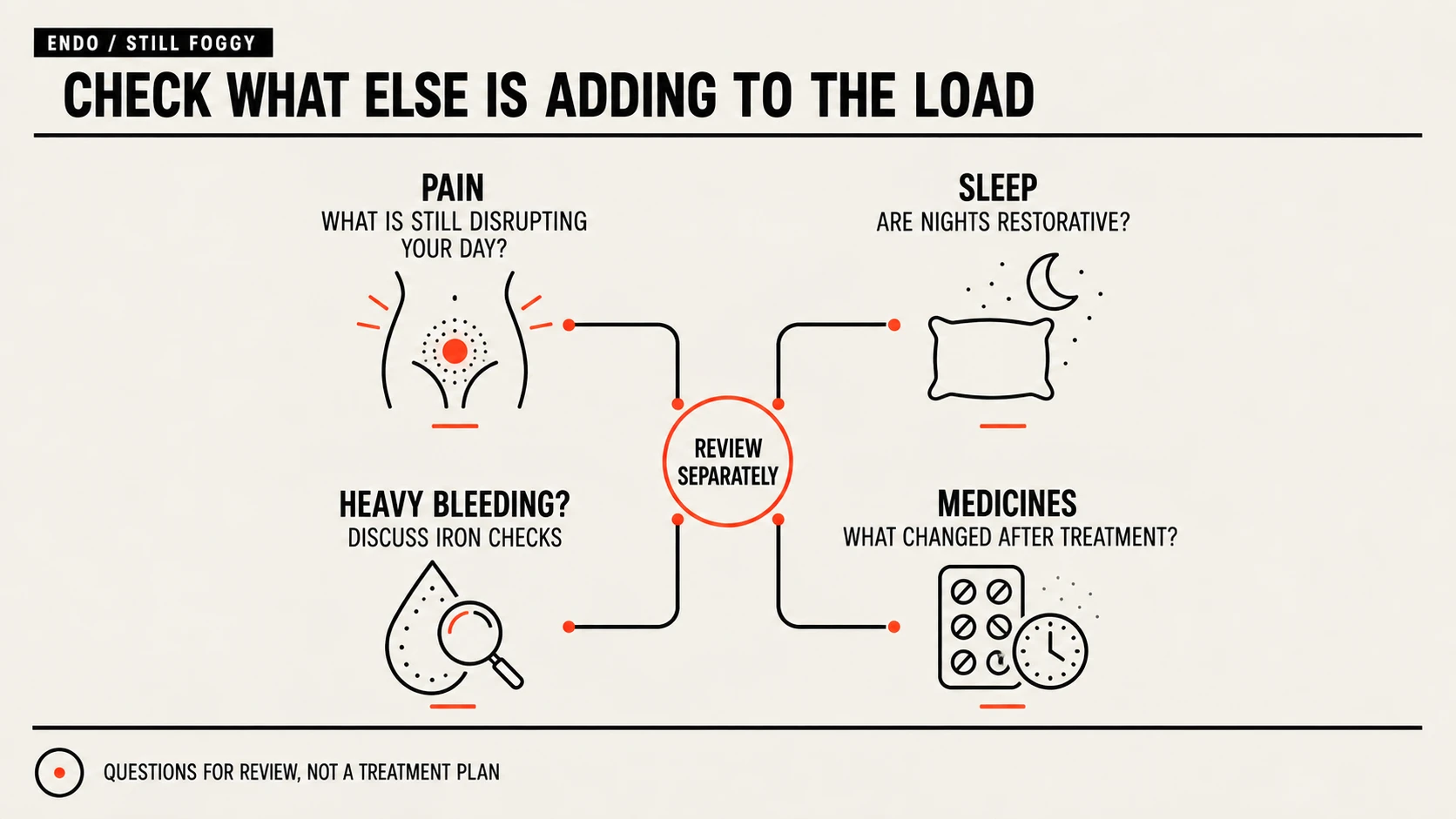
Review pain, sleep, heavy bleeding, possible low iron and medicine changes separately. These are questions for the next appointment, not a treatment plan.
View full-size illustration (opens in a new tab)Immediate support actions
Body
Light movement as tolerated. Rest during flares. Heat packs for pain.
Food
Anti-inflammatory eating. Iron-rich foods if heavy bleeding. Regular meals for blood sugar stability.
Water
Stay hydrated. Helps with both pain and cognitive function.
Environment
Keep a heating pad or TENS unit handy.
Connection
Endo support communities are active and helpful. Endometriosis is common, affecting up to 1 in 10 women of reproductive age.
Ask
Ask whether the worst thinking lands on the same part of the cycle as the worst pain and bleeding.
Avoid
Don't accept 'normal' scans as dismissal. Don't see non-specialists for surgery. Don't ignore anemia.
This Week
What to try next
Check if symptoms change with your cycle. If brain fog worsens predictably around your period and you also have pelvic pain, discuss endometriosis evaluation with your gynecologist. Check iron/ferritin if you bleed heavily. Anemia is common and treatable.
Start with one helpful change before adding more.
Light movement as tolerated. Rest during flares. Heat packs for pain.
NICE NG73 Section 1.4 covers pain management including heat and exercise.
Anti-inflammatory eating. Iron-rich foods if heavy bleeding. Regular meals for blood sugar stability.
Weekly focus: Food. Observational studies suggest anti-inflammatory diets may help endo symptoms.
Stay hydrated. Helps with both pain and cognitive function.
Weekly focus: Hydration.
Keep a heating pad or TENS unit handy. Chronic pain itself impairs cognition.
Weekly focus: Environment. Chronic pain is tied to cognitive decline, a systematic review found.
Endo support communities are active and helpful. Endometriosis is common, affecting up to 1 in 10 women of reproductive age.
Weekly focus: Connection.
Recovery
How long does it last?
Treating endometriosis symptoms, heavy bleeding, iron deficiency, pain, sleep disruption or medicine effects may change how clear-headed someone feels. Research hasn't shown that brain fog responds predictably to endometriosis surgery or hormone treatment.
Typical timeline: anemia treatment takes weeks, hormone treatment takes months, and surgery varies. Pain, bleeding, anemia and treatment side effects each change at their own pace, so check how your thinking is doing apart from them.
Severity and location of endometriosis
Whether surgery was needed and what it addressed (excision and ablation are both used; the choice is made with a gynaecology team)
Anemia correction (common with heavy bleeding)
Pain control (chronic pain itself impairs cognition)
Hormonal management approach
Sleep quality
NICE NG73 Endometriosis (2017, updated 2024); Becker CM et al. ESHRE guideline: endometriosis. Hum Reprod Open. 2022. PMID: 35350465; Innes KE, Sambamoorthi U. J Alzheimers Dis. 2020. PMID: 33252087 (pain-cognition link)
Treatment and support
How is it treated?
Lifestyle
- Anti-inflammatory diet
- Light movement
Investigations
- Endometriosis Evaluation
- Assess Comorbidities
Medical options
- Surgical management (excision or ablation)
- Hormonal management
Supplements
- Iron (if ferritin < 30 mcg/L)
- Omega-3, vitamin D, NAC and magnesium have mixed evidence and no dependable benefit for endometriosis pain.
Diet Options
Diet approaches that fit this cause
Anti-Inflammatory
Eating to lower inflammation may help endometriosis symptoms. The Mediterranean diet, which overlaps with anti-inflammatory eating, has the most consistent evidence for lowering inflammation levels.
What to eat: Omega-3 rich foods (fatty fish, walnuts), vegetables, fruit, whole grains, olive oil. Reduce red meat, alcohol, processed foods, and trans fats. Alcohol may increase estrogen levels, which can worsen endometriosis.
No specific 'endo diet' is well-documented. Anti-inflammatory eating may help. Some report improvement with gluten or dairy elimination, though evidence is limited.
Gentle Anti-Inflammatory (Recovery-Adapted)
This suits people who are too fatigued, nauseous or overwhelmed for complicated diet changes. It's the smallest step that still helps.
What to eat: Small, frequent, simple meals. Broth/soup if appetite is poor. Add ONE portion of oily fish per week. Add berries when tolerable. Reduce (don't eliminate) ultra-processed food. Hydrate. Don't force large meals.
If you can barely cook, this is for you. One fish meal a week, some berries, drink water. That's enough to start. You can do more when you feel better.
Iron-Repletion Focus
For confirmed or suspected iron deficiency. Pair iron-rich foods with vitamin C. Separate from tea/coffee/dairy.
What to eat: Iron-rich foods: red meat 2-3x/week, liver 1x/week (if tolerated), lentils, spinach, fortified cereals. Pair them with vitamin C for better absorption (bell pepper, orange, kiwi, strawberry). Separate tea/coffee from iron-rich meals by 1hr.
TEST FIRST. Take iron only after a ferritin test confirms deficiency. Too much iron is harmful. If your ferritin is below 30 mcg/L and you have symptoms, ask your doctor about IV iron (faster than tablets).
Low-Moderate - observational studies suggest benefit
Community Insights
What real patients keep noticing
What Helped
- Excision surgery by a specialist: brain fog lifted significantly afterwards
- Treating anemia: I was severely iron deficient from heavy bleeding
- Anti-inflammatory diet - noticeably helped
- Finally being believed and diagnosed (the wait averages nearly 7 years)
What Didn't Help
- Being told 'periods are supposed to hurt' - delayed diagnosis for years
- Ablation surgery instead of excision: regrowth was rapid
- Hormonal treatments that caused brain fog as side effects
Surprises
- Endo brain fog is a recognized problem: I wasn't imagining it
- Inflammation from endo affects the whole body, not just the pelvis
- Many endo patients have normal scans. ESHRE's 2022 guideline lets doctors diagnose without laparoscopy (keyhole surgery) when they can try treatment first
Common Mistakes
- Accepting 'your scans are normal' as dismissal: imaging often misses endo
- Seeing a general gynecologist instead of an endo specialist for surgery
- Not checking iron/ferritin with heavy bleeding
Community Tip
The average time to an endometriosis diagnosis is nearly 7 years. If you have cyclical pain, heavy bleeding and cognitive symptoms together, push for an evaluation. 'Normal' scans don't rule out endo.
Daily Practices
Low-risk options
Specialist surgical consultation
If surgery comes up, ask what type and location of endometriosis is suspected, and why excision (cutting out) or ablation (burning away) is advised there. If it's complex or deep, an endometriosis specialist may help.
Evidence: Surgery is a guideline-supported option for pain. Evidence comparing excision with ablation is limited and depends on the lesion, its location and the treatment goal.
Pelvic floor physical therapy
Pelvic floor PT specializes in chronic pelvic pain and can help alongside other treatments.
Evidence: Small trials showed some pain improvement.
Therapy
Who else can help
Gynecologist specializing in endometriosis. Pelvic floor physical therapist. Consider therapy if chronic pain affects mental health.
Metabolic Lens
How metabolic problems can make it worse
During flares, endometriosis pain, broken sleep and hormone shifts can worsen fatigue and thinking problems. Metabolic and autonomic (automatic body function) problems can do the same.
- Cycle-linked cognitive worsening with fatigue and pain.
- Pain flares disrupt appetite, meal timing, and sleep architecture.
- Overlap with hormonal and mood causes is common.
Bottom Line
Key points
- Cycle-linked pain plus brain fog is the main sign.
- Heavy bleeding can push iron low enough to worsen cognition.
- Poor sleep from pain is often part of the picture.
- This overlaps with PMDD, anemia, and hormone-related causes.
- If the fog follows the flare, the flare matters.
FAQ
Questions that actually matter here
My periods are awful and my brain goes with them - is this endo or could it be PMDD?
Endometriosis may be more likely when brain fog rises with pelvic pain, heavy bleeding, bloating, bowel flares or the inflammatory part of the cycle. PMDD is more likely when mood crashes, irritability and worse thinking come before your period and lift soon after bleeding starts. Ferritin, sleep loss and medicine effects can blur both, so note your symptoms across two full cycles before deciding which fits. You can ask for help sooner.
NICE NG73; Becker CM et al. Hum Reprod Open. 2022. PMID: 35350465; Reilly TJ et al. J Affect Disord. 2024. PMID: 38199397; Yen JY et al. Compr Psychiatry. 2012. PMID: 21821238
How quickly can I tell whether treatment is helping?
Treating iron deficiency: thinking may improve within weeks as ferritin rises. Hormonal management (OCP, dienogest, GnRH agonists): usually 4-12 weeks before you can judge it. Surgery varies widely, and current evidence does not establish a predictable cognitive response to it. If nothing has moved after an adequate trial, re-check competing causes and consider clinician-level testing.
NICE NG73; Becker CM et al. ESHRE guideline. Hum Reprod Open. 2022. PMID: 35350465; Bruner AB et al. Randomised study of cognitive effects of iron supplementation in non-anaemic iron-deficient adolescent girls. Lancet. 1996;348(9033):992-6. PMID: 8855856; Falkingham M et al. The effects of oral iron supplementation on cognition in older children and adults: a systematic review and meta-analysis. Nutr J. 2010;9:4. PMID: 20100340; Strowitzki T et al. Dienogest in the treatment of endometriosis-associated pelvic pain: a 12-week, randomized, double-blind, placebo-controlled study. Eur J Obstet Gynecol Reprod Biol. 2010;151(2):193-8. PMID: 20444534; Harada T et al. Low-dose oral contraceptive pill for dysmenorrhea associated with endometriosis: a placebo-controlled, double-blind, randomized trial. Fertil Steril. 90(5):1583-8 (PubMed date 2007). PMID: 18164001; Berryman A, Machado L. Cognitive Functioning in Females with Endometriosis-Associated Chronic Pelvic Pain: A Literature Review. Arch Clin Neuropsychol. 2025;40(5):1066-1080. PMID: 39826909
My gynecologist says endo does not cause brain fog - who should I see instead?
You do not need someone who agrees with every internet claim. You need a clinician who will take cycle-linked pain and cognitive symptoms seriously and help sort endometriosis from PMDD, anemia, thyroid disease, medication burden, and sleep disruption. If your gynecologist dismisses the link outright, see a gynecologist or pelvic-pain specialist who focuses on endometriosis. Ask for basic ferritin, blood count and thyroid tests, rather than being passed from one general referral to the next.
NICE NG73; Becker CM et al. Hum Reprod Open. 2022. PMID: 35350465; Reilly TJ et al. J Affect Disord. 2024. PMID: 38199397; Yen JY et al. Compr Psychiatry. 2012. PMID: 21821238
Does endometriosis show up on MRI or ultrasound?
Sometimes, but often not. Transvaginal ultrasound can identify ovarian endometriomas (chocolate cysts), and MRI is better at detecting deep infiltrating endometriosis. But many lesions - especially superficial peritoneal implants - are invisible on imaging. A 2025 review confirmed that no reliable non-invasive biomarker exists for endometriosis. Normal imaging doesn't rule out endometriosis. If your symptoms fit but scans are clear, push for referral to an endometriosis specialist. Laparoscopy remains the gold standard for definitive diagnosis.
Saunders PTK, Horne AW. Biol Reprod. 2025;113(5):1029-1043. PMID: 40704733; Nisenblat V et al. Cochrane Database Syst Rev. 2016;2(2):CD009591. PMID: 26919512; Becker CM et al. ESHRE guideline: endometriosis. Hum Reprod Open. 2022. PMID: 35350465; NICE NG73
Can endometriosis come back after surgery?
Yes. One hospital study found reoperation in roughly 20% of people within two years. The extent and location of disease, the type of operation and the surgeon's experience all play a part. Excision and ablation are both used, and evidence comparing them for symptom outcomes is mixed, so the operation is chosen with a gynaecology team rather than by a single rule. Ongoing hormonal management after surgery (such as continuous OCP or dienogest) can reduce recurrence risk. For complex or deep disease, ask whether a specialist endometriosis centre is appropriate.
Becker CM et al. ESHRE guideline: endometriosis. Hum Reprod Open. 2022. PMID: 35350465; Shakiba K et al. Obstet Gynecol. 2008. PMID: 18515510; Zakhari A et al. Hum Reprod Update. 2021. PMID: 33020832; Bafort C et al. Cochrane Database Syst Rev. 2020. PMID: 33095458; Burks C et al. J Minim Invasive Gynecol. 2020. PMID: 33310168; Pundir J et al. J Minim Invasive Gynecol. 2017. PMID: 28456617
Can endometriosis cause brain fog even without severe pain?
Yes, though it's less common. Endometriosis keeps inflammation going through your whole body. Studies in women link endometriosis to a more sensitive brain and spinal cord, mostly in those with pelvic pain. That can affect thinking however bad the pain feels. Iron deficiency from heavy bleeding can also cause brain fog without severe pain. If your thinking follows your cycle but your pain is manageable, endometriosis is still worth checking.
As-Sanie S et al. J Pain. 2015. PMID: 26456676; Gomez-Llerena A et al. J Minim Invasive Gynecol. 2025. PMID: 40721059; Zondervan KT et al. Nat Rev Dis Primers. 2018. PMID: 30026507; Agic A et al. Gynecol Obstet Invest. 2006. PMID: 16679772; Taylor HS et al. Lancet. 2021. PMID: 33640070
How long does it take to get diagnosed with endometriosis?
The average diagnostic delay is nearly 7 years. Community reports consistently mention being told 'periods are supposed to hurt', which delayed diagnosis for years. If you have cyclical pelvic pain, heavy periods, and brain fog that follows your cycle, push back if you're dismissed. Ask for a referral to a gynaecologist with an interest in endometriosis, or to a specialist endometriosis centre if complex or deep disease is suspected.
NICE NG73; community reports; ESHRE guideline 2022
Is there newer 2024-2026 research on endometriosis and brain fog?
Yes. Recent papers continue to update the endometriosis picture, but they still need claim-level review before they should change how you interpret your own symptoms.
Cuffaro et al., International journal of molecular sciences 2024 (PMID 38928175); Dydyk et al., StatPearls 2025 (PMID 32119472)
Can endometriosis cause brain fog?
Yes. Endometriosis drives chronic inflammation that can reach the brain and spinal cord. A 2026 study found that this inflammation, repeating each cycle, inflames the brain and spinal cord and makes them more sensitive. Add iron deficiency from heavy bleeding and chronic pain using up mental energy, and several causes add up to brain fog.
What does endometriosis brain fog usually feel like?
Cyclical and tied to your body's rhythms. The fog often gets heavier around your period, alongside pelvic pain, fatigue, and that bone-deep exhaustion that comes from years of chronic inflammation. Some people describe it as a monthly cognitive crash, like your brain joins the rest of your body in shutting down for a few days. Word-finding drops, concentration breaks apart, and processing speed slows. Pain days cost you cognitively even after the worst pain settles.
What should I try first if I think endometriosis is involved?
Note your cycle day, pain, bleeding and how clear your thinking is, and bring the notes to your gynecologist without waiting two full cycles. If your thinking problems reliably worsen around your period or with pelvic pain, ask for an endometriosis evaluation. If your periods are heavy, ask for a ferritin test. Iron deficiency from bleeding is common and treatable, and itself causes brain fog.
What tests should I discuss for endometriosis brain fog?
Start with ferritin and CBC (heavy bleeding depletes iron - ferritin < 30 mcg/L suggests deficiency even without frank anemia). Full iron studies (serum iron, TIBC, transferrin saturation) are more informative than ferritin alone because ferritin can be falsely normal during inflammation. Also request CRP (inflammation marker), thyroid panel, and vitamin D. For endometriosis itself, imaging (transvaginal ultrasound, MRI) can identify some lesions, but normal scans don't rule out endo. Laparoscopy is the gold standard.
When should I bring endometriosis brain fog to a clinician?
STOP - Seek urgent care if: sudden severe abdominal pain, heavy bleeding soaking a pad per hour, fever, or signs of infection. Outside emergencies, see a clinician if you have cyclical pain plus thinking problems and haven't yet had endometriosis evaluation. The average diagnostic delay is nearly 7 years. Don't wait for self-tracking to 'prove' it first if symptoms are affecting your daily function.
How is endometriosis brain fog different from pain-related brain fog?
With endometriosis, brain fog tends to follow the menstrual cycle, worsening around periods with pelvic pain, bloating and heavy bleeding. With other chronic pain, it's more constant and less tied to hormone changes. A systematic review found chronic pain conditions are linked to declines in thinking, but endometriosis adds cyclical inflammation, iron loss from bleeding and hormone disruption. If your thinking problems reliably follow your cycle, endometriosis fits better than pain alone.
Can endometriosis affect fertility?
Yes. Of women with infertility, 25-50% have endometriosis. The ESHRE guideline addresses fertility specifically: excision surgery can improve natural conception rates in some cases, and IVF outcomes may be affected by endometriosis stage. Fertility anxiety itself compounds the cognitive and emotional burden. If fertility is a concern, ask your specialist about the Endometriosis Fertility Index and discuss treatment timing.
Clinical Evidence
The research at a glance
Neuropsychiatric
Finding: Endometriosis associated with neuropsychiatric manifestations including cognitive dysfunction
Acad Mental Health Well-Being 2025; Curr Obstet Gynecol Rep 2025
Endometriosis Brain
Finding: The "endometriosis brain" - cognitive symptoms independent of pelvic pain
Endometriosis brain review 2025
Doctor Prep
How to bring this to a clinician
Opening script
My brain fog tracks with my endometriosis symptoms, pain flares, or heavy bleeding. I want to look at endo-related inflammation, sleep disruption, and iron loss instead of treating the cognition as unrelated.
Tests to discuss
- Menstrual Cycle and Symptom Diary
- CBC + CMP Blood Test Bundle
- Ferritin
- Medication Review
- Pelvic ultrasound for suspected endometriosis
- Specialist pelvic MRI for suspected deep endometriosis
- Laparoscopy discussion when diagnosis or treatment remains uncertain
- Pregnancy test when pregnancy is possible
Signs to mention
- Pelvic pain, very painful periods, pain during or after sex, bowel or bladder pain, trouble becoming pregnant, or heavy bleeding occurs with brain fog.
- Your thinking is worse after a poor night of sleep, severe pain, heavy bleeding, or a medicine dose.
- Pelvic symptoms affect work, school, exercise, sleep, sex, eating, bowel movements, urination, or caring for other people.
- A close relative has endometriosis, or earlier surgery, ultrasound, or MRI found endometriosis, an ovarian endometrioma, or adenomyosis.
- Symptoms improve when pain, bleeding, sleep or another measured problem is treated, even if brain fog doesn't go away completely.
What to bring
- Bring any notes you already have about pelvic pain, bleeding, bowel or bladder symptoms, sex, sleep, energy, headaches, and brain fog. You do not need to wait for two or three full cycles before asking for help.
- Mark the first day of each period and note whether symptoms also happen between periods.
- Bring two real examples of what pain, bleeding, or fatigue stopped you from doing. This may include school, work, sleep, sex, exercise, or tasks at home.
- Bring the full reports from earlier pelvic ultrasound, MRI, laparoscopy, biopsy, or surgery. Include the operation note and pathology report when available.
- List every hormone treatment, pain medicine, antidepressant, sleep medicine, supplement, and non-prescription medicine. Write what helped, what did not, and any side effects.
- Bring earlier CBC, ferritin, iron, TSH, thyroid hormone, B12, and pregnancy-test reports if they were done.
- Say whether pregnancy is wanted now, later, never, or uncertain. This can change which treatments fit.
- Write any family history of endometriosis and any history of anemia, migraine, bowel disease, bladder problems, pelvic infection, fibroids, adenomyosis, or ovarian cysts.
Screening tools
- A short symptom diary can show when pain, bleeding, sleep, medicines, and thinking change. Start now and bring what you have. Keep your appointment even if the diary isn't perfect.
- A CBC can show anemia. Ferritin and other iron tests may be useful when periods are heavy, bleeding is frequent, or tiredness and reduced exercise tolerance are present.
- A pregnancy test is important when pregnancy is possible and there is new pelvic pain or bleeding. Endometriosis does not protect against an ectopic pregnancy.
- A pelvic exam may find tenderness, a mass, or reduced movement. A normal exam doesn't rule out endometriosis.
- NICE recommends an internal (transvaginal) ultrasound for suspected endometriosis, even with a normal exam. If you decline it or it isn't suitable, a belly (transabdominal) ultrasound is an option.
- Specialist ultrasound or pelvic MRI can help map deep endometriosis before treatment. Someone trained in gynecological imaging should plan and read the scan.
- A normal ultrasound or MRI does not rule out all endometriosis. Laparoscopy may be discussed when symptoms remain important, imaging is negative, and treatment has not worked or is not suitable.
- CA125, hormone panels, hs-CRP, saliva tests, and home inflammation tests do not diagnose endometriosis. Do not use one of these results to confirm or dismiss it.
Doctor Scripts
How to handle the next clinical conversation
Initial Visit
I think Endometriosis may be part of my brain fog because the timing and symptoms keep lining up. I want to check the strongest rule-outs and measurements before guessing.
- What specific test results or findings would confirm or rule this out?
- What tests make sense, and what can we treat now?
- If the first round of tests is unclear, what else should we check?
- Endometriosis Evaluation: Ultrasound and MRI are part of the work-up, but normal imaging doesn't rule out superficial endometriosis, and scans can look normal even with significant disease. ESHRE says laparoscopy may be considered when imaging is negative, or when treatment based on symptoms hasn't worked or isn't appropriate.
- Assess Comorbidities: Anemia from heavy bleeding is common and contributes to fatigue and fog. Treating anemia helps.
Age And Context
Endometriosis brain fog across life stages
Adolescents and young adults
Endometriosis often begins in adolescence but is rarely diagnosed early. Severe period pain dismissed as 'normal' during teenage years is a hallmark of early-onset endo. If you've had debilitating periods since your teens plus cognitive symptoms, this pattern matters. Don't accept 'you'll grow out of it' - advocate for evaluation.
Reproductive years (20s-40s)
Peak diagnostic period. Fertility concerns often drive evaluation. IVF and hormonal treatments can themselves affect cognition. GnRH agonists create a temporary menopause-like state with potential cognitive side effects. If fertility is relevant, ask about the Endometriosis Fertility Index.
Perimenopause and beyond
Endometriosis is estrogen-dependent and often improves after menopause, but not always. Some women continue to have symptoms post-menopause, especially if on HRT. Thinking changes in perimenopause can overlap with leftover endo brain fog, making causes harder to separate.
Visit prep
Open the Endometriosis doctor handout
Open the public handout now to prepare focused questions for your visit.
This opens in your browser. We don't ask for email or add you to lists.
Supporter: I'm supporting someone with endometriosis
Supporting someone whose thinking has changed
Brain fog with endometriosis is often dismissed as period complaints. The person you are helping may find it hard to say how much thinking they have lost, because the problem itself makes describing it harder.
Recognition
What it often feels like
Endometriosis-related brain fog usually follows the cycle, shaped by pain, inflammation, bleeding and poor recovery.
Does brain fog reliably worsen with pelvic pain, bleeding, bloating or the inflammatory part of the cycle?
Endometriosis may be central, but anemia, PMDD, histamine reactions, poor sleep or thyroid problems can overlap heavily.
Timing
My brain fog rises with my cycle and pain, not on its own.
Symptom
Heavy bleeding, exhaustion or low-iron symptoms happen with the brain fog.
Symptom
Bloating, pelvic inflammation, bowel symptoms, or flare days make my head worse too.
Timing
Pain days cost me cognitively even after the worst pain settles down.
Patient Language
How people describe it
Their brain and their pelvis go down at the same time. On the worst pain days, thinking slows, memory drops, and brain fog follows the cycle so closely that they can predict their bad brain days by their bad body days.
- When the pain and inflammation are bad, my thinking is worse too.
- Brain fog tends to show up around the same part of the cycle as the rest of the endo flare.
- This feels tied to pain, bleeding, and poor recovery, not just mood.
Common Confusions
Causes that look similar
Pain
People can confuse endometriosis and chronic pain because both can leave them tired and struggling to think. The surrounding details usually tell them apart.
Key question: If you line up the timing, triggers, and the symptoms that happen with brain fog, does this look more like Endometriosis or Pain?
Meds
People can confuse endometriosis with medicine side effects because both can leave them tired and struggling to think. The surrounding details usually tell them apart.
Key question: Endometriosis or medicine side effects: which fits better?
Migraine
Endometriosis and Migraine can sound alike in a short symptom list. You can usually tell them apart once you look closely at timing, triggers and your other symptoms.
Key question: If you look at the whole picture, not just the brain fog, does endometriosis or migraine fit better?
Immediate support actions
Body
Light movement as tolerated. Rest during flares. Heat packs for pain.
Food
Anti-inflammatory eating. Iron-rich foods if heavy bleeding. Regular meals for blood sugar stability.
Water
Stay hydrated. Helps with both pain and cognitive function.
Environment
Keep a heating pad or TENS unit handy.
Connection
Endo support communities are active and helpful. Endometriosis is common, affecting up to 1 in 10 women of reproductive age.
Ask
Ask whether the worst thinking lands on the same part of the cycle as the worst pain and bleeding.
Avoid
Don't accept 'normal' scans as dismissal. Don't see non-specialists for surgery. Don't ignore anemia.
Timing
When brain fog tends to show up
Worse in the morning
After-meal worsening
Worse after exertion
Doctor Prep
How to bring this to a clinician
Opening script
My brain fog tracks with my endometriosis symptoms, pain flares, or heavy bleeding. I want to look at endo-related inflammation, sleep disruption, and iron loss instead of treating the cognition as unrelated.
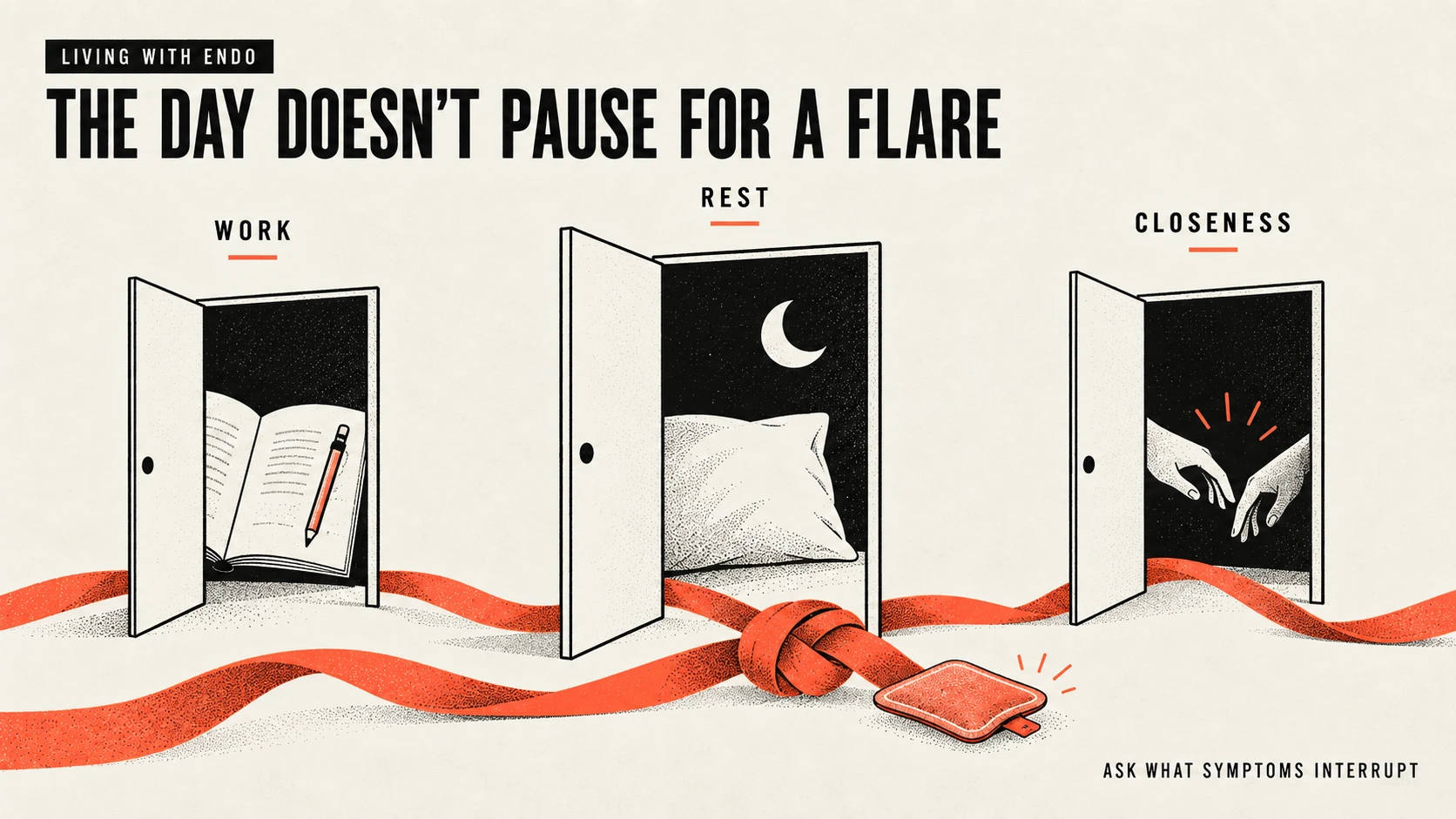
Bring two real examples of what pain, bleeding, or fatigue stopped you from doing. This may include school, work, sleep, sex, exercise, or tasks at home.
View full-size illustration (opens in a new tab)Tests to discuss
- Menstrual Cycle and Symptom Diary
- CBC + CMP Blood Test Bundle
- Ferritin
- Medication Review
- Pelvic ultrasound for suspected endometriosis
- Specialist pelvic MRI for suspected deep endometriosis
- Laparoscopy discussion when diagnosis or treatment remains uncertain
- Pregnancy test when pregnancy is possible
Signs to mention
- Pelvic pain, very painful periods, pain during or after sex, bowel or bladder pain, trouble becoming pregnant, or heavy bleeding occurs with brain fog.
- Your thinking is worse after a poor night of sleep, severe pain, heavy bleeding, or a medicine dose.
- Pelvic symptoms affect work, school, exercise, sleep, sex, eating, bowel movements, urination, or caring for other people.
- A close relative has endometriosis, or earlier surgery, ultrasound, or MRI found endometriosis, an ovarian endometrioma, or adenomyosis.
- Symptoms improve when pain, bleeding, sleep or another measured problem is treated, even if brain fog doesn't go away completely.
What to bring
- Bring any notes you already have about pelvic pain, bleeding, bowel or bladder symptoms, sex, sleep, energy, headaches, and brain fog. You do not need to wait for two or three full cycles before asking for help.
- Mark the first day of each period and note whether symptoms also happen between periods.
- Bring two real examples of what pain, bleeding, or fatigue stopped you from doing. This may include school, work, sleep, sex, exercise, or tasks at home.
- Bring the full reports from earlier pelvic ultrasound, MRI, laparoscopy, biopsy, or surgery. Include the operation note and pathology report when available.
- List every hormone treatment, pain medicine, antidepressant, sleep medicine, supplement, and non-prescription medicine. Write what helped, what did not, and any side effects.
- Bring earlier CBC, ferritin, iron, TSH, thyroid hormone, B12, and pregnancy-test reports if they were done.
- Say whether pregnancy is wanted now, later, never, or uncertain. This can change which treatments fit.
- Write any family history of endometriosis and any history of anemia, migraine, bowel disease, bladder problems, pelvic infection, fibroids, adenomyosis, or ovarian cysts.
Screening tools
- A short symptom diary can show when pain, bleeding, sleep, medicines, and thinking change. Start now and bring what you have. Keep your appointment even if the diary isn't perfect.
- A CBC can show anemia. Ferritin and other iron tests may be useful when periods are heavy, bleeding is frequent, or tiredness and reduced exercise tolerance are present.
- A pregnancy test is important when pregnancy is possible and there is new pelvic pain or bleeding. Endometriosis does not protect against an ectopic pregnancy.
- A pelvic exam may find tenderness, a mass, or reduced movement. A normal exam doesn't rule out endometriosis.
- NICE recommends an internal (transvaginal) ultrasound for suspected endometriosis, even with a normal exam. If you decline it or it isn't suitable, a belly (transabdominal) ultrasound is an option.
- Specialist ultrasound or pelvic MRI can help map deep endometriosis before treatment. Someone trained in gynecological imaging should plan and read the scan.
- A normal ultrasound or MRI does not rule out all endometriosis. Laparoscopy may be discussed when symptoms remain important, imaging is negative, and treatment has not worked or is not suitable.
- CA125, hormone panels, hs-CRP, saliva tests, and home inflammation tests do not diagnose endometriosis. Do not use one of these results to confirm or dismiss it.
Doctor Scripts
How to handle the next clinical conversation
Initial Visit
I think Endometriosis may be part of my brain fog because the timing and symptoms keep lining up. I want to check the strongest rule-outs and measurements before guessing.
- What specific test results or findings would confirm or rule this out?
- What tests make sense, and what can we treat now?
- If the first round of tests is unclear, what else should we check?
- Endometriosis Evaluation: Ultrasound and MRI are part of the work-up, but normal imaging doesn't rule out superficial endometriosis, and scans can look normal even with significant disease. ESHRE says laparoscopy may be considered when imaging is negative, or when treatment based on symptoms hasn't worked or isn't appropriate.
- Assess Comorbidities: Anemia from heavy bleeding is common and contributes to fatigue and fog. Treating anemia helps.
FAQ
Questions that actually matter here
My periods are awful and my brain goes with them - is this endo or could it be PMDD?
Endometriosis may be more likely when brain fog rises with pelvic pain, heavy bleeding, bloating, bowel flares or the inflammatory part of the cycle. PMDD is more likely when mood crashes, irritability and worse thinking come before your period and lift soon after bleeding starts. Ferritin, sleep loss and medicine effects can blur both, so note your symptoms across two full cycles before deciding which fits. You can ask for help sooner.
NICE NG73; Becker CM et al. Hum Reprod Open. 2022. PMID: 35350465; Reilly TJ et al. J Affect Disord. 2024. PMID: 38199397; Yen JY et al. Compr Psychiatry. 2012. PMID: 21821238
How quickly can I tell whether treatment is helping?
Treating iron deficiency: thinking may improve within weeks as ferritin rises. Hormonal management (OCP, dienogest, GnRH agonists): usually 4-12 weeks before you can judge it. Surgery varies widely, and current evidence does not establish a predictable cognitive response to it. If nothing has moved after an adequate trial, re-check competing causes and consider clinician-level testing.
NICE NG73; Becker CM et al. ESHRE guideline. Hum Reprod Open. 2022. PMID: 35350465; Bruner AB et al. Randomised study of cognitive effects of iron supplementation in non-anaemic iron-deficient adolescent girls. Lancet. 1996;348(9033):992-6. PMID: 8855856; Falkingham M et al. The effects of oral iron supplementation on cognition in older children and adults: a systematic review and meta-analysis. Nutr J. 2010;9:4. PMID: 20100340; Strowitzki T et al. Dienogest in the treatment of endometriosis-associated pelvic pain: a 12-week, randomized, double-blind, placebo-controlled study. Eur J Obstet Gynecol Reprod Biol. 2010;151(2):193-8. PMID: 20444534; Harada T et al. Low-dose oral contraceptive pill for dysmenorrhea associated with endometriosis: a placebo-controlled, double-blind, randomized trial. Fertil Steril. 90(5):1583-8 (PubMed date 2007). PMID: 18164001; Berryman A, Machado L. Cognitive Functioning in Females with Endometriosis-Associated Chronic Pelvic Pain: A Literature Review. Arch Clin Neuropsychol. 2025;40(5):1066-1080. PMID: 39826909
My gynecologist says endo does not cause brain fog - who should I see instead?
You do not need someone who agrees with every internet claim. You need a clinician who will take cycle-linked pain and cognitive symptoms seriously and help sort endometriosis from PMDD, anemia, thyroid disease, medication burden, and sleep disruption. If your gynecologist dismisses the link outright, see a gynecologist or pelvic-pain specialist who focuses on endometriosis. Ask for basic ferritin, blood count and thyroid tests, rather than being passed from one general referral to the next.
NICE NG73; Becker CM et al. Hum Reprod Open. 2022. PMID: 35350465; Reilly TJ et al. J Affect Disord. 2024. PMID: 38199397; Yen JY et al. Compr Psychiatry. 2012. PMID: 21821238
Does endometriosis show up on MRI or ultrasound?
Sometimes, but often not. Transvaginal ultrasound can identify ovarian endometriomas (chocolate cysts), and MRI is better at detecting deep infiltrating endometriosis. But many lesions - especially superficial peritoneal implants - are invisible on imaging. A 2025 review confirmed that no reliable non-invasive biomarker exists for endometriosis. Normal imaging doesn't rule out endometriosis. If your symptoms fit but scans are clear, push for referral to an endometriosis specialist. Laparoscopy remains the gold standard for definitive diagnosis.
Saunders PTK, Horne AW. Biol Reprod. 2025;113(5):1029-1043. PMID: 40704733; Nisenblat V et al. Cochrane Database Syst Rev. 2016;2(2):CD009591. PMID: 26919512; Becker CM et al. ESHRE guideline: endometriosis. Hum Reprod Open. 2022. PMID: 35350465; NICE NG73
Can endometriosis come back after surgery?
Yes. One hospital study found reoperation in roughly 20% of people within two years. The extent and location of disease, the type of operation and the surgeon's experience all play a part. Excision and ablation are both used, and evidence comparing them for symptom outcomes is mixed, so the operation is chosen with a gynaecology team rather than by a single rule. Ongoing hormonal management after surgery (such as continuous OCP or dienogest) can reduce recurrence risk. For complex or deep disease, ask whether a specialist endometriosis centre is appropriate.
Becker CM et al. ESHRE guideline: endometriosis. Hum Reprod Open. 2022. PMID: 35350465; Shakiba K et al. Obstet Gynecol. 2008. PMID: 18515510; Zakhari A et al. Hum Reprod Update. 2021. PMID: 33020832; Bafort C et al. Cochrane Database Syst Rev. 2020. PMID: 33095458; Burks C et al. J Minim Invasive Gynecol. 2020. PMID: 33310168; Pundir J et al. J Minim Invasive Gynecol. 2017. PMID: 28456617
Can endometriosis cause brain fog even without severe pain?
Yes, though it's less common. Endometriosis keeps inflammation going through your whole body. Studies in women link endometriosis to a more sensitive brain and spinal cord, mostly in those with pelvic pain. That can affect thinking however bad the pain feels. Iron deficiency from heavy bleeding can also cause brain fog without severe pain. If your thinking follows your cycle but your pain is manageable, endometriosis is still worth checking.
As-Sanie S et al. J Pain. 2015. PMID: 26456676; Gomez-Llerena A et al. J Minim Invasive Gynecol. 2025. PMID: 40721059; Zondervan KT et al. Nat Rev Dis Primers. 2018. PMID: 30026507; Agic A et al. Gynecol Obstet Invest. 2006. PMID: 16679772; Taylor HS et al. Lancet. 2021. PMID: 33640070
How long does it take to get diagnosed with endometriosis?
The average diagnostic delay is nearly 7 years. Community reports consistently mention being told 'periods are supposed to hurt', which delayed diagnosis for years. If you have cyclical pelvic pain, heavy periods, and brain fog that follows your cycle, push back if you're dismissed. Ask for a referral to a gynaecologist with an interest in endometriosis, or to a specialist endometriosis centre if complex or deep disease is suspected.
NICE NG73; community reports; ESHRE guideline 2022
Is there newer 2024-2026 research on endometriosis and brain fog?
Yes. Recent papers continue to update the endometriosis picture, but they still need claim-level review before they should change how you interpret your own symptoms.
Cuffaro et al., International journal of molecular sciences 2024 (PMID 38928175); Dydyk et al., StatPearls 2025 (PMID 32119472)
Can endometriosis cause brain fog?
Yes. Endometriosis drives chronic inflammation that can reach the brain and spinal cord. A 2026 study found that this inflammation, repeating each cycle, inflames the brain and spinal cord and makes them more sensitive. Add iron deficiency from heavy bleeding and chronic pain using up mental energy, and several causes add up to brain fog.
What does endometriosis brain fog usually feel like?
Cyclical and tied to your body's rhythms. The fog often gets heavier around your period, alongside pelvic pain, fatigue, and that bone-deep exhaustion that comes from years of chronic inflammation. Some people describe it as a monthly cognitive crash, like your brain joins the rest of your body in shutting down for a few days. Word-finding drops, concentration breaks apart, and processing speed slows. Pain days cost you cognitively even after the worst pain settles.
What should I try first if I think endometriosis is involved?
Note your cycle day, pain, bleeding and how clear your thinking is, and bring the notes to your gynecologist without waiting two full cycles. If your thinking problems reliably worsen around your period or with pelvic pain, ask for an endometriosis evaluation. If your periods are heavy, ask for a ferritin test. Iron deficiency from bleeding is common and treatable, and itself causes brain fog.
What tests should I discuss for endometriosis brain fog?
Start with ferritin and CBC (heavy bleeding depletes iron - ferritin < 30 mcg/L suggests deficiency even without frank anemia). Full iron studies (serum iron, TIBC, transferrin saturation) are more informative than ferritin alone because ferritin can be falsely normal during inflammation. Also request CRP (inflammation marker), thyroid panel, and vitamin D. For endometriosis itself, imaging (transvaginal ultrasound, MRI) can identify some lesions, but normal scans don't rule out endo. Laparoscopy is the gold standard.
When should I bring endometriosis brain fog to a clinician?
STOP - Seek urgent care if: sudden severe abdominal pain, heavy bleeding soaking a pad per hour, fever, or signs of infection. Outside emergencies, see a clinician if you have cyclical pain plus thinking problems and haven't yet had endometriosis evaluation. The average diagnostic delay is nearly 7 years. Don't wait for self-tracking to 'prove' it first if symptoms are affecting your daily function.
How is endometriosis brain fog different from pain-related brain fog?
With endometriosis, brain fog tends to follow the menstrual cycle, worsening around periods with pelvic pain, bloating and heavy bleeding. With other chronic pain, it's more constant and less tied to hormone changes. A systematic review found chronic pain conditions are linked to declines in thinking, but endometriosis adds cyclical inflammation, iron loss from bleeding and hormone disruption. If your thinking problems reliably follow your cycle, endometriosis fits better than pain alone.
Can endometriosis affect fertility?
Yes. Of women with infertility, 25-50% have endometriosis. The ESHRE guideline addresses fertility specifically: excision surgery can improve natural conception rates in some cases, and IVF outcomes may be affected by endometriosis stage. Fertility anxiety itself compounds the cognitive and emotional burden. If fertility is a concern, ask your specialist about the Endometriosis Fertility Index and discuss treatment timing.
Bottom Line
Key points
- Cycle-linked pain plus brain fog is the main sign.
- Heavy bleeding can push iron low enough to worsen cognition.
- Poor sleep from pain is often part of the picture.
- This overlaps with PMDD, anemia, and hormone-related causes.
- If the fog follows the flare, the flare matters.
Compare
Endometriosis vs similar causes of brain fog
Several conditions cause brain fog like endometriosis does. Brain fog that reliably follows the menstrual cycle usually points to endometriosis or PMDD.
PMDD (Premenstrual Dysphoric Disorder)
Both cause thinking problems that follow your cycle. PMDD brain fog comes after ovulation (luteal phase) and clears within days of your period. With endometriosis, symptoms can be present in every phase of the cycle.
Key question: Does your brain fog clear within a few days of your period starting, or last through your period?
NICE NG73; Zondervan KT et al. Nat Rev Dis Primers. 2018. PMID: 30026507
Iron-Deficiency Anemia
Anemia brain fog is steadier and not strongly cycle-linked. But endometriosis often causes anemia through heavy bleeding, so both can be present simultaneously. If treating iron deficiency helps but doesn't clear the brain fog, endometriosis may explain the rest.
Key question: Is your brain fog constant all month, or does it clearly follow your cycle and pain?
WHO Iron Supplementation Guidelines; Zondervan 2018
Fibromyalgia
In fibromyalgia, central sensitization drives brain fog, which appears with widespread pain, unrefreshing sleep and sensory overload. Endometriosis fog is more localized to pelvic pain and cycle-linked. However, central sensitization from chronic endometriosis pain can mimic fibromyalgia. About 6% of endometriosis patients also have a fibromyalgia diagnosis.
Key question: Is your pain mainly pelvic and cycle-linked, or widespread throughout your body?
Greenbaum H et al. Am J Reprod Immunol. 2019. PMID: 30682223; Sinaii N et al. Hum Reprod. 2002. PMID: 12351553
Visit prep
Open the Endometriosis doctor handout
Open the public handout now to prepare focused questions for your visit.
This opens in your browser. We don't ask for email or add you to lists.
Sources and notes
NICE NG73 Endometriosis: Diagnosis and Management (2017, updated 2024)
Zondervan KT et al. Endometriosis. Nat Rev Dis Primers. 2018;4(1):9. PMID: 30026507
WHO Endometriosis Fact Sheet, March 2023
Nnoaham KE et al. Impact of endometriosis on quality of life and work productivity. Fertil Steril. 2011;96(2):366-373. PMID: 21718982
As-Sanie S et al. Functional Connectivity is Associated With Altered Brain Chemistry in Women With Endometriosis-Associated Chronic Pelvic Pain. J Pain. 17(1):1-13. PMID: 26456676
Innes KE, Sambamoorthi U. Chronic Pain and Cognitive Decline: A Systematic Review. J Alzheimers Dis. 2020;78(3):1177-1195. PMID: 33252087
Saunders PTK, Horne AW. Endometriosis: new insights. Biol Reprod. 2025;113(5):1029-1043. PMID: 40704733
Moen MH, Magnus P. The familial risk of endometriosis. Acta Obstet Gynecol Scand. 1993;72(7):560-4. PMID: 8213105