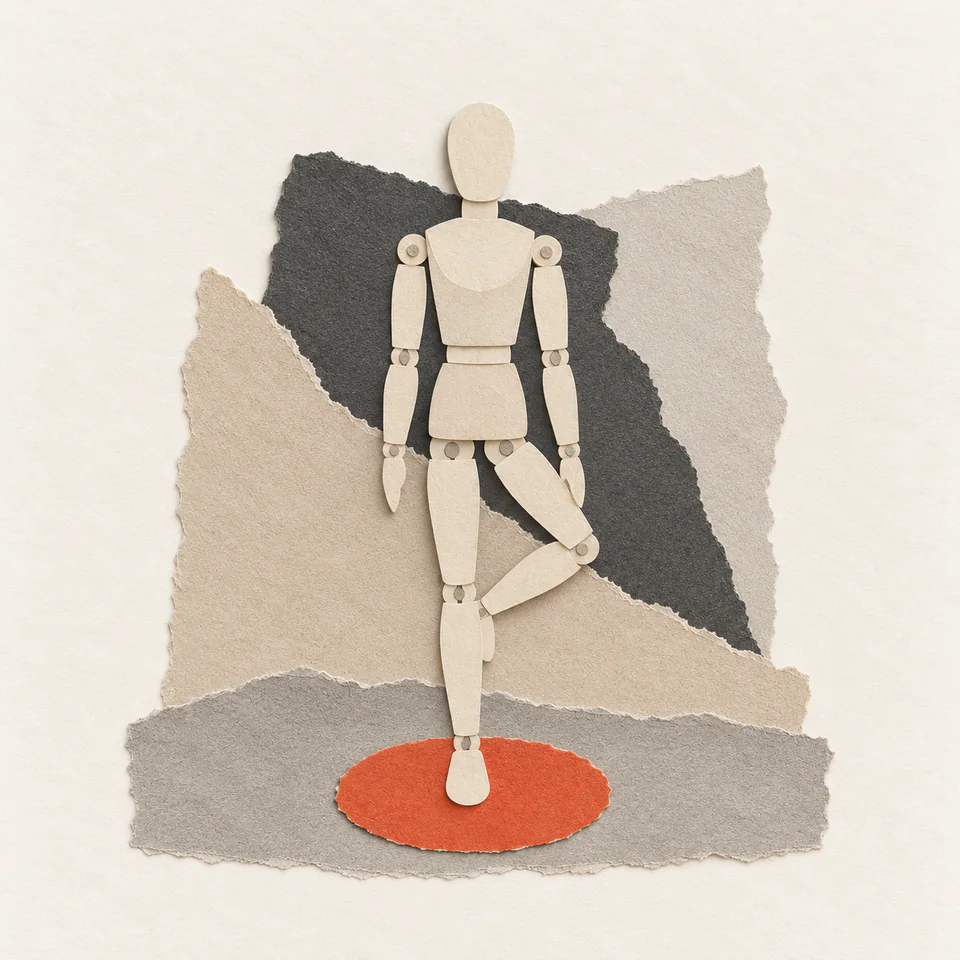
I do a 10-second single leg stance test every morning while I wait for my decaf. Barefoot. One foot on the back of my calf. Arms at my sides, eyes forward, 10 seconds each leg, all in under a minute. People who've seen me do this think I'm being weird. I'm testing my brain.
I Stand on One Foot Every Morning. A Study of 1,702 People Explains Why.
In 2022 a team from Brazil, the UK, Finland, Australia, and the US published a study in the British Journal of Sports Medicine. It followed 1,702 adults aged 51 to 75 for 7 years. They asked everyone to do one thing. Stand on one leg for 10 seconds.
20% couldn't do it.
Over the next 7 years, 17.5% of the people who failed the test died. 4.6% of the people who passed it died. The researchers accounted for weight, heart problems, diabetes, cholesterol and the other usual factors. Failing the test still meant an 84% higher risk of dying from any cause within the next decade.
A 10-second balance test predicted mortality better than most of the bloodwork your doctor orders annually.
Why balance predicts everything
Standing on one leg isn't a leg exercise. To not fall over on one foot your brain is running three systems at once and hoping none of them fail.
Proprioception : your body's sense of where it is in space. This runs up your spinal cord to your brainstem. If B12 deficiency, diabetes, neuropathy (nerve disease) or spinal compression damages those pathways, you wobble. I didn't know the word proprioception until I started looking into why my left side was consistently worse than my right. Turns out the nerve pathways aren't always symmetrical, and minor deficits that don't show up on any scan show up immediately when you're standing on one foot.
Vestibular function : your inner ear telling you which way is up. Age, infection, medication and head injury damage it.
Vision gives your brain information about where you are. A clinician may compare balance with eyes open and closed as part of an assessment. Do not turn this into an eyes-closed challenge at home.
Your brain needs at least two of three working to keep you upright. The single leg stance forces all three to perform under load at the same time. When any of them are slipping, balance is where you see it first.
The inability to balance doesn't kill you. What it's showing you is that your brain, your nerves, or your blood vessels are already declining, and those are the things that kill you. The lead researcher put it simply: standing on one leg integrates muscular, vascular, and brain systems into one test. It's crude. But it works.
The Romberg connection
There's a clinical version of this that neurologists have been using since the 1840s called the Romberg test. Stand with your feet together, eyes open, then close your eyes. If you're stable with eyes open but start swaying or falling with eyes closed, that's a positive Romberg sign. Your proprioception is shot, and your brain was using vision to cover for it without you knowing.
The Romberg specifically checks the dorsal columns of your spinal cord. The pathway that carries your sense of body position to your brain. When that pathway is damaged you lose the ability to know where your body is without looking at it. I went down a rabbit hole on this one night after a weird vertigo episode and ended up reading case studies for two hours. It's wild how much diagnostic information is sitting in a test you can do in your hallway.
B12 deficiency, diabetic neuropathy, multiple sclerosis, cervical (neck) spinal cord compression and vitamin E deficiency cause a positive Romberg. They're real neurological conditions that go undiagnosed for years, because who sees a doctor for feeling a little unsteady or having some brain fog and tingling in their feet? You tell your doctor that and they say stress. The Romberg test would've flagged it in 30 seconds.
What this has to do with brain fog
This is the part that changed how I think about all of this. 80% of your brain's neurons live in your cerebellum - 69 billion out of 86 billion, crammed into 10% of the brain's total mass. I had to look that number up twice because it doesn't seem right. Besides balance, the cerebellum coordinates thinking, memory, emotional regulation, timing and sequencing. Most doctors never look at it and most patients don't even know it exists.
When the systems that feed the cerebellum weaken, you get clumsy and also struggle to think clearly. That's why brain fog and balance problems so often go together. It's also why a 10-second standing test catches neurological decline that no blood panel is designed to look for.
This next one bothers me. Hashimoto's antibodies attack cerebellar tissue directly. Your thyroid panel can come back completely normal while your immune system is quietly damaging the brain structure that runs 80% of your neurons. I'm not an endocrinologist and I can't tell you exactly how common this is, but the research I've read on cerebellar autoimmunity is pretty unsettling. This is why I always say get TPO antibodies tested alongside TSH and free T4. The standard thyroid screen misses this entirely.
Why I do it every morning
I'm not training my legs. I'm monitoring my nervous system. My left side is always about two seconds worse than my right. It's been that way since I started checking. If one morning I can't hold 10 seconds clean when I could yesterday, something changed. Maybe I slept like garbage. Maybe I'm dehydrated. Maybe something bigger is going on and I want to catch it before it catches me. Free. 30 seconds. Done.
The failure rates from the study by age group:
51 to 55: about 5% failed.
56 to 60: about 8%.
61 to 65: about 18%.
66 to 70: about 37%.
71 to 75: over half.
Balance can improve with training.
Try it right now
This is a personal balance experiment, not a diagnosis.
Interactive Test
Take the 10-Second Balance Test
A guided timer for the single leg stance. Left leg, then right leg, 10 seconds each. You report what happened honestly. The timer can't check it.
Stand near a wall or counter for safety. Barefoot works best.
Or do it the simple way. Stand up. Put one foot on the back of your other calf. Arms at your sides. Eyes straight ahead. Hold for 10 seconds. Switch sides.
If you can do it easy, good. You have a baseline. Do it again tomorrow.
If you wobble or grab for something, that's data. Not a diagnosis. Maybe you're just out of practice and a week of daily stands will fix it. Or maybe something's off and worth mentioning next time you see your doctor.
You just tested your brain, your spinal cord, and your vestibular system standing next to your kitchen counter. No appointment. No copay.
How to actually improve your balance if you failed the test
When I first tried the 10-second test I couldn't hold it clean. I wobbled at about 6 seconds and had to put my foot down. That was my starting point. I used these stages to get to a clean hold.
Week 1 to 2: Supported single leg stand. Stand next to a kitchen counter or wall. Lift one foot. Use your fingertips on the counter for balance. Hold 10 seconds each side. Do this 3 times a day. You're teaching your brain to activate the stabilizer muscles. Using support is fine at this stage.
Week 3 to 4: One finger support. Same position but now only one fingertip on the counter. You'll feel your ankle and hip doing more work. Your brain is starting to rely less on the external support and more on internal proprioception. Stay here until you can hold 10 seconds with just one finger touching.
Week 5 to 6: No support, eyes open. Take your hand off the counter and let your arms hang at your sides. Pick a spot on the wall in front of you and keep your eyes on it the whole time, because that fixed point steadies you. Hold 10 seconds each side. If you wobble, put a finger back down and start the count again.
When to worry vs when to just keep practicing. If you're under 50 and can't hold 5 seconds with eyes open after 4 weeks of daily practice, that's worth mentioning to your doctor. It may indicate a proprioceptive or vestibular issue that training alone won't fix. If you're over 60 and can't hold 10 seconds, you're in the majority. Over half of 71 to 75 year olds in the study couldn't do it. But that doesn't mean you accept it. It means you train it. Balance is the most trainable neurological skill at any age.
Common questions about the balance test
I can stand on my right leg fine but my left is terrible. What does that mean?
Asymmetry is common and usually means one side has weaker stabilizer muscles or slightly different proprioceptive input. It can also reflect an old ankle injury, hip issue, or nerve irritation on one side. Train the weak side more. If the asymmetry is dramatic and doesn't improve with practice, it may be worth investigating with a physio.
Does it matter which foot I stand on?
The study allowed participants to use either foot. For your daily practice, do both. The weaker side is the one that needs the work and the one that gives you the most diagnostic information.
I have flat feet. Is that why I can't balance?
Flat feet can make balance harder because the arch of your foot acts as a proprioceptive sensor. Less arch means less sensory input from the foot. It's a harder starting point but not a reason you can't improve. Barefoot practice is especially important for flat feet because shoes further dampen the sensory input your brain needs.
Should I do this barefoot or with shoes?
Barefoot. Your feet have thousands of nerve endings that tell your brain where your body is. Shoes dull those messages. Training barefoot strengthens the link between feet and brain. If the floor is cold, thin socks are fine. Skip thick cushioned shoes for balance training.
I'm dizzy when I try this. Should I stop?
If you feel dizzy rather than just wobbly, stop and sit down. Dizziness during a balance test can point to an inner ear (vestibular) problem, not a problem sensing where your body is. Tell your doctor. The eyes-closed Romberg test in particular can bring on symptoms in people with inner ear problems. Rest when dizziness starts.
Can I improve my balance if I'm over 70?
Yes. Your brain can adapt (neuroplasticity) at every age. In studies, balance training improved how long older adults could stand on one leg within 4 to 12 weeks. You won't go from 3 seconds to 30 seconds overnight, but you can go from failing to passing the 10-second test within a few months of daily practice.
I have brain fog AND balance problems. Are they connected?
Possibly yes. Both can result from the same underlying cause. B12 deficiency affects both cognition and proprioception. Hashimoto's thyroiditis can attack both the cerebellum and thyroid function. Cervical spine problems affect both brainstem function and balance. POTS causes both cognitive impairment and unsteadiness. If you have both symptoms, that narrows the list of likely causes considerably. Take the assessment to see which causes match your full pattern.
My doctor says balance testing isn't important. Is that true?
The lead researcher on the 2022 study explicitly stated that the 10-second single leg stance provides useful prognostic information beyond standard clinical data and recommended including it in routine physical examinations. Harvard Health and Cleveland Clinic both covered the study and supported the recommendation. Your doctor may not be aware of this research. You can show them the paper.
Is this the same as a Romberg test?
Related but not identical. The Romberg test is done with both feet together and eyes closed. It specifically tests proprioception by removing visual input. The single leg stance is a broader test that challenges all three balance systems simultaneously under higher load. Both are useful. The single leg stance is the one studied for mortality prediction. The Romberg test is the one neurologists use to identify specific sensory pathway problems.
Can balance training help my brain fog directly?
Balance training works the cerebellum, which coordinates thinking as well as movement. Early evidence suggests that exercises challenging balance also improve executive function (planning and focus) and processing speed, particularly in older adults. It doesn't treat brain fog directly, but it trains the same brain systems that brain fog conditions often impair.
How long until I see improvement?
Most people notice measurable improvement in single leg stance time within 2 to 4 weeks of daily practice. The first few days feel frustrating because you wobble constantly. By week 2 you start finding the stability point faster. By week 4 to 6, holding 10 seconds with eyes open should be achievable for most people under 65 who don't have an underlying neurological condition.
References
- Araujo CG, de Souza e Silva CG, Laukkanen JA, Fiatarone Singh M, Kunutsor SK, Myers J, Franca JF, Castro CL. Successful 10-second one-legged stance performance predicts survival in middle-aged and older individuals. British Journal of Sports Medicine. 2022;56(17):975-980. DOI: 10.1136/bjsports-2021-105360
- Kaprive JF, Munakomi S, Cronovich H. Romberg Test. StatPearls. National Center for Biotechnology Information. 2023. NCBI Bookshelf
- Azevedo FAC, Carvalho LRB, Grinberg LT, Farfel JM, Ferretti REL, Leite REP, Filho WJ, Lent R, Herculano-Houzel S. Equal numbers of neuronal and nonneuronal cells make the human brain an isometrically scaled-up primate brain. J Comp Neurol. 2009;513(5):532-541. DOI: 10.1002/cne.21974
- Can a 10-second balance test predict longevity? Harvard Health Publishing, Harvard Medical School. harvard.edu
- Can the 10-Second Balance Test Predict Your Lifespan? Cleveland Clinic. clevelandclinic.org
This is educational, not medical advice. If balance problems are new, worsening, or accompanied by other neurological symptoms, see a doctor.