Brain fog field guide · Diet
Brain fog after eating
Food is the easiest thing to blame and the hardest thing to check. Start with what your body did after the meal, not with the food you suspect.
Written by the What Is Brain Fog editorial team. Clinically reviewed by Dr. Alexandru-Theodor Amarfei, M.D. Updated . Editorial policy
Not a food diary question
Three situations that need a clinician first
- Emergency care. Breathing difficulty, swelling of the lips, tongue or throat, collapse, or symptoms getting rapidly worse after eating. Get emergency care the first time this happens.
- Call the prescriber. Brain fog with shaking, sweating or confusion while taking insulin or another glucose-lowering medicine. That's a medicine question, and the clinician who prescribes it needs to hear about it.
- Book an appointment. You're eating very little, losing weight without meaning to, or down to a handful of foods you feel safe with. That needs a doctor or registered dietitian now, not another food removed.
On this page
Five groups of symptoms after eating
Pick the row that matches what you physically felt, not the food you suspect. More than one row may fit. Each row links to a different possible explanation. These are descriptions to take to an appointment, not diagnoses.
Shaky, sweaty, suddenly hungry or weak
Usually after a sweet drink, a refined-carbohydrate meal, or a long stretch with nothing to eat. Several different things produce that combination, and blood glucose is only one of them.
Blood sugar changesBloating, cramping or a change in stool
The gut symptom and brain fog start together after the same kind of meal. If the same gut symptom follows the same food on several days, that says more than a long list of suspect foods.
Gut symptomsFlushing, itching, headache or a racing heart
This set gets blamed on histamine, but it has other explanations, and no single test settles it. How soon the symptoms start after eating is the detail worth pinning down.
Histamine-related symptomsOne specific food, the same symptoms every time
A general worse-after-eating feeling doesn't count here. A recognizable set of symptoms returns with one food and stays away without it. This is the only situation where a planned removal and reintroduction is worth the effort.
Food sensitivityEating very little, or down to a few safe foods
On its own, eating too little can make you tired, cold, dizzy and unable to concentrate, and a narrow diet can run short on nutrients. Removing another food can make this situation worse.
Nutrient deficiencyFour changes that don't narrow your diet
Cutting foods is the most popular first move and the most expensive one to get wrong. It can hide a diagnosis, and it shrinks what you eat while you're already unwell. These four change timing or amount instead. Each one says what its cited paper measured, so you can judge how much weight to give it.
Shorten the gap between meals
If brain fog turns up late morning or mid afternoon, look at how long you'd gone without eating before you look at what the last meal contained. Compare a meal that leaves you hungry again in an hour with one that holds you until the next.
What the paper measured. Leidy et al. 2015 reviewed protein, appetite, body weight and food intake. It didn't measure concentration or brain fog, and it sets no gram target and no required time after waking.
Steady meals, no fastingDrink normally across the day
It's quick to try and undo, and it narrows nothing. On the days brain fog is worst, notice thirst, dry mouth, headache and urine color, and skip counting glasses.
What the paper measured. Riebl and Davy 2013 examined mild dehydration, cognitive performance and mood. It doesn't prove that dehydration explains most brain fog, and it doesn't support buying an electrolyte product.
Ask a clinician first if you have kidney disease, heart disease or blood-pressure treatment, where changing salt or fluid intake carries its own risk.
Move caffeine earlier, keep the amount the same
Have the same cups earlier in the day, then compare how you sleep. That way the amount can't explain any change in your sleep.
What the paper measured. Gardiner et al. 2023 pooled 24 studies and found caffeine cut total sleep time and shifted sleep stages. It measured sleep, not the next day, and because caffeine lasts longer in some people it supports no single afternoon cut-off.
If you want a whole-diet change, start with Mediterranean-style eating
It works by adding foods, not banning them. That makes it the least risky of the popular options while you're still working out what's going on.
What the paper measured. Estruch et al. 2018 followed 7,447 older adults at high cardiovascular risk and recorded fewer major cardiac events. The trial didn't measure brain fog.
Mediterranean and MIND dietsWhy longer fasts and supplements aren't first steps
Mattson et al. 2018 is animal research and proposed mechanisms, and it sets no fasting schedule for brain fog. If long gaps already leave you shaky, weak or dizzy, extending them can make those symptoms harder to interpret.
Zeisel 2000 describes choline as an essential nutrient, based on pregnancy and animal development research. It includes no adult trial of choline foods or supplements for brain fog.
How to test a single food without wrecking the test
Use this method when one food repeatedly brings back the same symptoms. Remove only that food, then eat it again after the planned test period. Keeping the rest of your diet similar makes the comparison easier to understand.
Medical tests first
Some tests only work while the food is still in your diet. That's true of celiac blood testing, and avoiding the food makes allergy testing harder to read. If either might be relevant, ask about testing before you remove anything. See the gluten and celiac testing question below, and read the celiac page if it applies to you.
If a food has ever caused swelling, breathing difficulty or collapse, it's never one to try again at home. That's a job for an allergy service.

Change one food. Keep everything else roughly the same.
The comparison only works if the food is the thing that changed. If you swap your whole diet at the same time, you can't tell what caused any improvement.
- Before changing the food: Write down when you eat it and what symptoms follow.
- While the food is out: Write down whether the problems you linked to it still happen.
- After eating it again: Write down which problems returned and how soon.
Symptoms that ease while the food is out and come back when it returns make a connection more plausible. That's a reason to talk to a clinician, not a diagnosis of allergy or intolerance on its own.
What the 2011 gluten trial actually did
The researchers gave gluten or a placebo to 34 people with irritable bowel syndrome, without telling them which one. All of them had already improved on a gluten-free diet, so the researchers had chosen people likely to react. On gluten, overall symptoms, pain, bloating, stool consistency and tiredness were worse.
The trial didn't measure brain fog, and it didn't show how gluten made symptoms worse. So it's good evidence that gluten can worsen symptoms in some people with IBS, and it's the reason the removal-and-reintroduction method is worth doing carefully. It isn't evidence that gluten explains thinking problems in the general population.
Diet plans that remove and reintroduce foods
What gut-brain research and glucose studies can tell you
People with brain fog after meals hear about both, often as if they were one finding. The two answer different questions and use different measurements. Neither one reaches down to a single person's meal.
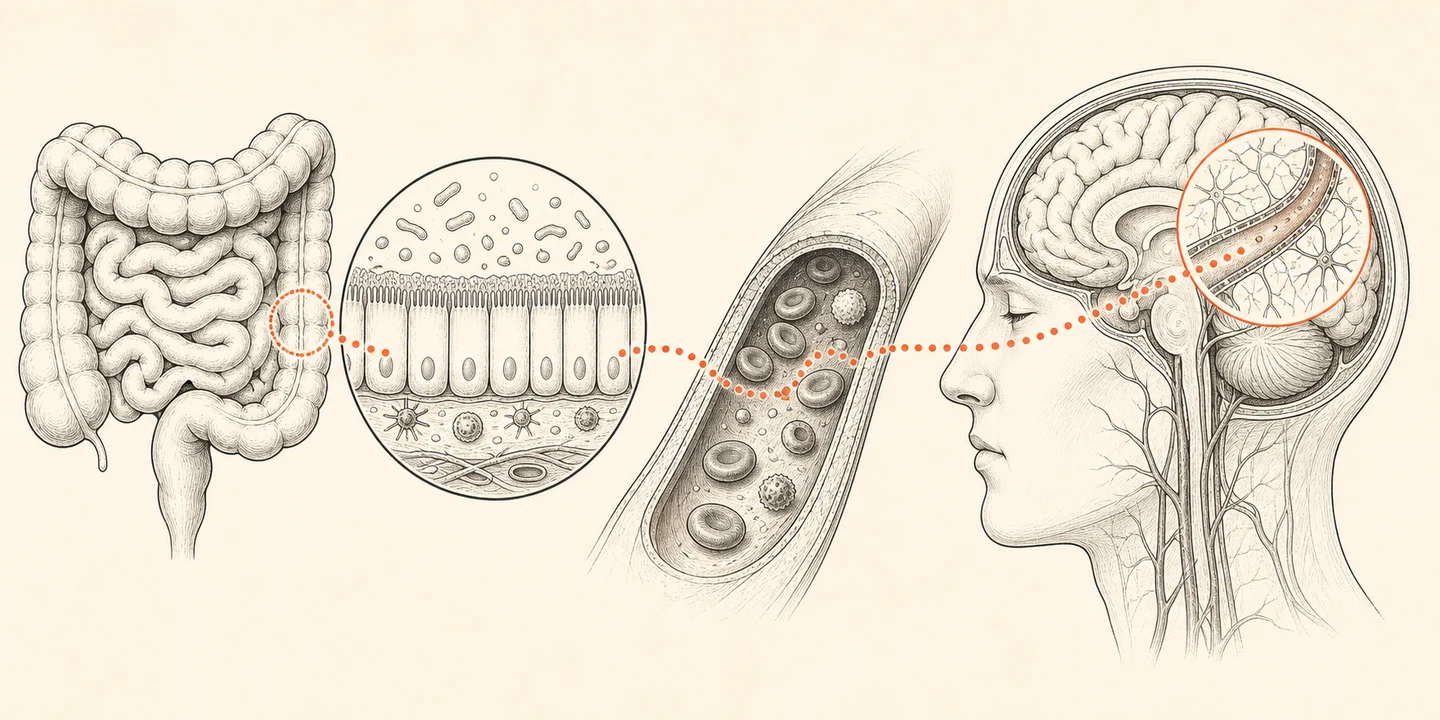
Research on the gut-brain axis
What researchers measure between the gut and the brain
The gut-brain axis is the two-way communication between the digestive tract and the brain: nerves, immune activity, the intestinal lining and the substances gut microbes make. People talk about it as one finding. In the research it's four measurements, each taken in a different place, and nobody has shown every step from the first to the last.
- 1 Inside the intestine
Gut microbes, and the substances produced while they and the digestive system work on food. Findings here compare groups of people, which is a different thing from a result about you.
- 2 At the intestinal lining
The proteins holding lining cells together, and whether microbial products pass beyond them. Researchers measure this in a laboratory. It isn't what the popular “leaky gut” label describes, which is a guess made from symptoms.
- 3 In the blood
Microbial products and inflammatory molecules. Finding one of these tells you it's there. Whether it produced any brain symptom is a separate question that these measurements leave open.
- 4 At the blood-brain barrier
Whether molecules in blood change the barrier around the brain or activate immune cells called microglia. Most of this work uses animals and laboratory models, not people with brain fog after meals.
If the same kind of meal repeatedly brings brain fog and a gut symptom together, tell a clinician about both and when they began. The research can't show whether your own gut bacteria, intestinal lining, blood-brain barrier or brain inflammation caused your thinking problems. It isn't enough evidence to choose a supplement or remove foods.
Sources: Carabotti et al. 2015, PMID 25830558 and Parker et al. 2020, PMID 31368397.

Research on glucose after a meal
You can measure blood glucose, but it can't show brain fog.
Researchers can measure how blood glucose rises and falls after you eat. A review by Blaak and colleagues looked at these changes, long-term metabolic health and some research on thinking.
This research may be relevant when brain fog repeatedly follows sweet drinks or refined carbohydrates and you're shaky, sweaty, suddenly hungry or weak. Tell a clinician about the meal, the timing and the other symptoms. A single home reading won't tell you the cause.
Source: Blaak et al. 2012, PMID 22780564.
What each cited paper measured
These are the ten papers behind the diet claims people hear most often. Open a row to see who the researchers studied and what they actually recorded: brain fog, cognition, sleep, appetite, heart events or a biological mechanism. Not one of them tests a diet as a treatment for brain fog. That's why the tier label sits on the card, not in a footnote.
Filter by evidence tier
All rated papers (10 papers)
Tier A means a controlled human study directly measured brain fog after the diet change. Tier B means researchers measured cognition or a closely related symptom. Tier C means the paper measured another human outcome, such as sleep or heart events. Tier D means the source is mechanistic, a general review, or does not test the claim on the card. No current card qualifies for Tier A.
Brain fog and food questions
Can a meal cause brain fog?
Brain fog can follow a meal, but timing alone can't identify the cause. Record any body symptoms that begin with brain fog. If the same sequence happens after the same meal on several days, show the written record to a clinician.
Should I remove gluten before a celiac blood test?
No. Celiac blood tests look for an antibody response to gluten, and that response fades once gluten leaves the diet. If celiac disease is possible, ask about testing while you're still eating gluten. A clinician can tell you how much and for how long based on your circumstances.
Is it faster to remove several foods at once?
No. If the symptoms settle, you can't tell which food mattered, so you have to reintroduce them one at a time anyway. Cutting several foods at once also cuts how much you eat overall, and eating too little produces its own tiredness and trouble concentrating. Change one food and keep the rest of your meals similar.
What should I do if many foods seem to cause brain fog?
Keep the foods you still eat, so you aren't left with very little. Bring a list of those foods, your symptoms and their timing to a doctor or registered dietitian. They can check for too little food, a nutrient deficiency, celiac disease, an allergy, a gut condition or something unrelated to food.
The twelve papers cited above
The first ten are the papers rated above. The last two are the gut-brain reviews used above.
- Blaak et al. 2012, post-meal glucose and cardiometabolic health, PMID 22780564
- Yurko-Mauro et al. 2010, DHA and age-related cognitive decline, PMID 20434961
- Biesiekierski et al. 2011, gluten in people with irritable bowel syndrome, PMID 21224837
- Comas-Basté et al. 2020, histamine intolerance review, PMID 32824107
- Zeisel 2000, choline biology review, PMID 11023003
- Gardiner et al. 2023, caffeine and sleep meta-analysis, PMID 36870101
- Leidy et al. 2015, higher-protein diets and appetite, PMID 25926512
- Riebl and Davy 2013, hydration and cognitive performance, PMID 25346594
- Estruch et al. 2018, Mediterranean diet and cardiovascular events, PMID 29897866
- Mattson et al. 2018, fasting mechanisms and brain health, PMID 29321682
- Carabotti et al. 2015, gut-brain communication review, PMID 25830558
- Parker et al. 2020, gut microbes and the blood-brain barrier, PMID 31368397