Vitamin D and Brain Fog
Where are you now?
What brought you here?
Symptoms, tests, and evidence
Can low vitamin D cause brain fog?
Fatigue, aches, low mood, and slower thinking can happen alongside low vitamin D. Only a blood test can show whether your level is low.
Still muddled after treatment?
If your level rises but your thinking doesn't improve, another cause may still be contributing.
Evidence consensus
Moderate - deficiency effects well-established; optimal levels debated
Demay et al., Endocrine Society Clinical Practice Guideline, J Clin Endocrinol Metab, 2024; Holick, NEJM, 2007
Evidence and recovery context
Investigating: I think low vitamin D might be causing my fog
Can Low Vitamin D Cause Brain Fog?
Tiredness, low mood, muscle weakness, aches, and slower thinking can happen alongside a low vitamin D level. None of those symptoms shows the level is low or proves vitamin D caused your brain fog. The standard 25-hydroxyvitamin D blood test, usually written 25-OH vitamin D or 25(OH)D, can show whether the level is low. How your thinking responds to treatment is separate evidence of whether low vitamin D contributed.
Recent research
What 2025 and 2026 research added
Two 2025 trials asked different questions
VitaMIND asked whether treatment could improve thinking in 620 adults with mild to moderate deficiency and early cognitive impairment. It did not. The Finnish Vitamin D Trial asked whether long-term supplementation could prevent diagnosed dementia in 2,492 largely vitamin-D-sufficient older adults. It found no significant difference, but only 45 people received a dementia diagnosis during follow-up. The first trial did not study severe deficiency. The second mostly did not study deficiency at all.
Low levels still show up in long-term risk studies
A 2025 meta-analysis pooled 22 observational studies and found more dementia in the lowest vitamin D group than in the highest. In a 2026 six-year cohort, people with deficiency declined more in overall thinking and executive function, but not in memory or orientation. These studies can show who declined. They cannot prove that supplements would have changed it.
Different parts of thinking may respond differently
A 2026 review pooled nine randomized trials and found improvement in overall thinking, language, working memory, and visual-spatial skills. It found no clear benefit for executive function, attention, or perceptual speed, and the authors said more trials are still needed. This skill-by-skill result is more useful than saying vitamin D works or doesn't.
“Brain fog” was not one shared research outcome
VitaMIND tested executive function and broader cognition. The Finnish trial counted dementia diagnoses. The 2026 review separated language, working memory, attention, speed, and other cognitive jobs. You may care most about losing words or running out of mental stamina, while a study measures something else. The headline depends on what the researchers counted.
Vitamin D Risk Factors
Practical Tool
Do you have reasons for a low level?
Eight questions about reasons a vitamin D level may run low.
Is winter sunlight weak where you live?
Do you spend most daylight hours indoors?
Is your skin tone medium to dark?
Are you an older adult?
Is your body mass index (BMI) above 30?
Do season, clothing, indoor life, or sun protection limit sunlight on your skin?
Has anyone told you that a medicine may change how your body handles or absorbs vitamin D?
Do you have a condition or surgery that makes it harder to absorb nutrients, such as celiac disease, inflammatory bowel disease (IBD), or gastric bypass?
These questions cover common reasons a vitamin D level may run low. They aren't a validated screening score and can't replace a 25(OH)D blood test.
What the symptoms can and cannot tell you
What people notice when brain fog and low vitamin D appear together
You may still get through work or an ordinary day, but everything takes longer. You lose your place. Choices that were easy now take effort. Tiredness or aching muscles may be there too. That's the experience, but it's not a vitamin D signature. The 25-OH vitamin D test shows whether the level is low.
The symptoms alone don't point to vitamin D. It's a more likely cause when you have a reason your level may be low, such as limited ultraviolet B (UVB) light, reduced absorption, or a medicine that affects vitamin D. A blood test must also show the level is low.
I can still get through the day, but thinking and ordinary tasks take more effort than they used to.
Symptom
I tend to do worse with low sun, winter, or long periods indoors.
Timing
I often get brain fog alongside low mood, low energy, aches, or poor recovery.
Symptom
Nothing about it felt obviously related to vitamin D until the blood result came back low.
Symptom
Common phrases
How people describe it
- Thinking takes longer at the same time as tiredness or aches.
- The change may build slowly, with no single obvious start.
- Because the same complaints occur in many conditions, the blood test matters more than the description.
What makes a low vitamin D level more likely
A repeatable change after meals isn't a known sign of low vitamin D and should be checked separately.
less-common
Aches, weakness, or less stamina for exercise can happen with a deficiency, but a crash after ordinary effort likely has another cause as well.
less-common
Some studies find lower vitamin D alongside worse thinking test scores, but they don't find one distinctive day-to-day form of brain fog.
common [Annweiler 2009]
Winter and long periods indoors can reduce UVB exposure. If your thinking gets worse during those times, that's more reason to suspect low vitamin D, but only a blood test can show if it's low.
common
Trouble thinking clearly often shows up alongside low mood, aches, and tiredness, not on its own.
common
Timing
When timing makes vitamin D worth checking
Morning heaviness
Vitamin D isn't known to make mornings worse. Sleep, medicines, blood pressure and other causes may need separate attention if thinking problems peak on waking.
After meals
A consistent change after meals isn't specific to vitamin D, so it can't show your level is low.
Winter or long indoor stretches
If thinking gets harder in winter or long indoor stretches, vitamin D is worth checking.
The cause of the low result
Why is it low in the first place?
A low result should lead to a search for the cause
Low vitamin D can come from little UVB exposure, darker or covered skin, age, higher body fat, poor absorption, kidney or liver disease, weight-loss surgery, pregnancy, or medicines.
Holick, NEJM 2007 (PMID 17634462); Lips, Prog Biophys Mol Biol 2006 (PMID 16563471); Kennel et al., Mayo Clin Proc 2010 (PMID 20675513); StatPearls Vitamin D Deficiency
Vitamin D brain fog or another cause?
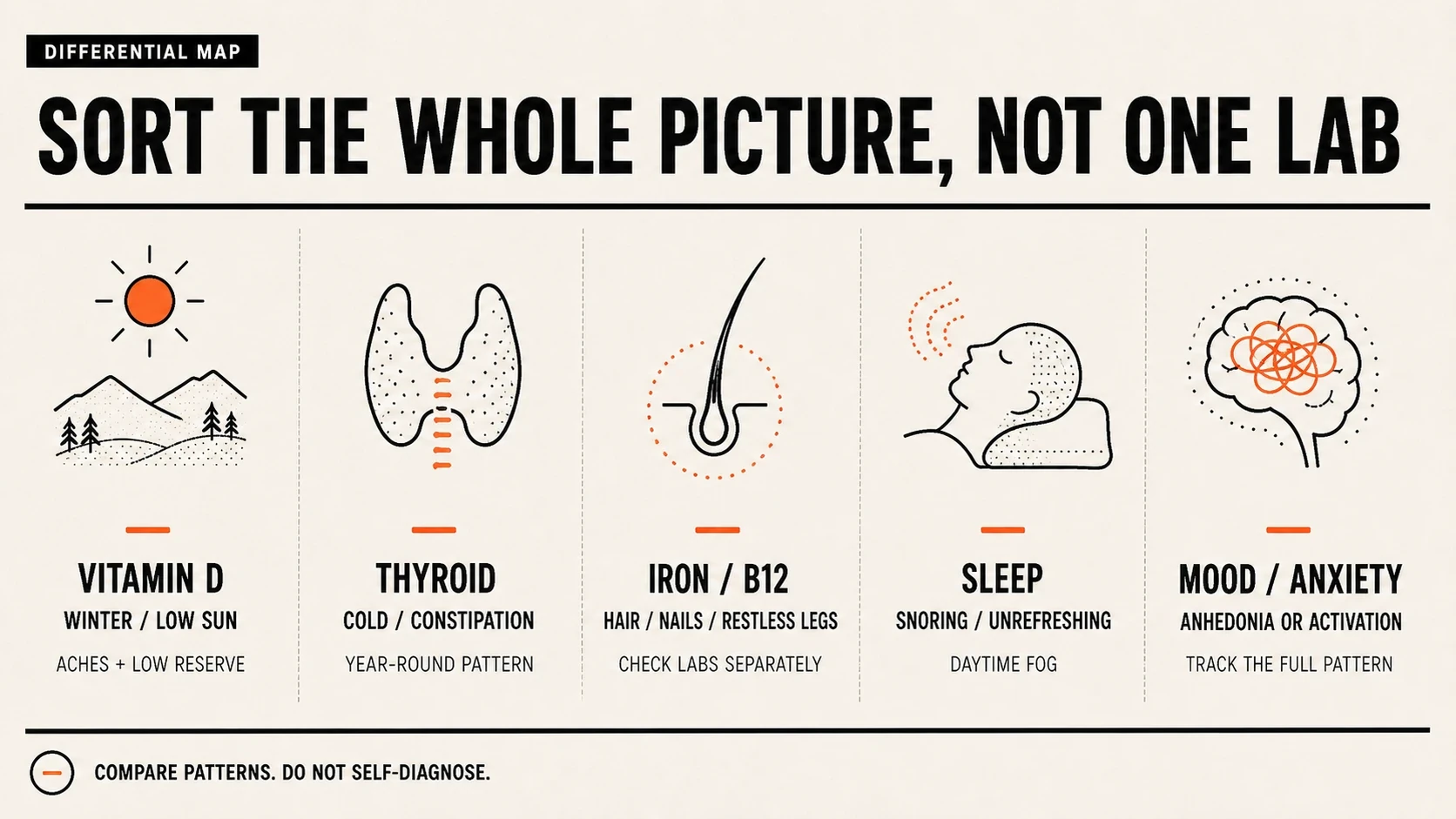
A low vitamin D result can appear alongside iron deficiency, thyroid disease, depression, anxiety, medication effects, or an absorption problem. The comparisons below show which symptoms and tests point toward each possibility.
or another nutrient deficiency
Low vitamin D, low iron, low B12, and low folate can all leave someone tired, mentally slower, and short of stamina. More than one deficiency can be present.
If the symptoms continue all year and ferritin, B12, folate, or blood-count results are also abnormal, vitamin D may be only one deficiency involved.
or Depression
Both low vitamin D and depression can involve low energy, low mood, and poorer concentration. Both can also get worse in winter, so one doesn't prove the other.
If the main change is loss of interest, low mood, or disturbed sleep, depression needs its own assessment even when vitamin D is also low.
or Anxiety
Anxiety can make concentration and recall worse, especially when the body feels on alert. That's a different day-to-day problem from finding a low vitamin D level.
If thinking gets harder with worry, racing thoughts, panic, or hypervigilance, anxiety may explain more of that episode than vitamin D.
or Thyroid
Thyroid disease and low vitamin D can both sit beside fatigue, brain fog, low mood, and body aches. If you have thyroid symptoms, your vitamin D result can't rule out thyroid disease.
If you also have constipation, dry skin, cold intolerance, hair change, or a slower pulse, ask about thyroid testing alongside the vitamin D result.
or Anemia
Iron problems and low vitamin D can both show up as fatigue, slower thinking, and poor stamina. They can also coexist, so one low result doesn't rule out the other.
Hair loss, brittle nails, restless legs, unusual cravings, heavy periods, or a history of low ferritin mean iron deficiency may also need checking.
or Celiac
Celiac disease can reduce absorption of fat-soluble vitamins, including vitamin D. If your vitamin D level stays low, it may be worth asking about malabsorption instead of only changing the supplement.
Ask about celiac testing if you have ongoing gut symptoms, unexplained anemia, a family history of celiac, or a level that stays low despite a clear plan.
or medication effects
Some medicines can affect how your body handles or absorbs vitamin D, and some can also cause brain fog directly. Those are two separate questions.
If thinking problems or the low result began after a medication change, bring your medicine list and ask whether the drug could affect vitamin D, thinking, or both.
The test is only the beginning
What makes vitamin D a more or less likely cause?
Without this, vitamin D is a weak explanation
- A 25-OH vitamin D blood test shows a low level.
These details make it more convincing
- The timing makes sense for vitamin D, such as worsening during low-sun months or a long period indoors.
- Your history gives a reason to check vitamin D: darker or covered skin, older age, higher body fat, poor absorption, kidney disease, relevant medicines, or little UVB exposure.
- The level is low, the history explains why it may be low, and the symptoms began or worsened during the same period.
- Thinking, energy, pain, or mood improve after treatment corrects the low level, and other causes look less likely.
These details point somewhere else
- Iron, B12, folate, thyroid, sleep, mood, medicines, or another cause explains the symptoms and timing better.
- The blood result isn't low, and there's no medical reason to suspect deficiency.
How Vitamin D May Affect the Brain
Researchers have found vitamin D receptors and vitamin D-related enzymes in brain tissue, including areas involved in memory, stress, and regulation. That gives them a biological reason to study vitamin D and thinking. This finding doesn't prove one low result caused your brain fog, or that vitamin D is a guaranteed treatment for thinking problems.
Eyles et al., J Chem Neuroanat 2005 (PMID: 15589699); Annweiler et al., Eur J Neurol 2009 (PMID: 19659751). [Eyles 2005] [Annweiler 2009]
When vitamin D stays low
A low result may point to another health problem
If the level stays low despite treatment, reduced absorption, kidney or liver disease, bariatric surgery, or a medicine may be interfering with it. Those causes can need attention in their own right.
- A level that stays low raises questions about absorption, medicines, and whether you followed the agreed treatment.
- If your level recovers but thinking doesn't, ask about sleep, mood, iron, B12, thyroid, and medicines.
- If the level and the symptoms both improve, vitamin D may have contributed without being the only cause.
The blood result shows the deficiency. Your history and response to treatment show whether it can explain any of your thinking problems.
Evidence details
17 facts that make the blood result easier to understand
Risk factors change the chance of a low result, not the diagnosis. Latitude, indoor work, darker skin, age, higher body fat, covered skin, and limited sun exposure can all matter, but no count can replace a 25-OH vitamin D result.
Vitamin D ranges were not designed to predict clearer thinking. National Institutes of Health (NIH) population ranges describe deficiency risk and general adequacy. Current Endocrine Society guidance does not identify one blood level that prevents disease or improves thinking for everyone.
Vitamin D2 and vitamin D3 both raise vitamin D levels. Comparative research generally finds vitamin D3 raises 25-OH vitamin D more effectively, but a vitamin D2 prescription isn't automatically wrong. Ask why that form was chosen and whether the follow-up result changed.
Taking vitamin D with a meal can improve absorption for some people because it's fat-soluble. A study found better absorption with the largest meal, but your body still absorbs some without fat. Meal timing may explain a poor response, but it isn't a dosing instruction.
Magnesium participates in vitamin D metabolism, but a low vitamin D result does not prove magnesium deficiency. Adding magnesium automatically can create another treatment without establishing that it's needed.
Prevalence changes with the threshold, population, season, and survey year. A frequently quoted US estimate used older National Health and Nutrition Examination Survey (NHANES) data and counted levels under 20 ng/mL. It doesn't tell you how many people today have brain fog from vitamin D.
The amount recommended in an ordinary diet is not the same as treatment for a confirmed deficiency. NIH intake guidance is 600 international units (IU) daily for adults through age 70 and 800 IU after 70.
Ask: 'Does this low 25-hydroxyvitamin D result help explain my symptoms, or could it be an unrelated finding?'.
Sunlight through a window doesn't help skin make vitamin D because glass blocks ultraviolet B (UVB) light. At higher latitudes in winter, sunlight can also be too weak. This makes season and time outdoors worth asking about, but only a blood test can show if your level is low.
Food can contribute vitamin D without becoming a cure claim. Fatty fish, egg yolks, ultraviolet-exposed mushrooms, and fortified foods are sources. Whether food is enough depends on the confirmed result and the treatment goal.
There's no single follow-up schedule for everyone. Timing depends on how low the first result was, the treatment, why your clinician chose it, and other health conditions. The useful comparison is whether the level changed and whether the symptoms changed with it.
Vitamin D receptors and an enzyme that activates vitamin D have been found in human brain tissue. This finding doesn't show how much vitamin D a person needs, whether a low result caused thinking problems, or whether supplements help.
Feeling worse in winter has several possible explanations. Less ultraviolet B (UVB) light can reduce vitamin D production, while seasonal mood change, infections, sleep changes, and disrupted routines can also affect thinking.
Vitamin K2 is often marketed beside vitamin D, but that doesn't make it a standard companion treatment for brain fog. Vitamin K has its own evidence, medicine interactions, and clinical reasons for use.
Treatment can correct a low vitamin D result while brain fog stays. Treatment trials don't provide a dependable timetable for when thinking should improve.
For adults aged 75 and older, the 2024 Endocrine Society guideline suggests vitamin D without routine blood testing because it may reduce mortality. That prevention recommendation for this age group is not proof that vitamin D will improve existing brain fog or memory problems.
Pregnancy changes which vitamin D plan is safe. Prenatal intake, your blood result, calcium, other supplements and advice from your pregnancy care team all matter. So your plan needs to fit you, not copy one trial's dosing.
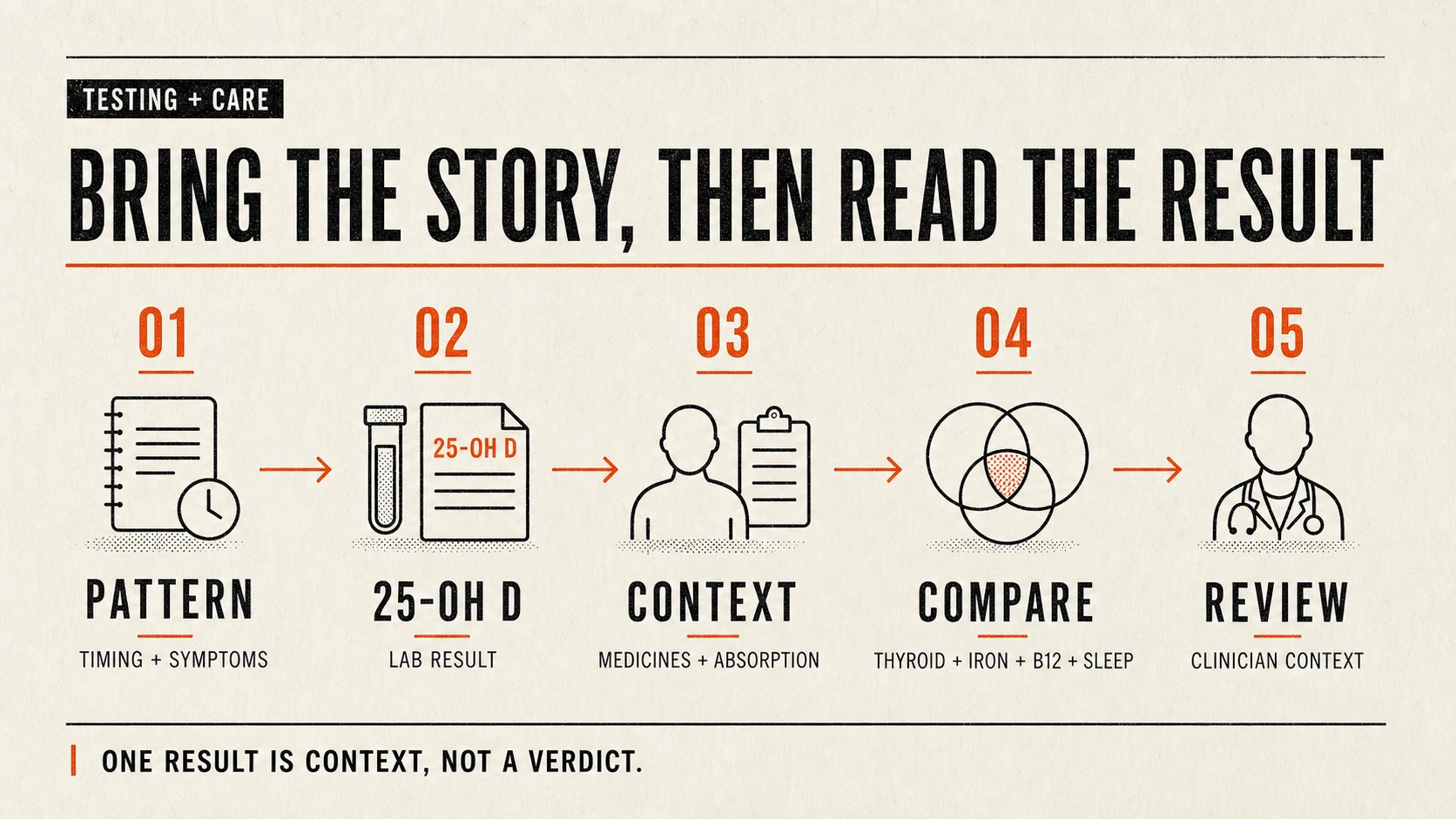
Opening line
"I have brain fog with low mood, fatigue, or muscle aches. I would like to know whether my vitamin D level is low instead of guessing from symptoms alone."
Questions you can use
How to start the conversation
- What specific test results or findings would confirm or rule this out?
- I'd like to start with testing, not trial-and-error treatment.
- If the first round of tests is unclear, what else should we check?
Test to discuss
25-OH Vitamin D: The result can show whether the level is low. By itself, it can't show vitamin D caused your brain fog.
Tests to ask about
- 25-OH Vitamin D
- Calcium, phosphate, and alkaline phosphatase
- Parathyroid hormone
- Kidney and liver function
- Malabsorption and medicine review
- Bone density, X-ray, or urine calcium when indicated
- Tests for other causes of brain fog
Details that change what gets checked
- Is the test 25-hydroxyvitamin D, the standard status test, or 1,25-dihydroxyvitamin D, which answers a different medical question?
- Are the result and units ng/mL or nmol/L, and which US, UK, Australian, bone, kidney, or pregnancy guideline is being used?
- Are there bone pain, muscle weakness, difficulty rising, falls, fractures, low calcium, or child growth and bone changes?
- Could little sun, darker skin, covering clothing, poor gut absorption, kidney or liver disease, obesity, pregnancy, or a medicine explain the result?
- Could anemia, iron or vitamin B12 deficiency, thyroid disease, depression, poor sleep, pain, infection, or another medicine explain brain fog more directly?
- Did the vitamin D level improve while concentration stayed the same, or did several symptoms and lab results improve together?
Signs vitamin D may not be the cause
- Your 25-hydroxyvitamin D result is adequate under the guideline in use, and no bone, absorption, kidney, liver or medicine problem changes what it means.
- The result corrects but brain fog and daily function don't change.
- Brain fog follows sleep loss, anemia, thyroid disease, depression, pain, infection, POTS, migraine, menopause, alcohol, or medicine timing more closely.
- You tested low while an illness kept you inside more, and that illness explains your brain fog.
[NIH Office of Dietary Supplements] [Endocrine Society] [Corbett 2025] [PMID 31340012] [UK Government] [NHS] [Healthdirect Australia] [Cancer Council Australia] [RCPA]
FAQ
Questions people ask about vitamin D and brain fog
My vitamin D is low-normal. Is it worth supplementing, or could something else be causing my brain fog?
Iron, B12, folate, thyroid, mood, sleep or absorption problems could also matter. If you feel worse in winter or stay indoors a lot, ask about vitamin D. Your clinician should pick tests for you, not a standard nutrient panel.
[Editorial]
My vitamin D is low - how much should I take, and do I need to get retested?
There's no single safe amount for every low result. Treatment depends on the result, current intake, kidney and calcium context, medicines, absorption, pregnancy, and the reason for testing. A clinician or pharmacist should explain the chosen form, amount, duration, and whether you need follow-up testing.
[Editorial]
My vitamin D was really low. How long after supplementing will my thinking improve?
There's no dependable week when brain fog should lift. Follow-up is more informative when it compares the new blood result with what actually changed in thinking, energy, mood, pain, and daily life.
[Editorial]
Can vitamin D cause brain fog?
Low vitamin D can occur alongside cognitive complaints, fatigue, low mood, and aches. Those symptoms overlap with many other conditions, so they can't show whether vitamin D is responsible. A 25-OH vitamin D blood test can show whether the level is low. Your clinician still needs to read the result with your symptoms, medicines, and other conditions.
What does vitamin D brain fog usually feel like?
There is no single feeling that identifies vitamin D deficiency. Some people with a low result also describe low energy, slower thinking, low mood, aches, or poor recovery. The same complaints occur with sleep problems, anemia, thyroid disease, depression, medicines, and other causes.
What should I check first if I think vitamin D is involved?
First, check if you've had a 25-OH vitamin D test and why your doctor ordered it. The laboratory range can show whether the result is low. It can't show that vitamin D caused your brain fog, or that pushing your level higher will clear it.
What tests should I discuss for vitamin D brain fog?
25-hydroxyvitamin D is the standard blood test for checking the level. Whether the test is useful depends on symptoms, risk factors, existing results, and local guidance. Calcium, kidney or parathyroid problems, poor absorption, medicines, and other causes of brain fog may need attention.
When should I ask for medical advice about low vitamin D and brain fog?
Ask your doctor if a low result needs treatment, stays low despite treatment, or improves but brain fog continues. Also ask if your kidneys, calcium, parathyroid, pregnancy, medicines, or absorption could change the plan.
How is vitamin D brain fog different from iron or B12 deficiency?
Vitamin D, iron, B12, and folate problems can produce overlapping complaints, and more than one can be present. Existing history and targeted blood results separate these questions more reliably than symptoms alone.
How long does it take for vitamin D to improve brain fog?
Research has not established a standard time in which vitamin D treatment clears brain fog. Follow-up timing depends on how low the first result was, the treatment plan, other health conditions, and why the level was low. If your result improves but your thinking doesn't, vitamin D is less likely to be the whole cause.
Can you have brain fog with normal vitamin D levels?
Yes. Brain fog has many possible explanations, and a vitamin D result in the laboratory range does not rule them in or out. The 2024 Endocrine Society guideline did not identify one blood level that prevents disease or improves thinking for everyone.
Is vitamin D brain fog reversible?
It can improve when a confirmed deficiency is treated, but improvement is not guaranteed and there is no fixed timetable. Your blood result can improve while brain fog stays. When that happens, other explanations deserve another look instead of simply aiming for a higher vitamin D number.
Community reports
What people say helped, and what did not
What Helped
- Getting tested: I was severely deficient and had no idea
- Correcting a confirmed low result was useful for some people
- Keeping the agreed treatment consistent made the follow-up result easier to interpret
- Taking vitamin D with a meal improved absorption for some people
What didn't help
- Assuming a different supplement form would explain every persistent symptom
- Increasing vitamin D after my result improved but my brain fog didn't
- Adding magnesium without first establishing a separate reason for it
Surprises
- How common deficiency is, especially in northern climates
- The blood result improved, but thinking problems sometimes remained
While the cause is still unclear
What can help before the cause is clear
Sun exposure
Sunlight helps skin make vitamin D, but no single exposure time is safe for every skin tone, latitude, season, age, or skin-cancer risk.
Food sources
Fatty fish, eggs, mushrooms exposed to UV light, and fortified foods can contribute vitamin D. Food may not correct a confirmed deficiency on its own.
Taking it with food
If you already take vitamin D, check whether the label or prescriber gives meal instructions. A meal can improve absorption, but it's not the whole treatment plan.
Practical support
If you want company outdoors or help keeping an agreed treatment consistent, ask for that specific support.
What to keep for follow-up
Keep the dated blood result to hand, and ask which symptoms actually changed after treatment and which did not.
Avoid
Lingering brain fog isn't a reason to take more vitamin D before your doctor reads your result and checks other causes.
Country guidance
How testing and treatment differ by country
Healthcare guidance
Endocrine Society Clinical Practice Guideline on Vitamin D (Demay et al., J Clin Endocrinol Metab, 2024)
- •Use the laboratory range alongside current NIH population guidance; aiming for a higher result may not clear your thinking problems
- •High-risk groups: older adults, dark skin, obesity, malabsorption, limited sun exposure
- •D2 and D3 can both raise 25-OH vitamin D; D3 generally raises it more effectively
- •NIH recommended dietary allowance: 600 IU through age 70 and 800 IU after 70. These daily amounts aren't for treating deficiency.
Vitamin D healthcare: United States
Where people usually start, what happens next, and common access barriers
Primary care usually manages vitamin D testing and supplementation.
Understanding Your Vitamin D Results
What each number means and when to ask questions
A 25(OH)D result can show whether the level is low.
Lab ranges vary by facility.
Safety considerations
Driving
A vitamin D result can't tell you whether driving is safe. Fatigue, dizziness, slower reactions, or cognitive symptoms can affect driving regardless of the cause.
Work and occupational safety
Low vitamin D sometimes sits beside fatigue and cognitive complaints that affect work. If treatment corrects the blood result but work capacity doesn't improve, another explanation may still be active.
Red Flag
Urgent warning signs
Get checked urgently for sudden confusion, new weakness, trouble speaking, or another rapid neurological change. Brain fog that lasts once your vitamin D is normal again isn't an emergency by itself, but it does need another explanation.
Vitamin D questions and blood-test results
- What was the 25-OH vitamin D result, in which unit, and why was it tested?
- What vitamin D is already coming from prescriptions, supplements, and fortified foods?
- Could kidney disease, calcium problems, malabsorption, pregnancy, or medicines change the plan?
- The NIH adult dietary allowance is 600 IU through age 70 and 800 IU after 70. Those intake figures aren't a treatment plan for a confirmed deficiency.
25-OH Vitamin D: NIH population guidance links below 12 ng/mL with deficiency. It calls 12 to below 20 generally inadequate and 20 or more generally adequate for most healthy people. It links above 50 with possible harm.
PTH (parathyroid hormone): May help interpret a low vitamin D result when bone, calcium, kidney, or parathyroid questions are present; use the laboratory's own range
Calcium: Can matter when vitamin D intake is high or symptoms raise concern for hypercalcaemia; use the laboratory's own range
Phosphate: This may matter when a clinician checks whether the deficiency has affected your bones or mineral levels. Use the laboratory's own range.
History
A Brief History of Vitamin D and Brain Health
The early milestones come from a 2022 historical review of vitamin D research. The later entries show why finding vitamin D activity in the brain didn't automatically mean supplements would improve thinking.
[Jones 2022 historical review]
1650s
Rickets first described
First clinical descriptions of rickets appear in England, marking the earliest recognition of vitamin D deficiency disease.
1922
Vitamin D identified
Elmer McCollum identifies the anti-rachitic factor and names it vitamin D, distinguishing it from vitamin A.
1930s
Milk fortification begins
Fortification of milk with vitamin D begins in the US and UK, dramatically reducing rickets rates.
1968-1971
The blood marker and active hormone are identified
Researchers identified 25-hydroxyvitamin D as the main form in the blood, then 1,25-dihydroxyvitamin D, the active hormone. That's why the two blood tests answer different questions.
1973
Vitamin D receptor evidence follows
Researchers produced clear evidence of the vitamin D receptor. This helped show that the active hormone changes cell activity through a receptor, unlike an ordinary nutrient.
2005
Brain VDR mapping
Eyles et al. mapped vitamin D receptors and a vitamin D-activating enzyme in several parts of the human brain. That showed the biology is present in brain tissue, but it did not prove that a low blood result causes brain fog.
2007
Deficiency declared a pandemic
Holick's NEJM review called vitamin D deficiency a pandemic affecting an estimated 1 billion people worldwide.
2009
First cognitive review
Annweiler et al. publish one of the first systematic reviews of vitamin D and cognitive performance in adults.
2013
Depression association reported
Anglin et al. pooled observational studies and reported an association between lower vitamin D levels and depression in adults. That did not show that low vitamin D caused depression.
2019
Dementia association studied
Chai et al. reported an association between vitamin D deficiency and dementia risk. Observational association does not prove that deficiency caused dementia.
2023
Supplement use linked with lower dementia incidence
Ghahremani et al. followed 12,388 people and found vitamin D supplement use was associated with lower dementia incidence. The observational design cannot show that supplementation caused the difference.
2024
Updated Endocrine Society guideline
The Endocrine Society's updated prevention guidance set no single 25-OH vitamin D target. A UK Biobank analysis again linked vitamin D and dementia.
PMID 38828931; PMID 38296029
2025
Trials separated treatment from prevention
One trial tested whether thinking could improve after early cognitive impairment began. Another tested whether supplements could prevent a later dementia diagnosis in adults who mostly had enough vitamin D. Neither found clear benefit, but they studied different people and outcomes.
2026
Researchers stopped treating cognition as one score
Recent studies measured memory, attention, executive function (planning), and orientation (time and place) separately. Change in one area didn't always show up elsewhere, so one overall score can hide important differences.
References
Primary Sources
Managing: I take vitamin D but still have brain fog
You took the supplement. Perhaps the number rose. You still feel muddled. That does not make the original low result meaningless, and it does not mean you should keep increasing vitamin D. What happens next depends on whether the level stayed low or the level corrected and your thinking did not change.
How to read a 25(OH)D blood result
Practical Tool
What does my number mean?
Enter the 25(OH)D result from your blood test. The calculator converts the units and shows where the result sits in the NIH range.
The ranges come from the NIH Office of Dietary Supplements. The 2024 Endocrine Society guideline explains why one blood number is not a universal treatment target.
Safety boundary
Why this page doesn't calculate a dose
A public calculator can't safely pick a high starting dose, ongoing dose, or target level. These depend on a confirmed diagnosis, current intake, calcium levels, kidney health, medicines, pregnancy, and conditions that can raise sensitivity to vitamin D.
Bring the laboratory result and a complete supplement and medicine list to a clinician or pharmacist.
Supplement questions
D3, magnesium, and K2 are not one package
D3 can raise 25-OH vitamin D more effectively than D2 in comparative research. Magnesium helps your body process vitamin D, but that doesn't mean everyone taking vitamin D needs a magnesium supplement. K2 has its own evidence and safety questions and is not a standard brain-fog treatment. Each decision needs its own reason.
Vitamin D3
Why the amount varies: Amount depends on the indication, blood result, current intake, and clinical context
Vitamin D receptors and vitamin D-metabolizing enzymes are present in brain tissue, which gives researchers a biological reason to study cognition. That doesn't show that a low result caused one person's thinking problems. Comparative research generally finds D3 raises 25-OH vitamin D more effectively than D2 (Tripkovic 2012, PMID 22552031).
Holick, NEJM, 2007; Tripkovic et al., Am J Clin Nutr, 2012 (PMID 22552031)
Magnesium
Why the amount varies: A separate supplement decision, not an automatic partner to vitamin D
Magnesium helps the enzymes that process vitamin D (Uwitonze and Razzaque 2018, PMID 29480918). That's a reason to look at your wider health when treatment isn't working. It doesn't justify automatically adding magnesium to every vitamin D plan.
Uwitonze & Razzaque, J Am Osteopath Assoc, 2018 (PMID 29480918)
Vitamin K2 (MK-7)
Why the amount varies: Not routinely required with vitamin D
Vitamin K helps with bone health and blood clotting. Current evidence doesn't support taking K2 as a standard add-on for brain fog or vitamin D treatment.
van Ballegooijen et al., Int J Endocrinol, 2017
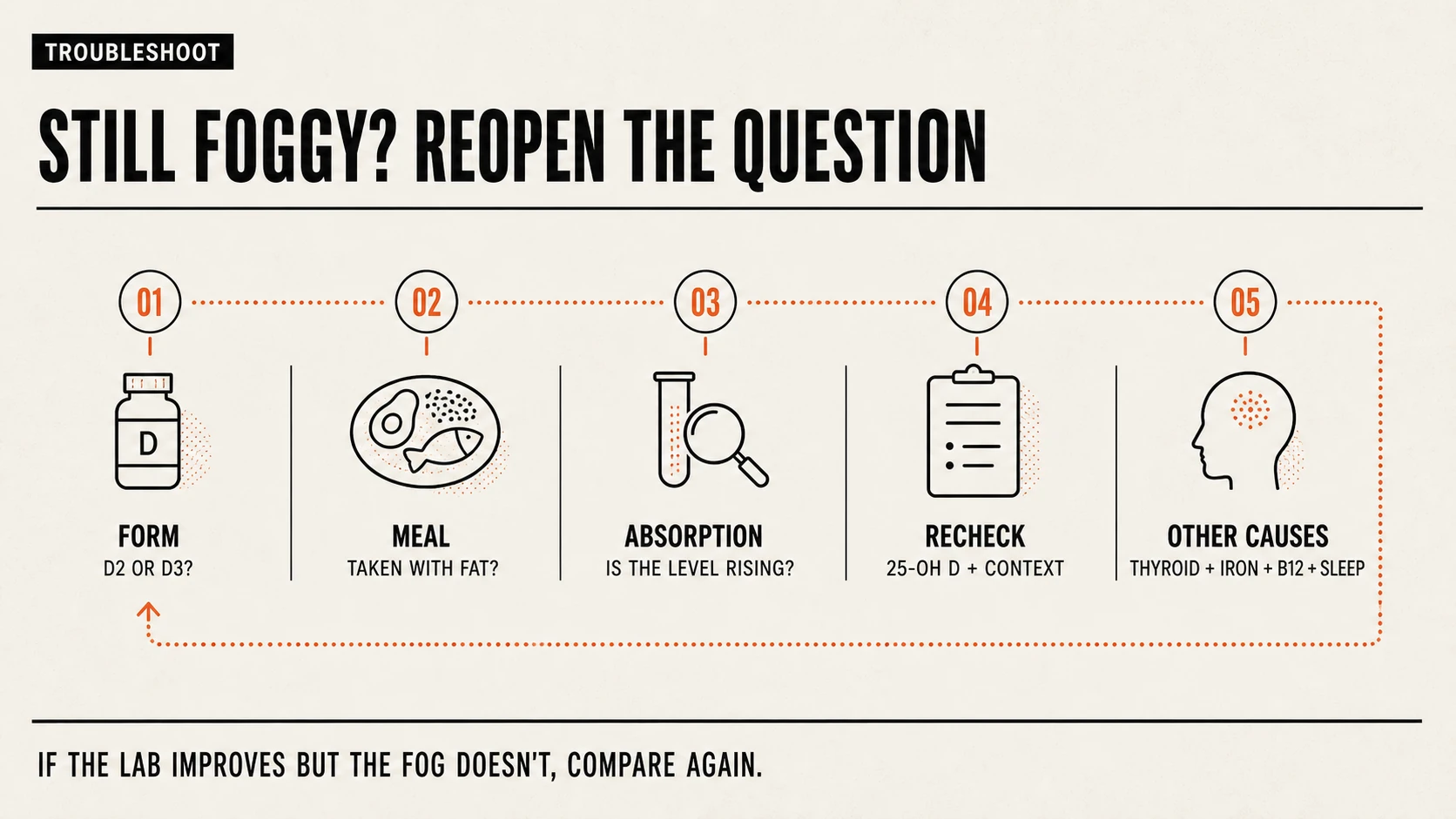
A result can stay low because the treatment, absorption, or medical context needs another look. The result can also improve while your thinking stays the same. Those are different problems.
Which form are you using?
Vitamin D2 and vitamin D3 can both raise the level, although vitamin D3 generally raises 25-OH vitamin D more effectively. A prescription for vitamin D2 is not automatically wrong. Ask why that form was chosen before changing it.
Could meal timing affect absorption?
Vitamin D is fat-soluble, and taking it with a meal can improve absorption. Your body still absorbs some vitamin D without fat, so meal timing is only one thing to check when your level stays low.
Is magnesium actually low?
Magnesium is involved in vitamin D metabolism. That doesn't show you're low in magnesium or that adding it will clear your brain fog. Treat it as a separate clinical question, especially if you have kidney disease or take medicines that affect magnesium.
Could absorption be the problem?
If the level stays low despite following the agreed plan, reduced absorption may need review. Celiac disease, inflammatory bowel disease, bariatric surgery, and some medicines can matter. That is a different question from simply increasing the amount.
Your level improved, but your thinking didn't?
That weakens a simple vitamin D explanation. It's a reason to look again at the timeline, medicines, other symptoms, and connected causes instead of raising vitamin D further. It won't tell you which explanation is right.
At follow-up
Three results lead to three different questions
The level is still low
The treatment result needs explaining
Check whether you followed the agreed plan, then ask whether absorption, medicines, kidney health, or the reason for the deficiency needs another look.
The level and the fog improved
Vitamin D may have contributed
A lasting improvement after treatment corrects the deficiency makes vitamin D more convincing.
The level improved but your thinking didn't
Look beyond vitamin D
The deficiency still deserved treatment, but it is less likely to explain the remaining cognitive problem. Sleep, thyroid, iron, B12, mood, medicines, and other causes may still be open.
If brain fog lingers
Other causes that may still matter
Correcting vitamin D does not rule out another cause. These guides cover problems that can produce similar symptoms or contribute at the same time:
Vitamin D foods and what they can change
Where food helps
Food can contribute vitamin D, and meals can affect absorption for some people.
Fatty fish, egg yolks, UV-exposed mushrooms, fortified foods, and any label or prescriber instructions about taking vitamin D with food.
Food alone may not correct a confirmed deficiency. Sun exposure and supplementation questions depend on the blood result, medical context, and local guidance.
Simple anti-inflammatory eating
For people who are too fatigued, nauseous, or overwhelmed for complex dietary changes.
Eat small, simple meals often. Add broth or soup on low-appetite days, oily fish if you eat it, and berries if tolerated. Limit ultra-processed food when possible. Drink enough so fatigue doesn't worsen.
This isn't a vitamin D treatment. It makes eating easier while you sort out the blood result and other causes.
An ordinary day of food
Meals using common vitamin D foods
No vitamin D-specific diet has clinical evidence for clearing brain fog. To treat a confirmed deficiency, clinicians weigh the blood result, medical context, diet, medicines, and other risks together.
Sample day
breakfast: Eggs or a fortified alternative, depending on your diet and local shops
lunch: Sardines, mackerel, salmon, or a non-fish meal that uses a fortified food
snack: A fortified yogurt or plant alternative if it fits your diet
dinner: Fatty fish or UV-exposed mushrooms alongside an ordinary balanced meal
evening: Your usual evening meal is fine
Adapt it to your budget, culture, preferences, and what is available.
Questions to review
Before changing a vitamin D supplement
Put the dated 25-OH vitamin D result beside the symptoms that led to testing. - This separates a low result from the claim that it caused brain fog.
Check whether season, latitude, skin tone, clothing, indoor work, or limited mobility reduce UVB exposure. - These details can explain why a level is low, but they can't predict the result on their own.
[Vitamin D position statement] [UVB, season, and latitude study] [Skin pigment and vitamin D study] [Clothing and vitamin D study] [Indoor work and vitamin D review] [Homebound older adults study]
Check what vitamin D is already coming from food, prescriptions, and supplements. - The total intake and product form matter when someone reads a result or changes treatment.
[Vitamin D consensus statement] [Vitamin D intake and blood level analysis] [Vitamin D2 versus D3 meta-analysis]
If your level stays low, ask whether absorption, medicines, kidney health, or the treatment itself needs another look. - Brain fog that lasts after treatment fixes your level is a different problem.
[Vitamin D deficiency review] [UVB, season, and latitude study]
Ask for practical help with the plan you already chose, if you need it. - Consistent treatment makes a later result easier to interpret without turning another person into your prescriber.
At follow-up, put the new level beside any lasting change in thinking, energy, mood, pain, or strength. - If the level improves and your thinking doesn't, vitamin D is less likely to explain the remaining problem. If both improve together, vitamin D may have contributed without being the only cause.
What happens after treatment
How long could improvement take?
Treatment can correct a low vitamin D level. Brain fog has no fixed recovery timetable because vitamin D may not be the cause, and cognitive studies haven't found one reliable week when improvement should appear.
Timeline: Follow-up timing depends on the starting result, treatment plan, medical history, and the clinician interpreting the test.
- How low the starting 25-OH vitamin D result was
- The treatment chosen and whether it's taken consistently
- Conditions or surgery that reduce fat absorption
- Kidney, calcium, parathyroid, medicine, and pregnancy context
- Sun exposure and skin tone (darker skin needs more sun for synthesis)
Vitamin D questions and blood-test results
- What was the 25-OH vitamin D result, in which unit, and why was it tested?
- What vitamin D is already coming from prescriptions, supplements, and fortified foods?
- Could kidney disease, calcium problems, malabsorption, pregnancy, or medicines change the plan?
- The NIH adult dietary allowance is 600 IU through age 70 and 800 IU after 70. Those intake figures aren't a treatment plan for a confirmed deficiency.
25-OH Vitamin D: NIH population guidance links below 12 ng/mL with deficiency. It calls 12 to below 20 generally inadequate and 20 or more generally adequate for most healthy people. It links above 50 with possible harm.
PTH (parathyroid hormone): May help interpret a low vitamin D result when bone, calcium, kidney, or parathyroid questions are present; use the laboratory's own range
Calcium: Can matter when vitamin D intake is high or symptoms raise concern for hypercalcaemia; use the laboratory's own range
Phosphate: This may matter when a clinician checks whether the deficiency has affected your bones or mineral levels. Use the laboratory's own range.
History
A Brief History of Vitamin D and Brain Health
The early milestones come from a 2022 historical review of vitamin D research. The later entries show why finding vitamin D activity in the brain didn't automatically mean supplements would improve thinking.
[Jones 2022 historical review]
1650s
Rickets first described
First clinical descriptions of rickets appear in England, marking the earliest recognition of vitamin D deficiency disease.
1922
Vitamin D identified
Elmer McCollum identifies the anti-rachitic factor and names it vitamin D, distinguishing it from vitamin A.
1930s
Milk fortification begins
Fortification of milk with vitamin D begins in the US and UK, dramatically reducing rickets rates.
1968-1971
The blood marker and active hormone are identified
Researchers identified 25-hydroxyvitamin D as the main form in the blood, then 1,25-dihydroxyvitamin D, the active hormone. That's why the two blood tests answer different questions.
1973
Vitamin D receptor evidence follows
Researchers produced clear evidence of the vitamin D receptor. This helped show that the active hormone changes cell activity through a receptor, unlike an ordinary nutrient.
2005
Brain VDR mapping
Eyles et al. mapped vitamin D receptors and a vitamin D-activating enzyme in several parts of the human brain. That showed the biology is present in brain tissue, but it did not prove that a low blood result causes brain fog.
2007
Deficiency declared a pandemic
Holick's NEJM review called vitamin D deficiency a pandemic affecting an estimated 1 billion people worldwide.
2009
First cognitive review
Annweiler et al. publish one of the first systematic reviews of vitamin D and cognitive performance in adults.
2013
Depression association reported
Anglin et al. pooled observational studies and reported an association between lower vitamin D levels and depression in adults. That did not show that low vitamin D caused depression.
2019
Dementia association studied
Chai et al. reported an association between vitamin D deficiency and dementia risk. Observational association does not prove that deficiency caused dementia.
2023
Supplement use linked with lower dementia incidence
Ghahremani et al. followed 12,388 people and found vitamin D supplement use was associated with lower dementia incidence. The observational design cannot show that supplementation caused the difference.
2024
Updated Endocrine Society guideline
The Endocrine Society's updated prevention guidance set no single 25-OH vitamin D target. A UK Biobank analysis again linked vitamin D and dementia.
PMID 38828931; PMID 38296029
2025
Trials separated treatment from prevention
One trial tested whether thinking could improve after early cognitive impairment began. Another tested whether supplements could prevent a later dementia diagnosis in adults who mostly had enough vitamin D. Neither found clear benefit, but they studied different people and outcomes.
2026
Researchers stopped treating cognition as one score
Recent studies measured memory, attention, executive function (planning), and orientation (time and place) separately. Change in one area didn't always show up elsewhere, so one overall score can hide important differences.
References
Primary Sources
Supporter: I'm helping someone with vitamin D deficiency
What a gradual change can look like
It's not like catching a cold where you suddenly feel bad. Your usual capacity can edge down almost unnoticed. Energy drops a little. Mood flattens a little. Muscles ache a little more. Thinking gets a little slower. Each thing on its own seems minor, so you assume you're just tired or getting older or not trying hard enough.
They may not know why their capacity has changed. The blood test can answer one question: is the vitamin D level low? It cannot decide that vitamin D explains every difficulty.
What Not to Say
"Just go outside more"
That may not be practical or sufficient. Season, latitude, skin tone, clothing, mobility, work hours, and skin-cancer risk all change how much UVB someone receives. A blood test is more useful than assuming more time outdoors will solve the problem.
"Everyone's tired in winter"
Lots of people feel tired in winter, but that won't tell you whether this person's vitamin D is low or something else is affecting their energy and thinking.
"You look fine"
Vitamin D deficiency is invisible. There's no rash, no limp, no obvious sign. The person may feel persistently below their usual capacity even when nothing shows on the outside.
"Just take a vitamin"
A supplement is not a diagnosis. The blood result, current medicines, kidney and calcium context, absorption problems, and reason the level is low can all change the treatment decision.
Practical Ways to Support Someone
Encourage testing, not guessing
A 25-OH vitamin D result can answer whether the level is low. Asking "Has anyone checked your vitamin D?" is better than deciding that deficiency explains their thinking problems.
Help them keep the treatment they already chose consistent
If they are following a clinician-approved plan, practical reminders can make the follow-up result easier to interpret. Leave supplement changes to them and their clinician.
Make ordinary meals easier
Fatty fish, eggs, and fortified foods contain vitamin D, and a meal can improve supplement absorption. Food helps them get vitamin D, but a confirmed deficiency still needs its own treatment.
Suggest outdoor time together
Offer company if they already want to go outside. Sun exposure is not a precise treatment because season, latitude, skin tone, clothing, age, and skin-cancer risk change what it can provide.
Wait for the planned follow-up
The blood result and the symptoms may change at different speeds. A planned follow-up is more useful than repeatedly asking whether their thinking has improved.
Seasonal rhythm
Why winter makes low vitamin D more likely
Winter can reduce UVB exposure enough to lower vitamin D production, especially at higher latitudes. Skin tone, clothing, indoor work, age, diet, and supplements also change the result, so latitude alone cannot predict deficiency.
Feeling worse every winter makes season worth mentioning. It does not separate vitamin D from seasonal mood change, disrupted routines, infections, or other winter-linked problems.
When to encourage medical review
- Their thinking hasn't improved, though their blood result is now normal
- The level remains low despite following the agreed plan, especially when absorption or medicine effects are possible
- They have bone pain, muscle weakness, or frequent fractures
- They have symptoms suggesting another condition alongside D deficiency (thyroid, anemia, autoimmune)
- Sudden cognitive changes, which need urgent evaluation whatever the vitamin D result
Their decision
Help without taking over
Ask what would actually help. They may want company at an appointment, help remembering the plan they already chose, or no help at all. A low result does not hand someone else control over what they test or take.
Vitamin D questions and blood-test results
- What was the 25-OH vitamin D result, in which unit, and why was it tested?
- What vitamin D is already coming from prescriptions, supplements, and fortified foods?
- Could kidney disease, calcium problems, malabsorption, pregnancy, or medicines change the plan?
- The NIH adult dietary allowance is 600 IU through age 70 and 800 IU after 70. Those intake figures aren't a treatment plan for a confirmed deficiency.
25-OH Vitamin D: NIH population guidance links below 12 ng/mL with deficiency. It calls 12 to below 20 generally inadequate and 20 or more generally adequate for most healthy people. It links above 50 with possible harm.
PTH (parathyroid hormone): May help interpret a low vitamin D result when bone, calcium, kidney, or parathyroid questions are present; use the laboratory's own range
Calcium: Can matter when vitamin D intake is high or symptoms raise concern for hypercalcaemia; use the laboratory's own range
Phosphate: This may matter when a clinician checks whether the deficiency has affected your bones or mineral levels. Use the laboratory's own range.
History
A Brief History of Vitamin D and Brain Health
The early milestones come from a 2022 historical review of vitamin D research. The later entries show why finding vitamin D activity in the brain didn't automatically mean supplements would improve thinking.
[Jones 2022 historical review]
1650s
Rickets first described
First clinical descriptions of rickets appear in England, marking the earliest recognition of vitamin D deficiency disease.
1922
Vitamin D identified
Elmer McCollum identifies the anti-rachitic factor and names it vitamin D, distinguishing it from vitamin A.
1930s
Milk fortification begins
Fortification of milk with vitamin D begins in the US and UK, dramatically reducing rickets rates.
1968-1971
The blood marker and active hormone are identified
Researchers identified 25-hydroxyvitamin D as the main form in the blood, then 1,25-dihydroxyvitamin D, the active hormone. That's why the two blood tests answer different questions.
1973
Vitamin D receptor evidence follows
Researchers produced clear evidence of the vitamin D receptor. This helped show that the active hormone changes cell activity through a receptor, unlike an ordinary nutrient.
2005
Brain VDR mapping
Eyles et al. mapped vitamin D receptors and a vitamin D-activating enzyme in several parts of the human brain. That showed the biology is present in brain tissue, but it did not prove that a low blood result causes brain fog.
2007
Deficiency declared a pandemic
Holick's NEJM review called vitamin D deficiency a pandemic affecting an estimated 1 billion people worldwide.
2009
First cognitive review
Annweiler et al. publish one of the first systematic reviews of vitamin D and cognitive performance in adults.
2013
Depression association reported
Anglin et al. pooled observational studies and reported an association between lower vitamin D levels and depression in adults. That did not show that low vitamin D caused depression.
2019
Dementia association studied
Chai et al. reported an association between vitamin D deficiency and dementia risk. Observational association does not prove that deficiency caused dementia.
2023
Supplement use linked with lower dementia incidence
Ghahremani et al. followed 12,388 people and found vitamin D supplement use was associated with lower dementia incidence. The observational design cannot show that supplementation caused the difference.
2024
Updated Endocrine Society guideline
The Endocrine Society's updated prevention guidance set no single 25-OH vitamin D target. A UK Biobank analysis again linked vitamin D and dementia.
PMID 38828931; PMID 38296029
2025
Trials separated treatment from prevention
One trial tested whether thinking could improve after early cognitive impairment began. Another tested whether supplements could prevent a later dementia diagnosis in adults who mostly had enough vitamin D. Neither found clear benefit, but they studied different people and outcomes.
2026
Researchers stopped treating cognition as one score
Recent studies measured memory, attention, executive function (planning), and orientation (time and place) separately. Change in one area didn't always show up elsewhere, so one overall score can hide important differences.
References
Primary Sources
Related context
Can low vitamin D cause brain fog?
What a low result can explain, and what it cannot.
Public tools
Connected causes