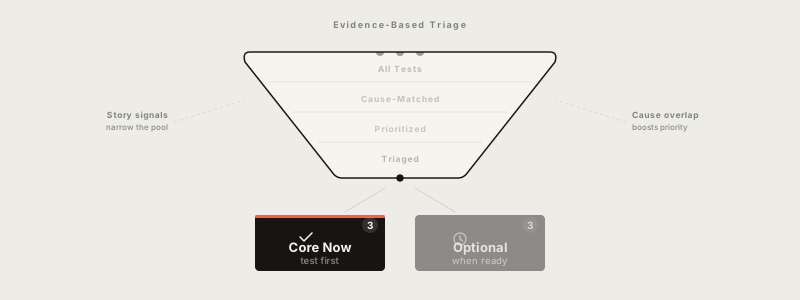
This is a practical measurement guide, not a shopping list of random labs. Start with the highest-yield basics, then add more only when your pattern still needs better explanation.
First Step: Normal blood work but the fog is still there? Start with
what normal blood work can miss
before adding more tests at random.
Already have results?
Enter your blood test values and see what they mean for brain fog - 95 tests, 38 cause connections.
PHQ-9 when low mood and slowed thinking are prominent.
GAD-7 when panic, dread, or constant anxious activation may be consuming bandwidth.
MDQ when bipolar-spectrum illness is part of the differential.
PCL-5 when trauma symptoms and flashbacks may be driving the fog.
ASRS-v1.1 when lifelong attention problems and executive dysfunction fit the pattern.
Screen Time Audit when fog tracks with high-screen, high-notification days and improves when devices are absent.
Important Caveat
Helpful, Not Diagnostic by Themselves
These tools are useful for structuring an appointment, not for diagnosing yourself in isolation.
If the story is sudden, bizarre, age-atypical, or comes with hallucinations, severe dissociation,
seizures, fever, or a major personality change, widen the workup instead of forcing it into one
psychiatric label.
Pair screens with medication review, sleep history, substance history, and medical rule-outs like
thyroid, B12, CBC, and CMP when the presentation is complex.
A Practical Measurement Plan
Nutrient Panel Shortcut
If the fog feels gradual, depleted, and physically corroborated, start with a
Comprehensive Nutrient Panel
instead of a CBC alone. That keeps ferritin, B12, folate, vitamin D, homocysteine, and the broader risk-factor story in one conversation.
This is especially useful when the story includes heavy periods, gut trouble, restrictive eating, pregnancy or postpartum change, or medications like PPIs or metformin.
Pregnancy Brain Fog: Test Priorities
If brain fog started or worsened during pregnancy, the highest-yield tests are:
ferritin (iron requirements nearly double in pregnancy),
TSH and Free T4 (thyroid function using trimester-specific reference ranges), and
vitamin D. Iron-deficiency anemia and thyroid dysfunction are common in pregnancy, directly worsen fog, and are treatable.
Also discuss: glucose screening (gestational diabetes, usually at 24-28 weeks), blood pressure monitoring (preeclampsia can cause cognitive symptoms), and
perinatal depression screening (Edinburgh Postnatal Depression Scale is more specific than PHQ-9 for this period).
If the story includes low drive, poor recovery, sexual-function change, or suspected androgen issues, do not stop at one total testosterone number. The high-yield set is
Total Testosterone,
Free Testosterone, and
SHBG,
usually alongside LH and FSH.
Draw testosterone labs in the morning, then interpret them together rather than as isolated values.
Kidney Shortcut: When the Fog Tracks with Labs, Swelling, or Blood Pressure
If the story includes diabetes, hypertension, edema, foamy urine, abnormal routine labs, or a broad sense that body chemistry is slipping, do not stop at one creatinine value. The useful kidney conversation usually includes creatinine with eGFR, cystatin C, UACR, a CBC, ferritin or iron studies, and electrolytes or bicarbonate when fatigue and mental slowing are prominent.
The main question is trend, not just one reassuring number: is kidney function stable, or quietly drifting?
Air Quality Shortcut: When the Fog Clearly Follows the Room
If the fog is clearly worse in one bedroom, office, car, or smoke pattern, the first useful “tests” are often environmental rather than blood-based. Start with room-level CO₂ and PM2.5 monitoring, then widen to a fuller air-quality review if the pattern is still convincing.
This is most useful when the story changes by place faster than it changes by sleep, food, or supplements.
Medication Shortcut: When the Fog Tracks with a Prescription Timeline
If the fog began after a new medication, a dose increase, or several mildly sedating drugs stacking together, the first useful “tests” are usually review tools, not exotic labs. Start with a formal medication review and anticholinergic burden check, then add a depletion panel when PPIs, metformin, or anticonvulsants make nutrient loss plausible.
This shortcut is most useful when the story has a clear timing pattern: worse a few hours after a dose, or a morning hangover after night-time sedating medications.
Food Sensitivity Shortcut: When the Fog Tracks with Specific Foods
If the fog reliably follows specific foods or food groups (not all meals), the first "tests" are
tracking tools, not exotic labs. Start with a 2-week food-symptom diary, then a structured
elimination-reintroduction trial. Lab tests come second - and only to rule out competing causes.
Order matters: Get celiac testing (tTG-IgA + total IgA) before eliminating
gluten - removing gluten first causes false negatives. IgG food sensitivity panels are NOT
recommended by the AAAAI or gastroenterology societies.
Start here: Food-symptom diary (2 weeks), then elimination-reintroduction (6-12 weeks)
Tier 1 labs: tTG-IgA + total IgA (celiac), IgE food panel (true allergy), hs-CRP (inflammation)
Standard lab ranges are based on avoiding disease, not optimizing function. A TSH in the upper "normal" range may leave some people symptomatic - discuss your individual target with your doctor.
TSH
Normal: 0.4-4.5 → Often optimal: lower half of range*
Ferritin
Normal: >12 → Optimal: 50-150
B12
Normal: >200 → Optimal: >500
Visual Guide
Sleep Apnea and Brain Fog: The Overnight Oxygen Pattern
Shows how repeated oxygen drops, arousals, and REM or supine clustering can leave the brain unrecovered by morning.
Sleep & Brain Fog
How Sleep Apnea Starves Your Brain
During apnea events, oxygen drops repeatedly throughout the night. Each dip damages neurons and fragments sleep architecture.
Brain PanicsCortisol + adrenaline surge to wake you
→
4
Micro-ArousalYou wake briefly (often unaware), sleep fragments
This cycle repeats 5–100+ times per hour in severe cases
Why This Causes Brain Fog
Hippocampal Shrinkage
Memory center volume reduced. Reversible with treatment.
-10-20% volume in severe OSA
Neuroinflammation
Repeated hypoxia triggers inflammatory cascades in brain tissue.
↑ IL-6, TNF-α, CRP
Sleep Architecture Destroyed
No deep sleep = no memory consolidation, no glymphatic clearance.
↓80% slow-wave sleep
Prefrontal Cortex Impairment
Executive function, attention, and decision-making suffer first.
Similar to 0.05% BAC
AHI: Apnea-Hypopnea Index
Events per hour of sleep. Your sleep study result.
<5Normal
5-14Mild
15-29Moderate
30+Severe
Even mild OSA (AHI 5-14) causes measurable cognitive impairment
Clues You Might Have Sleep Apnea
Snoring (especially loud or with pauses)
Waking unrefreshed despite "enough" hours
Drowsy driving or falling asleep in meetings
Waking with headaches or dry mouth
Frequent nighttime urination (nocturia)
Partner notices breathing pauses
Try this: STOP-BANG screening
Snoring? Tired? Observed apneas? Pressure (high BP)? BMI >35? Age >50? Neck >16"? Gender male? Score 3+ = high risk → request a sleep study.
How to discuss this with your doctor
Print this section or copy it to your phone. Say: "I've been tracking a persistent brain fog pattern and want to start with the highest-yield measurements first. Could we start here?"
If a clinician wants to start smaller, ask which markers would most help strengthen or weaken the leading theory.
Mold / Water-Damage Follow-Through
Mainstream First
Allergy / Exposure Lane
ERMI for environmental dust context when hidden mold is suspected.
Mold-specific IgE or skin-prick testing through allergy clinics when rhinitis, asthma, or sinus disease fit.
Use these with the building story, not instead of it.
TGF-beta-1 belongs in the same specialist conversation when available; VEGF is often discussed alongside it.
Caution
Do Not Overinterpret One Test
Urine mycotoxin testing, single abnormal inflammatory markers, or one failed screener do
not prove that mold is the cause of your brain fog. The exposure story, response away
from the environment, and competing causes still matter more than one result in
isolation.
Mercury exposure marker that reflects recent-to-intermediate methylmercury exposure over roughly the past 2-3 months. Most useful for fish-related exposure patterns.
Use these measurements to make your pattern more legible, not to chase certainty. Standard reference ranges tell you whether something looks overtly abnormal; more useful clinical interpretation depends on symptoms, timing, and context.
A quick visual reminder that a reference range is not the same thing as the range where people tend to feel and function best.
Brain Fog Lab Guide
Lab "Normal" vs Brain Optimal
Your labs can be "normal" while your brain starves. These are the ranges where cognition actually works.
Lab Reference Range
Brain Optimal Zone
Ferritin
ng/mL
Lab
12–150
Optimal
50–100
Vitamin B12
pg/mL
Lab
200–900
Optimal
500+
Vitamin D
ng/mL
Lab
30–100
Optimal
50–80
Magnesium RBC
mg/dL
Lab
4.2–6.8
Optimal
5.5–6.5
!
Write this down for your doctor: "My ferritin is [X]. The lab says normal, but research shows cognitive symptoms often persist until ferritin reaches 50+. Can we discuss optimization?"
Core First
Use core tests first, then optional-later tests only when pattern evidence supports it.
Visit Efficiency
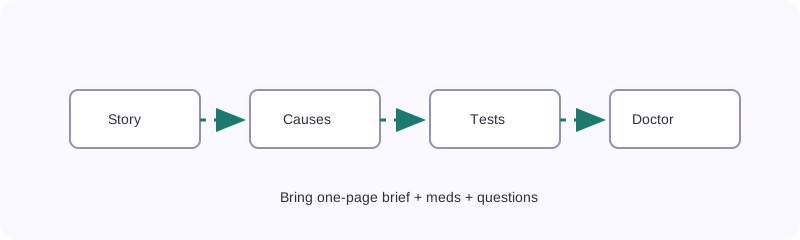
Bring a concise story + top causes + test shortlist to reduce repeat visits.
Evidence Highlights
Tier A · A1c + fasting glucose context review
Normal average labs do not always exclude meaningful glucose variability when symptoms are strongly timing-linked.
Anticholinergic burden scoring is a practical way to surface medication-related cognitive risk, especially in people taking several sedating or antimuscarinic drugs together.
Room-level CO2 monitoring is a practical way to test whether poor ventilation is part of a place-linked brain-fog story, especially in bedrooms and workspaces.